
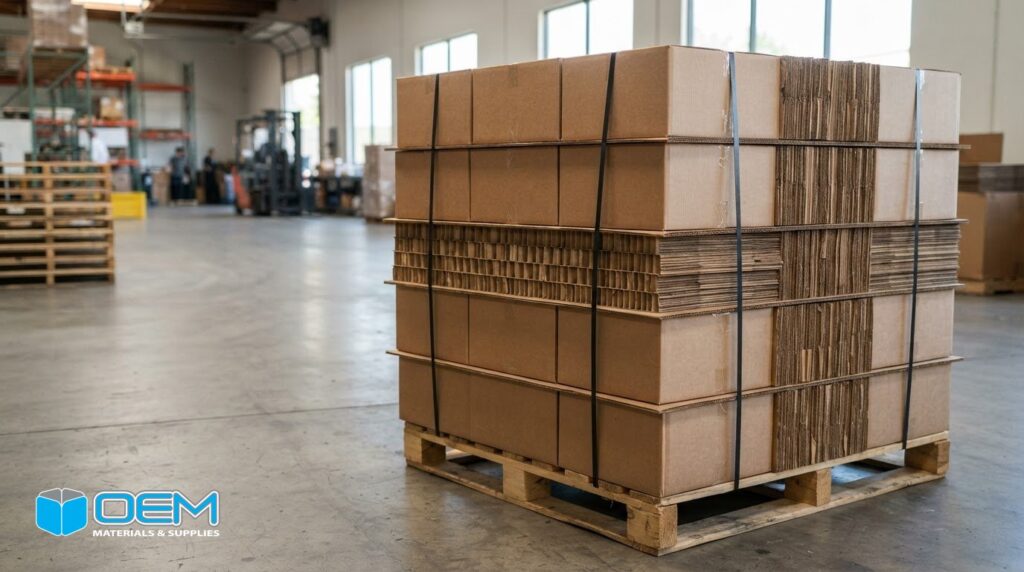
Pallet stability depends on controlling product contact and supporting the load. For buyers evaluating a honeycomb dunnage supplier in Los Angeles, honeycomb dunnage is a lightweight, paper-based alternative to wood blocking that can cushion products and distribute pressure across a surface. Honeycomb pads separate layers and help stabilize pallets, while corrugated dunnage can fill gaps that might otherwise let lightweight loads shift.
Broad, flat support can help reduce concentrated pressure and chafing, but pad size and placement matter. A pad that does not match the load footprint may drift or buckle under uneven pressure, and paper-based materials need consideration in moisture-prone conditions. Corrugated separators and void fillers address different parts of the same packing challenge: keeping items in position during handling and transport.
This article explains how honeycomb pads and corrugated dunnage support layer separation and pallet stability, what to consider when matching dunnage to a load, and how these materials differ from wood blocking. Use these practical criteria to select a configuration based on product dimensions, load contact points, and shipping conditions.
Key Takeaways
- Honeycomb pads separate pallet layers and spread pressure across a broader contact area, supporting load stability when the pad matches the product footprint.
- Corrugated dunnage can fill gaps and help limit lateral movement, while honeycomb and corrugated materials serve different roles in a load plan.
- Load dimensions, contact points, and shipping conditions guide the shape and placement of dunnage, including considerations such as moisture exposure and concentrated pressure.
- The article discusses a minimum order quantity of 5,000 for the products covered, while delivery timing and shipping costs depend on the order and destination.
- OEM Materials & Supplies offers corrugated boxes, foam packaging, and packaging kits to support related protective packaging needs.
Honeycomb pads for layer separation and pallet stability
At the interface between palletized layers, a honeycomb pad creates a broad, flat surface. This contact separates layers, helps stabilize the load, and distributes pressure over a wider area. For example, a pad between stacked cartons can reduce direct surface-to-surface contact. It also creates a more even interface than narrow blocking points, which can concentrate pressure in small areas. The pad’s role is support and separation, not a substitute for securing the load.
Match the pad footprint to the product footprint before building the pallet. A pad that extends too far or sits unevenly may shift as the load moves. One that covers too little area may concentrate pressure instead of distributing it. For uniform cartons, align the pad edges with the layer below, then center the next layer. For irregular products, use the actual contact area to guide placement rather than relying on pallet dimensions alone.
Load geometry also affects where compression may occur. Honeycomb can crush or buckle under concentrated pressure, such as beneath a narrow base or uneven edge. Review contact points between layers, and avoid placing a pad where a small protrusion carries much of the weight. For products with exposed finishes, the pad’s broad, flat surface may be gentler than direct contact with rough or narrow supports. Let the product surface and load distribution guide pad selection.
Paper rolls offer another application. Riser pads can separate rolls and help stagger them during loading for a more controlled arrangement. Place each pad to support the intended roll position, then check that the next roll does not rest on an unsupported edge. The goal is to distribute contact and keep layers aligned, not to rely on the pad alone to prevent movement. Restraint and pallet configuration still matter for the complete load.
Include moisture in the planning review because honeycomb pads are paper-based. A pallet staged in a damp area or exposed to wet conditions may call for a different material or added protection. Consider the route from packing through storage and transport, including where condensation or water exposure could occur. This is especially relevant for shipments that pass through changing environments. Evaluate these conditions alongside the pad’s support function.
Review the load from bottom to top: identify product contact points, match the pad to the supported footprint, and inspect layer alignment after placement. For example, if one corner sits higher than the rest of a carton layer, correct the support condition rather than forcing the next layer down. This helps reveal uneven loading before wrapping or shipment. Honeycomb pads contribute to stability when their size, position, and load conditions work together.
Honeycomb and corrugated dunnage
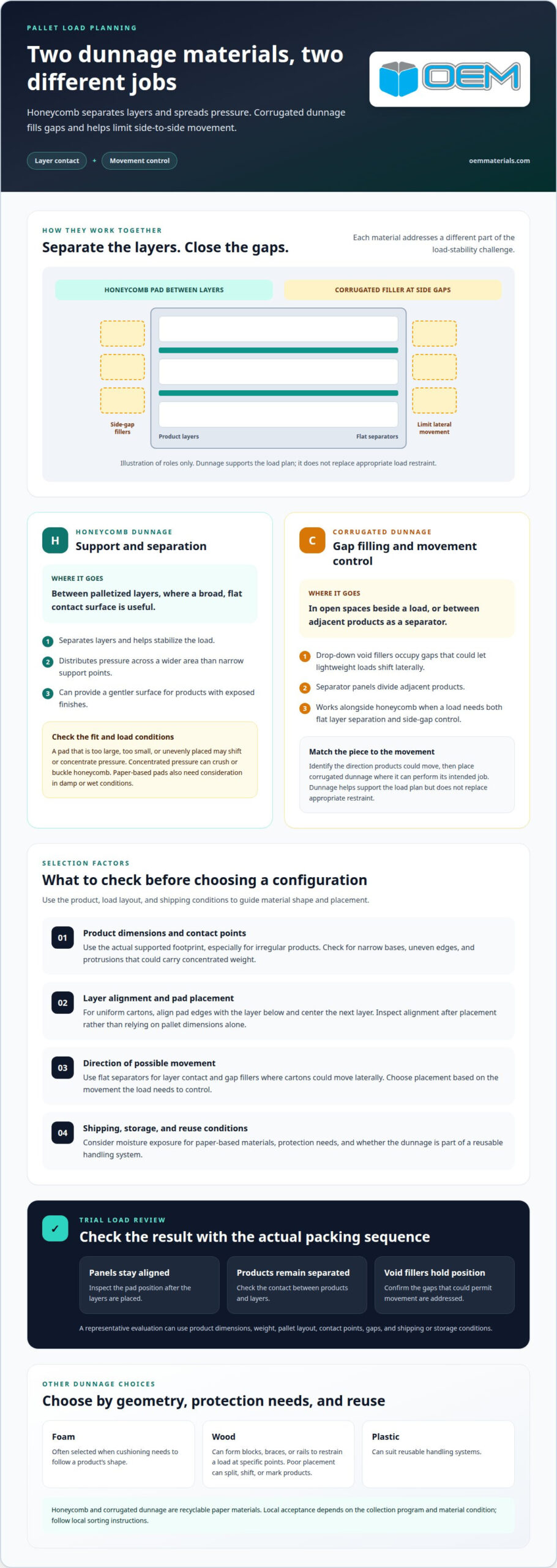
Honeycomb and corrugated dunnage are paper-based materials with different roles in a pallet load. Honeycomb panels cushion products, separate layers, and distribute pressure across a surface. Corrugated drop-down void fillers help prevent lightweight loads from shifting laterally during transport. On a pallet of boxed components, honeycomb can sit between product layers while corrugated pieces fill open spaces beside the load. Together, they address both layer contact and movement within the shipping unit.
Compared with foam, wood, and plastic dunnage, honeycomb provides a broad, paper-based support surface suited to separation and pressure distribution. Foam is often selected when a design needs cushioning around a product’s shape. Wood can form blocks, braces, or rails to restrain a load at specific points, but poorly placed pieces can split, shift, or mark products. Plastic dunnage can suit reusable handling systems. Choose based on load geometry, protection needs, and reuse plans.
Corrugated dunnage complements honeycomb rather than duplicating its role. A separator panel divides adjacent products, while a void filler occupies space where cartons could otherwise move. For example, a lightweight stack inside a trailer may need side-gap control, while the layers within the stack need flat separators. Identify the direction of movement first, then place each material where it performs its intended job. Dunnage supports the load plan but does not replace appropriate restraint.
Honeycomb and corrugated dunnage are recyclable paper materials. In Los Angeles, acceptance depends on the local collection program and the material’s condition. Keep paper dunnage clean and separate from contaminants, and flatten or bundle it if the local program requests that preparation. Coatings, attached materials, moisture, and product residue can affect how paper packaging is handled. Follow applicable local sorting instructions before putting used dunnage into a recycling stream.
To request a honeycomb dunnage quote or sample, prepare the product dimensions, weight, pallet layout, and intended use. Include photos or a simple sketch showing contact points, gaps, and the direction products shift. Describe shipping and storage conditions, including possible moisture exposure. These details help define the required configuration and a representative sample for evaluation. Test any sample with the actual load and packing sequence.
Evaluate a trial by checking whether panels stay aligned, products remain separated, and void fillers hold position after normal handling. Note any visible crushing, shifting, or surface contact, then adjust the footprint or placement. Depending on the load and handling system, a packaging plan may also include a corrugated box or plastic pallet. Compare how each component supports the complete shipment, not just the material in isolation.
Custom honeycomb dunnage sizes and configurations Los Angeles
Custom sizing starts with the product and the job each piece must perform. A flat separator for boxed components needs different dimensions from a riser supporting paper rolls. Honeycomb and corrugated dunnage can be tailored to application-specific shapes and sizes. For a Los Angeles packaging plan, base the configuration on the actual product arrangement, pallet pattern, and handling sequence, not just the nominal pallet footprint.
Set dimensions from the load’s contact surfaces. Record the length and width of the supported area, then note any overhang, recessed edge, or protruding feature. For example, a rectangular part with a raised center may need support around its perimeter rather than across the raised section. A drawing or photograph with measurement references can show where a panel should sit and which areas must remain clear.
Choose the configuration by function. A full-layer sheet separates stacked products, while individual panels can divide rows or protect selected contact areas. Riser pads support a planned position for paper rolls. Corrugated void fillers occupy open spaces around a load, such as a side gap between cartons and a shipping enclosure. Give each piece a defined place in the packing sequence so operators can position it consistently.
Product variation can change the required layout. If a shipment contains multiple carton sizes, map the pallet pattern for each configuration instead of assuming one sheet placement suits every layer. A mixed load may need separators aligned with one product group and void fillers beside another. Mark contact edges and open spaces on the layout before specifying pieces. This helps prevent a cut size from interfering with stacking or access.
Handling conditions also shape the design brief. A piece placed during initial pallet building may need a different shape from one inserted between products later. Describe the loading direction, where each panel enters, and whether operators need to lift or reposition it during packing. For a line-side process, a clearly defined orientation can reduce placement variation. Packaging instructions should show which face or edge aligns with the product.
For an accurate custom specification, assemble product measurements, a pallet layout, and images of the load at key packing stages. Mark supported areas, gaps, and any surface that must remain clear of contact. Then review a trial configuration against the actual packing sequence. Check that pieces fit their intended positions and do not obstruct stacking, handling, or access. These details provide a practical basis for specifying honeycomb dunnage sizes and configurations for Los Angeles shipments.
Minimum order quantities and lead times for Los Angeles honeycomb dunnage
For the products discussed, the listed minimum order quantity is 5,000. Treat that figure as a purchasing threshold when planning honeycomb or corrugated dunnage for a Los Angeles operation. It affects how procurement aligns order volume with packaging consumption, storage capacity, and shipment schedules. For example, a facility using several dunnage configurations should map demand by configuration instead of treating all pieces as interchangeable.
Start with the packing rate for each product and the number of pieces used per load. A pallet plan with one separator per layer has a different consumption pattern from one using several inserts around individual items. Combine usage with the planned order quantity to determine how much material the warehouse needs to receive and store. This helps prevent an order from arriving without a workable storage or replenishment plan.
Configuration details also shape the order. One standard panel and a set of differently shaped pieces need distinct specifications and quantities. Group demand by part dimensions, placement, and function. If a Los Angeles facility ships two product families, for example, track the dunnage for each family separately. This breakdown helps purchasing compare quantities with the listed minimum and avoid assuming one configuration can serve every load.
Begin lead-time planning with a complete specification. Product dimensions, dunnage shape, intended application, and order quantity define what needs to be prepared. A drawing showing the pallet layout can clarify the number of pieces and their positions. Changes to dimensions or configuration after approval can alter the work required, so align engineering, operations, and purchasing before finalizing the order.
Delivery timing also depends on the steps between specification and receipt. The configuration must be defined, order details finalized, and the shipment routed to its destination. A Los Angeles warehouse with a scheduled production run should plan backward from the required in-house date. Allow time for internal review, receiving, and storing the material in the right location, rather than planning only around the expected shipment date.
For repeat demand, use actual consumption records to build a replenishment plan. Compare dunnage issued to packaging lines with the volume of completed shipments, then note changes in product mix or pallet patterns. If a new carton or load arrangement changes the pieces used per pallet, revise the forecast before ordering. This keeps purchasing aligned with operating demand while respecting the 5,000-unit minimum order quantity.
Review an order in three steps: confirm each configuration, verify the total quantity against the minimum, and align the required receipt date with the packing schedule. For example, an order containing multiple panel shapes needs a quantity breakdown for each shape, not just an overall total. These details give the supplier a precise basis for processing the request and help the receiving team prepare for delivery.
Honeycomb dunnage delivery areas and shipping costs in Southern California
For a Southern California shipment, the destination affects routing and freight planning. A receiving dock in Los Angeles County has different access details from a facility in Orange County, the Inland Empire, or San Diego County. Provide the complete delivery address, receiving hours, dock or access requirements, and appointment procedures. These details define the shipment’s final delivery conditions.
Shipping costs depend on the order. A quote reflects factors such as dunnage dimensions, order quantity, packaging, and destination. Oversized panels may take up more trailer space than compact pieces, even when order quantities are similar. Mixed configurations can also affect how materials are packed for transport. Share piece sizes and quantities by configuration so freight planning reflects the actual shipment.
- List each dunnage configuration and its dimensions.
- Provide the quantity required for each configuration.
- Identify the Los Angeles, Orange County, Inland Empire, or San Diego County delivery location.
- Describe receiving access, dock conditions, and delivery scheduling requirements.
For example, a Los Angeles facility receiving large, flat panels should provide their dimensions and unloading setup. A San Diego County facility receiving several configurations should list a separate quantity for each type. Clear details reduce the risk of planning around an incomplete shipment profile and help purchasing compare the order with available storage and planned packaging use.
Receiving capacity is part of the delivery plan. Confirm where the shipment can be unloaded and where the dunnage will be stored after arrival. A warehouse with limited staging space may need delivery timed to its production schedule. For example, an Inland Empire facility receiving material for a specific packing line should identify the required receiving window and internal drop-off point.
Packaging and transportation conditions matter after dispatch, too. Protect paper-based dunnage from moisture during storage and handling. Identify any transfers between receiving and production areas, especially if materials will pass through exposed or damp spaces. A clear destination and handling plan help preserve the material’s intended condition from receipt to use.
Request a quote with the destination, dimensions, quantities, and receiving requirements together. Pricing depends on order details and shipping requirements and is provided after a quote request. For Los Angeles County and nearby Southern California destinations, complete information gives purchasing and operations teams a practical basis for coordinating order scope, freight, and receiving preparation.
OEM Materials & Supplies
OEM Materials & Supplies helps Los Angeles businesses address protective packaging needs alongside dunnage planning. When a shipment requires more than layer separation, corrugated boxes provide an outer container, while foam packaging and cushioning materials protect individual products from impact. Packaging kits can bring compatible components together for a defined packing process.
For example, a manufacturer shipping delicate components may need to consider both pallet-level stability and product protection inside each box. Sharing product dimensions, weight, packing method, and shipping conditions helps clarify which packaging components fit the application. OEM Materials & Supplies can help evaluate these related needs without treating one material as the answer for every load.
Contact OEM Materials & Supplies to discuss your packaging requirements.
Build the Next Packaging Step Around Your Load
Use the dunnage plan to set a clear packaging objective for your operation. Identify the main handling challenge, such as keeping a load organized during transfer or making the packing sequence easier to follow. A defined objective helps your team assess whether the current process supports consistent shipment preparation.
For a honeycomb dunnage supplier in Los Angeles, connect that objective with your operation’s priorities. Consider how the chosen approach fits existing workflows, storage practices, and receiving routines. OEM Materials & Supplies can discuss how its packaging capabilities support your broader requirements.
Contact OEM Materials & Supplies to discuss your packaging requirements. A focused conversation can help your team move forward with a practical plan.
Frequently Asked Questions
What is Honeycomb Dunnage?
Honeycomb dunnage has a paper cellular core between facing sheets. The core geometry gives the panel structure, while the facings provide broad contact surfaces. This construction is useful for packaging teams reviewing a sample or comparing designs. Inspect panel edges and faces for damage before use, and make sure the supplied configuration matches the approved specification.
Where can I find honeycomb dunnage suppliers in Los Angeles, California?
For a Los Angeles project, define purchasing requirements before comparing supplier proposals. A useful specification records the approved drawing revision, item identification, packing-line application, and receiving destination. Keep those details consistent across purchasing and operations records. This makes it easier to determine whether a proposal addresses the intended application and reduces confusion if the design changes during a later production run.
What should buyers know about Los Angeles honeycomb dunnage manufacturers and distributors?
For procurement, clarify who owns specification updates and how revisions will appear in order documents. A manufacturer may convert material into components, while a distributor may coordinate supply from manufacturing sources. The key operational detail is keeping the approved drawing, quoted configuration, and purchase order aligned. For example, a revised product footprint should prompt a review of the dunnage specification before the next order is released.
Which honeycomb dunnage products are available for shipping and packaging?
Available configurations depend on the load and packing process, so purchasing documents should identify each required item separately. Record an internal part number, drawing revision, quantity per shipment, and intended product family. If the same material supports multiple packing lines, specify where each configuration is used. Item-level documentation helps receiving and production teams distinguish similar-looking components and maintain consistent packing instructions.