
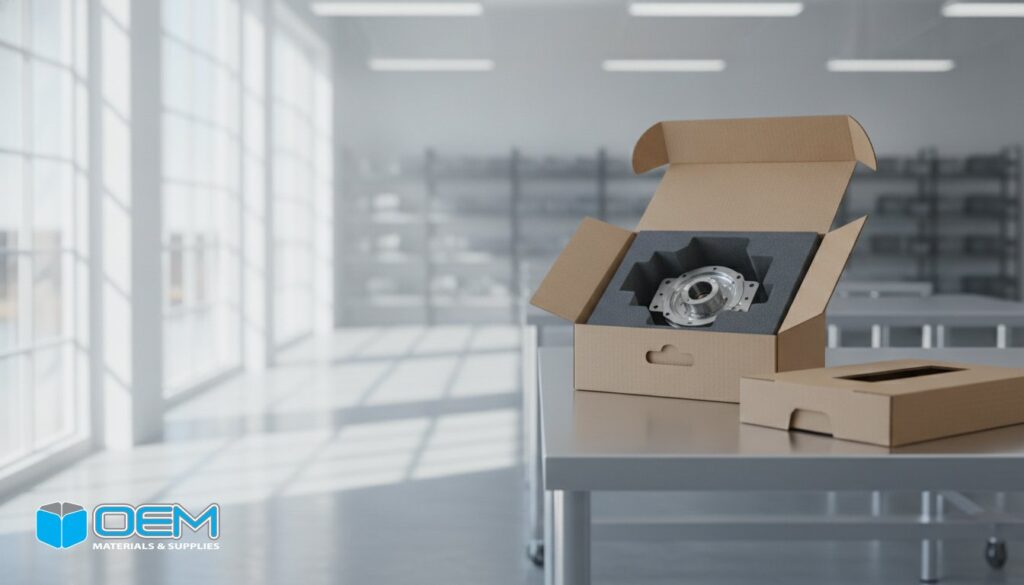
Standard shipping cartons are often the hidden source of escalating operational costs for Southern California manufacturers. Many procurement professionals find that using generic packaging for sensitive aerospace components or medical devices leads to excessive material waste and high product damage rates. You likely already know that packing station efficiency is just as critical as the durability of the box itself. When your facility relies on oversized containers, you are paying for air and risking the integrity of your components. Implementing custom die-cut boxes is a strategic move to eliminate these logistical bottlenecks and protect your bottom line.
This article demonstrates how custom die-cut boxes provide superior product protection and operational efficiency for manufacturers in Orange County and Los Angeles. You will learn how these precision-engineered designs reduce dimensional weight shipping costs and facilitate faster assembly times. We also examine how a strategic packaging partnership helps you avoid inventory shortages and maintain a zero-defect standard for sensitive industrial components. By the end of this guide, you will understand why tailored packaging architecture is a vital component of a resilient and cost-effective supply chain.
Key Takeaways
- Learn how custom die-cut boxes provide superior structural integrity and precise fitment compared to standard slotted containers.
- Understand the technical selection process for corrugated board grades and ECT ratings to ensure zero-defect protection for sensitive components.
- Discover industry-specific packaging applications tailored for the rigorous standards of Southern California aerospace and medical device sectors.
- Explore how local manufacturing and vendor-managed inventory programs reduce lead times and warehouse overhead for regional facilities.
- Identify the steps for CAD-driven prototyping to optimize material usage and lower dimensional weight shipping costs.
Engineering Precision: Why Custom Die-Cut Boxes Outperform Standard Packaging
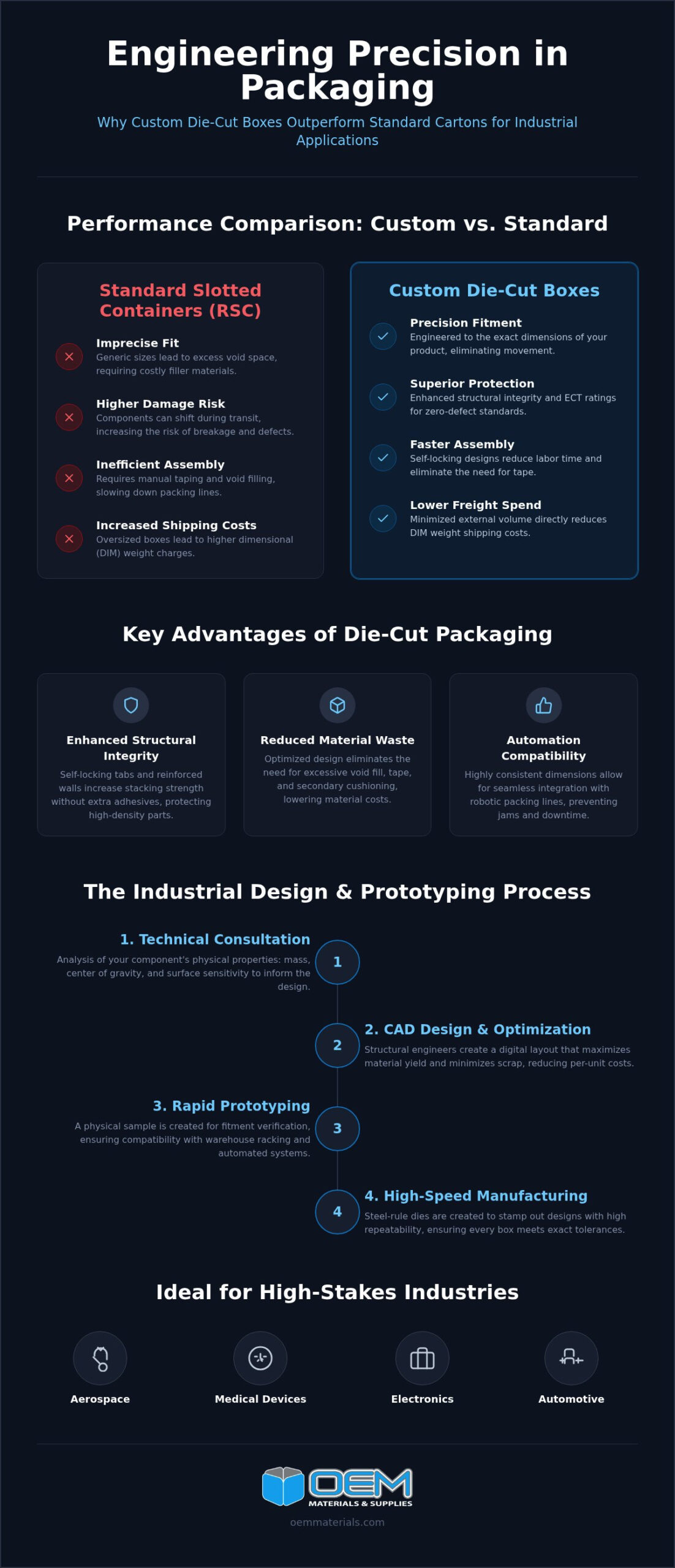
Standard Regular Slotted Containers (RSC) serve a purpose in general logistics, but they often lack the structural precision required for high-stakes manufacturing. Custom die-cut boxes are engineered using steel-rule dies that stamp out specific patterns with high repeatability. This process allows for complex geometries and tight tolerances that standard folding methods simply cannot achieve. For industries like aerospace or medical device manufacturing, these precise dimensions ensure that sensitive components remain stationary during transit. It’s a method that effectively eliminates the need for excessive void fill or secondary cushioning materials. By removing the reliance on extra tape and loose fill, manufacturers reduce both material waste and labor time at the packing station.
Unlike standard boxes that are limited to 90-degree folds, die-cutting supports custom flaps, dust-proof closures, and integrated handles. These design elements improve the end-user experience while maintaining the high Edge Crush Test (ECT) ratings necessary for industrial stacking. When your product requires a zero-defect environment, the accuracy of the container is just as important as the product itself. Precise packaging isn’t just a container; it’s a functional industrial tool that stabilizes your supply chain.
The Structural Advantages of Die-Cut Corrugated
Die-cut designs frequently incorporate self-locking tabs and reinforced walls that significantly increase the box’s stacking strength without the need for external adhesives. These structural features are vital when shipping high-density industrial parts that would otherwise stress the seams of a standard taped box. Key benefits include:
- Self-locking mechanisms: Reduce the need for packaging tape and external adhesives.
- Reinforced sides: Multi-wall options provide extra protection for heavy or sharp components.
- Automation compatibility: Consistent dimensions allow for seamless integration with robotic packing lines in Southern California facilities.
Because the manufacturing process is automated and highly consistent, these containers prevent jams and downtime, allowing for a more predictable throughput in high-volume environments.
Reducing Dimensional Weight and Shipping Costs
Shipping costs are increasingly dictated by dimensional (DIM) weight rather than actual weight. When a manufacturer uses an oversized stock box, they’re essentially paying the carrier to transport air. Custom die-cut boxes are designed to the exact footprint of the product or its internal foam packaging, minimizing the exterior volume of the package. This reduction in “shipped air” leads to measurable savings in freight costs, especially for high-volume distributors in Los Angeles and Orange County. Precision-engineered packaging dimensions optimize freight spend by aligning physical volume with actual product requirements.
The Design and Prototyping Process for Industrial Die-Cutting
Industrial packaging begins with a technical consultation rather than a simple price quote. We analyze the physical properties of your component, focusing on mass, center of gravity, and surface sensitivity. This data informs the CAD design phase, where structural engineers use specialized software to create a layout that maximizes material yield. By optimizing the “nesting” of the box flat on the corrugated sheet, we reduce scrap and lower the per-unit cost for high-volume runs. Engineering the box structure at this stage ensures that the container provides maximum protection with the minimum amount of material required.
Rapid prototyping allows for physical verification before you commit to full-scale production. For manufacturers in Orange County or Riverside, this step is essential to ensure that custom die-cut boxes fit perfectly within existing warehouse racking or automated conveyor systems. Once the prototype is approved, we create the steel-rule dies required for high-speed manufacturing. This tooling ensures that every box in a 10,000 unit run is identical to the first, maintaining the tight tolerances required for aerospace and medical applications. If your project requires immediate physical testing, you can request a prototype for fitment verification to see how the design performs with your actual hardware.
Integrating Engineered Foam Inserts
A container is only as effective as its internal support. We design many of our solutions to house custom foam packaging for maximum shock absorption. The choice between polyethylene and polyurethane depends on your product sensitivity. Polyethylene offers high-density support for heavy automotive parts, while polyurethane provides softer cushioning for delicate electronics. By treating the box and the insert as a single protective system, we eliminate internal movement that leads to abrasion. This integrated approach simplifies your kitting process by providing a ready-to-use solution that requires no additional assembly or secondary void fill.
Testing and Quality Assurance
We validate every design through rigorous performance standards. Utilizing the Edge Crush Test (ECT) allows us to calculate exactly how many units can be safely stacked in a warehouse without risking bottom-box failure. Physical drop testing simulates the harsh conditions of LTL freight and parcel transit, ensuring the structure holds up under impact. Flute profile selection is another critical variable in this process. While ‘C’ flute offers excellent stacking strength, ‘E’ flute provides a thinner profile that is better suited for smaller, high-precision medical kits. We help you select the optimal balance of cushioning and thinness to minimize your overall package footprint.
Material Selection: Balancing Structural Integrity and Cost
Selecting the appropriate substrate for custom die-cut boxes is a technical decision that impacts both the safety of your components and your total landed cost. Corrugated board grades range from lightweight single-wall sheets to heavy-duty triple-wall configurations designed for high-density industrial equipment. We don’t just pick a grade based on price; we analyze the entire lifecycle of the package. While single-wall is suitable for many standard applications, manufacturers in the aerospace and automotive sectors often require the superior puncture resistance of double-wall board. It’s a choice that depends on the product’s weight, the shipping environment, and the required stacking height in the warehouse.
Edge Crush Test (ECT) ratings are the primary metric for evaluating material performance in modern supply chains. Unlike traditional burst tests, ECT measures the vertical compression strength of the board. This data is vital for Southern California distributors who need to maximize pallet density without risking bottom-layer box failure. For sensitive electronics, we provide specialty materials such as electrostatic discharge (ESD) liners. Similarly, medical device manufacturers often require cleanroom-compatible liners that minimize particulate shedding. Balancing these technical needs with sustainability goals involves choosing between recycled content and virgin fiber; while recycled materials support environmental mandates, virgin fiber typically offers higher structural strength for critical load-bearing applications.
Corrugated Flute Profiles for Die-Cut Applications
The flute profile determines the thickness and cushioning capability of the box wall. B-flute and E-flute are preferred for smaller mailers and component boxes because their thinner profiles allow for sharper, more accurate folds during the die-cutting process. These profiles also provide a smoother surface for high-quality printing. For heavy industrial equipment, C-flute or double-wall combinations are necessary to provide the required shock absorption and vertical stacking strength. Flute orientation is equally critical; we engineer the grain of the corrugated board to run vertically when the box is assembled, ensuring maximum resistance against crushing forces during long-term storage.
Coatings and Barrier Protections
Environmental factors can compromise corrugated materials, especially during overseas shipping or high-humidity storage in coastal regions like San Diego or Los Angeles. We offer moisture-resistant coatings that prevent the fibers from softening when exposed to damp conditions. For high-finish automotive or medical parts, abrasion-resistant liners are essential to prevent surface scratching caused by internal movement. These specialized corrugated boxes specifications ensure that your product arrives in pristine condition regardless of the logistical challenges. Selecting the right combination of flute, grade, and coating creates a packaging system that is both cost-effective and structurally sound.
Industry-Specific Applications for Southern California Manufacturers
Southern California’s manufacturing landscape is defined by high-stakes industries that require more than just a standard shipping container. For companies operating in the aerospace, defense, and medical device sectors, custom die-cut boxes serve as a critical component of the quality control process. These containers aren’t designed for retail shelf appeal; they’re engineered to maintain the integrity of mission-critical hardware and sensitive diagnostic tools. In the electronics sector, we integrate specialized cushioning materials and ESD-safe liners directly into the die-cut structure. This approach eliminates the variability of manual wrapping and ensures that every unit receives the exact same level of protection. For automotive manufacturers, precision-cut dividers and partitions allow for the high-density transport of sub-assembly components while preventing metal-to-metal contact.
Medical and Life Science Packaging Requirements
Medical device manufacturers in Orange County and Los Angeles face unique regulatory and clinical challenges. Packaging must be sterile-ready and designed for immediate access in high-pressure clinical environments. We use die-cutting to create organized, multi-component kits that present surgical tools or diagnostic sensors in a logical sequence. This organization reduces the risk of error and improves procedural efficiency. Material compatibility is also a primary concern. Our designs ensure that the corrugated structure and internal inserts can withstand common sterilization processes without losing structural integrity or shedding particulates.
Aerospace and Heavy Industrial Solutions
The aerospace hubs in Los Angeles and San Diego require packaging that can handle massive, irregularly shaped components with extreme precision. When a standard box fails to meet the weight or size requirements of aviation hardware, we provide heavy-duty custom die-cut boxes reinforced with double-wall or triple-wall board. In cases where corrugated material alone isn’t sufficient, we integrate these designs with custom crates to provide a hybrid solution that meets rigorous military and commercial shipping standards. These systems are designed to withstand the high vibration and impact forces typical of long-range freight. If your operation requires a container engineered for technical performance rather than aesthetics, contact our engineering team for a specific application review.
Optimizing Your Supply Chain with Local Die-Cut Manufacturing
Localizing your packaging supply chain is a strategic decision that directly impacts operational agility. For manufacturers in Orange County and Riverside, sourcing custom die-cut boxes from a regional partner reduces lead times from weeks to days. This proximity is essential for supporting lean manufacturing initiatives that rely on just-in-time delivery. When your supplier is local, you eliminate the risks associated with long-distance freight delays and rising fuel surcharges. Consolidating your procurement by sourcing boxes, integrated foam, and plastic pallets from a single partner further simplifies your vendor list. This integrated approach reduces administrative overhead and ensures that all components of your packaging system are designed to work together.
The VMI Advantage for SoCal Facilities
Warehouse floor space is expensive in Southern California. A vendor-managed inventory (VMI) program allows you to reclaim that space for production. OEM Materials & Supplies monitors your actual usage levels and maintains a buffer stock of your custom die-cut boxes in our local facilities. This proactive management prevents packaging stockouts that can halt a production line. Purchasing managers benefit from a streamlined procurement process; instead of managing dozens of individual purchase orders, you rely on a structured replenishment system. It’s a functional remedy for the inventory shortages that often plague manufacturers relying on distant commodity vendors.
Partnering with a Local Industrial Specialist
Technical packaging challenges are often best solved on the factory floor. Our team provides on-site consultations at your Los Angeles or San Diego facility to observe your packing station workflows firsthand. This grounded approach allows us to identify inefficiencies that a remote vendor would miss. Whether you need a rapid design change for a new product iteration or an urgent production run to meet a sudden demand spike, local manufacturing provides the necessary responsiveness. For a more detailed framework on selecting a supplier, refer to our Corrugated Packaging Box Manufacturers guide. Choosing a partner who understands the specific logistical pressures of the Inland Empire and the coastal counties ensures your supply chain remains resilient.
Modernizing Your Industrial Packaging Strategy
Effective industrial packaging is a balance of engineering precision and logistical efficiency. Transitioning from standard shipping containers to custom die-cut boxes allows Southern California manufacturers to reduce product damage and eliminate the costs of transporting excess air. This strategic shift ensures that sensitive aerospace and medical components remain secure while optimizing your packing station workflows. Integrating these designs with local inventory management and rapid prototyping creates a resilient system that adapts to fluctuating market demands.
OEM Materials & Supplies has served the aerospace and medical sectors with technical expertise and local inventory solutions since our inception. We provide full-service design and prototyping from our Southern California facilities to ensure your packaging performs under rigorous industrial conditions. When you’re ready to improve your supply chain reliability and reduce dimensional weight costs, we’re here to help. Contact OEM Materials & Supplies today for a custom die-cut packaging consultation and quote. We look forward to partnering with you to build a more efficient distribution network.
Frequently Asked Questions
What is the minimum order quantity for custom die-cut boxes?
Minimum order quantities for custom die-cut boxes vary based on the specific dimensions and material grades required for your project. We offer short-run capabilities to support prototyping and small-batch manufacturing for specialized aerospace or medical components. It’s a flexibility that allows you to validate a design before committing to high-volume production. Our team can provide specific volume thresholds once we review your product dimensions, weight, and annual usage requirements.
How much does the tooling for a custom die-cut box cost?
Tooling for these specific containers requires an initial investment in a steel-rule die, which is manufactured to the exact specifications of your CAD design. This is a one-time cost that ensures every box in your production run is identical and meets tight industrial tolerances. While this adds to the setup expense, the high repeatability and faster assembly times often offset the initial tooling investment over the product lifecycle.
Can die-cut boxes be made with sustainable or recycled materials?
We provide a variety of sustainable options, including corrugated board with high percentages of post-consumer recycled content. While recycled fibers are excellent for many applications, we analyze your structural requirements to ensure the Edge Crush Test (ECT) rating remains sufficient for your stacking needs. Using recycled materials helps Southern California manufacturers meet state regulatory mandates while maintaining the durability necessary for protecting industrial hardware during transit.
How do custom die-cut boxes reduce labor costs in the warehouse?
Custom die-cut boxes reduce labor costs by streamlining the packing station workflow. Many designs feature self-locking tabs that eliminate the need for excessive packaging tape and manual folding. Because the boxes are engineered for a precision fit, your team spends less time applying void fill or secondary cushioning materials. These incremental time savings at the packing station lead to faster throughput in high-volume distribution environments across Orange County and Los Angeles.
What is the difference between a standard shipping box and a die-cut box?
Standard Regular Slotted Containers (RSC) are limited to 90-degree folds and require tape for all closures. In contrast, die-cut designs are manufactured using a press and die to create complex shapes, integrated handles, and self-locking mechanisms. This precision allows for tighter tolerances and a more professional presentation. These containers are specifically engineered to fit the product, whereas standard boxes often require extra cushioning to fill empty space.
Do you provide prototyping services for custom packaging designs?
We provide comprehensive prototyping services to ensure your packaging design performs as expected before full production begins. Our structural engineers create CAD models and physical samples that you can test with your actual product. This process allows you to verify fitment, test shock absorption with foam inserts, and confirm that the box integrates seamlessly with your automated packing lines or warehouse racking systems in Southern California.
How long does it take to manufacture a custom die-cut box order?
Lead times for manufacturing depend on the complexity of the die and the current availability of specific corrugated grades. Sourcing from our local Southern California facilities typically reduces the total turnaround time compared to out-of-state vendors. Once the initial tooling is created and the design is approved, subsequent production runs are often faster. We work with procurement managers to establish predictable delivery schedules that align with your specific manufacturing cycles.
Are die-cut boxes strong enough for heavy industrial equipment?
These containers are engineered to handle heavy industrial equipment by utilizing high-performance board grades like double-wall or triple-wall corrugated. We select specific ECT ratings and flute profiles to provide the vertical stacking strength and puncture resistance required for dense machinery parts. By optimizing the structural grain of the board, we ensure the container maintains its integrity under high-mass loads during long-range freight or international shipping.