
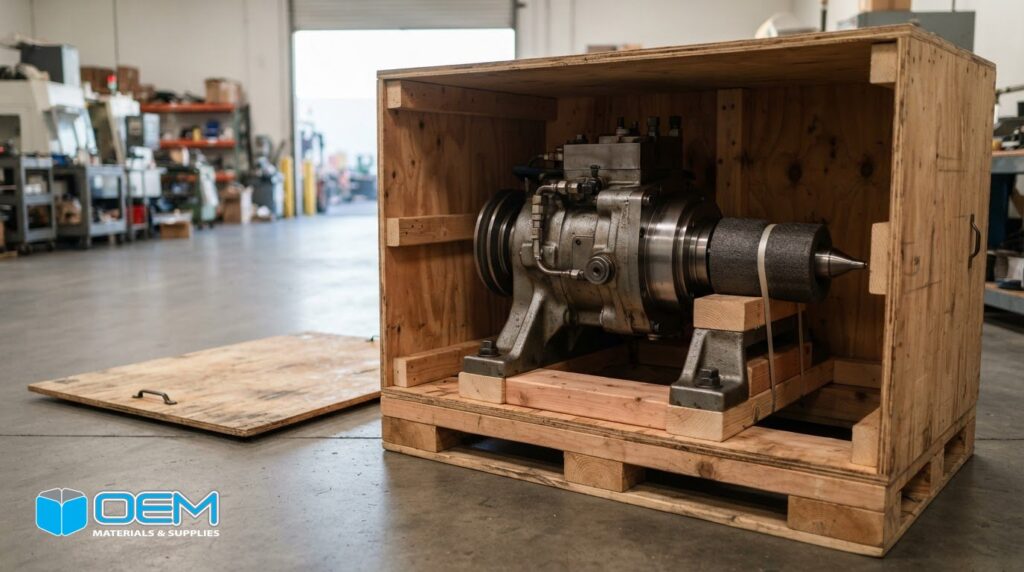
The right crate must do more than fit the product. Yes, custom industrial shipping crates in Los Angeles can be designed around an OEM’s shipping requirements, including the item’s dimensions, weight, materials, fragility, and route. For export shipments using solid wood packaging, ISPM 15 calls for heat treatment to a core temperature of 56°C for at least 30 continuous minutes.
That fit matters because heavy machinery, delicate electronics, and irregular components place different demands on crate structure, internal support, and cushioning. A standard package may not address those differences.
This guide explains how to turn shipping requirements into crate design decisions, from structural support and cushioning to export considerations. It also covers protection for machinery, electronics, and oversized freight, plus the product and shipment details that help shape an effective packaging plan.
Key Takeaways
- Match crate structure to the shipment’s dimensions, weight, fragility, and handling requirements.
- Consider export requirements early, since the wood materials and construction can affect crate design.
- Choose internal cushioning and support based on the item being shipped, from sensitive electronics to heavy machinery.
- Assess how the shipment will be handled and transported to identify where movement, impact, or stacking could pose risks.
- Combine corrugated boxes, foam packaging, and other packaging components when a single material does not meet the protection needs.
Do your crates meet international shipping regulations?
They can, when material selection and crate construction account for the shipment’s destination and handling requirements. For exports using solid wood packaging, ISPM 15 calls for heat treatment to a core temperature of 56°C for at least 30 continuous minutes.
Shipment-Specific Crate Design
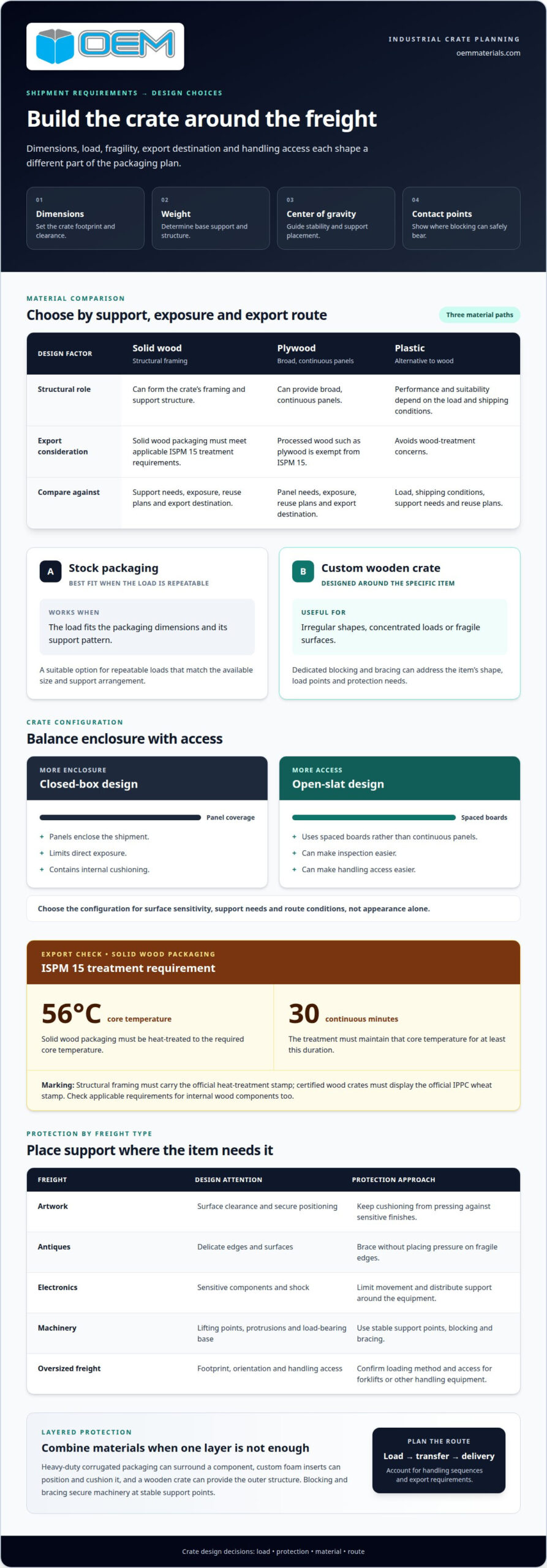
Start with the item’s outside dimensions, weight, center of gravity, and contact points. These details shape the crate footprint, base support, internal blocking, and clearance around fragile surfaces. A heavy machine with a low center of gravity needs different support from a tall, delicate assembly. The item’s value also helps determine how much protection and handling control the plan should prioritize.
Wood, Plywood, and Plastic Materials
Solid wood can form structural framing, while plywood can provide broad, continuous panels. Processed wood such as plywood is exempt from ISPM 15; solid wood packaging must meet its applicable treatment requirements. Plastic avoids wood-treatment concerns, but its structural performance and suitability depend on the load and shipping conditions. Compare materials by support needs, exposure, reuse plans, and export destination.
Stock packaging suits repeatable loads that fit its dimensions and support pattern. Custom wooden crates address irregular shapes, concentrated loads, or fragile surfaces that need dedicated blocking and bracing. Fabrication follows the approved design: measure the product, plan the base and frame, position supports, then assemble panels and closures. For crate options, review industrial shipping crates.
Closed-box designs enclose the shipment with panels, limiting direct exposure and containing internal cushioning. Open-slat designs use spaced boards, which can make inspection and handling access easier. Choose the configuration based on the item’s surface sensitivity, support needs, and route conditions, not appearance alone.
Custom industrial shipping crate manufacturers in Los Angeles typically work from product dimensions, weight, fragility, and shipment requirements to define the design. For Los Angeles crate manufacturers, reviews are most useful when they describe comparable freight and packaging needs; service-area details clarify where design, fabrication, and delivery apply.
For export packaging, blocking and bracing secure the item against movement inside the crate. Solid wood packaging must be heat-treated to a core temperature of 56°C for at least 30 continuous minutes under ISPM 15. Structural framing must carry the official heat-treatment stamp, and certified wood crates must display the official IPPC wheat stamp. Internal wood components also require attention to applicable wood packaging rules.
How long does a custom industrial shipping crate take to build in Los Angeles? Timing depends on design complexity, material selection, treatment requirements, and fabrication scheduling. Medical-device packaging also has quality-system considerations: according to the U.S. Food and Drug Administration, its Quality Management System Regulation requires harmonized ISO 13485 packaging controls and took effect in February 2026.
Crating for artwork, antiques, electronics, machinery, and oversized freight
Different freight needs different internal support. A framed artwork shipment needs surface clearance and secure positioning, while an antique cabinet may need bracing that avoids pressure on delicate edges. Electronics require controlled movement around sensitive components. For machinery, identify lifting points, protrusions, and the base areas that must carry the load before specifying a crate.
Oversized freight adds handling constraints. A wide industrial assembly may need a base that supports its footprint while leaving access for forklifts or other handling equipment. Confirm the shipment’s orientation, center of gravity, and loading method, then place blocking to prevent movement without loading vulnerable components. These details align the crate design with the actual freight-handling process.
Fragile medical and electronic equipment needs particular attention to shock. Precision robotic surgery consoles can have shock tolerances as low as 15G to 30G. A single 15G shock during transit can render a precision surgical robot or MRI array useless. Internal cushioning should limit movement and distribute support around the equipment, rather than allowing impact against the crate walls.
An integrated design can combine heavy-duty corrugated packaging, custom foam inserts, and a wooden crate. Corrugated packaging can surround a component, foam can position and cushion it, and the crate can provide the outer structure. For artwork or antiques, the interior layout should keep cushioning from pressing against sensitive finishes. For machinery, blocking and bracing should secure the load at stable support points.
Domestic and international routes can involve different handling sequences, transfer points, and export requirements. Map the shipment from loading through delivery, including any planned transfers, before choosing closures and internal restraints. The Port of Los Angeles and the Port of Long Beach together handle approximately 31% of all containerized waterborne trade in the United States, making port-bound freight a relevant consideration for Los Angeles OEMs.
Compare total ownership costs, not just the initial packaging materials. Damage exposure, repacking labor, storage footprint, and crate reuse plans all affect operating costs. Freight dimensions and loaded weight can also affect carrier charges. Reducing unused space may help avoid paying to move unnecessary packaging volume, but keep the crate sized to the item’s support needs without compromising protection.
To assess possible freight surcharges, document the packed dimensions, loaded weight, handling orientation, and destination. Review those details against the shipment’s carrier requirements before finalizing the design. A shipment brief with this information gives the packaging team a practical basis for discussing crate construction and freight fit when preparing a quote.
Custom wooden crating for commercial and residential shipments
Wooden crating protects shipments that need a rigid outer structure and planned internal support. Design the crate around the item, destination, handling method, and packing sequence.
Crating Oversized and Irregular Items
For oversized furniture or irregular equipment, measure the widest, tallest, and deepest points, including handles or protrusions. Note fragile edges, projecting controls, and stable support areas before setting the crate footprint. A carved cabinet, for example, needs clearance around decorative details, while a machine with an uneven base needs support beneath its load-bearing points.
Plan the base and internal blocking around those measurements. The crate should restrain the item without pressing against glass, trim, or other vulnerable surfaces. For commercial shipments, include forklift access and loading orientation in the layout. For residential cargo, consider doorways, stairs, and the space available for packing and final placement.
On-Site Measurements and Crating
On-site measurement is useful when an item is difficult to move or has dimensions that are hard to capture in storage. Record its overall dimensions, access restrictions, lifting points, and the route from its current position to the loading area. A large production assembly, for example, may need measurements taken around attached brackets and controls.
Use these observations to plan crate assembly and packing access. Confirm where the crate can be built, how the item will enter it, and which surfaces need protection during placement. This helps avoid a design that fits the product but cannot be assembled or loaded in the available work area.
Items Suitable for Crating
Crating can suit valuable artwork, antiques, machinery, large electronics, furniture, and unusually shaped components. The key question is whether the item needs a rigid enclosure, stable internal restraint, or a base suited to its weight and handling method. A framed piece may need surface clearance; a control cabinet may need protected corners and secured internal components.
Before packing, identify detachable parts, exposed finishes, and areas that must remain accessible. Keep fasteners and removed components organized with the shipment. For fragile or high-value items, the internal layout should prevent contact with crate walls and limit shifting during handling.
Packing, crating, and freight coordination work best when responsibilities and sequence are clear. Document who prepares the item, who closes the crate, and who arranges transportation. A packing list should identify the contents, orientation, and handling instructions. This gives warehouse staff and freight teams consistent information from dispatch through receipt.
For Los Angeles shipments, plan pickup and delivery around the crate’s dimensions, loading access, and receiving-site constraints. Confirm the pickup location, delivery address, dock or doorway access, and equipment needed to handle the packed item. These details help coordinate local transportation without assuming every site has the same loading setup.
Assessment of item size, weight, materials, and fragility
A custom shipping crate quote needs the item’s length, width, height, total weight, material, fragile areas, destination, and handling method. For custom industrial shipping crates in Los Angeles, include photos or drawings when available to clarify the product’s shape and configuration.
Measure the item at its widest points, including handles, brackets, cables, and other protrusions. Record dimensions with components attached and note any parts that ship separately. A control panel with projecting knobs, for example, needs clearance that a simple measurement of its body would miss. Accurate measurements help define the crate’s interior space and avoid unnecessary empty volume.
Weight affects the crate base, support points, and handling plan. Record the total packed load when known, then identify the item’s center of gravity and stable bearing surfaces. A machine resting on narrow feet needs support beneath those points, while a broad, flat assembly may distribute its load across a larger base. Note lifting points and forklift access requirements.
Material and finish determine contact-protection needs. Stainless steel equipment, painted housings, glass panels, and polished surfaces may each need different separation from blocking and cushioning. Identify surfaces that must not be scratched, exposed to moisture, or placed under pressure. For an electronic assembly, list exposed connectors and fragile controls so supports avoid sensitive areas.
Describe fragility in practical terms. Identify components that could shift, bend, crack, or lose alignment during handling. A fragile instrument with a protruding sensor needs localized support, while a heavy enclosure may need restraint at its frame. Photos from several angles can clarify these features during planning.
Share shipment details alongside product data. Include the destination, expected handling orientation, loading method, and whether the shipment will pass through a domestic distribution hub or international port. Mention stacking constraints, storage exposure, and receiving-site restrictions. These details influence crate layout, closure access, and the space needed for handling equipment.
For repeat shipments, provide the quantity per release and expected annual usage. Note changes between product configurations, since a different bracket or accessory can alter dimensions and support needs. This helps the packaging team distinguish a stable, repeatable load from a one-time shipment that needs a separate design.
A useful quote request brings these inputs together: item dimensions, weight, material and finish, fragile areas, photos or drawings, destination, handling needs, and shipment frequency. This gives the design team a practical basis for recommending crate structure and internal cushioning. Missing product details can result in a crate that fits the outer dimensions but fails to support the item properly.
Shock absorption and structural support
Crate protection depends on controlling movement and supporting the load through each handling stage. For electronics, machinery, and automotive components, the design must address both impact and vibration.
Start with the item’s load-bearing points, not just its outside dimensions. A rigid base should support stable contact areas, while blocking prevents sliding or rotation. If a component has a narrow frame or uneven underside, support in the wrong place can concentrate force. Map the contact points before positioning internal supports.
Shock absorption manages brief impacts; vibration control limits repeated movement during transit. Cushioning must fit the item and stay in position. A loose insert may shift, while excessive pressure can stress a delicate housing. Use shaped supports around stable areas, leaving clearance for controls, connectors, and fragile edges.
Automotive components need a balance of vibration dampening and stacking strength. Standard catalog boxes often lack the structural integrity required for heavy, irregular Tier 1 automotive components. A crate design can instead account for load distribution, internal bracing, and the forces created by stacked freight. Confirm the component’s orientation and support points before choosing the structure.
Foam inserts can locate parts and help absorb shock. Polyethylene and polyurethane are materials used for custom foam inserts for automotive components. The insert shape should match the component’s contours and support it without loading vulnerable features. For a multi-part assembly, separate cavities can keep individual pieces from striking each other. Explore foam packaging options as part of the cushioning plan.
For a heavy machine, combine a load-bearing base with bracing around the frame and cushioning at sensitive contact areas. For electronics, stabilize the enclosure while protecting exposed controls and connectors. These examples show why one internal layout cannot suit every product, even when the outer crate dimensions look similar.
Before approving a design, review the crate and item as one system. Check that the load rests on the intended supports, internal blocking restricts movement, and cushioning stays in place. Then consider how workers will load, close, and unload the package. A design that protects the product but obstructs handling can create avoidable packing difficulties.
Document the product orientation, support locations, and fragile components in the packaging plan. If the item’s configuration changes, reassess the fit and contact points before reusing the design. Clear specifications help production teams pack consistently and receiving teams remove the product without stressing its supports.
OEM Materials & Supplies: Corrugated Boxes
OEM Materials & Supplies provides corrugated boxes for shipments that need a practical alternative or complement to a wooden crate. Corrugated packaging can contain smaller components, parts, and accessories within a larger shipment, while foam packaging or cushioning materials can separate items and limit movement inside the box.
Packaging kits bring compatible components together for repeatable packing workflows. Mailing tubes and cores suit items that need a cylindrical format rather than a box. Matching the package to the item’s shape, protection needs, and packing process helps operations teams select a suitable format for each shipment.
For help assessing packaging options for an industrial shipment, contact OEM Materials & Supplies.
Set the Next Shipment Up for Success
Start your next packaging decision with the product and the route it needs to travel. Bring engineering, procurement, and warehouse teams into the review so dimensions, handling requirements, and packing steps align before shipment. That coordination can identify design changes while the packaging plan is still being developed.
For OEMs evaluating custom industrial shipping crates in Los Angeles, organize the details that shape the design: product drawings or photos, packed dimensions, weight, fragile areas, destination, and expected shipment frequency. Clear inputs give the packaging discussion a practical starting point and connect crate requirements with the broader packing workflow.
OEM Materials & Supplies can help assess packaging needs for industrial shipments. Share the product and shipping details with the team to begin the conversation. Request a packaging quote and move your next shipment toward a packaging plan built around its requirements.
Frequently Asked Questions
Can you design packaging that meets specific OEM shipping requirements?
Yes. Packaging can be designed around an OEM’s product geometry and shipping requirements. Share drawings, assembly details, and any restrictions on orientation, handling, or materials. For example, an electronics manufacturer may need packaging that keeps connectors separated and specifies the correct unpacking sequence. Clear requirements help align the package with production and receiving workflows, not just the product’s outer dimensions.
How do you determine the type of crate an item needs?
The right crate depends on the item’s shape, load-bearing areas, handling path, and destination. A component with a flat, stable base may need a different support layout from equipment with projecting controls or uneven feet. Consider how staff will load and unload it. Forklift access, lifting points, and whether the shipment will be stacked can all influence the crate configuration.
What are Crating Services?
Crating involves planning and producing a rigid shipping enclosure for an item that needs structured support. The work can include measuring the product, selecting crate materials, preparing internal supports, and assembling the package around its handling requirements. For example, a manufacturing component with exposed fittings may need a layout that protects those fittings while keeping the main load secure during shipment.
What materials do you use inside the crate?
Interior materials can include foam and other cushioning selected for the item’s shape and protection needs. Options include polyethylene, polyurethane, expanded polystyrene, and EPE or EPP foam. Anti-static and ESD foam are available for electronics applications. A foam insert can separate parts or hold a product in position; cushioning pads can protect contact areas without filling the entire interior.
How much do custom industrial shipping crates cost in Los Angeles?
Price depends on the crate’s dimensions, materials, construction, internal protection, and shipping requirements. A simple enclosure and a crate with custom supports involve different design and material considerations. The total also depends on shipment quantity and whether the design must accommodate repeat packing. A quote request with product details and destination provides the basis for project-specific pricing.
Custom shipping crate companies near Los Angeles with reviews and service areas
When comparing Los Angeles-area crate manufacturers, look for reviews describing freight and packaging needs similar to yours, and check service-area details to confirm where design, fabrication, and delivery are available.