
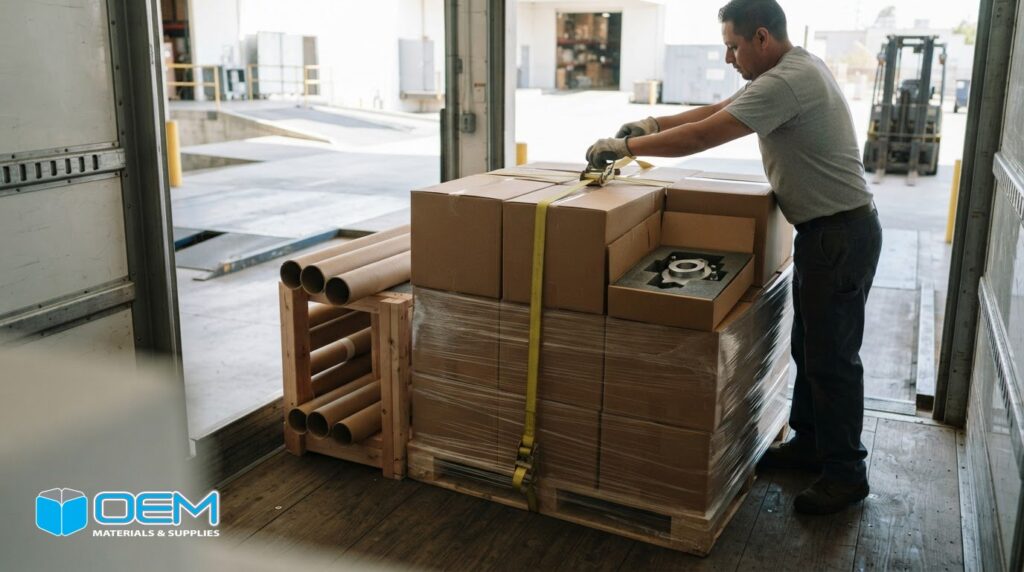
Packaging failures can turn a routine shipment into a handling problem. Perris, CA logistics and packaging services help coordinate material selection, packing, pickup, transport, delivery, and inspection. Freight packaging should suit the goods and transit demands, using boxes, crates, or pallets as appropriate; before transport, secure freight with straps or stretch wrap and label it.
Reliable Perris CA logistics and packaging depend on more than choosing a container. The package must protect the product, support safe handling, and arrive ready for its next step. Clear handoffs between packing, pickup, and receiving help keep the process organized.
This article explains how logistics workflows typically fit together, what affects packaging choices, and what to consider when planning shipments in Perris. You’ll learn how cushioning, corrugated boxes, crates, pallets, and stretch film support different loads, and how packing details and inspections can reveal problems before goods move onward.
Key Takeaways
- Match packaging to the product and transit conditions, using suitable boxes, crates, or pallets to protect freight.
- Organize handling, packing, pickup, transport, delivery, and inspection as connected steps with clear handoffs.
- Compare Perris logistics and packaging options by the services and materials needed for your operation.
- Review local requirements and plan for disruptions that could affect shipments, warehouse operations, or delivery schedules.
- Use corrugated boxes, foam packaging, or packaging kits to address product protection and packing workflow needs.
Material handling and packing duties
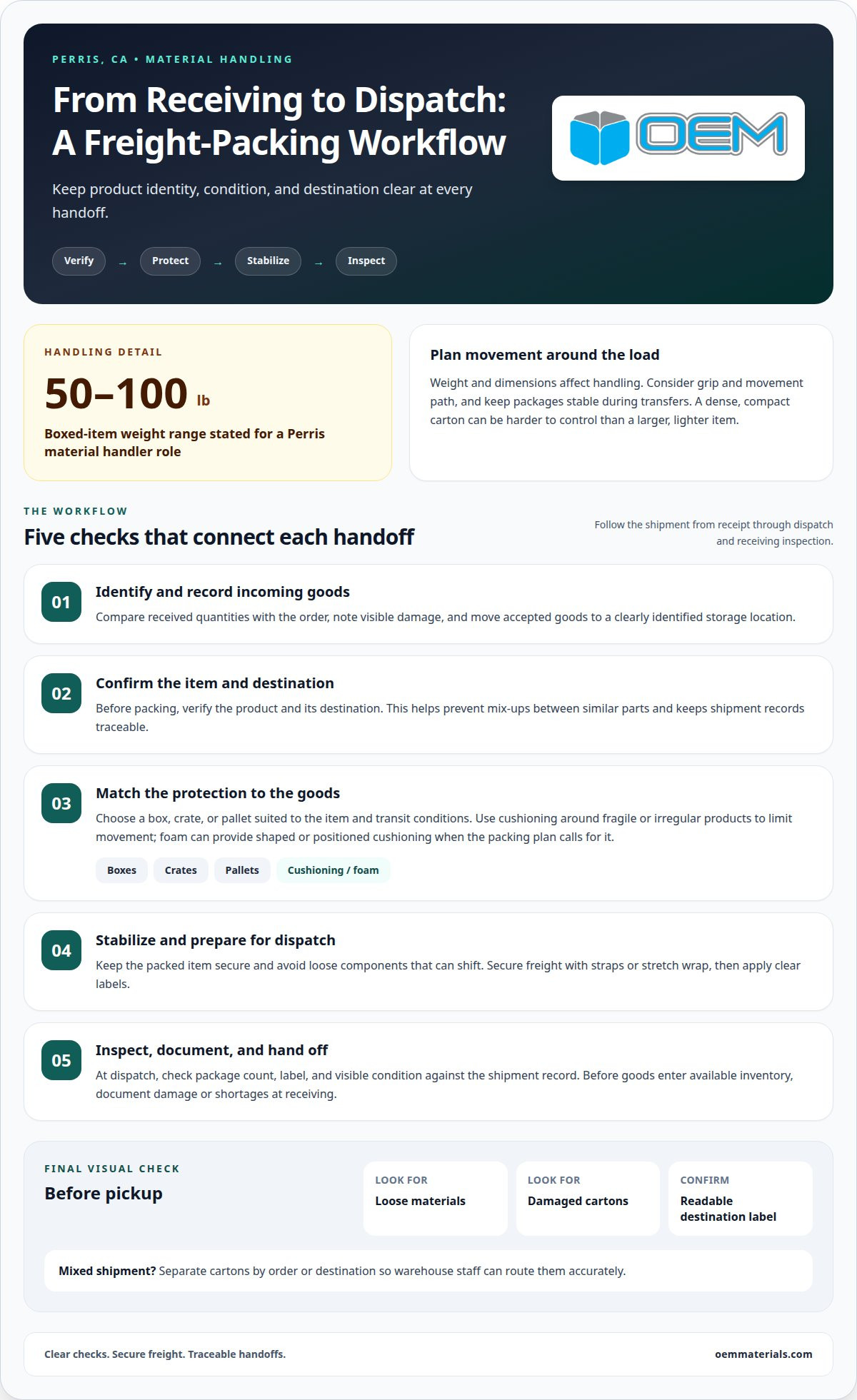
Material handling connects receiving, storage, packing, and dispatch inside a Perris warehouse. Each handoff should preserve product identity and condition. For example, staff can compare received quantities with the order, record visible damage, and move accepted goods to a clearly identified storage location. At packing, the team verifies the item and destination before selecting a container. These checks reduce mix-ups between similar parts and help operations staff trace shipments through distribution.
Weight and dimensions shape the handling plan. A Perris material handler job requires workers to handle boxed items weighing 50 to 100 pounds. That range makes package weight, grip, and movement path practical planning details. A dense component in a compact carton can be harder to control than a larger, lighter item. Before packing, measure the product and assess where it can be supported. Keep the package stable during transfers, and avoid leaving loose components that can shift inside the carton.
- Identify the shipment: Match the product, order details, and destination before packing begins.
- Choose protection: Use a box, crate, or pallet suited to the item and transit conditions.
- Stabilize the load: Add cushioning around fragile or irregular items so movement inside the package is limited.
- Prepare dispatch: Secure freight with straps or stretch wrap, then apply clear shipping labels.
For example, a component with exposed corners needs protection at those contact points, while a fragile assembly needs cushioning that limits movement. Foam packaging can help protect products when the packing plan calls for shaped or positioned cushioning. The team should also check that the packed item sits securely and that labels remain visible after wrapping. A final visual inspection can catch loose materials, damaged cartons, or an unreadable destination label before pickup.
How should businesses choose a third-party logistics or packaging provider in Perris? Compare each provider’s scope with your actual workflow: product type, handling needs, packing requirements, pickup coordination, transportation, delivery, and inspection. Ask for a clear description of each handoff, then assess whether the process addresses issues such as fragile components, mixed orders, or heavy boxed goods.
Inspection closes the handling loop. At dispatch, confirm the package count, label, and visible condition against the shipment record. At receiving, document damage or shortages before goods enter available inventory. For a mixed shipment, separate cartons by order or destination so warehouse staff can route them accurately. This creates a consistent process from initial receipt through final delivery, rather than treating packing as an isolated task.
Once shipments arrive, incoming items are put away efficiently. The Perris material handler position is scheduled Monday through Thursday, 6pm-4:30am. That schedule makes clear coordination across receiving, packing, and dispatch especially useful: workers can keep shipment records current at each transfer and leave the next team an understandable account of what was checked, packed, or held for review.
Consistent notes help staff resolve discrepancies without relying on memory. A final check of package condition and destination keeps OEM Materials & Supplies dispatch records aligned with the physical shipment. Clear handoffs also make it easier to identify where a delay or damage concern arose and what needs attention before goods continue through distribution.
What logistics and packaging companies are located in Perris, CA?
Perris has a growing warehouse and distribution sector, but regional logistics involves distinct functions that businesses often need to source through specialized partners. A warehouse may store inventory, pick orders, and prepare freight for dispatch. A transportation provider moves shipments between facilities and delivery points. A packaging operation prepares products for handling and transit. Manufacturers can distinguish these roles to identify whether they need storage, order preparation, freight movement, or protective packing from external providers.
One documented development in the area is the proposed Perris Airport Logistics Center at Goetz Road and East Ellis Avenue, along I-215. The project proposes two industrial warehouse and distribution buildings: one at 795,109 square feet and another at 71,961 square feet. Together, the proposed buildings represent 867,070 square feet of industrial development across 87.69 acres. These project details describe planned infrastructure, not a directory of operating logistics or packaging companies ready for immediate contract.
That distinction matters when mapping the broader supply chain. A distribution facility may provide receiving, storage, and outbound freight capacity, while an off-site packaging provider handles materials and preparation for individual products. For example, a manufacturer shipping delicate assemblies may need protective packing coordinated before freight pickup. A distributor handling mixed orders may prioritize accurate staging and clear carton identification.
Use the shipment workflow to define the type of provider your operation needs:
- Inventory storage: Identify whether goods need short-term staging or ongoing warehouse storage.
- Order handling: Specify whether staff must pick, sort, or prepare mixed-SKU orders.
- Packaging: Describe the product, its fragility, and the protection required for transit.
- Transportation: Map pickup and delivery points, shipment size, and required handoffs.
A business shipping one finished machine part has different needs from a distributor sending a pallet of several product types. The first may focus on fit and cushioning; the second may need consistent grouping and labels that distinguish each order. Clear requirements help teams compare service scope without assuming every warehouse handles specialized packaging or transportation.
Before engaging a partner, document the origin, destination, product dimensions, weight, order profile, and inspection points. Then match each task to the operation responsible for it. For packaging planning, share your product and shipment requirements with OEM Materials & Supplies so the materials discussion can start with the actual load and handling conditions.
Service functions can include inventory storage, order picking and preparation, freight staging, packaging for handling and transit, and transportation between facilities and delivery points. Order handling may also involve sorting mixed-SKU orders and preparing outbound freight.
What packaging services do Perris companies offer, including custom packaging and labeling?
Packaging support can include material selection, package preparation, load stabilization, and shipment identification. In Perris, the right combination depends on the product, its handling path, and how freight moves through distribution. A standard carton may suit uniform parts, while an irregular component may need a fitted protective layout. For palletized freight, consider how cartons fit together and whether the load will remain stable during handling.
Custom packaging starts with the product and its transit conditions. A packaging team can review dimensions, weight, fragile surfaces, protrusions, and loading and unloading methods. These details guide choices such as a box, crate, or pallet, as well as the placement of protective materials. A machine component with a projecting connector, for example, may need clearance around it, while smaller parts may need separate compartments to prevent contact.
Packaging preparation can also make warehouse work more consistent. A defined sequence helps staff place the product, add protection, close the package, and check its contents. A kit of related components, for example, can be arranged so workers can identify each item during packing and receiving. Clear instructions and a set package layout help reduce avoidable differences between shipments.
Consistent labeling supports inventory identification during receiving and storage. A business can define the details each package needs, such as an order reference, product identifier, or destination department. A carton containing an assembly and replacement components, for example, can use distinct identifiers to help receiving staff route its contents correctly. Consistent label placement also makes checks easier.
- Assess the product: Record dimensions, weight, fragile areas, and handling needs.
- Choose the package: Match a box, crate, or pallet to the load and transit conditions.
- Set the packing sequence: Define product placement, protection, closure, and inspection steps.
- Standardize identification: Specify the package details staff need for order processing and receiving.
For Perris operations, compare packaging support by task rather than by a broad service label. A manufacturer shipping one sensitive assembly may prioritize tailored protection; a distributor preparing mixed orders may need consistent packing steps and clear product identification. Documenting these needs gives the packaging discussion a practical starting point and connects package design to actual warehouse handling and transportation.
Related warehouse staffing information can help place packaging work within broader handling operations, although it does not define a packaging service. These role and shift details can be considered separately when coordinating package preparation, movement, and shipment identification; they do not specify materials, custom designs, or labeling requirements. Businesses can still evaluate packaging support by matching protection, packing steps, and identification standards to each product and route.
What permits and regulations apply to logistics and packaging businesses in Perris, CA
Permit planning for a Perris warehouse starts with the actual operation and facility. A company that stores sealed cartons has different site activities from one that modifies buildings, operates loading areas, or handles regulated materials. Map each activity to its location, equipment, and materials before preparing a compliance plan. This prevents a broad warehouse description from obscuring important operational differences.
Separate the review into site use, construction, fire protection, environmental handling, and transportation. Adding a packing line, for example, can affect building layout, equipment placement, and emergency access. Storing chemicals used in production raises different considerations from storing ordinary packaged components. The product, quantity, handling method, and storage arrangement determine which issues need evaluation.
A practical first step is to build a permit and approval matrix. List each activity, the facility area involved, the responsible internal owner, required documents, and approval or inspection milestones. Review a planned warehouse expansion separately from routine changes to packing procedures. Keep records together so operations, facilities, and safety teams work from the same project scope.
- Define the operation: Document storage, packing, loading, vehicle movement, and any processing work.
- Describe the site: Record the facility layout, planned changes, equipment, and occupied areas.
- Identify materials: Classify stored products and process materials by handling and storage needs.
- Track approvals: Assign an owner and retain submitted plans, decisions, and inspection records.
Fire and emergency planning should reflect the facility’s physical layout. For a warehouse storing cartons, foam, and palletized goods, document storage zones, aisles, exits, and equipment. A new rack arrangement or packing station can change access paths. Review those changes in the facility plan before installation, then keep the approved layout available to supervisors and maintenance staff.
Transportation creates a separate compliance workstream. A Perris business coordinating its own vehicles should document vehicle use, loading practices, shipment records, and the roles of dispatch and warehouse staff. Businesses using outside carriers should define where custody transfers and which shipment documents accompany freight. These records connect facility controls with pickup and delivery procedures.
For a proposed facility change, assign a project lead to gather site plans, process descriptions, material inventories, and equipment details. Use this information to identify applicable approvals and inspections before work begins. Revisit the matrix when the operation adds a process, changes storage conditions, or alters the building layout. This keeps permitting tied to the business’s actual activities, not just a one-time checklist.
What risks or challenges affect logistics and packaging in Perris, such as traffic, fire, or supply-chain delays?
For Perris shipments, route disruption can affect pickup timing, dock schedules, and delivery commitments. I-215 is a key local corridor, so dispatch planning should account for the route between the warehouse, carrier pickup point, and destination. A delay at one handoff can leave a loaded dock waiting or push receiving work into another shift. Map alternate routing options and give the receiving team a clear process for schedule changes.
Fire exposure deserves attention wherever a warehouse stores packaging and finished goods. Corrugated cartons, foam, and palletized inventory can add combustible material to a storage area. Keep aisles and exit paths clear, separate packing supplies from heat-generating equipment, and establish a process for reporting damaged electrical equipment. A change in rack layout or packing-station location should prompt a review of access paths and storage arrangements.
Supply-chain interruptions can start before a shipment reaches Perris. A delayed component, missed pickup, or shortage of packaging material can disrupt production and order fulfillment. Identify the materials that prevent a shipment from being packed, then set reorder points based on actual usage and replenishment patterns. A manufacturer shipping fragile assemblies, for example, should monitor the protective inserts those assemblies need, not just finished-product inventory.
- Route exposure: Record pickup windows, likely handoff points, and a communication path for delays.
- Facility exposure: Keep storage layouts, aisle access, and packing-station locations visible to supervisors.
- Supply exposure: Track critical components and packing materials against current production demand.
- Damage exposure: Review returned or damaged shipments for repeated failure points in packing and handling.
Packaging design can reduce transit damage, but it must match the product and freight journey. A loose part may shift inside a carton; a poorly stabilized pallet may move during loading. Review damage reports by product, package configuration, and route. Then adjust internal support or load arrangement and test the revised process before applying it to orders.
Build a practical response plan with clearly assigned owners. Dispatch should communicate route changes, warehouse staff should flag inventory shortages, and receiving teams should record delivery damage. Use one shipment record to connect the order, package configuration, carrier handoff, and inspection result. This makes recurring problems easier to trace and correct.
Share your product dimensions, weight, and shipping conditions to request packaging guidance for shipments exposed to handling or supply interruptions.
OEM Materials & Supplies: Corrugated Boxes
OEM Materials & Supplies supports product protection and packing with corrugated boxes, foam packaging, packaging kits, and mailing tubes and cores. Corrugated boxes help protect products during shipping and handling, while foam packaging and cushioning materials provide protection inside the package. Packaging kits bring coordinated materials together for a defined shipment or product set. Mailing tubes and cores suit products that need a tube format.
Consider these packaging options when damage, inconsistent packing, or handling requirements call for a closer review. Product dimensions, weight, and shipping conditions help guide the design. Contact OEM Materials & Supplies to discuss your packaging requirements.
Put Your Packaging Plan Into Action
Use your next packaging review to connect product protection with how orders move through your operation. Start with a representative shipment: record the product’s dimensions and weight, note vulnerable areas, and describe how it will be handled and transported. These details give your team a practical basis for evaluating Perris, CA logistics and packaging requirements.
Before changing a package, assign an owner to approve the specification and record revisions. Purchasing, engineering, and warehouse teams can then use the same current instructions. This helps prevent an outdated package design from remaining in circulation after a product or process changes.
Request a quote from OEM Materials & Supplies with your product dimensions, weight, annual usage, and shipping details. A clear set of requirements is a strong first step toward a more consistent packaging plan.