

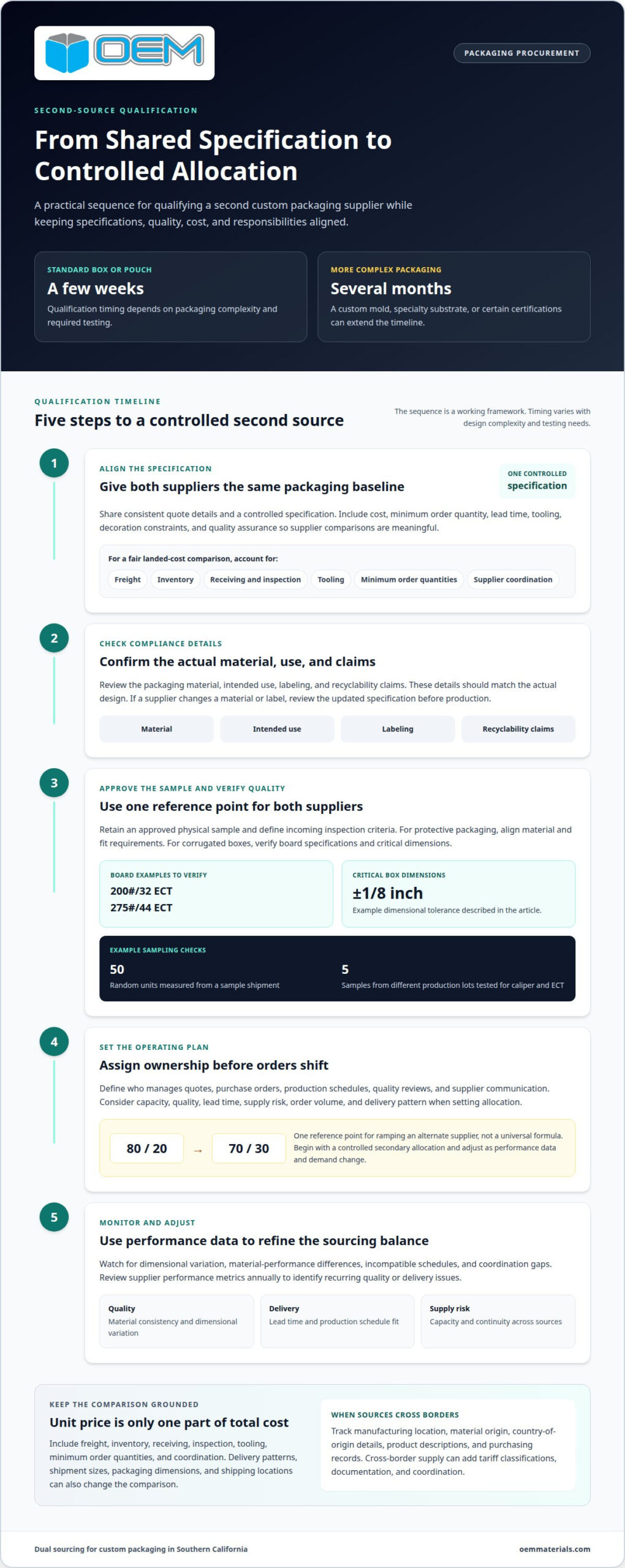
A dual sourcing strategy for custom packaging in Southern California can qualify a standard box or pouch with a second supplier in a few weeks. A custom mold, specialty substrate, or certain certifications can take several months. The qualification timeline depends on how complex the packaging is and how much testing the specification requires.
Adding a supplier can strengthen continuity, but it also brings coordination, qualification work, and additional purchasing decisions. The lowest unit price may not mean the lowest landed cost once freight, tariffs, inventory, and handling are included.
This article explains how a dual sourcing strategy for custom packaging in Southern California affects total cost, tariff exposure, supplier selection, and procurement efficiency. It also compares domestic and offshore supply and outlines what to expect when qualifying a second source, so you can decide whether the added resilience fits your packaging needs.
Key Takeaways
- Compare suppliers on total landed cost, including freight, inventory, and coordination, rather than unit price alone.
- Use consistent packaging specifications and quote details to make supplier comparisons meaningful.
- Factor regional sourcing into continuity planning, while accounting for the added tariff tracking that cross-border supply can require.
- Match sourcing decisions to the packaging’s design stability and volume: products still undergoing revisions may benefit from domestic sourcing, while stable, high-volume items may suit offshore supply.
- Define who owns supplier coordination before adding sources, so procurement and operations responsibilities stay clear.
Is dual sourcing always more expensive than single sourcing?
Not necessarily. A second supplier can raise procurement and freight costs, but it can also reduce exposure to shortages and production interruptions. Qualification time depends on packaging complexity: a standard box or pouch may take a few weeks, while a custom mold, specialty substrate, or certain certifications can take several months.
For custom packaging in California, compliance review should account for the material, intended use, labeling, and recyclability claims. Those details should match the actual packaging design. If either supplier changes a material or label, review the updated specification before using it in production.
Dual sourcing adds work: procurement must manage another quote, purchase order, production schedule, quality review, and supplier relationship. Compare total cost, not just unit price. Include minimum order quantities, tooling, freight, receiving, inspection, and the inventory needed to cover each supplier’s lead time. Send both suppliers the same specification and request consistent details on cost, MOQ, lead time, tooling, decoration constraints, and quality assurance.
Freight can also change the comparison. Separate shipment sizes or delivery schedules may increase transportation and receiving activity, while a nearby secondary source may reduce reliance on long-haul shipping. The balance depends on order volume, delivery frequency, packaging dimensions, and shipping locations. An oversized box can also incur dimensional-weight surcharges, so include the packed product’s dimensions when evaluating freight.
Keep quality consistent with one controlled specification and an approved physical sample. For corrugated boxes, examples of board specifications to verify include 200#/32 ECT and 275#/44 ECT. Critical box dimensions can be held to a tolerance of ±1/8 inch. A comparison process can measure 50 random units from a sample shipment and test five samples from different production lots for caliper and ECT. For protective applications, foam packaging also needs consistent material and fit requirements across suppliers.
Key risks include dimensional variation, differences in material performance, incompatible production schedules, and added coordination. Mitigate them with a shared specification sheet, a retained approved sample, incoming inspection criteria, and one person responsible for supplier communication. Review supplier performance metrics annually to spot recurring quality or delivery issues.
Order allocation should reflect capacity, quality, lead time, and supply risk rather than a fixed rule. An 80/20 split moving toward 70/30 is one reference point for ramping an alternate supplier, not a universal formula. Start with a controlled secondary allocation, then adjust it as performance data builds and demand changes.
Tariff exposure and regional sourcing
Tariffs can change the delivered cost of custom packaging when suppliers source materials or manufacture products in different countries. A second supplier in another region may reduce dependence on one trade route, but it can also add tariff classifications, documentation, and coordination. Evaluate the supplier’s manufacturing location and material origin, not just the address on its quotation.
Cross-border sourcing adds compliance work. Starting in August 2025, companies sourcing from multiple countries will need to track two to three times more tariff rate categories. That makes supplier and origin records important procurement inputs. Keep country-of-origin details, product descriptions, and purchasing records consistent across orders so teams can assess cost exposure and avoid confusion when sourcing changes.
Regional supply can serve a different purpose. A Southern California manufacturer may use a local source for replenishment or urgent capacity while keeping a second supplier in another region for volume flexibility. A regional packaging partner can help reduce exposure to port congestion and long-haul shipping delays. It does not eliminate freight costs, but it can shorten the distance materials travel and help replenishment reach a facility sooner.
Supplier-plus-one strategies are receiving attention among industrial manufacturers. Deloitte reported that 57% of industrial manufacturers with operations in China were considering this approach. The figure describes those manufacturers, not a universal sourcing target. For a packaging buyer, the practical question is whether a regional alternate can produce the same specification and support the required volume when the primary source faces disruption.
Build the comparison around operational fit. Map each supplier’s production location, material origin, available capacity, freight route, and expected order volume. Then model how a disruption at one source affects packaging availability and outbound shipments. A 70/30 split between a primary supplier and a second supplier in another region is one example, not a fixed allocation rule. The right balance depends on demand patterns, production capability, and the cost of maintaining activity across both sources.
McKinsey’s 2025 risk survey found that 39% of companies were pursuing dual sourcing strategies for components or raw materials. For packaging, the decision should connect that resilience goal to a clear operating plan: assign responsibility for tariff and origin records, align specifications, and set allocation rules before orders shift. Those controls keep regional sourcing consistent across procurement and operations.
For a Southern California packaging review, share your packaging requirements to discuss how regional supply needs fit the application, volume, and delivery pattern.
Total landed cost and procurement efficiency
A supplier’s unit price is only one part of custom packaging cost. Total landed cost also includes freight, receiving, inspection, storage, order administration, and packaging-related damage. For example, an oversized box may increase dimensional-weight charges, while extra inspection can add labor at receiving. Compare each cost category for both suppliers using the same order volume and delivery assumptions.
Start with a packaging audit covering the past 12 months. Review order history to identify repeat purchases, seasonal peaks, and low-volume items that create separate orders. Then examine shipping damage rates by product line. If a fragile assembly has recurring damage, compare the packaging specification and resulting shipment costs, not just the supplier’s quoted unit price.
Quote comparisons work only when every vendor receives the same minimum viable specification. Request consistent information on cost, minimum order quantity, lead time, tooling, decoration constraints, and quality assurance. A sample evaluation matrix might show a primary supplier’s standard-order lead time at 10-12 business days and a secondary supplier’s at 12-15 business days. That difference affects reorder timing and the inventory needed to protect production.
Procurement complexity also has a cost. Two suppliers mean more purchase orders, forecast updates, invoice processing, schedule coordination, and quality records. Assign one owner to maintain the shared specification, communicate changes, and coordinate allocations. A controlled process helps prevent conflicting versions, such as one supplier producing an old box dimension after an engineering revision.
Inventory policy can shift the landed-cost calculation. Vendor-managed inventory can move stock ownership and storage from a customer’s facility to a regional hub, with deliveries coordinated to production needs. This can ease on-site storage pressure, but its value depends on order patterns, replenishment frequency, and available space. Include inventory carrying costs and handling requirements in the comparison.
Resilience matters too. A dual-sourced network may limit the operational impact of a disruption, but keeping volume active across suppliers can add coordination and inventory costs. Compare the cost of a backup allocation with the likely impact of a packaging shortage, including delayed shipments and idle packing operations. Let that comparison guide the split, rather than targeting a unit price alone.
Use the same landed-cost worksheet for each sourcing scenario. Include freight, surcharges, inspection, storage, administration, and damage-related costs, then test it against normal demand and a disruption scenario. This gives procurement a consistent basis for deciding whether the second source improves total supply-chain cost and operating flexibility.
Domestic and offshore sourcing trade-offs
Domestic sourcing is often a better fit for packaging still in development. A product redesign may change dimensions, cushioning, or closure requirements, making fast sampling and revision rounds valuable. Shorter lead times can also help teams respond to demand changes without committing to a large order. For example, a manufacturer revising a protective insert can use a domestic source to review the fit before finalizing the specification.
Offshore sourcing can suit stable, high-volume packaging with finalized specifications. It typically offers lower unit costs but involves higher minimum order quantities and longer lead times. A mature product shipped in the same configuration throughout the year may support those commitments. A design still undergoing engineering changes may not, because a large order of outdated packaging can leave unusable inventory.
Assess packaging components separately. A custom outer carton may have a stable design, while interior cushioning changes as products evolve. The carton could be a candidate for offshore volume production, while the changing insert remains domestic during development. This approach ties sourcing decisions to specification stability instead of treating every packaging item as one purchasing category.
Lead time affects more than the purchase schedule. Longer replenishment windows require earlier forecasts and more inventory planning. A delayed shipment can leave the packing line without a required component, even when the finished product is ready. Before assigning volume offshore, map the order cycle from production through transit, receiving, and inspection. Compare that timeline with the facility’s replenishment needs.
Evaluate the full operating fit, not just unit cost. Include minimum order quantities, expected annual usage, revision frequency, freight, storage capacity, and inventory carrying costs. A high-volume item with locked dimensions may accommodate larger purchase lots more easily than a low-volume item with frequent engineering changes. A specification review should also confirm that both sources can meet the same material and performance requirements.
For operations in Orange County, Los Angeles, San Diego, and Riverside, the best mix depends on where inventory is needed and how quickly packaging must reach each facility. A domestic source may support faster sampling or replenishment, while an offshore source may serve planned production runs. Neither arrangement is automatically better. Evaluate product stability, volume, acceptable lead time, and the consequences of delays before assigning each packaging component to a source.
Evaluate each item’s specification stability and operating needs. Domestic packaging sourcing suits products in development or with frequently revised designs because it offers faster sampling, shorter lead times, and easier revision rounds. Offshore sourcing suits stable, high-volume SKUs with locked specifications, while typically involving lower unit costs, higher MOQs, and longer lead times.
Dual sourcing versus multi-sourcing
Dual sourcing assigns a packaging requirement to two qualified suppliers. Multi-sourcing uses more than two suppliers across a product, component, or purchasing network. The distinction affects procurement workload: two sources require coordinated forecasts and quality controls, while each additional supplier expands logistics and communication efforts.
For a manufacturer, dual sourcing can provide an alternate without dividing demand across a large supplier network. Multi-sourcing may suit operations with varied packaging formats, regional facilities, or capacity requirements that one alternate cannot cover. Choose the approach based on packaging risk and operational need, not a target number of vendors.
Qualification requirements also shape the model. A second supplier for a standard packaging item can be simpler to approve than a source for a custom mold, specialty substrate, or particular certification. Complex qualifications can take several months. Use a shared specification, quality standards, and an approved sample so each source produces packaging to the same acceptance criteria.
Multi-sourcing can also support distinct requirements across product lines. For example, a manufacturer could assign high-volume cartons to one supplier group and specialized protective packaging to another, with each group qualified for its own specification. This approach can expand options, but procurement must maintain clear ownership, documentation, and ordering rules for every packaging category.
Adding sources does not automatically require holding 6-12 months of safety stock. That inventory level is described as an outdated perception of dual sourcing. Instead, set stock targets around actual demand variability, replenishment timing, and the role each supplier can play during disruption. A third supplier may provide additional capacity, but only if its qualification and ordering arrangements are usable when needed.
Coordination needs a clear owner. A hybrid sourcing model requires one person to manage supplier communication, specification revisions, and issue escalation. Without that responsibility, manufacturers can create conflicting purchase orders or use outdated packaging standards. Review supplier performance metrics annually, including quality, delivery, responsiveness, and capacity changes.
A full sourcing hierarchy can take 3-5 years to build and implement, so begin with packaging needs that create the greatest operational risk. Keep dual sourcing focused where one alternate provides useful coverage; use multi-sourcing when distinct requirements justify added logistics. Request a packaging quote to discuss packaging requirements and sourcing needs.
Keep dual-sourcing allocations responsive to each supplier’s role rather than treating them as a fixed formula. A 60/40 split is an example, not a requirement for every packaging item. The appropriate share depends on the operating need: procurement can consider demand patterns, supplier capacity, and how quickly the alternate could take on more volume during a disruption. Make the allocation clear in forecasts and ordering instructions so both suppliers understand expected demand and changes can be managed without conflicting commitments.
Revisit the arrangement when packaging specifications, supplier performance, or production needs change. If a source is intended mainly as a contingency, maintain a practical way to keep it qualified and ready to supply. If both suppliers regularly fulfill orders, coordinate volumes against the same approved specification and quality expectations. This keeps the sourcing model aligned with its purpose while avoiding unnecessary complexity.
OEM Materials & Supplies
OEM Materials & Supplies supports manufacturers in Orange County, Los Angeles, San Diego, and Riverside with packaging that fits product protection and purchasing needs. Corrugated boxes, foam packaging, packaging kits, and mailing tubes and cores serve different product formats and shipping requirements. Clear specifications for dimensions, materials, and packing use help procurement compare options and maintain consistency across orders.
Bring your packaging requirements to OEM Materials & Supplies when reviewing a current design or planning an alternate source. Product dimensions, weight, shipment conditions, and expected usage help clarify which packaging format fits the application. OEM Materials & Supplies can discuss packaging options suited to those needs.
Contact OEM Materials & Supplies to discuss your packaging requirements.
Put Your Sourcing Plan Into Practice
A dual sourcing strategy for custom packaging in Southern California works best when procurement, engineering, and operations share the same priorities. Define the purpose of the second source, such as maintaining supply continuity, supporting design changes, or balancing regional capacity. Then make ownership explicit: identify who manages specification updates, supplier communication, and allocation decisions.
Before changing purchasing patterns, organize the information that will shape a useful discussion: packaging dimensions, product weight, annual usage, shipment conditions, and known design revisions. These details connect packaging requirements with practical sourcing decisions and give your team a stronger basis for considering how packaging choices fit production and distribution needs.
OEM Materials & Supplies can discuss packaging requirements for manufacturing and distribution applications. Contact OEM Materials & Supplies to discuss your packaging needs and plan a clear next step for your sourcing review.
Frequently Asked Questions
How long does it take to qualify a second packaging supplier?
The timeline depends on packaging complexity and the approvals required. Qualification involves more than receiving a sample: engineering, quality, and operations may need to approve fit, packing steps, and handling instructions. Build time into the launch plan for feedback and corrections, especially if a trial shows that packaging slows the line or needs adjustment before production use.
How do I know if a packaging item is ‘critical’ enough to dual-source?
An item is a strong candidate when its absence could stop production or shipping and no approved substitute is ready. Consider how quickly the team could switch to another packaging format, whether that change affects product protection, and which customers or production lines depend on the item. A simple risk ranking helps distinguish a true single point of failure from an item that is easy to replace.
Is domestic or offshore packaging sourcing better?
Neither is automatically better; the right choice depends on how the sourcing arrangement fits your controls and planning. Compare how each source handles specification changes, order communication, documentation, and issue resolution. Also consider how the purchasing team will coordinate orders across locations. A sourcing option is workable only if its processes match the company’s engineering approvals and production schedule.
What is a dual sourcing strategy for custom packaging?
A dual sourcing strategy for custom packaging in Southern California assigns one packaging requirement to two approved suppliers. In practice, the purchasing system should identify the same controlled specification for both sources and record which supplier receives each order. This makes allocation visible to procurement and operations, helps prevent orders from using different revisions, and clarifies who to contact if a shipment arrives with a discrepancy.
How should businesses qualify and audit a second packaging supplier?
Set expectations for change notifications, document control, and how the supplier will address a nonconforming shipment. During an audit, review whether the supplier can trace production to the approved packaging revision and communicate corrective actions clearly. Track recurring issues and their closure status, not just the number of orders delivered. These checks show whether supplier processes can support consistent purchasing after initial approval.