
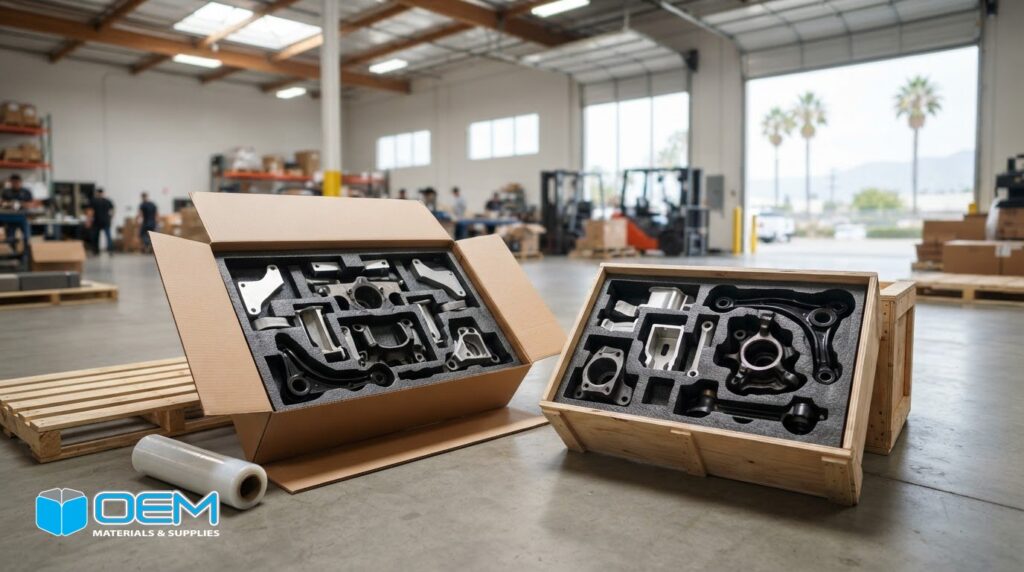
A part that shifts in transit can arrive scratched, bent, or out of position, even when the outer carton is intact. Effective dunnage for automotive parts shipping is designed around the component and its route, not added as generic filler after the box is selected.
Automotive teams need packaging that protects parts through handling and supports a consistent packing process. Too little restraint can allow components to move or contact one another. Too much packaging can add material, labor, and storage demands without improving protection.
This guide explains how to match dunnage to part geometry, weight, surface sensitivity, shipping conditions, and handling requirements. It also covers how foam inserts, cushioning materials, corrugated boxes, and crates can work together as a packaging system. You’ll learn which details help shape a practical design, from part orientation and shipment frequency to the packing workflow.
With a well-planned design, dunnage becomes a repeatable part of shipping that protects components and fits production needs. OEM Materials & Supplies develops custom packaging solutions, including prototypes and packaging for short runs and higher-volume operations.
Key Takeaways
- Use dunnage for automotive parts shipping to control movement and reduce contact, abrasion, and handling issues.
- Consider a component’s dimensions, weight, center of gravity, projections, and contact surfaces when planning support and restraint.
- Compare expendable and returnable systems based on shipment frequency, return logistics, packing labor, storage, and part requirements.
- Gather part details, shipment routes, and handling conditions before creating samples and refining a design.
- Coordinate inserts and cushioning with the outer box or crate and the packing workflow for a more repeatable system.
What Dunnage for Automotive Parts Shipping Does Beyond Filling Empty Space
Without adequate restraint, an automotive component can shift, hit another part, or rub against the packaging. That movement can cause surface abrasion, damage a projection, or make the load harder to handle consistently at receiving. Dunnage helps manage these risks by controlling how each component sits and moves inside its package.
Dunnage is material or a structure used to position, separate, cushion, or secure products during shipping. It includes more than loose filler. For automotive packaging, dunnage can take the form of shaped supports or dividers that hold a part in a planned orientation. The general shipping use of the term is described in What is Dunnage?
Shipping dunnage is different from warehouse storage racks. Racks support inventory in a storage or handling area; dunnage travels with the product and helps protect and locate it inside an outbound package or load. It is also different from generic void fill. Loose fill may occupy open space, but it may not hold a component in a repeatable position or prevent parts from contacting one another.
Which automotive parts commonly need dedicated dunnage?
Machined components, multi-part assemblies, and finished parts can all need different kinds of support. A machined surface may need separation from adjacent parts to limit contact. An assembly with projections may need a stable resting position that avoids pressure on those features. The part’s contact points, exposed surfaces, orientation, and shape determine where support and separation are useful.
A defined position can also make packing and unloading more consistent. When a part has a designated space, packers have a clear placement reference and receiving teams can remove it without sorting through loose material. The design still needs to suit the specific component. Parts in the same product family may have different support requirements.
What does dunnage need to control during transit?
Dunnage for automotive parts shipping can address several distinct concerns. Movement is unwanted shifting within the package. Impact occurs when a part or package receives a sudden force. Vibration can cause repeated movement, while abrasion occurs when surfaces rub against one another or against the packaging. Part-to-part contact is another concern when components share a container.
The protection needed depends on the part and its shipping conditions, including the route and expected handling. A design intended to cushion impact may not position the part or prevent contact on its own. Packaging design can coordinate these functions with the outer container, using foam inserts, cushioning, or corrugated dividers where appropriate. OEM Materials & Supplies provides custom packaging design to help coordinate these elements.
How Part Geometry and Shipment Conditions Shape Automotive Dunnage Design
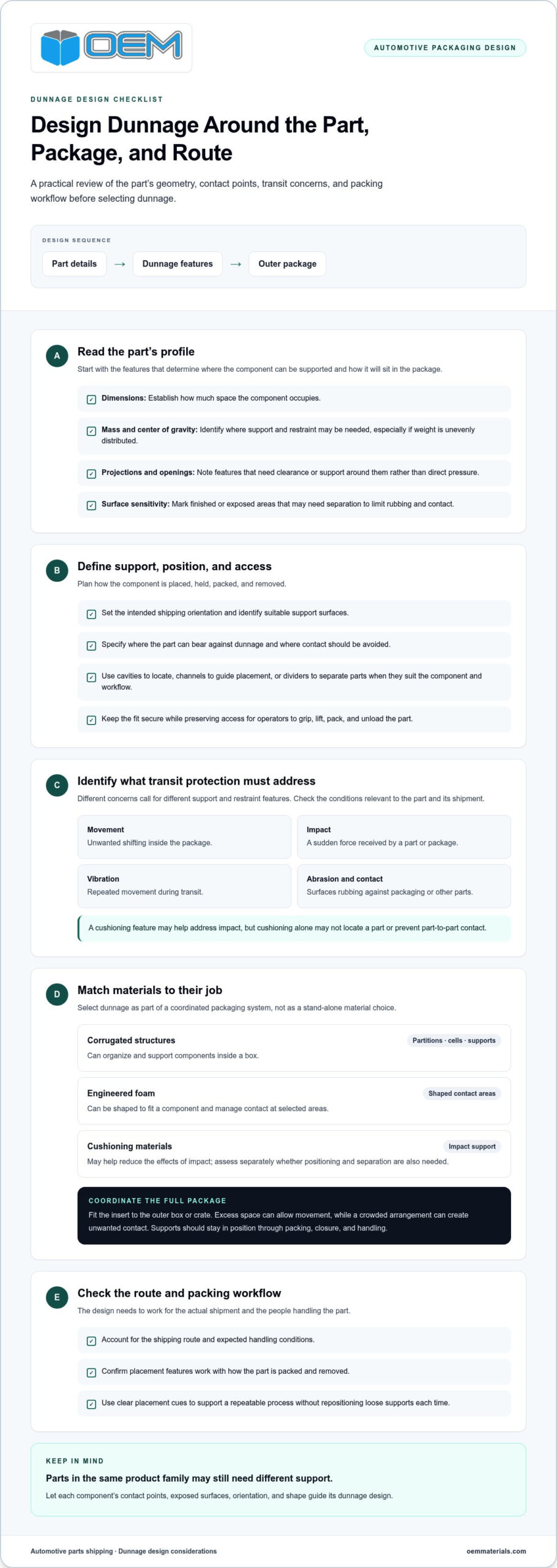
Dunnage design starts with the part, then accounts for the package and the route. Dimensions show how much space the component occupies, while mass and center of gravity help identify where support and restraint may be needed. A part that is heavier at one end, for example, may not remain stable if it rests on a broad surface that does not support it in the right place.
Projections, openings, and exposed contact surfaces add design constraints. A bracket with a protruding feature may need support around that area rather than directly beneath it. A finished component with a surface sensitive to rubbing may need separation from nearby parts and package walls. The design should specify where the part can bear against the dunnage and where contact should be avoided.
Map contact points, orientation, and support areas
Identify the intended support surfaces and the areas that need to remain clear. Then define the part’s shipping orientation. Cavities can locate a component, channels can guide placement, and dividers can separate multiple parts. These features work only when they match the actual packing and removal process.
Plan for handling access as well. A secure fit should not make it difficult for an operator to grip or lift the part during packing and unloading. Clear placement cues help make the process repeatable without requiring packers to reposition loose supports each time.
Match dunnage materials to the packaging system
Different materials perform different jobs. Corrugated structures can form partitions, cells, or supports inside a box. Engineered foam can be shaped to fit a component and manage contact at selected areas. For an overview of foam insert design, see this guide to foam packaging. Cushioning materials can help reduce the effects of impact, but cushioning alone may not locate a part or prevent part-to-part contact.
Choose materials based on the component and shipment conditions, not on a single material’s label. An insert may position a part while the outer container protects and contains the packed load. The fit between the two matters: excess space can allow movement, while a crowded arrangement can create unwanted contact.
A corrugated box can serve as the outer container for many components, with internal supports holding parts in position. A wood crate can be used when the configuration calls for one. In either case, design the dunnage and outer package together so the supports stay in position through packing, closure, and handling.
Useful starting details for a design discussion include a part drawing or sample, its weight and preferred orientation, sensitive surfaces, and the planned shipment route. OEM Materials & Supplies develops packaging concepts and prototypes that coordinate inserts or supports with the outer container and packing workflow.
Expendable or Returnable Dunnage: Compare the Shipping Workflows
The choice between expendable and returnable dunnage depends on shipment patterns and the work required to manage packaging after delivery. A one-way package travels with the part to its destination. A returnable system adds steps for collecting, inspecting, storing, and redeploying packaging. Neither approach is automatically simpler or more suitable.
Compare these operating requirements before selecting a format for dunnage for automotive parts shipping:
| Consideration | Expendable system | Returnable system |
|---|---|---|
| Shipment frequency | Can suit shipments that are irregular or do not follow a repeat lane. | Can be evaluated for recurring shipments between known locations. |
| Return logistics | Does not depend on packaging traveling back to the shipper. | Requires a defined collection and return process. |
| Packing labor | May involve preparing and disposing of packaging for each shipment. | Requires packing as well as inspection and preparation for reuse. |
| Storage | Requires space for supplies before use and handling after unpacking. | Requires space for empty packaging awaiting use, return, or redeployment. |
| Part requirements | Can be configured around a particular shipment and its destination. | Must suit repeated use and the actual part-handling process. |
When a one-way packaging system may fit the shipment
Consider the destination, shipment pattern, packaging recovery options, and space at the packing station. If parts go to varied destinations or packaging is unlikely to return through an established route, a one-way configuration may fit the workflow. That does not make it automatically easier: teams still need to source, stage, assemble, and handle the packaging consistently.
Corrugated packaging can pair an outer box with internal dunnage for a shipment-specific arrangement. The box and its interior supports should work together so the package can be packed and closed as intended. Material use and operating results depend on the part, design, and shipping requirements, so do not assume one-way packaging is always the lowest-cost choice.
When a return loop deserves evaluation
A returnable approach merits review when shipments move repeatedly along a defined lane and the receiving point can participate in packaging recovery. Map who collects containers, coordinates their return, inspects them, stores them, and prepares them for the next shipment. If responsibilities are unclear, the loop may add work or leave packaging unavailable when needed.
Compare the actual operating steps, not just the packaging materials. A reusable configuration must suit the part and fit the logistics process, including available space for empty units and the inspection required before reuse. Its environmental or financial effect depends on the full system and should not be assumed.
OEM Materials & Supplies helps evaluate packaging options based on part and shipping requirements. Include the shipment pattern and return process when requesting a packaging quote so the design discussion reflects the operation as well as the container.
A Practical Process to Specify and Validate Dunnage for Automotive Parts
A repeatable design process turns part and shipment requirements into packaging that can be evaluated before it becomes a standard packing method. For dunnage for automotive parts shipping, start with accurate part information, document operating conditions, and use sample packing to identify where the design needs refinement.
Prepare a useful packaging design brief
Gather a part drawing or dimensions, weight, quantity per shipment, and preferred orientation. Add notes about sensitive surfaces, projections, current damage concerns, and how the part is handled during packing and unloading. Include shipment destinations, route, expected handling conditions, production volume, and constraints such as available packing space or the outer container in use.
With those details, follow a clear sequence:
- Define the protection needs. Identify areas that need support, separation, or cushioning, as well as surfaces and features that should avoid contact.
- Document the current workflow. Record how operators position parts, add packaging, close the container, and access the parts at receiving. Note steps that vary between packers or require extra handling.
- Develop a packaging concept. Coordinate the dunnage with the outer box or crate and the way the package is handled. OEM Materials & Supplies supports engineering and prototype development through custom packaging design.
- Pack representative samples. Use the proposed configuration with the actual part and intended packing sequence. Check whether parts settle into the intended position and whether packers can load and remove them without unnecessary repositioning.
- Review and refine. Compare trial observations with the original requirements. Adjust supports, separation, orientation cues, or package arrangement if the trial shows movement, contact, difficult access, or inconsistent packing.
Use packing trials to refine the design
During representative trials, record whether parts stay positioned and separated through the handling included in the evaluation. Observe visible contact or movement, packing time, consistency between packers, and access during unloading. Note material-handling issues too, such as inserts that shift during loading or make the component harder to remove.
Keep results tied to the conditions tested. A trial provides project-specific evidence for comparing and improving a design, not a guarantee of performance across every route or handling environment. If the shipment pattern or packing process changes, review whether the packaging still fits.
Prepare part dimensions, weight, orientation, surface sensitivities, shipment route, and expected handling conditions to start a design discussion. Request a quote for automotive packaging and share the details needed to assess a prototype or refine an existing configuration.
Build an Automotive Dunnage Solution Around the Full Packaging Operation
Dunnage is one part of a larger packaging process. The outer container, internal supports, packing sequence, and material supply all affect how a component moves from the production floor to its destination. Plan these elements together to account for the handoffs between packing, staging, and shipping, rather than treating the insert as a standalone item.
Coordinate packaging components and production needs
A corrugated box can provide the outer structure, with foam inserts or cushioning materials inside. For configurations that call for a crate, consider how it works with the internal supports and how the packed load will be handled. The components should fit the available packing space and the operation’s closure, staging, and shipping steps.
Map the packing sequence at the workstation. Identify where each material is stored, who assembles the package, and how the completed unit moves to shipping. This can reveal process issues, such as packaging components staged separately or instructions that allow inconsistent assembly. Addressing those handoffs in the packaging plan can make the workflow clearer for operators.
Packaging design can account for the container, dunnage, and packing process together. Defining how the package is assembled and replenished also gives purchasing, engineering, and operations teams a shared basis for managing changes to parts or shipping requirements.
Plan for supply continuity and next steps
Kitting and assembly can be part of the packaging workflow, particularly when multiple components need to be prepared for packing. Vendor-managed inventory can support packaging supply planning around a program’s usage and replenishment needs. The right arrangement depends on the operation, including how materials are stored, released, and used at the workstation.
For manufacturers in Orange County, Los Angeles, San Diego, and Riverside, coordinating packaging design and supply planning can support regional operations. OEM Materials & Supplies also serves customers across the United States, which is relevant for programs involving facilities or shipping lanes beyond Southern California.
To discuss dunnage for automotive parts shipping as part of your packaging operation, gather the part dimensions, weight, quantity per shipment, annual usage, shipment destinations, and handling details. Include current packing constraints or material-supply concerns. Request a quote for automotive packaging to start a project discussion based on your parts and operation.
Keep Your Packaging Plan Aligned With Operations
A packaging design should stay connected to the conditions it was built for. When part revisions, shipment destinations, or packing procedures change, review whether the existing dunnage for automotive parts shipping still fits the operation. Assigning responsibility for that review can help teams catch mismatches, such as a revised component no longer seating properly or a new route changing how packages are handled.
Use feedback from packing and receiving teams to guide those reviews. Their observations can show where the process needs clearer placement instructions, easier access, or an updated packaging configuration. This keeps design decisions grounded in actual work rather than assumptions.
Bring your part dimensions, weight, annual usage, and shipment details to the next step. OEM Materials & Supplies can use that information to discuss a packaging approach suited to your automotive operation. Start your automotive packaging quote with the details needed to move toward a practical design plan.
Frequently Asked Questions
Can dunnage prevent automotive parts from shifting during shipping?
Properly designed dunnage can help restrain a part, but it cannot guarantee that shipping damage will not occur. A package may still be affected by conditions beyond the dunnage’s role. Evaluate the complete packed unit under handling representative of its route, including normal loading and unloading. For dunnage for automotive parts shipping, record where movement or contact occurs and adjust the design based on the evaluation.
Is foam or corrugated dunnage better for automotive parts?
Neither is universally better. The right choice depends on the component and the work required at the packing station. Compare concepts based on how clearly they guide placement, how easily packers can follow the sequence, and how practical the materials are to replace or replenish. A mixed approach may also work. Evaluate the complete setup with the actual part and packing steps before selecting a standard configuration.
Can automotive dunnage be designed for different parts in one shipment?
Yes, a package can accommodate a planned mix of components. Create a packing map that identifies each part’s assigned position and intended removal sequence. This is especially useful if one item needs to be accessed before another or if similar-looking parts could be confused during unloading. Account for part variations and shipment quantities so the layout reflects the actual mix instead of relying on operators to improvise.
Does dunnage replace the outer shipping box or crate?
No. Dunnage supports the arrangement of items inside a package, while a box or crate forms its outer enclosure. The outer container also provides surfaces for closure and shipping labels, so those tasks should remain practical in the finished design. For example, an insert should not obstruct access needed to close the package or apply its label. Select the container based on the complete shipment configuration.
What information is needed to design dunnage for an automotive component?
Provide dimensions, weight, quantity per shipment, preferred orientation, and details about surfaces that need careful handling. Include the current packing method, destinations, and production volume. If a component has multiple versions, identify the differences and indicate which versions ship together. Drawings, photographs, or a sample can clarify features that are difficult to describe with measurements alone. Tie the information to the specific part and shipment program.
How can a manufacturer tell if its current dunnage is excessive?
List each packaging element and the job it is meant to perform. If its purpose is unclear, review the packing process with operators and observe how the part is positioned, handled, and removed. For a controlled evaluation, change one element at a time and document any effect on packing steps, movement, contact, or access. Do not remove material solely to reduce quantity; confirm that the revised arrangement still meets the shipment’s needs.