

Packaging itself isn’t IATF 16949 certified. A supplier’s quality management system may be certified, while packaging controls help support automotive quality requirements. That distinction matters when evaluating IATF 16949 compliant packaging solutions: the goal is packaging specified for the part, process, and customer requirements, not a certification claim about the box or cushioning.
Automotive buyers know that packaging variation can lead to part damage, handling problems, or production disruption. The challenge is turning customer-specific requirements into specifications a packaging supplier can consistently produce and manage. This guide explains how to define fit-for-purpose requirements, review supplier process evidence and change communication, and prepare an RFQ that supports a useful recommendation.
We’ll cover packaging details that affect protection and handling, including product dimensions, weight, shipping conditions, and program volume. You’ll also learn how to specify packaging components, labeling, and delivery so requirements are clear from the start. The result is a practical framework for aligning packaging decisions with your automotive quality processes.
Key Takeaways
- Define packaging requirements using part dimensions, weight, fragility, surface sensitivity, orientation, and handling constraints.
- Evaluate IATF 16949 compliant packaging solutions by how well their design and supply controls support documented customer requirements.
- Separate evidence of a supplier’s process controls from claims about formal quality system certification.
- Plan sample reviews and handling trials around actual packing methods and distribution conditions before releasing work instructions.
- Build an RFQ with product and program details so recommendations can account for protection, production handling, and supply coordination.
What IATF 16949 Means for Automotive Packaging Solutions
Automotive packaging needs to fit the part, the production process, and the customer’s requirements. A box that protects a component in transit can still cause problems if parts are difficult to handle, shift in storage, or arrive in a configuration that differs from the approved packing method. When evaluating IATF 16949 compliant packaging solutions, distinguish the quality system behind a supplier’s work from the packaging itself.
What the standard does and does not certify
IATF 16949 is an automotive quality management system standard. Its formal scope describes quality management system requirements for automotive production and relevant service parts organizations. It focuses on how an organization manages processes to meet customer and applicable requirements, prevent defects, and support continual improvement. The IATF 16949 Wikipedia overview provides general background on the standard’s history and role in the automotive supply chain.
Certification applies to an organization’s quality management system within its defined scope. It does not certify an individual corrugated box, foam insert, or crate as “IATF compliant.” Packaging is designed and controlled against applicable product, process, and customer requirements. Any statement about a supplier’s certification should be supported by evidence of its actual scope, not inferred from the materials it provides.
Quotable distinction: “IATF 16949 certification applies to an organization’s quality management system, while packaging is specified and controlled to meet the buyer’s applicable requirements.”
Why packaging still matters to automotive quality
Packaging affects how parts are protected, handled, stored, and delivered. A fitted insert can help limit part movement, while a defined orientation can make loading and unloading more consistent. Design should account for surface sensitivity, how parts are picked up, and the conditions they encounter along the distribution route. For example, a component with a finished surface may need separation from adjacent parts to reduce contact during handling.
Repeatability is central to a controlled process. If package dimensions, component placement, or packing instructions vary from shipment to shipment, receiving teams may encounter different footprints or need to adjust how parts are unpacked. Clear specifications and work instructions communicate the approved configuration. If buyers have traceability expectations for packaging, labels, records, or revisions, state them explicitly and manage them through the applicable customer documentation.
For automotive programs in Los Angeles, Orange County, Riverside, and San Diego, packaging recommendations should reflect the actual part and operating conditions, not generic assumptions about automotive packaging. For components needing tailored cushioning, foam packaging design can be considered alongside handling and shipping requirements.
The practical goal is controlled packaging performance within the buyer’s process. Define what the package must protect, how it will be used, and which customer requirements apply. This gives procurement, engineering, and operations a shared basis for specifying packaging without confusing product suitability with quality-system certification.
Translate Automotive Quality Requirements into Packaging Specifications
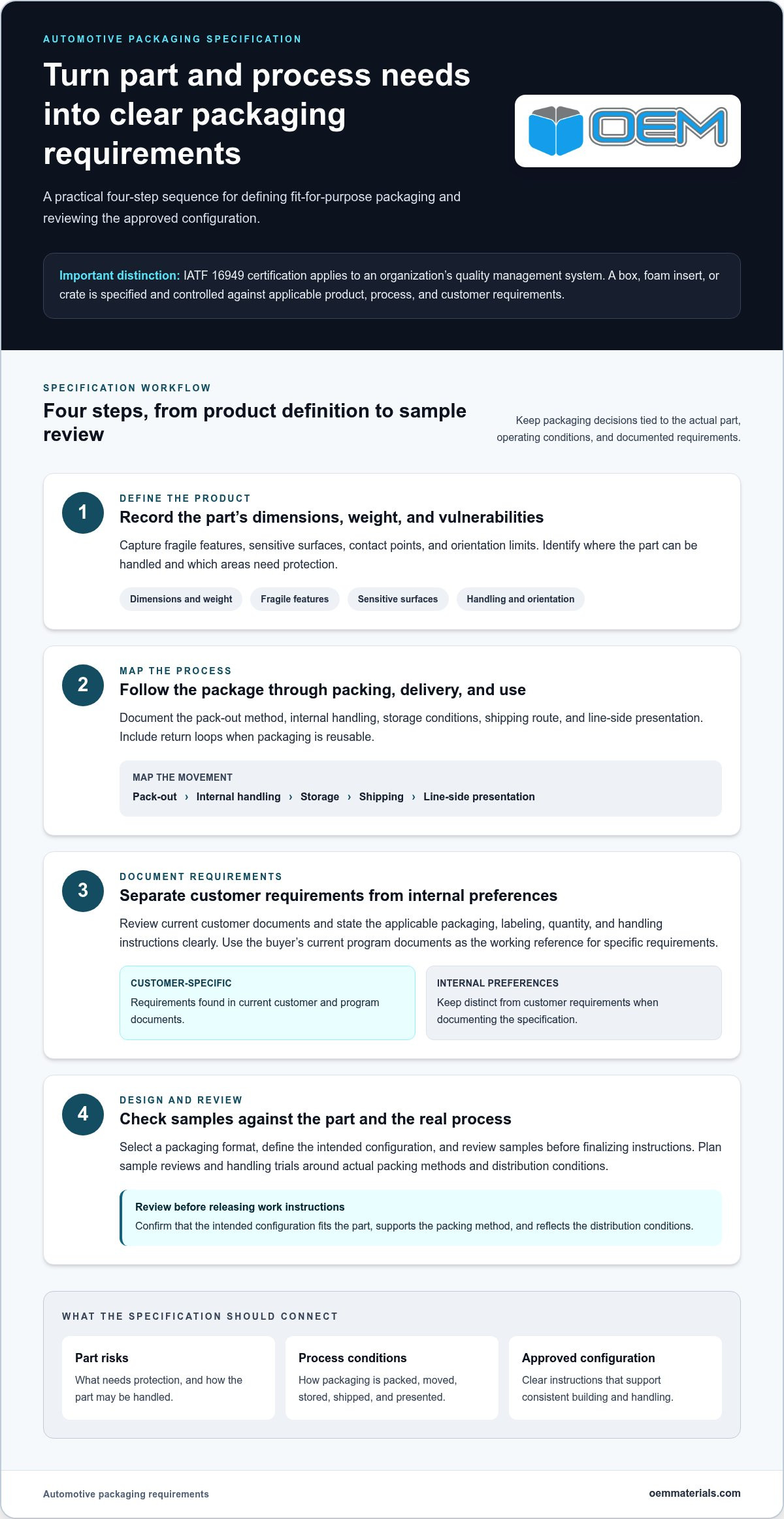
A useful packaging specification turns quality and customer requirements into instructions that engineering, purchasing, production, and suppliers can apply consistently. Start with the part and its risks, then map how it moves through packing, storage, shipping, and use at the receiving line. This keeps packaging decisions tied to actual operating conditions rather than assumptions.
- Define the product. Record dimensions, weight, fragile features, sensitive surfaces, contact points, and orientation limits. Identify where the part can be handled and which areas need protection.
- Map the process. Document the pack-out method, internal handling, storage conditions, shipping route, and line-side presentation. Include return loops if packaging is reusable.
- Document requirements. Separate customer-specific requirements from internal preferences. Review current customer documents for packaging, labeling, quantity, and handling instructions. The Official IATF Website provides access to IATF resources; the buyer’s current program documents remain the working reference for specific requirements.
- Design and review. Select a packaging format, define the intended configuration, and review samples against the part and process before finalizing instructions.
A usable packaging specification connects product risks to clear design inputs, so the approved package can be built and handled consistently.
Build a packaging brief around the part and process
Describe what the packaging must do, not just what it should be made from. Identify vulnerable features, surfaces that must not touch, acceptable movement, and the points where operators will lift or position the part. State pack quantity, orientation, unitization, and line-side presentation needs. For example, if operators must access parts in a fixed orientation, specify the arrangement and how it should be maintained during packing and delivery. These inputs guide custom packaging design and give reviewers a clear basis for evaluating samples.
Select materials and formats for the application
Choose materials according to the part, handling method, and shipping conditions. Corrugated packaging can provide an outer container and organize a shipment; engineered foam can separate or support parts inside it. Crates may suit applications that call for a more substantial enclosure. A combined system, such as a corrugated box with a fitted foam insert, can address both containment and part separation. The right configuration depends on the product and distribution conditions, not on material alone.
Specify design inputs that can be reviewed, including package dimensions, pack quantity, orientation, and component arrangement. For a tailored recommendation, share part dimensions, weight, annual usage, and shipping conditions through the packaging quote request. Clear inputs help shape IATF 16949 compliant packaging solutions around the program’s actual requirements.
How to Evaluate Packaging Suppliers and Their Process Evidence
A packaging supplier review should assess fit with the part, production process, and supply program. Don’t treat a certification claim as a substitute for evidence of how specifications are developed, communicated, and maintained. For IATF 16949 compliant packaging solutions, review working controls alongside any formal quality-system credentials your program requires.
Design capability: Can the supplier translate part geometry and handling needs into a defined packaging configuration? Look for clear design inputs and documented specifications.
Material fit: Can the proposed materials and format address the part’s protection needs and shipping conditions? Recommendations should relate to the application, not rely on a generic material preference.
Sample support: Can the supplier support prototypes or samples for review before production release? Agree on how feedback and revisions will be recorded.
Communication: Are specification changes identified and shared with the people responsible for approval and use? Establish how the current revision is distinguished from superseded versions.
Supply coordination: Can the supplier coordinate deliveries with the program’s consumption and inventory approach? Discuss vendor-managed inventory support when continuity is a concern.
Supplier review checklist: Compare design capability, material fit, sample support, revision control, communication, and supply coordination against your program’s documented needs.
Questions that reveal packaging program fit
Ask how recommendations account for part geometry, shipping conditions, and production handling. A useful discussion connects design choices to the package’s intended use and identifies the information needed to develop samples. Clarify how feedback is recorded, drawings or specifications are updated, and the approved version is communicated before production. These details help show how a packaging program can support prototypes and ongoing production.
Compare documentation and supply support
Work with your quality and purchasing teams to define the records the program needs. Depending on customer instructions, these may include drawings, specification revisions, sample approvals, or delivery records. Requesting documents without a program basis can add process burden without improving control. Set clear expectations for who reviews changes, how customer approval is captured when required, and how the released specification reaches production and receiving teams.
Formal certification and process evidence answer different questions. Certification, if required, concerns an organization’s quality management system and its defined scope. Process evidence helps your team understand how the supplier manages packaging specifications, revisions, and communication for the work at hand. Review certification claims against relevant documentation and assess packaging controls separately. A supplier’s certification alone doesn’t establish that a particular design meets your part or customer requirements.
For automotive programs in Los Angeles, Orange County, Riverside, and San Diego, align requested records with current customer documents and internal procedures. Then compare suppliers against the same criteria, focusing on program fit rather than broad claims. This gives teams a practical basis for discussing design collaboration, approvals, and supply coordination before packaging enters the operating process.
Plan Packaging Validation, Launch, and Change Control
A packaging design isn’t ready for routine use simply because a sample fits the part. The launch process should confirm that the configuration works for packing, handling, and distribution, then establish how instructions and revisions will be controlled. Define review steps with the buyer’s quality, engineering, operations, and purchasing teams so decisions are recorded through the program’s established process.
- Review requirements. Confirm current customer documents, the packaging specification, acceptance criteria, and approval responsibilities.
- Develop samples. Build samples to the proposed design and packing method, including the intended product orientation and pack quantity.
- Evaluate handling. Trial the package in conditions that reflect actual pack-out, internal movement, storage, and distribution route.
- Approve revisions. Record observations, decisions, and required design changes. Route revisions to designated reviewers before release.
- Release instructions. Provide the approved specification and packing instructions to the teams responsible for production, receipt, and replenishment.
Use samples and trials to evaluate fit
Set trial criteria before evaluating the sample. Review part fit, contact points, protection, pack-out sequence, and ease of handling. Use the specified orientation and loading method, and consider the actual distribution route rather than testing only at the packing station. Record observations against agreed criteria. For example, note whether the part stays in its intended position and whether operators can follow the documented packing sequence.
Acceptance criteria should reflect the product and customer program. Avoid broad impressions such as “looks secure.” Record the result, any issue found, the disposition decision, and whether another sample or review is needed. Keep the record within the buyer’s established quality process.
Control revisions through the supply relationship
Agree on who can request, review, and approve changes to dimensions, materials, pack quantity, or pack-out instructions. A proposed change should be clearly distinguished from the currently approved version, with its status communicated to the people who order, produce, pack, and receive the materials. This helps prevent teams from working from conflicting specifications.
Plan the transition as well. Identify affected packaging inventory and decide how it will be handled according to the buyer’s procedures and customer direction. If old and revised packaging are both present without clear status, operators may use the wrong configuration or receiving teams may encounter inconsistent shipments. Coordinate delivery and inventory plans around the approved revision and program needs.
OEM Materials & Supplies supports packaging design and supply programs for automotive manufacturers. To discuss a sample, prototype, or packaging revision, request a packaging quote with part dimensions, weight, annual usage, and shipping conditions. These project inputs help develop IATF 16949 compliant packaging solutions for the intended application.
Build an IATF-Aligned Automotive Packaging Program with OEM Materials & Supplies
Packaging should support the controls and requirements defined by your automotive program. OEM Materials & Supplies works with manufacturers on packaging design and supply, connecting part protection, production handling, and shipping needs to practical packaging choices. The role is to support the packaging program, not certify a supplier’s quality management system or declare a package IATF-certified. Buyers remain responsible for applying their quality processes and customer requirements.
That distinction keeps sourcing discussions focused. IATF 16949 compliant packaging solutions are developed around documented application needs and managed through the buyer’s required approval and change processes. The package is specified for its intended use, with a design, handling instructions, and supply arrangement suited to program requirements.
Match packaging support to program requirements
OEM Materials & Supplies supports packaging programs with corrugated boxes, foam packaging, crates, kitting, assembly, and supply services. Custom packaging design can coordinate format and materials around part geometry, handling, and distribution conditions. For components that need cushioning or separation, foam packaging options can be considered as part of the broader design. The recommended configuration depends on the application rather than a one-size-fits-all package.
Program scale matters, too. OEM Materials & Supplies supports prototypes, short runs, and high-volume programs, so packaging discussions can account for different stages of a product or supply program. A prototype can help teams review a proposed format, while production planning can address recurring material needs and coordination with packing operations. Kitting and assembly can also support workflows that use coordinated components.
Prepare a useful request for quote
A clear packaging brief gives the design and supply discussion a practical starting point. Include:
- Part dimensions, weight, fragile features, and surface sensitivities
- Annual usage and current packaging, including known limitations
- Shipping conditions, route, and storage requirements
- Pack quantity, orientation, and line-side handling needs
- Applicable customer-specific requirements and current reference documents
These details connect a recommendation to how the part is packed, transported, received, and used. Drawings, photos, or an existing package can add useful context. Include known approval steps or sample review needs so the proposed packaging can be evaluated within the program’s process.
OEM Materials & Supplies serves automotive manufacturers in Orange County, Los Angeles, Riverside, and San Diego, and supports programs across the United States. To request a tailored recommendation, request a packaging quote with part dimensions, weight, annual usage, current packaging, and shipping conditions. A complete brief helps focus the discussion on packaging fit, production handling, and supply requirements.
Put Your Packaging Program on a Clear Path
Make packaging ownership part of program planning, not an afterthought at launch. Give the approved packaging brief a clear place in your team’s working process, and use it to coordinate engineering, purchasing, operations, and supplier discussions as requirements evolve. A shared reference helps keep decisions tied to the part and its intended use.
OEM Materials & Supplies works with automotive manufacturers on IATF 16949 compliant packaging solutions tailored to program needs. Share your current packaging challenge, target application, and available part information to start a focused discussion about a practical path forward.
Request a packaging quote with part dimensions, weight, annual usage, and shipping conditions. These details give the team a useful starting point for evaluating the application and preparing a relevant recommendation.
Frequently Asked Questions
Is IATF 16949 a certification for packaging materials?
No. Packaging materials aren’t certified to IATF 16949. A buyer may set material properties or documentation requirements for a particular application, and a supplier may provide supporting technical information when requested. That information addresses the material or package, not certification to the automotive quality management standard. Keep material documentation, package acceptance criteria, and organizational certification records distinct in purchasing and quality files.
Can a packaging supplier support an IATF 16949-certified automotive manufacturer without being IATF-certified?
Yes, if the manufacturer’s supplier approval process and applicable customer requirements permit it. The manufacturer can define how packaging suppliers are evaluated based on their role in the program, then apply its own controls to the purchased packaging. A useful sourcing discussion clarifies the supplier’s scope of work, the records the buyer needs, and how packaging issues will be escalated through the buyer’s established process.
What packaging information should automotive buyers include in a supplier request?
Identify the part number and drawing revision so the supplier can distinguish the item from similar components. If the request covers multiple parts, clarify which ones share a package and which need separate configurations. Include an image or an example of the current pack when available, and describe the problem prompting the review, such as difficult unpacking or damage found at receipt. This context helps prioritize the design discussion.
How can automotive manufacturers evaluate packaging samples before production?
Use representative parts and involve the people who normally pack or handle them. Check whether the proposed method can be repeated consistently, not just completed successfully once by the designer. Compare the packed result with the approved sample and note variation in placement, closure, or part count. If results differ among operators, investigate whether the design or work method needs clarification before production release.
Does ISO 9001 replace IATF 16949 for an automotive supplier?
No. IATF 16949 is used in conjunction with ISO 9001 and adds automotive-sector quality management requirements. An ISO 9001 certificate alone doesn’t demonstrate conformity to IATF 16949. For sourcing decisions, distinguish which standard applies to the supplier’s role and certification scope, and use current customer and program requirements to determine what evidence is relevant. This avoids treating a general quality credential as automatic approval for an automotive program.
What records should a packaging supplier provide for an automotive program?
The records depend on the program’s documented requirements. Before requesting files, define which records the supplier creates, which approvals remain with the buyer, who maintains the controlled copy, and how the buyer will access it when needed. This division helps prevent duplicate or conflicting records. An internal record matrix can identify owners and intended use without assuming every packaging program needs the same documentation.
How should packaging changes be managed after a specification is approved?
Apply the same change process to supplier-proposed and buyer-requested revisions. A supplier suggestion is not an approved production change; route it to designated decision-makers and document its disposition. If an urgent issue arises, use the program’s established deviation process rather than relying on an informal email or verbal agreement. This gives purchasing, quality, and operations a shared record of what is authorized and when it applies.