

The fastest fix to a packaging problem isn’t always a faster machine. If packing steps consume labor, materials vary, or damage and stockouts interrupt shipments, the constraint may be in the workflow, package design, or replenishment plan. The most useful packaging process improvement ideas start with observable process data, not assumptions about which change should come first.
A change that improves speed but increases handling or product damage can create a new bottleneck. This checklist helps you locate where time, rework, or inventory interruptions occur, compare process, material, and supply improvements, and prioritize changes you can measure. It also explains when right-sized corrugated boxes, protective foam, crates, kitting and assembly, or coordinated replenishment may suit the product and shipping requirements. Test improvements against your operation’s actual constraints before committing to a broader change.
Key Takeaways
- Use symptoms such as rework, excess handling, material waste, and stockouts to identify the type of packaging problem.
- Map the workflow and track pack time, material use, damage, rework, and supply interruptions before selecting a change.
- Compare packaging process improvement ideas by the problem each option addresses, its tradeoffs, and the measure you’ll use to evaluate it.
- Pilot one change within a defined product family, station, or workflow, then review results before standardizing the process.
- Align packaging design and replenishment with the actual workflow, product, and shipping requirements to support a more reliable operation.
Packaging Process Improvement Ideas Start with the Operational Problem
Start with the symptoms on the floor. Are shipments arriving damaged? Are employees repacking orders, making avoidable trips for supplies, discarding excess material, or waiting for packaging stock? These symptoms point to different constraints. Identify where the process is breaking down before changing the box or adding equipment.
- Damage: Products shift, break, or arrive with visible package damage.
- Rework: Staff correct packing errors, replace packaging, or rebuild shipments.
- Excess handling: Products or materials move repeatedly between storage, preparation, and packing.
- Material waste: Packaging is cut down, discarded, or used in excess to fill or protect a shipment.
- Stockouts: Packing slows or stops because required materials aren’t available at the station.
Packaging process improvement means changing materials, methods, or supply flow to address a measured operating problem. These elements affect one another. A package designed for stronger protection may take longer to assemble, while a faster packing method may increase damage if it removes needed cushioning. Evaluate product protection, throughput, labor, and supply continuity together.
Classify the likely cause before choosing a fix. A product that moves inside a box may need a design change, such as corrugated packaging paired with foam when the product and shipping conditions warrant it. Repeated searching or awkward reaches point instead to workstation setup, staging, or training. If materials aren’t reaching the station when needed, investigate replenishment. Packaging engineering considers both design and production, a useful reminder that package performance depends on more than material selection alone.
Which packaging bottleneck is costing the operation attention?
Observe a shipment from material staging through handoff. Note repeated repacking, waits for supplies, searches for tools or materials, excess walking, and unnecessary product handling. Record where each delay occurs and what happened immediately before it. That sequence can distinguish a station-level issue from a recurring design or supply problem.
Separate product damage from packing errors and carrier-related damage. A packing error may involve an incorrect box or a missed protection step. Damage despite consistent packing may call for a closer review of package design or shipping conditions. Record what is known at each handoff instead of assigning a cause based only on the final appearance.
Set a baseline before changing the process
Record material use, time spent packing, rework, damage reports, and replenishment interruptions. Compare like with like: similar products, order types, shifts, and shipping conditions. A change in product mix can distort the result, so note the circumstances around each observation.
Use your operation’s baseline rather than an unsupported industry benchmark. If supply interruptions are the constraint, evaluate coordinated replenishment alongside workflow changes. OEM Materials & Supplies supports packaging supply programs through just-in-time packaging delivery, which can be part of a defined supply-continuity improvement.
Measure the Packaging Process Before Choosing an Improvement
A visible problem points to where to investigate, but it doesn’t show which change will help. Use a repeatable sequence: map the workflow, observe actual work, measure the suspected constraint, identify its cause, then select a bounded test. This keeps packaging process improvement ideas tied to operating evidence rather than assumptions or a push to change several things at once.
A documented baseline makes before-and-after comparisons more useful because it shows how the process performed before the change. Without that reference, a faster pack time could reflect a simpler order mix, a different shift, or a change in shipping requirements rather than the improvement being tested.
Map the current packing workflow
Trace the product, packaging materials, work instructions, and completed shipment through the operation. Include warehouse staging and replenishment, not just the packing bench. Mark handoffs, waits, duplicate handling, and points where operators leave the station to retrieve materials or resolve questions. The map should reflect the work as performed, including exceptions, not only the intended standard process.
Then observe representative orders from start to shipment handoff. Note where work pauses and what is happening at that point. A wait for a box differs from a pause to verify the packing method; each suggests a different constraint and requires a different test.
Choose measures that reflect the actual constraint
Track a small set of indicators tied to the problem. Define each measure consistently, including when timing starts and stops and what counts as rework or a stock interruption. Record the observation period, product mix, order type, shift, and relevant shipping conditions so the comparison uses a comparable group of work.
- Pack time: Time the same defined task or order type from the same start and end points.
- Material consumption: Record packaging used for comparable completed orders, including discarded or replaced material where practical.
- Rework and damage: Log packing corrections and damage reports separately, with details about when and where each issue was identified.
- Stock interruptions: Note when needed materials are unavailable, how the interruption affects work, and which item is involved.
Separate observed facts from explanations. “The operator left the station to retrieve a box” is an observation; “the layout caused the delay” is a hypothesis to test. Compare equivalent work before and after a change. If product mix or shipment requirements shift, record that difference instead of treating every change in the result as a packaging effect.
Once the constraint and baseline are clear, select one change that directly addresses it and define what result would support keeping it. If packaging design is part of the test, product dimensions, weight, packing method, and shipping requirements help frame the evaluation. Project requirements can be organized through a packaging project review.
Compare Packaging Process Improvement Ideas by the Problem They Solve
Once the constraint is clear, compare options by the problem they target, the result you can test, and the tradeoff they introduce. A machinery purchase isn’t the default answer. Repositioning supplies, clarifying work instructions, or changing a package may address the measured issue with less disruption. The most useful packaging process improvement ideas fit the operation’s product mix and workflow.
Excess reaching or walking
Candidate change: Reposition materials or tools at the station.
Benefit to test: Fewer trips and less movement during packing.
Tradeoff: The revised layout must still support safe access and replenishment.
Measure: Operator travel, interruptions, or task time.
Confusing material variation
Candidate change: Standardize materials for comparable orders where requirements allow.
Benefit to test: Less searching and simpler staging.
Tradeoff: A narrower material range may not suit every product or shipment.
Measure: Material use, packing errors, and stock interruptions.
Poor fit or product movement
Candidate change: Review package dimensions and internal protection, then test a revised design.
Benefit to test: Better product restraint and fewer packing corrections.
Tradeoff: Results depend on product dimensions, materials, and shipping requirements.
Measure: Damage reports, rework, and material consumption.
Inconsistent packing steps
Candidate change: Clarify work instructions and train operators on the standard method.
Benefit to test: More consistent assembly and fewer preventable errors.
Tradeoff: Instructions must stay practical and current as products or requirements change.
Measure: Rework and variation in packing results.
Repeated manual task is the constraint
Candidate change: Evaluate automation for the specific task.
Benefit to test: More consistent task execution or throughput.
Tradeoff: Equipment adds setup and integration needs and may be less suitable for variable orders.
Measure: Task time, output, and any new interruptions.
When to change the packing method, station, or packaging design
Match the intervention to the evidence. Excess reaching points toward station layout or material placement. Variation between operators suggests clearer instructions and focused training. Poor fit or product movement calls for a design review and controlled testing, not simply more cushioning. For box selection, consider product dimensions and shipping requirements alongside corrugated box options. Foam inserts may also be evaluated when the product needs added restraint or cushioning.
When standardization, automation, or supply coordination fits
Standardize materials when unnecessary variation creates confusion, handling, or replenishment complexity, but preserve options needed for distinct products and shipping conditions. Consider automation only after defining the task volume, variability, and constraint it should address. If material availability interrupts planned work, vendor-managed inventory or just-in-time delivery may help coordinate replenishment with the operation’s needs. Test one change at a time where practical so results show which intervention made a difference.
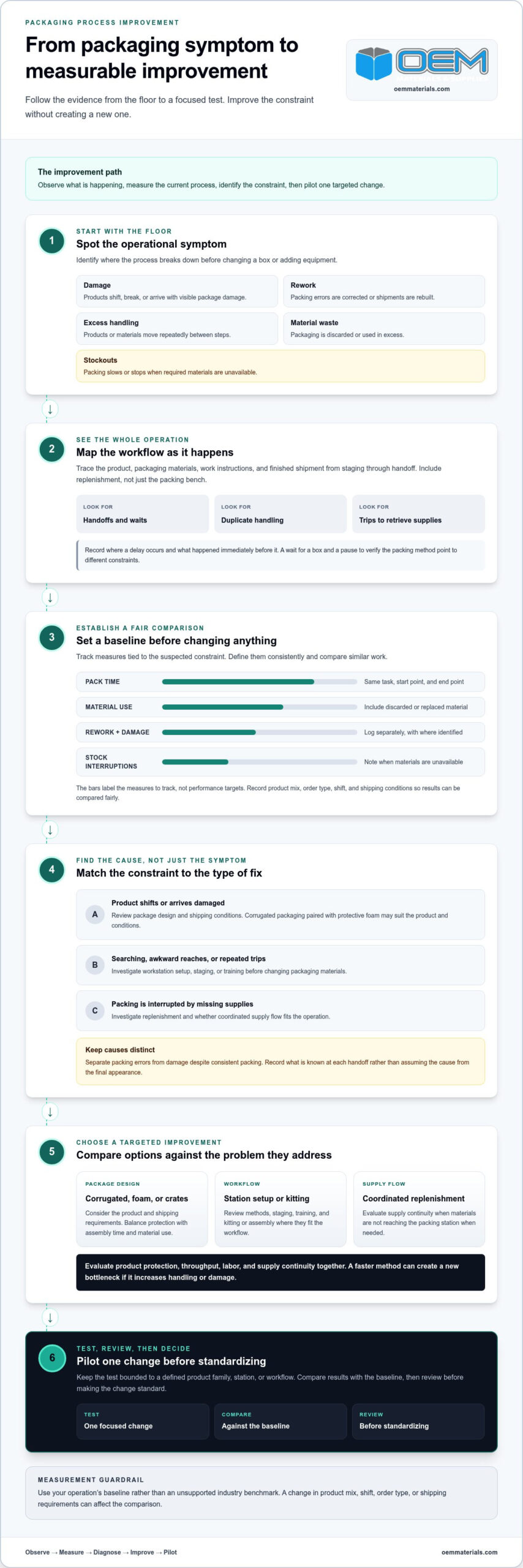
Use This Packaging Process Improvement Checklist to Pilot Changes
A packaging change should earn its place in the standard process through a controlled trial. Keep the test small enough to manage, but representative enough to reveal its effects on product protection, operator handling, and workflow. A product family, one packing station, or a defined workflow can provide a practical boundary.
Use this sequence to move from an identified problem to a clear decision:
- Define the scope. Identify the product family, station, or workflow included in the trial, along with the specific problem the change is intended to address.
- Assign an owner. Name the person responsible for coordinating the trial, recording results, and gathering input from the people doing the work.
- Document the baseline. Record the current method and relevant measures, such as packing time, material use, rework, damage, or stock interruptions.
- Test one change. Describe the proposed adjustment and evaluate it under representative operating conditions.
- Review the results. Compare trial performance with the baseline and note exceptions, operator feedback, and any effect on protection or handling.
- Standardize only when validated. Update work instructions and replenishment routines after the trial shows that the change meets operational requirements.
Run a controlled packaging change
Write down the current method, proposed change, responsible team, and evaluation period before starting. Test representative products and shipping conditions, not just the easiest order to pack. Ask operators to record where the new method helps or creates friction. Track material use, damage, rework, and exceptions alongside speed. For a unit-load wrapping trial, compare the current method with the proposed approach under the same shipment conditions, and refer to this stretch film information as you assess the material involved.
Decide whether to adopt, adjust, or stop
Compare trial results with the baseline using the same measures and, as much as possible, the same product and shipping conditions. A faster pack time doesn’t justify a change if protection declines or operators face harder handling. Lower material use matters only if the package still performs as required. If results are mixed, adjust the test or narrow its scope rather than rolling it out broadly.
Once the change is validated, document the approved method and any new material or replenishment requirements. If the test involves package design or supply planning, include the relevant dimensions, product weight, shipping conditions, and annual usage in your review. A packaging process consultation can be focused on those project details.
Build a More Reliable Packaging Process with the Right Supply Partner
A packaging improvement can stall if material design, packing method, and replenishment are treated as separate decisions. A supply partner can help connect those parts of a workflow, from selecting packaging for a product to planning how materials reach the packing operation. The goal is an approach that fits the product, shipping requirements, and production schedule.
Coordinate packaging design with production requirements
Start with the product’s dimensions and weight, how it is packed, and the conditions it must meet in shipment. Those details guide whether a corrugated box, foam insert, or crate is appropriate. A box may provide the outer structure, while foam can help restrain a product that needs additional cushioning. Crates may suit products or shipments with different protection requirements. Assess the right combination against the actual application and workflow rather than selecting materials in isolation.
Development can begin with a prototype or short run, then support a production program as requirements become established. OEM Materials & Supplies works with manufacturers from prototypes and short runs through high-volume production programs. This progression allows a packaging concept to be evaluated in the intended packing process before it becomes part of recurring operations. It also gives the team a chance to consider material handling, packing steps, and replenishment needs together.
Make replenishment part of the improvement plan
Even a well-designed package can create delays if components arrive inconsistently or require repeated preparation at the station. Kitting and assembly can consolidate recurring preparation steps, organizing packaging components for a defined workflow. The appropriate setup depends on what operators need at the point of use and how the process is organized.
For ongoing supply coordination, vendor-managed inventory and just-in-time packaging delivery can help address stock interruptions or excess on-site inventory when aligned with actual usage and replenishment needs. Evaluate these approaches as part of the workflow, not as a substitute for understanding which materials are required and when.
For manufacturers in Orange County, Los Angeles County, the Inland Empire, and San Diego County, coordinating packaging design and supply can keep an improvement grounded in local production needs. The same planning principles apply when supporting programs beyond Southern California. A clear project scope helps connect material choices and supply planning to the operation being improved.
For a packaging project review, organize the product dimensions, weight, and annual usage alongside the shipping requirements. Quote and consultation details can be used to frame the project around those needs.
Keep Improving as Your Operation Changes
A packaging process isn’t fixed forever. Product changes, order patterns, and shipping requirements can shift the original constraint or create a new one. Treat pilot results as a reference point, then revisit them when the workflow changes. This gives your team a practical way to decide whether a proven method still fits or needs another controlled adjustment.
The strongest packaging process improvement ideas address a specific operational need and are evaluated against what matters: reliable protection, workable handling, and consistent supply. A clear record of the product and process also makes it easier to discuss adjustments with the people responsible for packaging design and supply.
When preparing an improvement project, gather product dimensions, weight, and annual usage. These details help frame recommendations around the product and its shipping requirements.
Frequently Asked Questions
Is packaging automation necessary to improve a packaging process?
No. Automation is not a prerequisite for packaging process improvement ideas to produce operational value. Before selecting equipment, consider how it would fit the floor plan, interact with upstream and downstream tasks, and handle product changeovers. Also account for operator access, maintenance responsibilities, and the process for addressing equipment downtime. These requirements help determine whether automation suits the operation beyond the task it is intended to perform.
Can packaging changes reduce product damage without increasing material use?
They can, depending on where and how damage occurs. Review returned or damaged packages for patterns such as abrasion, crushed corners, or a shifted product, and compare those observations with the package’s orientation and closure. A targeted change to product position or contact points may address a specific failure more effectively than adding material throughout the package. Keep the current protective approach in place until the revised configuration has been evaluated for the intended shipment.
How often should a manufacturer review its packaging process?
Review it when a meaningful operating condition changes, not only on a calendar schedule. Triggers can include a product revision, a new shipping configuration, a packaging material substitution, or a recurring increase in packing questions. A routine review can also be included alongside an existing product or operations review. The useful interval depends on how often these conditions change and how quickly the team needs to respond to issues.
What information is useful when requesting a packaging improvement recommendation?
Along with product and usage information, include a drawing or clear photos showing the product’s orientation, contact surfaces, and any parts that must remain accessible. Describe how units are grouped for shipment and note current material identifiers if available. For a process concern, explain which step creates difficulty and what operators do to work around it. These details clarify fit, assembly, and workflow requirements before options are discussed.
Can packaging process improvements work for both short runs and high-volume production?
Yes, but implementation details should reflect how often the product or packing instructions change. For a short run, prioritize a method that can be set up and explained clearly without creating unnecessary material variety. For a stable, recurring program, consistent component identification and documented packing instructions can support repeatability across shifts. In either case, account for product versions so a process intended for one configuration isn’t mistakenly applied to another.
What should a team do if a packaging pilot improves speed but creates more rework?
Protect shipments first by setting a clear review point for packages prepared under the trial method. If rework appears, identify affected orders and route them through the established quality review process before release. Record the specific correction needed, such as a closure adjustment or a missing component, rather than relying on a general note that the package was incorrect. This creates useful information for deciding how the work instruction or trial controls should change.
To discuss a packaging improvement for your operation in Orange County, Los Angeles, the Inland Empire, or San Diego County, request a quote or packaging consultation and include product dimensions, weight, and annual usage.