
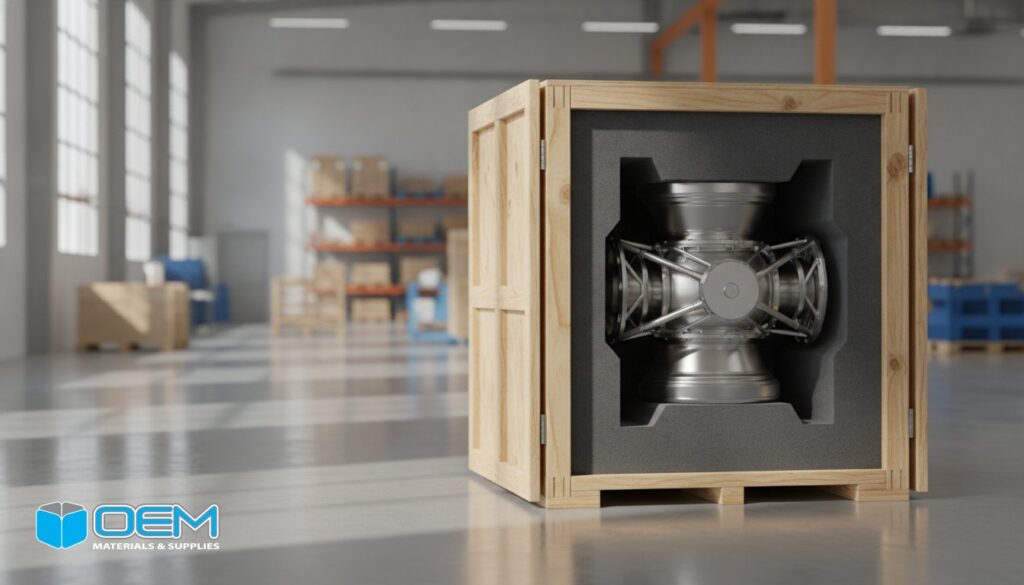
A single hairline fracture in a high-value industrial component often costs more in operational downtime and replacement fees than an entire year of packaging procurement. Shipping sensitive machinery through the busy logistics hubs of Los Angeles and Orange County requires more than just a sturdy outer shell. You likely recognize that structural rigidity alone cannot prevent the internal damage caused by constant vibration or G-force impacts during transit. To achieve zero-damage shipping for delicate equipment, you must address both external protection and internal stabilization simultaneously.
This article explains how to engineer the perfect balance of structural strength and internal cushioning using custom foam-lined wooden crates to protect your high-value assets. We will examine the technical selection of foam densities, the requirements for ISPM 15 export compliance, and how local manufacturing supports rapid prototyping for complex, irregularly shaped equipment. By understanding these engineering principles, you can eliminate shipping damage and optimize packing efficiency for both domestic and international freight. We will provide a clear framework for selecting the right materials and configurations to ensure your industrial assets arrive in factory condition every time.
Key Takeaways
- Learn how the combination of a rigid wood shell and precision-engineered foam inserts protects high-value assets from both structural impact and internal vibration.
- Understand why selecting specific foam densities, such as moisture-resistant polyethylene for heavy loads, is critical for achieving zero-damage transit.
- Identify the necessary ISPM 15 heat-treatment standards and wheat stamp requirements to ensure your international shipments clear customs without delays.
- Discover how local supply partners in Southern California provide foam-lined wooden crates designed for flat-pack storage to optimize your warehouse footprint.
- Explore how specialized crating solutions meet the rigorous stabilization and precision requirements of the aerospace and medical device sectors.
Understanding Foam-Lined Wooden Crates for Industrial Shipping
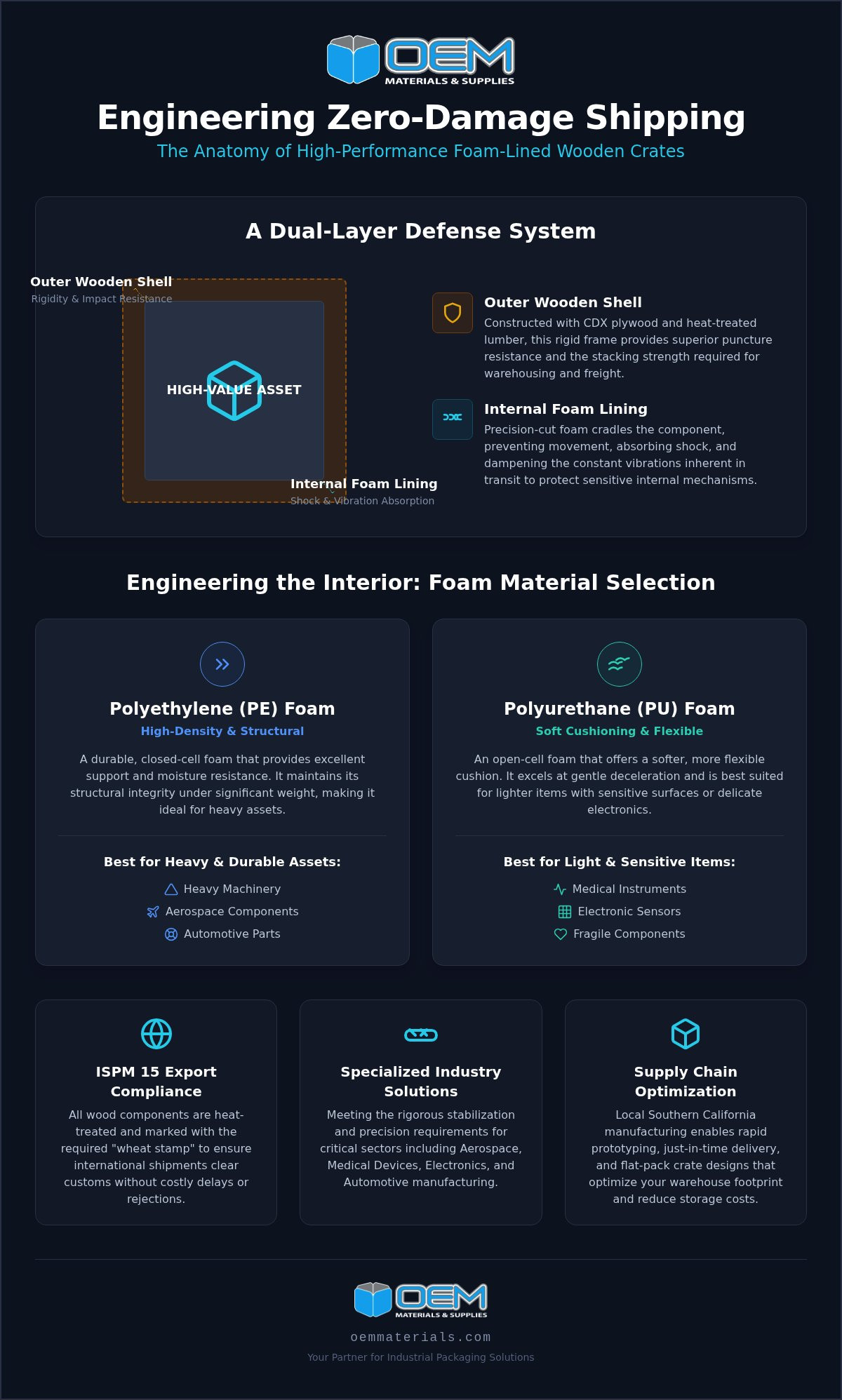
Foam-lined wooden crates are specialized industrial shipping containers engineered to protect heavy, high-value assets that require more than just structural containment. These units utilize a dual-layer defense system designed for precision and durability. The exterior wooden frame provides the necessary rigidity to support extreme weight and resist external impacts, while the interior foam lining acts as a shock absorber to neutralize kinetic energy. This combination is essential for sectors like aerospace and medical device manufacturing, where minor vibrations can lead to calibration errors or structural fatigue. By integrating these two distinct materials, manufacturers create a shipping environment that handles both static and dynamic stresses.
Choosing between standard corrugated boxes and custom foam-lined wooden crates usually depends on weight thresholds and the fragility of the cargo. When an item exceeds several hundred pounds or possesses sensitive external surfaces, corrugated material often lacks the puncture resistance and stacking strength required for long-distance transit. Wooden crates provide a rigid environment that won’t compress under the weight of stacked pallets. The primary components of these systems include plywood walls, heat-treated lumber frames, and engineered foam inserts, all working in mechanical synergy to protect the payload.
The Role of the Outer Wooden Shell
The exterior of a high-quality industrial crate typically consists of CDX plywood walls and heat-treated lumber frames. This construction offers superior puncture resistance against forklift tines and pallet jack errors commonly encountered in busy Los Angeles and Orange County shipping hubs. Plywood provides a consistent surface that resists splitting, while the lumber frame adds the necessary stacking strength for multi-tiered warehouse storage. Cleated panelboard crates serve as the structural backbone of industrial logistics by ensuring the container remains square and stable under heavy loads. This rigid shell acts as the first line of defense against the physical hazards of the supply chain.
The Function of the Internal Foam Lining
While the wood provides the shell, the custom foam packaging inside handles the delicate work of stabilization. This lining prevents surface abrasion and mitigates the constant vibration inherent in truck and air transport. For irregularly shaped components, engineered foam allows for “cradling,” where the material is precision-cut to match the specific contours of the part. A snug fit is vital because it prevents internal movement, which is a primary cause of damage during sudden stops or turbulent handling. By absorbing the energy of an impact before it reaches the product, the foam ensures that sensitive internal mechanisms remain intact and functional upon arrival.
Engineering the Interior: Selecting Foam Materials and Densities
Selecting the correct interior for foam-lined wooden crates requires more than a generic padding approach. It’s a technical decision based on the specific fragility, weight, and surface sensitivity of your industrial assets. Engineers must evaluate how the internal material reacts to static loading, which is the amount of pressure the product exerts on the foam while at rest. If the foam is too soft, the product will “bottom out” during a drop; if it’s too firm, the impact energy will transfer directly to the component. Achieving the right balance ensures that the cushioning remains active throughout the entire shipping cycle.
Polyethylene vs. Polyurethane in Wooden Crates
Industrial applications typically utilize two primary foam types. Polyethylene (PE) is a closed-cell foam known for its high durability and moisture resistance. It’s the standard for heavy machinery, automotive parts, and aerospace components because it maintains its structural integrity under significant pressure. Conversely, Polyurethane (PU) is an open-cell foam that offers a softer, more flexible cushion. PU is better suited for lighter, more delicate items like medical instruments or electronic sensors that require gentle deceleration. For a detailed breakdown of these materials, you can explore our custom foam packaging specifications to match a material to your specific load requirements.
Calculating Cushioning Requirements
Determining the right thickness for your lining involves identifying the G-factor of your equipment. The G-factor represents the maximum acceleration an item can withstand before damage occurs. Highly sensitive electronics might have a G-factor of 15 to 25, while rugged industrial pumps might handle 75 or more. To protect a low G-factor item, you need thicker foam or specific densities that allow for a longer deceleration period during an impact. This correlation between foam thickness and drop height ensures that the energy from a fall is absorbed by the lining rather than the asset.
Precision is key to avoiding “dynamic stiffness.” This occurs when the foam cannot compress enough to absorb shock, effectively acting as a rigid surface because it was over-engineered for the weight of the load. This is why technical calculations are vital for foam-lined wooden crates. If you’re unsure about the required density for your specific dimensions, you can speak with a packaging engineer to review your product weight and fragility data for a more accurate recommendation.
Structural Integrity and Compliance Standards for Wood Crates
Ensuring the structural integrity of foam-lined wooden crates involves meeting both physical load requirements and international regulatory mandates. Beyond the internal cushioning, the wooden container must withstand the rigors of stacking, lifting, and ocean or air transit. Compliance with ASTM standards for wood cleated panelboard crates provides a technical baseline for construction, ensuring that each unit possesses the necessary shear strength and puncture resistance. For industrial assets weighing several hundred pounds, manufacturers often utilize reinforced corners and heavy-duty fasteners to prevent the crate from racking or splitting when subjected to the dynamic forces of a moving vessel or aircraft.
Compliance is not merely about physical strength; it is also about legal passage. International trade requires adherence to ISPM 15 standards to prevent the cross-border spread of timber pests. Every wooden component in an export crate must undergo a certified heat-treatment process to ensure it is free of wood-boring insects. This process is validated by the application of the “wheat” stamp, a mandatory mark that customs officials globally use to verify the crate’s safety for entry. Failing to provide this documentation can result in immediate shipment rejection.
Export Certification and Heat Treatment
The heat-treatment process involves placing lumber in a kiln until its core reaches a specific temperature for a set duration. This is a non-negotiable requirement for most international shipping lanes. If a shipment arrives at a foreign port without the proper certification marks, it can be quarantined, fumigated at a high cost, or even denied entry and returned to the origin. Utilizing export-ready custom crates ensures that your high-value cargo moves through customs without these expensive and avoidable delays.
Fastening and Closure Systems
The choice of fasteners impacts both the security and the reusability of the crate. While traditional nails offer a permanent seal for one-way transit, screw-down lids are more effective for equipment that requires inspection or onsite assembly. Integrating metal strapping and edge and corner protectors provides additional reinforcement against the impacts of forklift tines. These components work together to maintain the crate’s geometry, ensuring the internal foam-lined wooden crates system remains properly aligned with the cargo it protects during every stage of the journey.
Industry Applications: From Aerospace to Medical Devices
Industrial sectors across Southern California require specialized configurations to address unique environmental and mechanical stressors. While the structural basics of foam-lined wooden crates remain consistent, the specific interior engineering varies significantly between a jet engine and a surgical laser. Precision-built assets demand a packaging partner that understands the difference between simple padding and technical deceleration. Each industry presents a different set of risks, from electrostatic discharge to particulate contamination, that must be mitigated through material selection. Precision is mandatory.
Aerospace and Defense Logistics
Aerospace and defense contractors in the Los Angeles and Orange County corridor deal with components that cannot tolerate even minor static or vibration. Avionics and flight-control systems are particularly susceptible to Electrostatic Discharge (ESD). Static control is essential. To mitigate this risk, we integrate specialized anti-static foam linings that prevent charge buildup during handling and transport. Turbine components and structural airframe parts also require zero-vibration environments to prevent micro-fractures during long-distance freight. Beyond protection, custom kitting within the crate organizes complex assemblies. This allows technicians to perform faster installations directly from the shipping container, which significantly reduces labor costs and potential assembly errors in the field.
High-Value Medical Equipment
Medical device OEMs require packaging that meets strict cleanliness and precision standards. Standard industrial foam can shed small particles. This is unacceptable for imaging equipment or laboratory instruments destined for sterile environments. We utilize non-dusting, cross-linked polyethylene foams that are cleanroom-compatible and resistant to chemical off-gassing. These inserts are often die-cut or CNC-routed to match the exact silhouette of the instrument, ensuring a zero-movement fit that prevents surface abrasion. Our custom packaging design team works with medical engineers to create these precision-fit interiors for sensitive diagnostic tools and surgical lasers.
In the automotive and manufacturing sectors, the challenges shift toward supporting extreme weight while protecting delicate electronics. Heavy engine blocks or custom-built tooling require high-density PE foam that supports the static load without permanent compression. Conversely, electronic control modules (ECMs) need the vibration dampening and moisture resistance typically found in lighter foam grades. Moving machinery between facilities in San Diego or shipping high-volume runs from the Inland Empire requires foam-lined wooden crates that provide necessary environmental and structural control. Facilities handling high-precision components should contact us for a technical consultation to discuss specific industry requirements and annual usage.
Optimizing Your Supply Chain with Custom Crate Solutions in Southern California
Manufacturing in Los Angeles and Orange County involves managing high real estate costs and complex port logistics. Storing fully assembled foam-lined wooden crates can consume valuable square footage that should be dedicated to production. We address this by designing crates that allow for flat-pack storage or modular assembly. This approach enables you to maintain an inventory of protective packaging without the bulk of traditional crating. By optimizing the physical footprint of your shipping materials, you improve overall warehouse efficiency and reduce secondary handling costs.
Local Support for SoCal Manufacturing Hubs
The logistical density of Southern California demands a partner capable of rapid response. Proximity to your facility in the Inland Empire or San Diego County significantly reduces lead times and transportation expenses for large-format packaging. Working with a local supplier allows for rapid prototyping, ensuring that new product designs can be tested with custom foam inserts in days rather than weeks. To further streamline operations, we offer packaging VMI (Vendor Managed Inventory) programs. This service ensures you have the exact number of foam-lined wooden crates required for your weekly production schedule, eliminating the risks of overstocking or line-down situations due to material shortages.
The Business Value of Engineered Protection
While custom-engineered crates require a higher initial investment than commodity boxes, the total cost of ownership is often much lower. Results in cost reduction depend on specific variables like product weight and the frequency of transit-related damage. By achieving zero-damage shipping for high-value assets, you eliminate the massive expenses associated with returns, repairs, and customer dissatisfaction. Additionally, the professional appearance of a well-engineered crate enhances your brand’s reputation for quality. When a client receives a high-value medical instrument or aerospace component in a precision-built, foam-lined container, it reinforces their confidence in your operational standards.
Selecting the right protective solution requires precise data. To provide an accurate recommendation, we typically ask for the product’s dimensions, total weight, and the anticipated annual usage. This information allows our engineering team to calculate the optimal foam density and wood thickness required for your specific application. Whether you need a short-run prototype or a high-volume supply chain solution, local expertise ensures that your industrial assets remain protected throughout the global distribution network.
Securing Your Industrial Assets for Global Distribution
Achieving zero-damage shipping for high-value industrial assets requires a technical synergy between external rigidity and internal stabilization. By selecting the correct foam densities and ensuring full ISPM 15 export compliance, you protect your components from both physical impact and regulatory delays. we provide specialized engineering for aerospace and medical OEMs throughout Southern California, ensuring that every container meets the rigorous standards of your specific sector.
Our local manufacturing facilities in Los Angeles, Orange County, and San Diego allow for rapid prototyping and just-in-time delivery to keep your production lines moving. Utilizing precision-engineered foam-lined wooden crates ensures your products arrive in factory condition, regardless of the transit distance or shipping method. we are ready to help you optimize your packing processes and reduce the total cost of ownership associated with shipping damage.
To get started on a solution for your facility, contact OEM Materials & Supplies for a custom crate quote and design consultation. Please provide your product dimensions, weight, and annual usage so our engineers can develop a tailored recommendation for your operations. We look forward to securing your supply chain.
Frequently Asked Questions
What is the difference between polyethylene and polyurethane foam lining?
Polyethylene (PE) is a closed-cell material that provides high durability and moisture resistance, making it the industry standard for heavy machinery and aerospace parts. Polyurethane (PU) is an open-cell foam that offers a much softer cushion, which is better suited for lighter, highly sensitive medical instruments. Selecting between them depends on the static load and fragility of your cargo. PE foam maintains its shape under significant pressure, while PU foam provides gentle deceleration for delicate surfaces.
Do my wooden crates need to be ISPM 15 certified for domestic shipping?
No, ISPM 15 certification is not legally required for shipments moving exclusively within the United States. However, many manufacturers in Los Angeles and Orange County choose heat-treated wood for all units to maintain a unified inventory and prevent accidental non-compliance during international export. If your supply chain involves moving goods between local facilities and global ports, using certified lumber for all your foam-lined wooden crates ensures that every unit is export-ready at a moment’s notice.
Can foam-lined wooden crates be reused for multiple shipments?
Yes, these crates can be engineered for multiple uses by incorporating screw-down lids or recessed latches instead of traditional nails. Reusability depends on the durability of the outer shell and the resilience of the internal foam inserts. While the upfront cost for a reusable unit is higher, it can lower the total cost of ownership for internal transfers between facilities in San Diego and Riverside. Regular inspection of the foam ensures it hasn’t lost its essential cushioning properties.
How do I determine the correct foam thickness for my heavy equipment?
Determining the correct thickness requires calculating the product’s G-factor and the anticipated drop height. Heavier equipment exerts more pressure on the foam, which can lead to “bottoming out” if the material is too thin or the density is too low. Our engineers analyze the static load to ensure the cushioning provides enough travel to absorb impact energy. Using the right calculations prevents over-engineering, which can be just as detrimental to sensitive equipment as under-packing.
Are custom foam inserts better than standard foam sheets for lining crates?
Custom foam inserts are significantly more effective than standard sheets because they are precision-cut to match the exact silhouette of your product. This “cradling” effect eliminates internal movement, which is the leading cause of surface abrasion and mechanical failure during transit. While standard sheets provide a basic layer of padding, they often shift during handling. For high-value aerospace or medical components, custom-engineered inserts provide the consistent, repeatable protection necessary for zero-damage shipping results.
What information do I need to provide for a custom crate quote?
To provide an accurate quote for custom foam-lined wooden crates, we require the product’s exterior dimensions, total weight, and fragility requirements. It’s also helpful to know your anticipated annual usage and whether the crate is for domestic or international transit. This data allows our team to specify the correct lumber thickness and foam density. If you’re shipping irregularly shaped machinery, providing a CAD file or physical prototype helps us engineer a more precise internal fit.
Can these crates be designed for easy opening and closing without heavy tools?
Yes, we can design crates with specialized closure systems like link locks, recessed latches, or screw-down lids that don’t require heavy pry bars. These features are particularly useful for medical devices or aerospace components that need frequent inspection or onsite assembly. Easy-access designs reduce the risk of damaging the crate shell during opening, which extends the lifespan of the container. This functionality improves operational efficiency at the receiving dock while maintaining a high level of security.
Does OEM Materials & Supplies offer on-site packaging consultations in Orange County?
Yes, OEM Materials & Supplies provides on-site packaging consultations for manufacturers throughout Orange County, Los Angeles, and the Inland Empire. Our team can visit your facility to evaluate your current packing process, measure equipment, and discuss logistical challenges. This local support allows us to provide rapid prototyping and just-in-time delivery for high-volume production runs. Being a local partner means we understand the specific challenges of Southern California supply chains and can respond quickly to your requirements.