
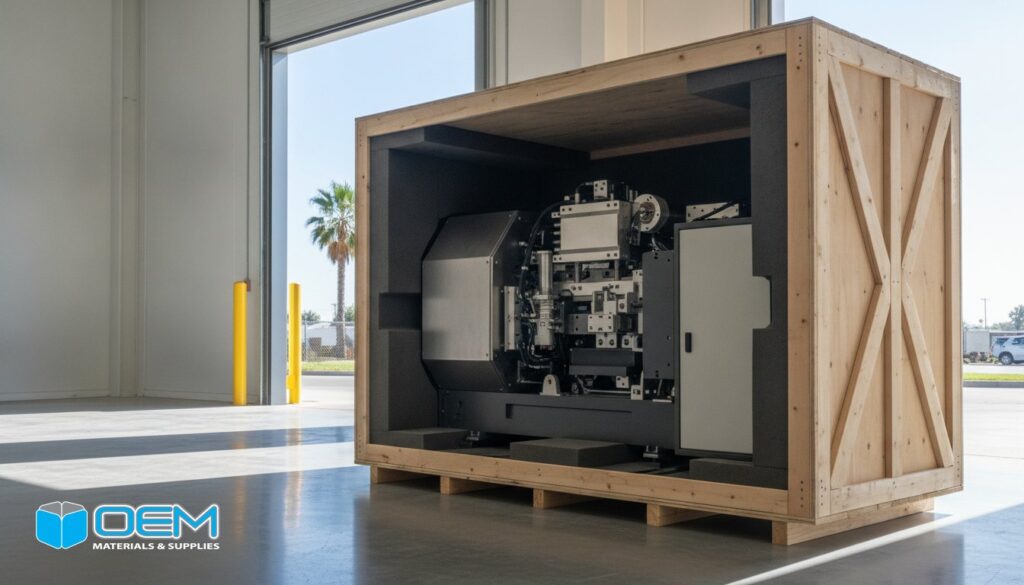
A single shipment of damaged industrial machinery can cost more in repair costs and operational downtime than an entire year of your packaging budget. For manufacturers in Los Angeles and Orange County, the stakes are high when high-value assets must move through complex international supply chains. You already know that standard shipping solutions often don’t provide the structural integrity required for sensitive electronics or heavy equipment. Relying on inadequate protection leads to expensive insurance claims and frustrated customers.
Specifying high-quality custom wooden crates is about engineering a solution that ensures zero-damage shipments and full compliance with ISPM-15 export regulations. This guide explains how to source crates that meet rigorous industrial standards while reducing your internal packing labor and total cost of ownership. We will examine how integrated foam cushioning and precision engineering protect your assets from the impact and vibration of global transit. You will learn how a local Southern California partner can provide the technical expertise and inventory management needed to keep your production lines moving without delay.
Key Takeaways
- Understand the critical role of ISPM-15 heat treatment certification for international regulatory compliance and asset protection.
- Learn why custom wooden crates provide superior structural integrity compared to standard corrugated boxes for heavy or irregular industrial loads.
- Evaluate the total cost of ownership by analyzing how precision engineering reduces the need for secondary packaging and lowers labor costs.
- Identify industry-specific requirements for aerospace and medical device shipping to ensure sensitive components remain secure and uncontaminated.
- Discover the logistical advantages of partnering with a local Southern California supplier to implement vendor-managed inventory programs.
The Role of Custom Wooden Crates in Industrial Logistics
Custom wooden crates are specialized industrial enclosures engineered to match the exact dimensions, weight distribution, and center of gravity of a specific product. Unlike stock packaging, these systems are designed to withstand the physical stresses of industrial handling and long-range transport. An industrial crate is a load-bearing structure designed specifically for mechanical handling. This structural integrity is critical for preventing catastrophic failure during transit, especially when moving sensitive equipment.
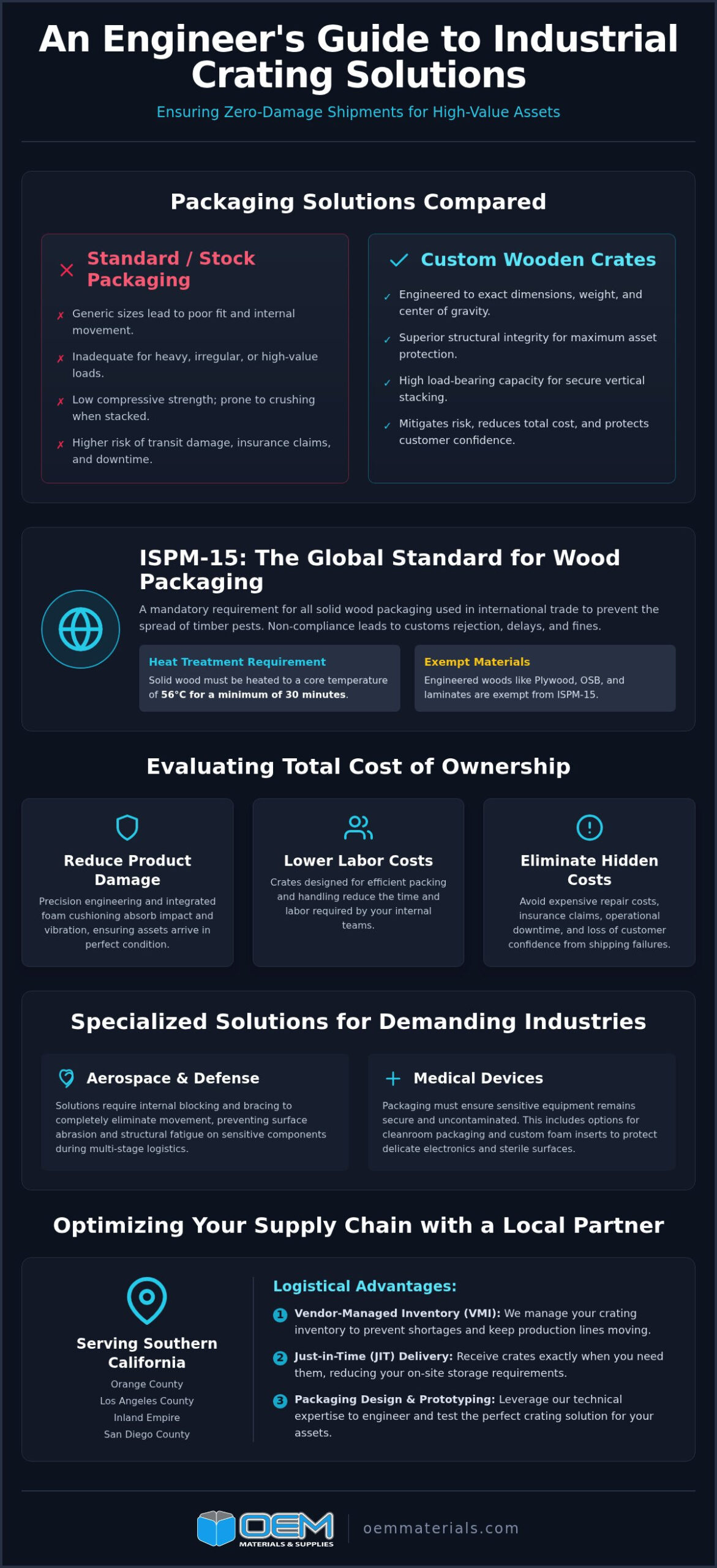
Standard corrugated boxes or stock crates often fail when tasked with protecting heavy, irregular, or high-value loads. These generic solutions lack the internal bracing and material thickness required to prevent crushing or puncture. When a package fails, the total cost of ownership extends far beyond the material price. You must account for the cost of transit damage, including replacement parts, expedited shipping, and the loss of customer confidence. Investing in custom wooden crates mitigates these risks by providing a rigid barrier that absorbs external impact while maintaining its shape under pressure.
When to Choose Wood Over Corrugated Packaging
Material selection usually depends on the weight and fragility of the asset. While custom corrugated boxes are ideal for lighter components and sub-assemblies, wood becomes necessary once a product exceeds specific weight thresholds or requires vertical stacking. In ocean and air freight, crates must often support thousands of pounds of static load from other shipments stacked on top. Wood provides the compressive strength that corrugated board cannot match, ensuring your equipment isn’t crushed during a two-week sea voyage.
Protecting High-Value Assets in Southern California
Manufacturers in Los Angeles and Orange County operate in high-precision sectors like aerospace and automotive. These industries require packaging that prevents even the slightest internal shifting. Custom designs utilize internal blocking and bracing to lock components into place, eliminating the movement that causes surface abrasions or structural fatigue. For local OEMs, crate durability is vital throughout multi-stage logistics chains where a product might be moved between several warehouses and transport vehicles before reaching its final destination. A well-engineered crate serves as a reliable protective shell that maintains its integrity through every hand-off.
Engineering Standards: ISPM-15 Certification and Structural Integrity
Engineering a high-performance shipping container requires more than just raw lumber and fasteners. It involves a technical understanding of load-bearing capacities and international regulatory frameworks. For manufacturers in the Inland Empire and Los Angeles, ensuring that custom wooden crates meet these specific standards is the only way to guarantee the safety of the cargo and the efficiency of the supply chain. A failure to account for structural mechanics or export laws can lead to catastrophic product damage or expensive shipments being quarantined at international borders.
Understanding ISPM-15 Compliance for Export
The International Standards for Phytosanitary Measures No. 15 (ISPM-15) is a global mandate designed to prevent the spread of timber pests. Any solid wood packaging material used for international transit must undergo a certified heat treatment process. This involves heating the lumber until its core temperature reaches at least 56 degrees Celsius for a minimum of 30 minutes. Once treated, the wood receives a permanent IPPC mark, which serves as a passport for the crate.
Non-compliant crates are often rejected at customs, leading to significant delays and potential fines for the shipper. It is vital to distinguish between solid wood and engineered wood materials. Plywood, oriented strand board (OSB), and pressurized laminates are considered processed wood and are generally exempt from ISPM-15 requirements because the manufacturing process eliminates pest risks. When your logistics plan involves overseas delivery, working with a partner who provides certified heat-treated crates is a non-negotiable requirement for compliance.
Hardware and Fastener Selection for Durability
The choice of fasteners directly impacts both the structural integrity and the reusability of a crate. While nails are common for one-way shipping due to their speed of assembly, they lack the withdrawal resistance needed for heavy-duty applications. Screws provide superior pull-out strength and allow for a crate to be disassembled and reassembled without damaging the wood. This is a critical feature for companies sending equipment to trade shows or managing product returns.
For heavy machinery weighing several tons, assembly often requires recessed bolts and steel plates to handle extreme shear forces. The base of the crate must be engineered as a heavy-duty skid or pallet, featuring specific entry points for forklifts and cranes. A 4-way entry base provides maximum flexibility for warehouse staff, reducing the risk of accidental drops during mechanical handling. By selecting the correct lumber grades and fastener types, you ensure the crate functions as a reliable protective system rather than just a simple box.
Custom vs. Stock Crates: Evaluating Total Cost of Ownership
Procurement professionals often focus on the unit price of a container, but the initial purchase price is only one component of the total cost of ownership. While stock crates may seem cost-effective upfront, they frequently lead to higher operational expenses. These generic solutions often require excessive amounts of secondary packaging materials to fill empty space and secure the load. By contrast, custom wooden crates are engineered to fit the product precisely, eliminating the need for surplus dunnage and reducing material waste. It is important to recognize that specific cost savings and operational improvements depend on variables such as product dimensions, material specifications, and shipping requirements.
Labor efficiency is another critical factor in the TCO equation. Crates designed for rapid loading and unloading allow warehouse teams to secure shipments in a fraction of the time required for stock alternatives. When a crate features built-in ramps, pre-installed mounting brackets, or removable panels, it streamlines the assembly line and reduces man-hours. These savings often offset the higher initial investment of a custom design, especially in high-volume manufacturing environments where every minute on the packing floor impacts the bottom line.
Integrating Custom Foam and Cushioning
A significant advantage of custom designs is the ability to integrate custom foam packaging directly into the crate structure. This hybrid approach provides both the rigid exterior protection of wood and the internal vibration dampening necessary for sensitive electronics or medical devices. Choosing the correct foam density depends on the fragility of your equipment and its G-force rating. Consider these options for internal cushioning:
- Polyethylene: Best for heavy items requiring high shock absorption and durability.
- Polyurethane: Ideal for lightweight, highly sensitive components that need soft support.
- Anti-Static Foam: Essential for protecting electronics from electrostatic discharge during transit.
Shipping Efficiency and Dimensional Weight
Carrier fees are increasingly tied to dimensional weight rather than actual weight. Right-sized crates minimize the external footprint of your shipment, preventing unnecessary surcharges for shipping empty air. Beyond freight costs, custom dimensions ensure that crates are stackable and fit perfectly within standard ocean containers or truck beds. This optimization improves pallet stability during transport, reducing the risk of load shifts that lead to transit damage and insurance claims in the long-haul logistics chains of Southern California.
Industry-Specific Crating Requirements for Aerospace and Medical Devices
High-precision industries like aerospace and medical manufacturing require more than basic containment; they demand engineered protection systems. Aerospace components and medical diagnostic equipment represent some of the highest-value assets moving through Southern California supply chains. Shipping these items requires custom wooden crates that go beyond structural support to include environmental controls and precision-engineered internal fixtures. A failure in the packaging of a turbine engine or an MRI machine doesn’t just result in an insurance claim; it halts critical operations and can impact public safety or national defense.
Aerospace and Defense Crating Solutions
Defense contractors in Orange County and Los Angeles often require mil-spec compliance for domestic and international shipments. This involves specific wood treatments and assembly methods that meet rigorous Department of Defense standards. For oversized components like wing sections or engine turbines, we design custom cradles that support the asset at its primary mounting points. This engineering prevents stress on sensitive airframe parts during the vibrations of air or sea transport. Because of the high cost and specialized nature of these fixtures, many aerospace firms utilize reusable crates for maintenance and repair (MRO) cycles. In these scenarios, the container is designed to travel back and forth between the manufacturing facility and the field multiple times without structural degradation.
Precision Crating for Medical and Lab Equipment
Medical device manufacturers must prioritize cleanliness and sensitivity above all else. We provide cleanroom-compatible crating solutions using dust-free materials to prevent the contamination of diagnostic tools or surgical equipment. These crates often feature integrated shock-watch and tilt-watch indicators. These devices provide a visual record of handling throughout the logistics chain, alerting receiving teams if the crate was tipped or dropped. Our kitting services often combine these robust enclosures with mailing tubes and cores to organize and protect smaller, high-precision components within the same master shipment. This organization reduces unpacking time and ensures that every part of a complex medical system arrives in a single, organized unit.
To protect finished surfaces from scratches or impact during the crating process, we integrate edge and corner protectors into the internal blocking and bracing. For long-term storage or ocean freight, moisture barriers and specialized desiccants are added to the interior to prevent corrosion and mold growth in humid environments. If you are shipping high-stakes equipment that requires specialized engineering, request a technical consultation to ensure your assets are protected to the highest industrial standards.
Optimizing Supply Chains with Local Southern California Crating Solutions
Sourcing custom wooden crates from a local partner in Los Angeles or Orange County provides a logistical advantage that national vendors cannot match. Proximity reduces lead times and eliminates the high freight costs associated with shipping empty, bulky enclosures across state lines. For manufacturers in San Diego County or the Inland Empire, a local supplier acts as an extension of the production team, offering the agility needed to respond to sudden changes in shipping schedules or design requirements. This regional focus allows for more frequent deliveries in smaller quantities, freeing up valuable floor space for manufacturing operations.
Vendor-Managed Inventory for Packaging Materials
Maintaining a consistent supply of large-format packaging is a significant challenge for facilities with limited warehouse capacity. Our packaging VMI services solve this by transferring the burden of inventory management to our team. We perform onsite monitoring and handle automatic replenishment based on your actual usage rates. This system eliminates the risk of crate stockouts and reduces the administrative overhead associated with managing multiple purchase orders. When crates arrive ready for immediate use through just-in-time delivery, your labor costs decrease because your team spends less time handling materials and more time on core production tasks.
Rapid Prototyping and Custom Design Services
Every new product launch requires a packaging system that balances structural protection with cost efficiency. Our custom packaging design process begins with a technical assessment of your product’s fragility, weight distribution, and handling requirements. We transition from initial 3D models and prototypes to full-scale production with precision and speed. This collaborative approach ensures that the final custom wooden crates integrate perfectly with your internal handling equipment and external shipping methods.
We encourage local manufacturers to provide specific data, including product dimensions, weights, and expected annual usage. This information allows us to engineer a solution that optimizes material usage and reduces your total cost of ownership. Whether you need a single specialized prototype for a trade show or high-volume production for a global rollout, a local Southern California partnership ensures your logistics remain efficient and reliable. By integrating crates with other essential materials like stretch film and plastic pallets, we serve as a single-source partner for your entire industrial packaging suite.
Securing Your Industrial Supply Chain with Engineered Protection
Protecting high-value assets requires a shift from commodity packaging to engineered protection systems. High-quality custom wooden crates serve as the foundation for zero-damage shipments and full regulatory compliance. By integrating precision internal cushioning with robust external structures, you eliminate the hidden costs of transit damage and the need for excessive secondary materials. This approach ensures your equipment remains secure throughout complex international or domestic logistics chains.
Partnering with a local Southern California supplier provides the agility necessary for just-in-time manufacturing. Our expertise in aerospace and medical device packaging ensures that your most sensitive components meet rigorous industry standards. We offer comprehensive kitting and assembly services alongside vendor-managed inventory programs to streamline warehouse operations and reduce administrative overhead in Orange County and Los Angeles. These value-added services allow your team to focus on core production while we manage the complexities of your packaging supply.
When you’re ready to optimize your logistics and lower your total cost of ownership, our technical team is prepared to assist. Request a Custom Wood Crate Quote from OEM Materials & Supplies by providing your product dimensions, weight, and annual usage requirements. We look forward to building a reliable partnership that protects your equipment and your bottom line.
Frequently Asked Questions
What is the difference between a wooden crate and a wooden pallet?
A pallet is a flat transport structure that supports goods in a stable fashion while being lifted by a forklift or pallet jack. A wooden crate is a fully enclosed container that provides six-sided protection for its contents. While pallets are used for general material handling, crates are engineered for specific product dimensions and offer superior defense against puncture, crushing, and environmental exposure during long-haul domestic or international transit.
How do I know if my crate needs ISPM-15 certification for international shipping?
If your shipment is crossing international borders, it likely requires ISPM-15 certification. This international standard applies to all solid wood packaging materials, including custom wooden crates, to prevent the spread of timber pests. Every crate must be heat-treated and stamped with the official IPPC mark. Processed woods like plywood or OSB are generally exempt; however, solid lumber components must comply to avoid customs delays or shipment rejection at the destination port.
Can custom wooden crates be reused for multiple shipments?
Custom wooden crates can be designed for multiple uses if they are engineered with durable fasteners like screws or recessed bolts instead of nails. Reusable crates are ideal for trade show circuits, maintenance cycles, or internal transfers between manufacturing facilities. By selecting high-grade lumber and reinforced bases, these crates maintain their structural integrity over several trips, effectively lowering the total cost of ownership for companies with recurring logistics needs.
What information do I need to provide for a custom crate quote?
To provide an accurate quote, we require the product’s exact dimensions (length, width, and height) and its total weight. It is also important to specify the sensitivity of the item, which determines the need for internal cushioning or blocking. Other critical details include the final shipping destination, whether the crate needs to be reusable, and if any specific industry standards like mil-spec or medical cleanliness apply to the shipment.
How does custom crating help reduce shipping costs compared to stock options?
Custom crating reduces costs by optimizing the external footprint to match the product, which minimizes dimensional weight charges from carriers. Unlike stock boxes that often require excessive dunnage to fill empty space, a solution utilizing custom wooden crates uses materials more efficiently. The superior protection of an engineered crate significantly reduces the risk of transit damage, preventing the high costs associated with replacement parts, insurance claims, and expedited return shipping for manufacturers.
Are there specific wood types required for industrial shipping crates?
Industrial shipping crates typically utilize softwoods such as Southern Yellow Pine or Douglas Fir due to their strength-to-weight ratio and availability. For international shipments, this lumber must be heat-treated to meet ISPM-15 standards. We also use high-grade plywood for panels because it provides a smooth, puncture-resistant surface and is naturally exempt from many export regulations. The choice of material depends on the load-bearing requirements and the environmental conditions of the transit route.
How do custom foam inserts integrate with wooden crates for fragile items?
Custom foam inserts are engineered to fit precisely within the wooden structure to provide shock absorption and vibration dampening. We select foam densities based on the fragility and G-force rating of your equipment. For sensitive electronics or medical devices, these inserts lock the item in place, preventing internal shifting while the outer wooden shell protects against external impacts. This integrated approach creates a comprehensive protective system for high-value industrial assets.
What are the benefits of sourcing crates from a local Southern California supplier?
Sourcing from a local supplier in Orange County or Los Angeles eliminates the high cost of shipping empty crates from national vendors. Local proximity allows for faster lead times and the implementation of vendor-managed inventory (VMI) or just-in-time (JIT) delivery programs. These services help manufacturers in San Diego and Riverside optimize their warehouse space and reduce administrative overhead by ensuring that packaging materials are always available when production lines are ready.