
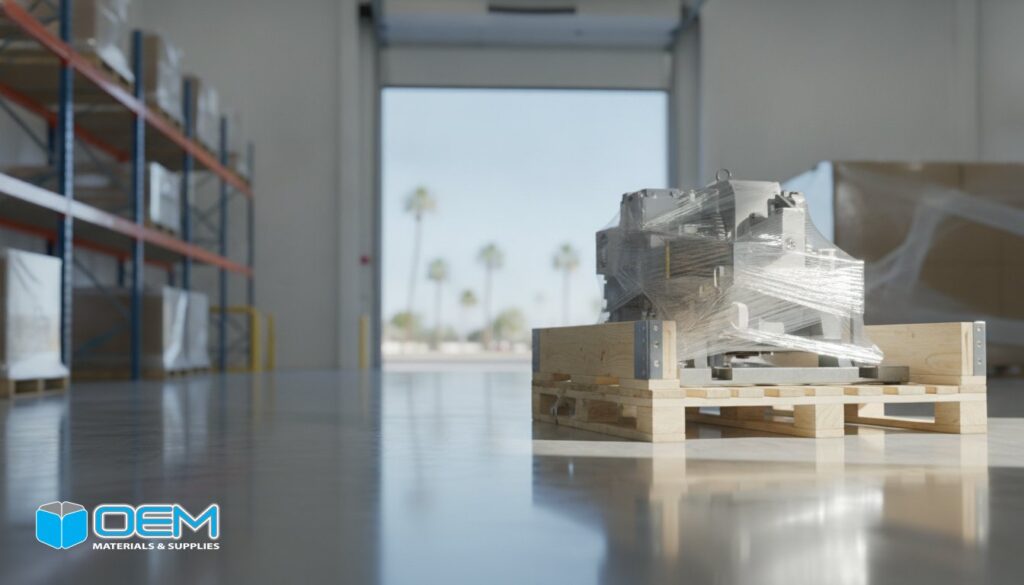
A shipping pallet is often the most overlooked component of an industrial load, yet it’s the only thing standing between your high-value product and a total loss during transit. Relying on standard platforms for specialized machinery or sensitive electronics frequently leads to costly overhang and unstable weight distribution. If you manage a production line in Orange County or Los Angeles, you need custom shipping pallets that provide a precise footprint to eliminate these risks and reduce the labor costs associated with manual modifications.
We understand that a reliable supply chain depends on precision at every level. Custom-engineered solutions protect high-value industrial loads while improving overall operational efficiency for Southern California manufacturers. This article explains how specific pallet designs can optimize your warehouse storage and ensure your shipments meet strict ISPM 15 export or cleanroom standards. You’ll learn how to identify the right specifications for your product dimensions, the importance of updated wood packaging regulations, and how a strategic partnership can stabilize your inventory supply.
Key Takeaways
- Standard GMA pallets often cause product overhang and transit damage, making custom footprints essential for protecting oversized industrial equipment.
- Engineering custom shipping pallets requires a technical understanding of both static and dynamic load capacities to ensure structural integrity during movement.
- Selecting between a four way entry pallet, a two way skid, or a heavy duty wood crate depends on the handling requirements and the sensitivity of the cargo.
- Southern California manufacturers can reduce manual labor and optimize warehouse footprints by integrating custom pallets with pre-assembled packaging kits.
- Local design and prototyping services in Orange County and Los Angeles provide the rapid response times necessary to stabilize complex supply chains.
Beyond Standard Dimensions: When Custom Shipping Pallets Are Necessary
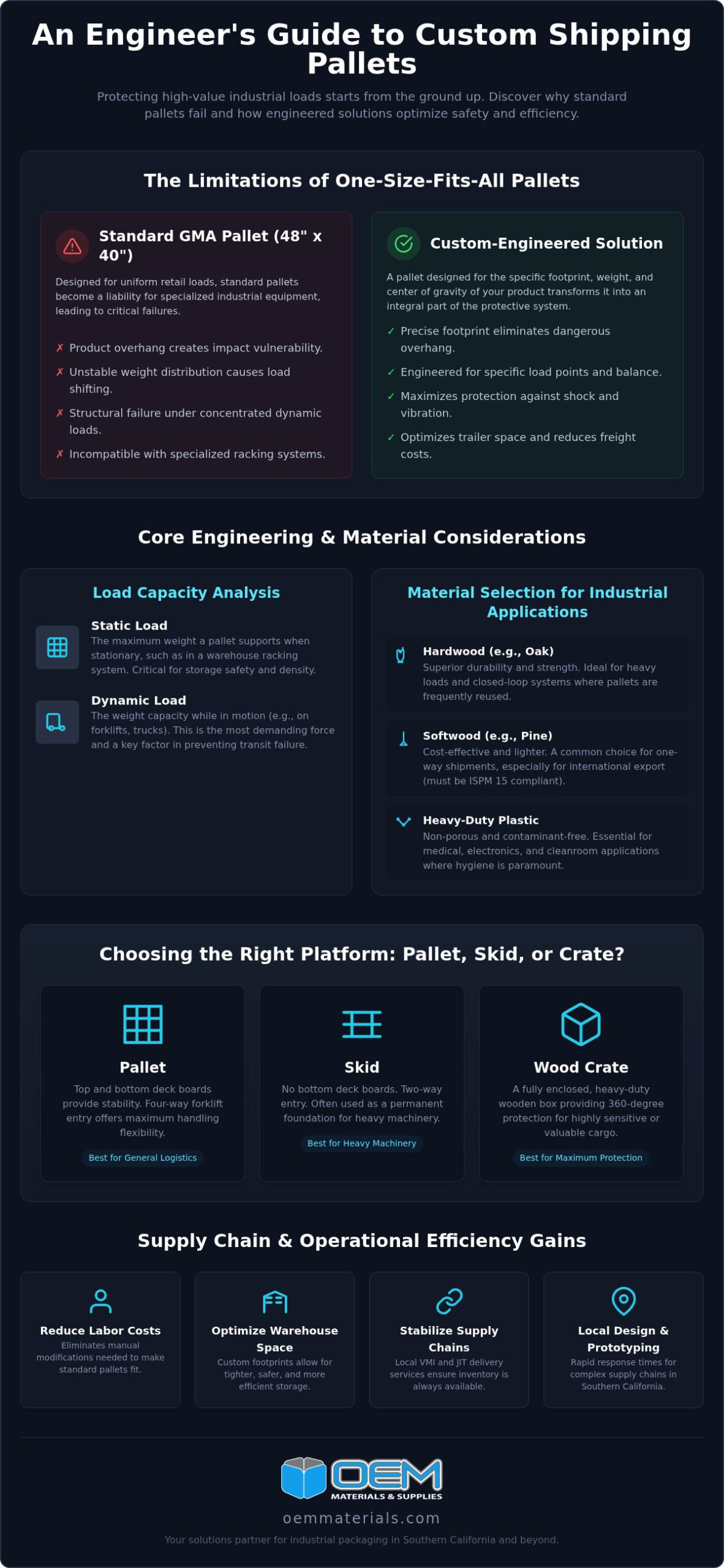
The 48 by 40 inch GMA pallet is the workhorse of the American logistics system. However, for manufacturers in Los Angeles and Orange County producing specialized industrial equipment, this one-size-fits-all approach often creates more problems than it solves. When a product’s footprint exceeds these dimensions, or if its weight distribution is uneven, a standard pallet becomes a liability. Using custom shipping pallets ensures that the base of your load is engineered specifically for the item it carries, rather than forcing a precision-engineered component onto a generic platform.
The Limitations of the Standard GMA Pallet
Standard pallets are designed for uniform loads and typical retail distribution. In an industrial setting, these platforms often suffer from structural weaknesses when loads aren’t perfectly centered. If a heavy motor or medical imaging device sits on a standard pallet with incorrect stringer placement, the wood can deflect or snap under dynamic pressure. There are many pallet types and materials available, and standard wood grades may lack the density required for high-capacity industrial loads. These limitations often lead to incompatibility with specialized racking systems, creating safety hazards in modern warehouses.
Protecting High Value and Sensitive Equipment
Product overhang is a leading cause of transit damage. When a load extends beyond the edge of the pallet, it’s vulnerable to side impacts from forklifts and other cargo. It also prevents edge protectors from functioning correctly. Engineering a pallet to match the specific center of gravity of heavy machinery is a critical step in custom shipping pallets design. This level of precision reduces vibration and shock during transit, which is vital for the aerospace and medical device sectors. By integrating these bases with comprehensive custom packaging design, manufacturers can maximize trailer utilization. Custom footprints allow for tighter packing in a truck, which reduces shipping costs and prevents load shifting. This technical approach transforms the pallet from a simple commodity into a functional component of the protection system.
Engineering Factors in Custom Pallet Design and Material Selection
Designing custom shipping pallets requires a technical analysis that goes beyond simple measurements. Engineers must evaluate how a load interacts with its base under various environmental stresses. This process ensures compliance with federal standards for wooden packaging construction, which dictate specific requirements for material strength and fastener placement. A pallet that is under-engineered will fail during transit, while an over-engineered one creates unnecessary material costs and increases shipping weight.
Static and Dynamic Load Capacity Analysis
Understanding the difference between static and dynamic loads is critical for preventing structural failure. Static load refers to the maximum weight a pallet can support when it is stationary on a flat surface, such as in a warehouse rack. Dynamic load is the weight capacity while the pallet is in motion, specifically during forklift handling or while vibrating on a moving truck. Dynamic forces are significantly more taxing on the wood or plastic structure. Custom stringer placement allows for better weight distribution, aligning the strongest parts of the pallet with the specific pressure points of heavy machinery or irregular loads. This structural adjustment prevents deck boards from bowing or snapping when the pallet is lifted by forks with uneven spacing.
Material Selection for Industrial Applications
The choice between hardwood and softwood depends on the expected lifespan and weight of the shipment. Hardwoods like oak offer superior durability for closed-loop shipping cycles where pallets are reused multiple times. Softwoods are often preferred for one-way international shipments to manage costs. For medical device and electronics manufacturers in Orange County, heavy duty plastic pallets provide a non-porous, contaminant-free surface suitable for cleanroom environments. These materials eliminate the risk of wood-borne pests and moisture absorption.
Compliance is another major factor in material selection. For international export, wood pallets must meet ISPM 15 standards, requiring heat treatment to prevent pest migration. As of January 1, 2026, enforcement of the ISPM 15 hyphen requirement has intensified, making accurate compliance marks essential to avoid border delays. A missing hyphen between the country and facility code can lead to immediate re-exportation of the cargo. If you’re unsure which material or load capacity fits your application, you can request a technical consultation to review your specific product data, including dimensions and total weight.
Comparing Pallets, Skids, and Heavy Duty Wood Crates
In the industrial packaging sector, choosing the right base is as critical as the packaging itself. While the terms are often used interchangeably, pallets, skids, and crates serve distinct logistical purposes. Custom shipping pallets are engineered for transport, but some projects require the simplicity of a skid or the total enclosure of a heavy duty wood crate. Understanding these structural differences prevents equipment damage and reduces unnecessary material spend for manufacturers in Orange County and Los Angeles.
Pallets vs Skids: Structural Differences
A skid is essentially a pallet without bottom deck boards. This design creates a lower profile and allows for easier dragging across a factory floor, but it lacks the stacking stability of a true pallet. Because skids only have top deck boards and stringers, they are typically two way entry only. This makes them incompatible with standard pallet jacks that require bottom board clearance for the load wheels. However, skids are technically superior for permanent machinery mounting. If a piece of equipment must remain on its base during operation, a custom skid provides a rigid, low-clearance platform that can be bolted directly to the machine frame. For mobile logistics, the bottom deck boards of a pallet are necessary to distribute the weight across racking and to provide the structural integrity required for four way entry forklift access.
Custom Pallets as the Foundation for Wood Crates
For maximum protection, custom shipping pallets serve as the structural floor for fully enclosed custom crates. In this application, the pallet must be designed to support the weight of the product and the vertical compression of the crate walls and lid. This is particularly important for aerospace components or sensitive medical equipment shipped through Southern California ports where stacking in containers is common.
Internal blocking and bracing are attached directly to the pallet deck to immobilize the load. This technique prevents lateral movement inside the crate, which is a primary cause of internal damage. While transitioning from a pallet to a full crate increases material costs, it’s a necessary investment for high-value items where environmental exposure or side-impact damage is a risk. We often recommend this integrated approach for electronics and automotive parts that require a secondary layer of shielding beyond stretch film and edge protectors. The pallet base ensures the entire unit remains forklift-accessible while the crate enclosure provides the ultimate barrier against the rigors of the supply chain.
Optimizing Supply Chain Efficiency with Custom Pallet Solutions
Supply chain efficiency is often measured in seconds saved on the assembly line or dollars reduced in freight. However, the most significant gains frequently come from removing friction in the packaging process. By integrating custom shipping pallets into pre-assembled packaging kits, manufacturers can drastically reduce labor costs. Instead of warehouse personnel spending valuable time sourcing separate components, a complete kit including the pallet, foam inserts, and corrugated boxes arrives ready for immediate use. This streamlined approach is particularly effective for high-volume aerospace and medical device production in the Inland Empire and Orange County.
Load Stabilization and Stretch Film Compatibility
A pallet is only as effective as the load stabilization system surrounding it. When custom shipping pallets are sized incorrectly for the product, it becomes difficult to achieve the necessary containment force with stretch film. If the pallet footprint is too large, the film cannot grip the base of the load securely, leading to shifting during transit. Conversely, improper sizing often causes “elephant footing,” where the film bunches at the bottom without providing structural support. Utilizing the correct stretch film for pallet wrapping ensures that the film and the pallet work together as a single unit to maintain load integrity through every turn and stop of the delivery truck.
Leveraging Vendor Managed Inventory for Pallets
Pallets are bulky assets that consume expensive warehouse square footage. For facilities in Los Angeles and San Diego where space is at a premium, implementing a packaging VMI services program is a strategic remedy. Under a VMI model, we monitor your production schedules and maintain a buffer of custom pallets at our facility, delivering them just-in-time as your assembly line requires. This predictive ordering based on production schedules in San Diego and Riverside eliminates the risk of pallet shortages that can halt production. It also removes the burden of inventory management from your procurement team, allowing them to focus on core operations. If you are struggling with inconsistent lead times or excessive warehouse overhead, you can request a quote to see how a managed inventory program can stabilize your Southern California logistics.
Sourcing Custom Pallets in Southern California: The OEM Materials Approach
Southern California manufacturers require more than just a pallet supplier; they need a technical partner who understands the localized pressures of the Los Angeles and Orange County logistics hubs. Our approach treats the pallet as a specialized industrial component rather than a commodity. We provide rapid response times for both short run prototypes and high volume production, ensuring that your assembly line never stalls due to a lack of specialized platforms. Reliability in the supply chain starts with a partner who can scale production based on your real-world demand.
Prototyping and Custom Design Services
Developing custom shipping pallets begins with a rigorous design phase. We develop physical prototypes for fit-testing with your industrial equipment, allowing engineers to verify mounting points and center-of-gravity stability before full-scale production begins. This engineering review process ensures that every platform meets safety and compliance standards specific to your industry. Our design team serves the San Diego and Riverside manufacturing corridors, providing professional consultations to solve complex logistical challenges. This local presence allows for faster iterations and more accurate fit-testing than national vendors who lack a physical footprint in Southern California.
Integrated Packaging Kits and Assembly
We solve the common problem of fragmented supply chains by offering integrated packaging solutions. Instead of managing multiple vendors, you can receive complete packaging kits that include pallets, corrugated boxes, and custom foam packaging. This system-wide approach lowers the total landed cost by streamlining the assembly process at your facility. When every component is designed to fit together, you eliminate the labor costs associated with modifying standard materials to fit your product. It’s a functional remedy for manufacturers looking to optimize their internal packing speeds.
To provide an accurate recommendation, our team requires specific data points including your product dimensions, total weight, and estimated annual usage. This information allows us to engineer custom shipping pallets that balance material strength with cost efficiency. Sensitive medical electronics and heavy aerospace sub-assemblies alike require a custom-engineered base to ensure a damage-free supply chain. Contact us to schedule a professional consultation or to request a prototype for your next project.
Stabilize Your Southern California Supply Chain
Precision-engineered packaging is the difference between a successful delivery and a costly insurance claim. By moving beyond standard GMA dimensions and utilizing custom shipping pallets, you align your logistics strategy with the actual physical requirements of your equipment. This technical approach, combined with vendor-managed inventory and pre-assembled kitting, allows manufacturers to reclaim warehouse space and reduce manual labor. A well-designed base is not just a platform; it’s a critical component of your product’s protection system.
We serve the manufacturing corridors of Los Angeles, Orange County, San Diego, and Riverside with expert design services tailored specifically for the aerospace and medical sectors. Our team is ready to help you solve complex shipping challenges with reliable, high-performance solutions that meet both domestic and international standards. To receive a recommendation based on your specific load requirements, please request a custom pallet quote from OEM Materials & Supplies. We look forward to helping you optimize your distribution process and build a more resilient supply chain.
Frequently Asked Questions
What is the difference between a custom pallet and a standard pallet?
Standard pallets, such as the 48 by 40 inch GMA model, are built for generic retail distribution and uniform loads. Custom pallets are engineered for specific product dimensions, weight distributions, and transit environments. They eliminate issues like product overhang and insufficient load support. For manufacturers in Los Angeles and Orange County, this means a base that matches the exact footprint of high-value machinery or sensitive electronics, providing superior protection over one-size-fits-all platforms.
How do I determine the correct load capacity for a custom pallet?
Determining load capacity requires analyzing both static and dynamic forces. Static capacity is the weight limit when stationary; dynamic capacity accounts for the stresses of forklift handling and truck vibrations. We evaluate the weight of your product, its center of gravity, and the intended shipping route. Engineers also consider stringer placement and deck board thickness to ensure the pallet supports the load without deflection during transit through complex Southern California logistics hubs.
Are custom wood pallets compliant with international shipping regulations?
Yes, custom wood pallets can be manufactured to meet ISPM 15 standards for international export. This requires the wood to be heat-treated to prevent the spread of wood-borne pests. As of January 1, 2026, enforcement of the ISPM 15 hyphen requirement has increased. Our compliance marks include the mandatory hyphen between the country code and facility code to prevent re-exportation or delays at international borders for our Riverside and San Diego clients.
When should a manufacturer choose plastic pallets over wood for custom applications?
Plastic pallets are the preferred choice for environments requiring high levels of hygiene or moisture resistance. Medical device and electronics manufacturers often select heavy duty plastic for cleanroom use because they are non-porous and free of dust or pests. While wood is cost-effective for one-way shipments, plastic provides superior durability for closed-loop systems where the pallet is reused multiple times within a controlled supply chain in the Inland Empire.
Can custom pallets be designed to integrate with automated warehouse systems?
Custom designs are essential for compatibility with automated storage and retrieval systems (ASRS). Automated systems require precise tolerances for pallet dimensions and bottom deck board placement to ensure sensors and conveyors function correctly. We engineer custom shipping pallets with specific block or stringer configurations that prevent jams and system errors, allowing Southern California facilities to maximize their investment in warehouse automation while reducing the risk of equipment downtime.
How does a vendor managed inventory program work for custom pallets?
A vendor managed inventory (VMI) program transfers the responsibility of inventory tracking to the supplier. We monitor your production schedules and maintain a buffer of custom pallets at our facility. This ensures you have a consistent supply without consuming valuable warehouse space in high-rent areas like Los Angeles. Deliveries are made just-in-time, allowing your team to focus on manufacturing rather than procurement and storage logistics, which stabilizes your overall supply chain.
What information is needed to get an accurate quote for custom shipping pallets?
To provide a precise recommendation, we require the dimensions and weight of your product. You should also specify the shipping environment, such as whether it is a one-way international trip or a local closed-loop cycle. Providing data on annual usage and storage requirements helps us optimize material selection. This information allows our design team to create a custom shipping pallets prototype that balances structural integrity with cost-efficiency tailored to your specific industrial application.
Do custom pallets help reduce overall shipping costs?
Custom pallets reduce total landed costs by optimizing trailer utilization and preventing product damage. Standard pallets often lead to wasted space or require expensive secondary packaging to fix overhang issues. By engineering a base with the correct footprint, you can fit more units per truckload and eliminate the labor costs associated with manual modifications. These savings depend on variables like product dimensions, material weight, and the specific shipping requirements of your Southern California operation.