
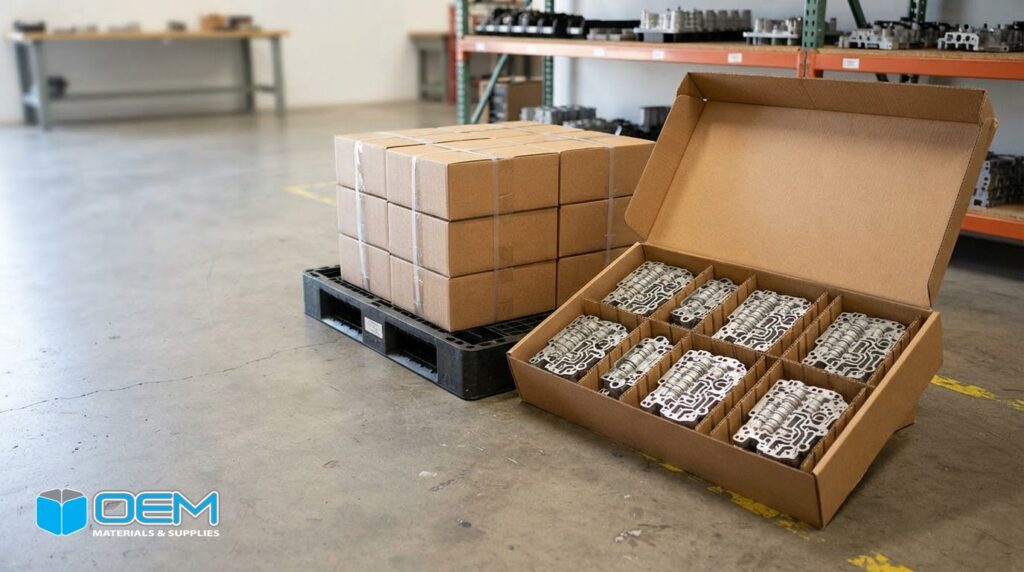
Packaging is part of product quality, not a shipping afterthought. Under IATF 16949:2016, packaging and labeling support product preservation under Clause 8.5.4.1, “Preservation – Supplemental.” The IATF 16949 packaging and labeling requirements work alongside applicable customer-specific requirements; the standard is a quality management system standard, not a standalone labeling specification.
For automotive suppliers, that distinction matters. A package must do more than contain a part: it needs to help protect the product and support the customer’s handling and identification needs. The exact requirements can vary by customer, so a general packaging approach may not satisfy every contract or shipment.
This article explains how IATF 16949:2016 relates to packaging and labeling, where customer-specific requirements fit, and how preservation connects packaging choices to product condition. It also clarifies what the standard requires at a system level, so purchasing, quality, operations, and warehouse teams can align their decisions with documented customer expectations.
Key Takeaways
- Understand how IATF 16949:2016 builds on ISO 9001:2015 for automotive production, service, and accessory parts.
- Identify where customer-specific requirements fit into your quality management system and packaging decisions.
- See how Clause 8.5.4.1 connects packaging and labeling to product preservation.
- Learn what to consider when aligning package identification and traceability with customer expectations.
- Explore how packaging process validation and documented information support consistent execution.
First, What Is IATF 16949:2016?
IATF 16949:2016 is an automotive quality management system standard, not a labeling standard. It sets requirements for organizations involved in automotive production, service, and accessory parts. The standard is designed to be used with ISO 9001:2015. Together, they establish a quality management framework for automotive suppliers and manufacturers.
The International Automotive Task Force formed the automotive standard in 1999, when it was titled ISO/TS 16949. ISO/TS 16949:1999 was first published in June 1999. The IATF published IATF 16949:2016 on October 3, 2016, replacing ISO/TS 16949. The 2016 standard incorporates ISO 9001 requirements and adds automotive-specific controls.
This scope affects more than a finished vehicle assembly line. It covers organizations producing automotive parts, providing related services, or supplying accessory parts. Its requirements address how an organization manages quality across its processes, including the work that influences product conformity. The IATF 16949 packaging and labeling requirements fit into this wider system rather than operating as an independent label specification.
Certification applies to specific sites where value-added manufacturing processes take place. A company with multiple facilities, for example, considers which locations perform those processes when defining its certification scope. This site-based approach links the quality management system to actual production activity rather than assuming every business location is covered.
Product design responsibilities also affect the system’s scope. An organization may exclude product design and development requirements when it does not control the part’s specifications, but it cannot exclude manufacturing process design. A supplier that receives a customer-defined part specification may therefore have different product-design responsibilities from a company that develops the part, while both remain responsible for their manufacturing processes.
For automotive supply chains, the standard provides a shared structure for controlling quality across production and related services. Customer-specific requirements apply alongside IATF 16949:2016, so organizations must account for applicable customer expectations within their quality management system. Packaging and labeling decisions belong in that context: they support product handling and preservation, while their detailed requirements depend on the relevant customer requirements. This distinction helps teams separate the standard’s system-level controls from contract-specific packaging instructions.
About 30 percent of more than 100 existing motorcar manufacturers follow IATF 16949 requirements. This figure places the standard within a broad manufacturing landscape, while also showing that following it is not universal among the manufacturers counted. The standard’s role is best understood through its requirements and the organizations’ quality systems, rather than as a label or a guarantee attached to every automotive product.
For suppliers, its relevance lies in organizing quality controls across the activities in scope and addressing applicable customer-specific requirements. Packaging and labeling remain part of that wider quality work, with their detailed expectations tied to the relevant customer requirements.
Applicable customer-specific requirements
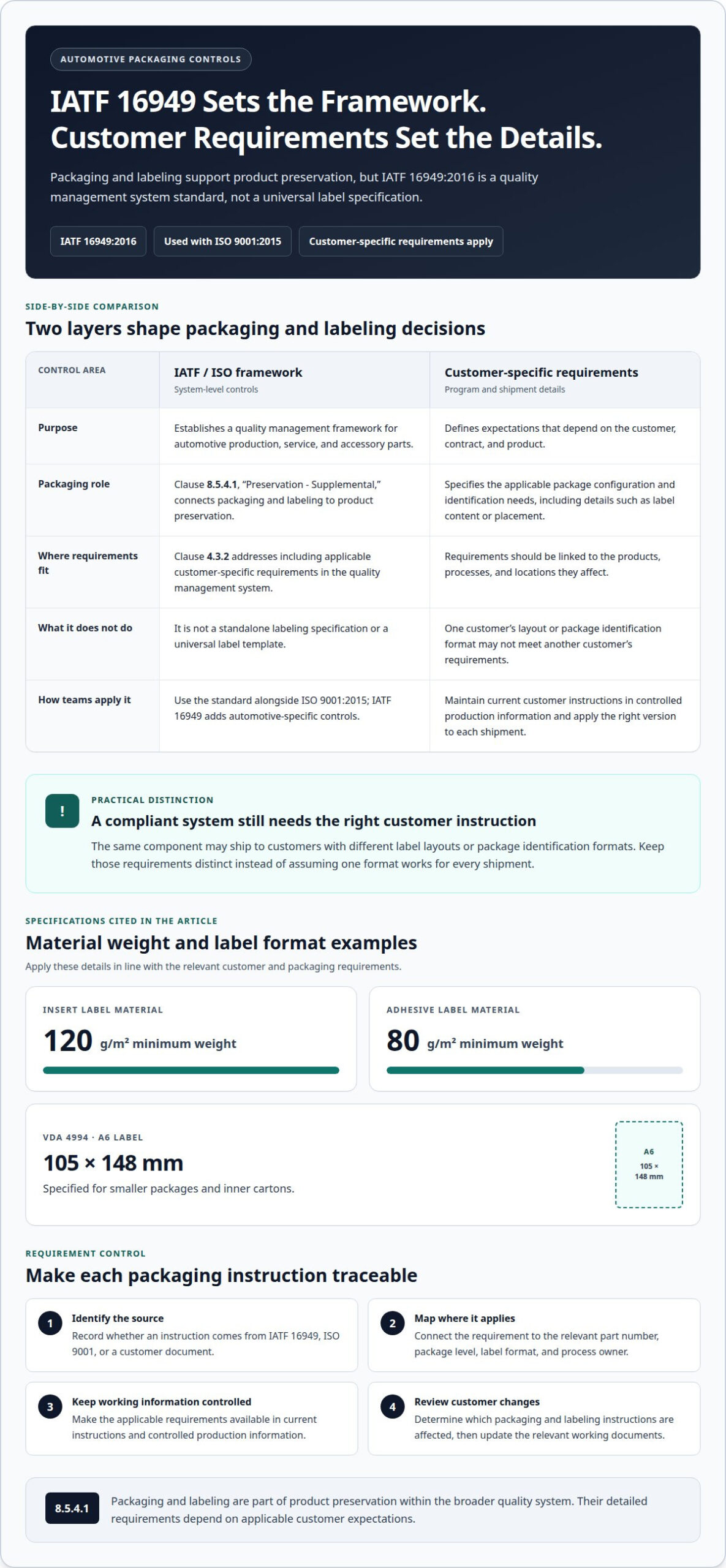
ISO 9001:2015 provides the broader quality management framework; IATF 16949 adds automotive-specific controls. Customer-specific requirements add another layer, defining expectations that depend on the customer, contract, and product. Clause 4.3.2 addresses including applicable customer-specific requirements within the organization’s quality management system. The IATF standard itself is not a universal label template.
For packaging and labeling, that distinction affects the details teams must apply. A customer may define label content, package identification, label placement, or packaging configuration in its requirements. The IATF 16949 packaging and labeling requirements operate alongside those customer instructions, rather than replacing them. Teams should connect applicable requirements to the products, processes, and locations they affect.
A practical way to manage the difference is to map each requirement to its source and application. For example, record whether an instruction comes from IATF 16949, ISO 9001, or a customer document. Then identify the relevant part number, package level, label format, and process owner. This makes it easier to distinguish standard-wide controls from instructions that apply to a particular customer program.
Label-material specifications also show why customer context matters. The listed minimum weight is 120 g/m² for insert label material and 80 g/m² for adhesive label material. VDA 4994 specifies an A6 label size of 105 × 148 mm for smaller packages and inner cartons. These details should be applied in line with the relevant customer and packaging requirements.
Consider a supplier shipping the same component to two automotive customers. One may require a particular label layout, while the other specifies a different package identification format. The supplier’s quality system should preserve those distinctions in current instructions and controlled production information. Using one customer’s layout for both shipments can create a mismatch even when the component is correct.
Customer documents can change, so a controlled review process helps teams identify revised specifications, determine which packaging and labeling instructions are affected, and update working documents. Purchasing, quality, production, and warehouse teams need access to the applicable version. For example, a warehouse label check should use the requirements for that customer’s shipment, not a superseded work instruction.
Clause 4.3.2 makes customer-specific requirements part of the quality management system’s scope. It does not make every customer’s packaging instructions identical. The useful distinction is between the management system framework and the contract-level details: the former establishes how requirements are managed, while the latter defines the applicable package and label expectations for each customer relationship.
Packaging and labeling under product preservation
Auditors may review customer packaging specifications, approved work instructions, label checks, and records showing how products are preserved. Common issues include using an outdated instruction, applying the wrong customer label, or failing to follow a documented packaging method.
IATF 16949:2016 Clause 8.5.4.1, “Preservation – Supplemental,” connects packaging and labeling with product preservation. The aim is to maintain product condition during handling, storage, and delivery. Packaging controls should reflect the part’s characteristics and the conditions it encounters. For example, a surface-sensitive component needs packaging that prevents contact damage during normal handling.
The IATF 16949 packaging and labeling requirements sit within a broader preservation process. Packaging protects the product; labeling helps identify and handle it according to applicable instructions. A correct label cannot compensate for packaging that allows damage. Likewise, suitable cushioning does not correct a label that identifies the wrong part or shipment.
Automotive product audits may check packaging and labeling requirements, making packing part of product-quality verification rather than merely a warehouse task. An audit might compare a packed part with its current packaging instruction, then check whether required identification is legible and correctly placed. The audit scope follows the applicable product and customer requirements.
Barcode performance is another control to consider where customer requirements call for it. ISO/IEC 15416 barcode quality Grade 3.0 (B) or higher is specified for automotive labels. A verification record can show whether scanned labels meet the applicable quality threshold. If a barcode fails to scan, the label may not reliably support identification at the next supply-chain handoff.
Preservation evidence should link the approved method to actual packing activity. Useful records may include the applicable packaging specification, current work instruction, inspection or label-verification results, and documented responses to identified problems. For each customer shipment, teams should be able to trace which instruction governed the package and what checks were completed before release.
Common breakdowns often start with a gap between controlled documentation and floor practice. A revised customer instruction may not reach the packing station, or an employee may use an old label template. A damaged package found before shipment can also show that the selected method does not adequately preserve the part. Recording the issue, containment, and corrective action demonstrates how the organization addressed it.
Keep packaging records tied to the relevant product and customer instruction. This connection helps quality, production, and warehouse teams apply consistent preservation controls and gives auditors a clear trail from requirement to packed product.
What are the IATF 16949 requirements for lot identification and traceability on packaging?
IATF 16949 does not establish one universal lot-label template for every automotive package. Applicable customer-specific requirements determine which identifiers belong on a shipment and how they must appear. A supplier should connect each package to the relevant customer instruction, part, and production lot. That connection helps receiving teams identify material and supports investigation if a quality issue occurs.
Lot identification links packaged parts to a defined production group. Traceability connects that group to records such as production, inspection, and shipment information. For example, a carton label might carry the customer item number and lot identifier required by the customer. Internal records can then associate those identifiers with the corresponding production and inspection data.
VDA 4994 provides a defined Package ID structure. It assigns 9 digits to the serial number and 4-13 digits to the customer item number. Those fields offer a format reference for package identification, but they do not make every VDA field mandatory for every customer. The applicable customer requirement determines which format and data elements govern a shipment.
Different package levels may also need distinct identification. An inner-carton label may identify its contents, while a master-carton label identifies the larger handling unit. If a master carton contains multiple inner cartons, the supplier’s identification process should preserve the link between each inner package and the outer package. Customer instructions define the required level of detail.
Consistency matters at every handoff. Before release, a warehouse operator should compare the physical package with the current shipping instruction. If the label’s item number differs from the packing record, the link between the product and its records can break. Scanning or visual checks can help catch the mismatch before the package leaves the facility.
To support effective traceability, map each required identifier to its source record and package level. A lot code should lead back to the applicable production information, while the customer item number should match the customer’s identification instruction. This mapping also helps teams determine which shipments may be affected if a lot requires investigation.
Customer-specific instructions remain central. One customer may require a Package ID format, while another defines different label data or package-level identification. Quality, production, and warehouse teams should use the controlled instruction applicable to each shipment. A shared review process helps keep label templates and packing records aligned as customer requirements change.
How should organizations validate packaging and labeling processes and maintain documented information?
Start with the customer’s approved packaging and labeling requirements. Translate them into controlled work instructions covering package configuration, label fields and placement, and inspection method. For example, a packing instruction can show the approved container, internal protection, label location, and required part identification. Operators then have a clear reference at the packing station.
Evaluate the process under representative operating conditions. A packaging trial can assess whether the chosen configuration protects the part through normal handling and shipping conditions. A label check can confirm that the correct template prints, required data appears, and the barcode scans with the organization’s equipment. Record the trial conditions, results, issues, and changes made before release.
For product approval, IATF 16949 Clause 8.3.4.4 addresses approval conforming to customer requirements and references PPAP. Packaging or label changes that affect customer approval should follow the applicable customer process. Clause 8.3.2.1 references APQP as an example of multidisciplinary planning involving internal and external stakeholders. Quality, engineering, production, and logistics can therefore coordinate packaging decisions during planning.
Keep documented information connected to the process it controls. Useful records may include the current customer specification, approved packaging instruction, label template, validation results, and completed verification records. For each shipment, the organization should be able to identify the applicable instruction and checks performed. Version control helps prevent an obsolete label file or work instruction from returning to use.
When requirements or materials change, assess the affected process before using the revised configuration. A change to a carton layout, for example, may affect label placement, packing sequence, or product restraint. Document the change review, relevant approval, updated instruction, and operator communication. If verification finds an incorrect label or inadequate protection, retain the finding and corrective-action records with the related process documentation.
Internal audits can compare documented instructions with actual packing activity. An auditor might select a customer shipment, review its applicable specification, and observe whether the packing station follows the instruction. The organization can also review label-verification and change records for consistency. These checks help uncover gaps between approved requirements and routine execution.
For packaging materials that need to be matched to a defined product and packing method, request a packaging quote with the part dimensions, weight, and shipping conditions.
OEM Materials & Supplies: Corrugated Boxes
OEM Materials & Supplies provides corrugated boxes designed to support a product’s packaging and handling needs. Corrugated boxes can serve as outer containers for organized packing and clear label placement. For parts needing added cushioning, foam packaging can help separate or protect items inside the package. Packaging kits bring components together for a defined packing application.
When discussing a packaging requirement, share the part dimensions, weight, shipping conditions, and applicable customer packaging instructions. These details help shape a recommendation around the product and shipping process. The customer’s controlled requirements remain the governing reference for labeling and package identification.
Contact OEM Materials & Supplies to discuss corrugated boxes, foam packaging, or packaging kits for your application.
Put Your Packaging Plan Into Practice
Use the next packaging review to connect customer instructions with decisions at the packing station. Bring quality, engineering, procurement, and warehouse teams together around the same approved requirements. This alignment can help keep packaging specifications, label templates, and daily handling practices consistent.
Applying the IATF 16949 packaging and labeling requirements starts with understanding the customer’s needs and how the package must preserve the product. Then assess whether the packaging configuration supports the part through its intended handling and shipment. Corrugated boxes, foam packaging, and packaging kits can support different packaging applications, depending on product and process needs.
For a packaging project, prepare the product dimensions, weight, shipping conditions, and applicable customer instructions. These details give the discussion a practical starting point. Share your packaging requirements with OEM Materials & Supplies to discuss an appropriate packaging solution for your operation.
A controlled, product-focused plan gives your teams a clear basis for consistent packing and ongoing review. Start with the requirements most relevant to the next shipment, then build from there.
Frequently Asked Questions
What does IATF 16949 require for packaging and labeling?
IATF 16949 requires packaging controls that support product conformity, but it does not prescribe one universal shipping-label layout. In practice, compare the packaging instruction with the actual packed unit before release. Check that the selected protection fits the part, that labels remain readable after packing, and that required information transfers correctly into the shipping record. These checks help catch execution errors beyond template approval.
Which IATF 16949 clauses cover product identification, traceability, preservation, packaging, and shipping labels?
Clause 8.5.4.1 addresses preservation, while Clause 4.3.2 addresses customer-specific requirements in the quality management system. These clauses do not provide one complete shipping-label specification. For traceability, distinguish the label’s visible identifiers from the internal records that connect a shipped unit to its production history. Keep the applicable requirements clear in the organization’s controlled process documents.
What customer-specific packaging and labeling requirements must suppliers follow under IATF 16949?
Suppliers must follow the customer’s applicable packaging and labeling instructions for the program and shipment. A useful control is a customer-by-part matrix that identifies which packaging instruction and label template apply to each item. For a mixed-customer production line, this helps prevent operators from selecting a similar-looking template intended for another program. Keep the matrix aligned with current customer documentation.
How should suppliers protect products from damage, contamination, corrosion, and deterioration during storage and transport?
Match protection to the product’s exposure risks during storage, staging, loading, and transport. A part with a finished surface, for example, may need separation from other components, while moisture-sensitive items require attention to the storage environment and packaging barrier. Review the route and handling transitions, not just the final container. Define inspection points for visible damage or contamination before shipment.
What steps should a supplier take to implement compliant packaging and labeling controls?
Create a control plan that assigns ownership for packaging specifications, label-template changes, and shipment checks. Test the process with a representative order, including mixed quantities or package levels if these occur in production. Confirm that operators can find the correct instruction at the workstation and that shipment records match the packed goods. Review discrepancies with affected teams and update controlled documents before routine use.