
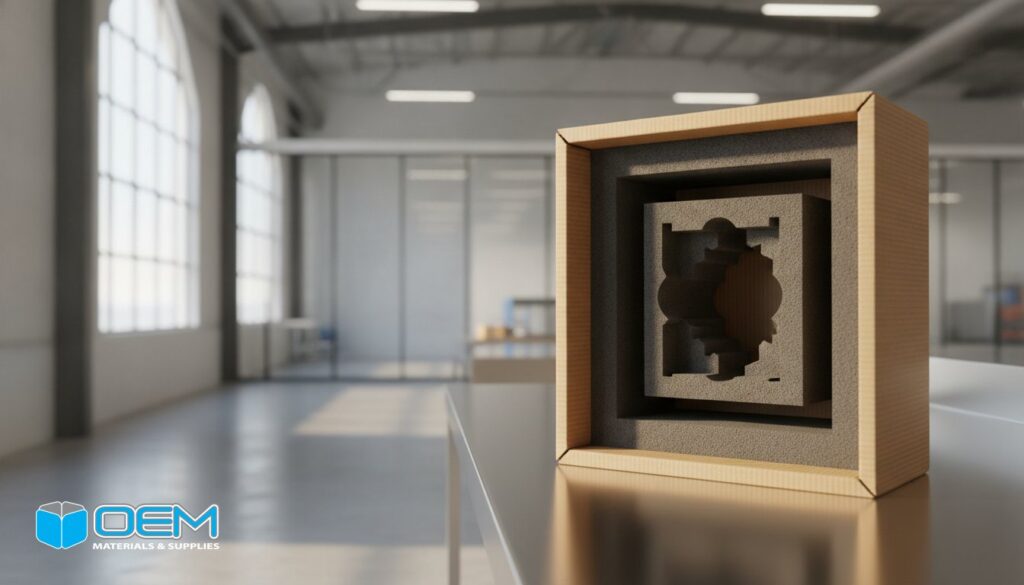
A standard shipping box is often the most expensive component in your supply chain, not because of its material cost, but because of the damage it fails to prevent. For manufacturers in aerospace, medical devices, and electronics, a generic container rarely provides the structural integrity required for sensitive components. You likely recognize the frustration of high product damage rates during transit or the bottleneck created by excessive packing time on the assembly line. Effective die cut packaging design solves these logistical hurdles by creating a physical extension of the product itself, ensuring every contour is supported and every vibration is dampened.
This guide provides a technical overview of how engineered die-cut solutions protect complex components, reduce labor costs, and optimize your Southern California supply chain. We’ll examine the relationship between custom corrugated structures and precision foam inserts, showing how the right geometry can lower shipping costs while utilizing local prototyping to maintain a lean, responsive operation.
Key Takeaways
- Understand the technical differences between standard RSC boxes and custom die cut packaging design to ensure your components receive precise structural support.
- Learn how to select the correct corrugated flute size and integrate engineered foam inserts for high-performance, multi-material protection.
- Identify specific methods to reduce assembly labor and freight costs by optimizing the geometry and palletization of your industrial packaging.
- Discover the advantages of working with a Southern California partner for rapid prototyping and vendor-managed inventory to maintain a lean supply chain.
What is Industrial Die Cut Packaging Design?
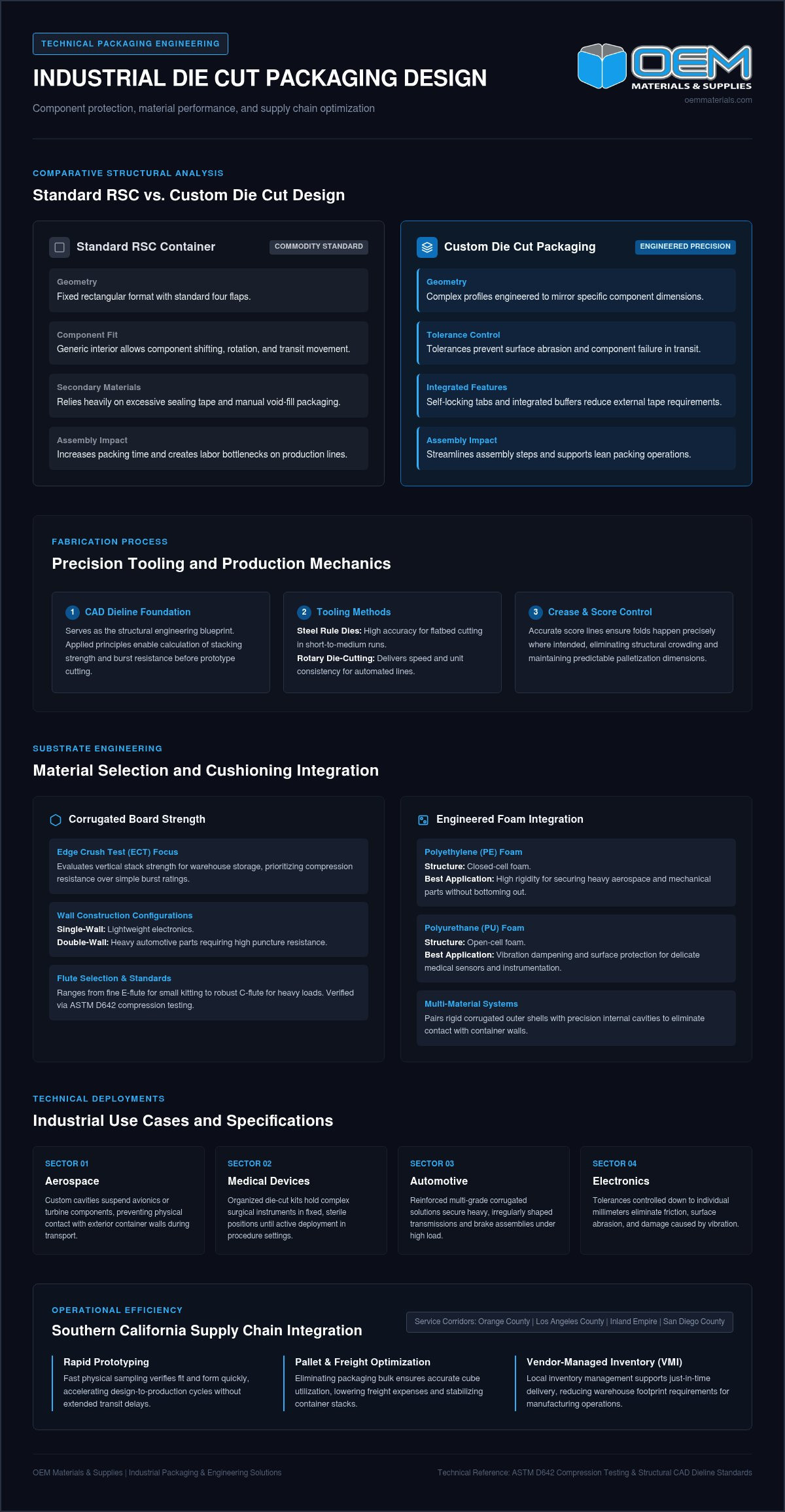
Industrial die-cutting is a precision fabrication process that uses specialized tooling to cut, score, and crease materials into specific shapes. While a standard Regular Slotted Container (RSC) follows a fixed rectangular format with four flaps, die cut packaging design allows for complex geometries that mirror the physical profile of an industrial component. This process transforms a flat sheet of corrugated board or foam into a high-performance protective shell. Industrial applications require significantly tighter tolerances than retail packaging. In sectors like aerospace or medical manufacturing, a variance of just a few millimeters can lead to internal movement, surface abrasion, or component failure during transit.
The foundation of every custom project is the dieline. This technical CAD drawing serves as the blueprint for the structural integrity of the container. By applying established corrugated box design principles, engineers can calculate stacking strength and burst resistance before the first prototype is ever cut. Unlike basic boxes that rely on excessive tape and void fill, a well-engineered die-cut solution often features self-locking tabs and integrated buffers that simplify assembly while providing superior protection.
The Mechanics of Precision Die Cutting
High-quality results depend on the specific tooling used during production. Steel rule dies are the standard for flatbed cutting, offering high accuracy for short to medium-run projects common in Southern California’s specialized manufacturing hubs. For high-volume requirements, rotary die-cutting provides incredible speed and consistency. These tools create identical units every time, which is vital for automated assembly lines. Accurate crease and score lines ensure the material folds exactly where intended, preventing the structural “crowding” that can occur with inferior custom packaging design. When creases are precise, the box maintains its intended dimensions, allowing for predictable palletization and storage.
Industrial Use Cases for Die Cut Solutions
Different industries leverage die-cutting to solve specific logistical challenges. In the aerospace sector, engineers use custom-fit cavities to suspend sensitive avionics or turbine components, preventing contact with the outer walls of the container. Medical device manufacturers utilize die-cut kits to organize complex surgical instruments, ensuring every piece remains in a fixed, sterile position until use. For automotive suppliers, reinforced corrugated structures are designed to hold heavy, irregularly shaped parts like transmissions or brake assemblies. These designs often incorporate multiple material grades to provide the necessary puncture resistance and load-bearing capacity for heavy industrial freight.
Evaluating Material Performance for Custom Designs
The success of a die cut packaging design depends as much on material science as it does on structural geometry. Selecting a substrate is not a matter of aesthetics; it is a technical decision based on the weight, fragility, and sensitivity of the industrial component. In the manufacturing hubs of San Diego and the Inland Empire, procurement teams must balance the need for high-performance protection with the practicalities of shipping weight and storage space. Material choice directly influences the durability of the die-cut tool and the long-term repeatability of the packaging’s protective qualities.
Corrugated Strength and Flute Selection
Vertical stack strength is the primary concern for warehouse operations. To ensure a container can withstand the rigors of palletized transit, engineers look at Edge Crush Test (ECT) ratings rather than simple burst strength. While single-wall corrugated board is sufficient for lightweight electronics, heavy-duty automotive parts often require double-wall construction to prevent wall collapse. The flute profile, from the fine E-flute used for small kits to the robust C-flute for larger shipments, determines the cushioning and compression resistance of the box. Professionals often utilize ASTM D642 compression testing to verify that a custom design can support the intended load under real-world conditions. You can find detailed technical specifications for these materials in our catalog of corrugated boxes.
Integrating Engineered Foam Inserts
Corrugated board provides the outer shell, but internal protection often requires a multi-material approach. Polyethylene (PE) foam is a closed-cell material preferred for its rigidity and ability to secure heavy aerospace parts. In contrast, polyurethane (PU) foam is an open-cell option better suited for vibration dampening and protecting delicate medical sensors. Effective die cut packaging design uses these materials to create custom cavities that lock products into a “floating” position, preventing any contact with the outer box walls. This method eliminates the need for loose-fill peanuts or excessive bubble wrap, reducing both material waste and assembly time. For specialized components, exploring various foam packaging options is essential to find the right density for your specific part geometry.
Electronics and medical devices introduce additional requirements, such as Electrostatic Discharge (ESD) protection or cleanroom compatibility. Anti-static foams and corrugated coatings prevent static buildup that could fry sensitive circuits during handling. For medical applications, materials must be low-linting and capable of maintaining integrity in temperature-controlled environments. If you are unsure which material grade meets your industry’s compliance standards, it’s best to consult with a packaging specialist to review your product’s technical data sheet and shipping profile.
The Design Process: From Prototype to Production
The engineering phase is where theoretical protection meets practical manufacturing. It begins with a detailed assessment of the component’s center of gravity, surface sensitivity, and total weight. A die cut packaging design must account for these variables to ensure the structural load is distributed across the strongest points of the corrugated board. This initial consultation prevents common failures, such as bottoming out during transit or wall punctures caused by shifting parts. By understanding the specific logistics profile of your supply chain, designers can anticipate the stresses your product will face.
CAD Design and Dieline Engineering
Transitioning from a three-dimensional part to a two-dimensional flat pattern requires specialized CAD software. Engineers precisely calculate fold allowances and material thickness to ensure the final product fits snugly without stressing the score lines. If these tolerances are off by even a fraction of an inch, the box may not close properly, or the internal foam inserts won’t align. Our custom packaging design services focus on creating these high-precision dielines, ensuring that every tab and slot functions as a structural lock. This technical precision is what differentiates industrial-grade packaging from standard folding cartons.
Validation is the next critical step. Before moving to high-volume production, the design should undergo rigorous transport simulation. Following ISTA transit testing protocols allows manufacturers to verify that the package can survive drops, side impacts, and high-frequency vibrations. These simulations replicate the harsh conditions of a long-haul truck or a busy distribution center, providing the data needed to refine the design before it reaches the assembly line.
Prototyping and Validation for SoCal Manufacturers
Proximity to a packaging partner is a strategic advantage for operations in Los Angeles and Orange County. Rapid prototyping allows engineers to test physical samples on their actual assembly lines within days. This local presence eliminates the communication gaps often found with overseas or out-of-state vendors. By testing a physical prototype, warehouse managers can identify if a design is too difficult to assemble or if it requires too much storage space. Reducing lead times during the prototyping phase means your production schedule stays on track. This iterative approach ensures the final high-volume run is optimized for both protection and operational speed.
While the primary goal of die cut packaging design is part protection, its impact on operational throughput is equally significant. In high-volume manufacturing environments, every second spent on the assembly line contributes to the total cost of goods sold. Standard boxes often require multiple strips of tape and secondary void fill, creating a labor-intensive process. Custom die-cut solutions eliminate these inefficiencies by integrating structural features that simplify the packing sequence.
Streamlining Assembly Line Labor
Custom designs often incorporate self-locking tabs and friction-fit inserts that secure the product without the need for excessive packaging tape. This reduction in material also translates to a reduction in motion. When a box is engineered for an intuitive packing sequence, warehouse staff can assemble and fill a unit in a fraction of the time required for a standard RSC. Reducing these touchpoints directly impacts your bottom line. For a more detailed breakdown of how these efficiencies scale, review our packaging cost savings analysis. By minimizing the “seconds per unit” metric, operations managers can reallocate labor to more critical manufacturing tasks.
Logistics and Warehouse Optimization
Space utilization in facilities across Riverside and the Inland Empire is a constant challenge. Die-cut supplies are delivered flat, significantly reducing their storage footprint compared to pre-assembled crates or bulky foam blocks. Custom-sized outer containers are also designed to maximize pallet density. By eliminating the “air” inside the box, you can fit more units per pallet, which lowers freight costs and improves pallet stability during transit. These designs facilitate packaging VMI programs. When a vendor manages your inventory, they can deliver assembly-ready kits just-in-time, ensuring you never face a stockout during a production surge.
Kitting services enhance these efficiencies by delivering all necessary components, including corrugated shells, foam inserts, and edge protectors, as a single, pre-sequenced unit. This approach prevents warehouse staff from having to pull materials from different aisles, which reduces the risk of assembly errors. In a vendor-managed inventory model, these kits are replenished based on your actual usage rates. This keeps your overhead low while maintaining high operational readiness. The synchronization between die cut packaging design and distribution is what transforms packaging from a commodity into a strategic asset.
If your current packing process is creating a bottleneck, contact us for a custom design audit to identify specific labor and freight savings for your operation.
Choosing a Die Cut Packaging Partner in Southern California
Selecting a partner for your die cut packaging design is a strategic decision that affects your entire production cycle. For industrial OEMs in Southern California, the choice often comes down to technical capability and geographic proximity. A supplier located near manufacturing hubs in San Diego or the Inland Empire provides a level of responsiveness that out-of-state vendors can’t match. This proximity is vital when you need to iterate on a prototype or adjust an order based on shifting demand. It’s about finding a guide who understands the intricacies of industrial supply chains and the rigorous standards of your specific sector.
Regional Logistics and Support
Local delivery to Orange County or San Diego factories reduces transit times and eliminates the freight volatility associated with long-haul shipping. A SoCal-based partner understands the specific regional logistics, from port congestion to local trucking routes. This local support allows for more personalized service, where engineers can meet on-site to solve complex industrial engineering challenges. Shipping sensitive medical equipment or heavy automotive parts requires a partner who can provide JIT delivery to ensure your warehouse isn’t cluttered with unused supplies. It’s a functional remedy for inventory bloat and high overhead costs.
Evaluating Supplier Capabilities
When vetting a potential partner, look beyond the price per unit. Ask about their tooling capabilities and the range of material grades they stock, including ESD-safe foams and high-ECT corrugated board. A versatile supplier should handle everything from short-run prototypes to high-volume production without compromising on precision. It’s also important to assess their experience in specialized sectors like aerospace and medical manufacturing, where compliance and durability are non-negotiable. They shouldn’t just sell boxes; they should provide engineered protection that integrates with your existing workflow.
Value-added services like kitting and assembly-ready packaging units further differentiate a true solutions partner from a commodity reseller. If a supplier can manage your inventory through a VMI program, it reduces your administrative burden and ensures consistent availability. You should also verify their ability to scale; as your production cycles fluctuate, your packaging partner must have the capacity to maintain lead times. This reliability is what builds long-term trust in a manufacturing partnership. To see how a tailored solution fits your operation, you can request a quote for custom die cut packaging based on your specific part dimensions, weight, and annual usage requirements.
Optimizing Your Industrial Supply Chain
Transitioning to a custom die cut packaging design is a strategic shift from basic containment to precision engineering. By integrating engineered foam inserts with high-strength corrugated board, manufacturers can virtually eliminate transit damage while simultaneously reducing assembly line labor. These solutions aren’t just about protection; they’re about optimizing the entire logistical footprint of your product. A local partnership in Southern California ensures your operation remains lean through rapid prototyping and inventory optimization services like VMI and JIT delivery.
We specialize in serving the rigorous requirements of the aerospace and medical device sectors across Orange County, San Diego, and the Inland Empire. Our team provides the technical expertise needed to verify fit and function through custom prototypes before you commit to mass production. It’s a proactive approach that secures your supply chain against the hidden costs of inefficiency and product loss. We’re ready to help you transition from commodity boxes to engineered solutions that meet your specific manufacturing standards.
Request a custom die-cut packaging quote for your manufacturing project. For the most accurate consultation, please provide your specific part dimensions, weight, and estimated annual usage. We look forward to helping you streamline your packaging operations.
Frequently Asked Questions
What is the typical lead time for a custom die-cut prototype?
Lead times for custom die-cut prototypes typically range from 48 to 72 hours depending on design complexity and material availability. Because our facility is located in Southern California, we can often provide faster turnaround for manufacturers in Orange County or Los Angeles. This speed allows your engineering team to verify fit and function early in the development cycle, preventing costly delays in your production schedule.
How do custom die-cut boxes reduce shipping damage compared to standard RSCs?
Custom die-cut designs reduce shipping damage by eliminating internal movement and providing structural support tailored to your part’s geometry. While a standard RSC relies on loose void fill, a precision die cut packaging design uses integrated buffers and locking features to suspend the product. This prevents the item from impacting the outer walls during transit, which is a common cause of failure for sensitive medical devices and electronics.
Are there minimum order quantities for custom industrial packaging designs?
We support a wide range of production scales, including short-run prototypes and high-volume industrial programs. We don’t enforce a rigid one-size-fits-all minimum; requirements vary based on material type and tooling costs. Our goal is to serve as a long-term partner for Southern California OEMs, whether you need 50 units for a specialized aerospace project or 50,000 units for a monthly distribution cycle.
Can die-cut packaging be designed for heavy aerospace components?
Yes, die-cut packaging is specifically engineered to secure heavy and irregularly shaped aerospace components. By utilizing high-ECT double-wall corrugated board and high-density polyethylene foam, these designs support significant weight while maintaining structural integrity. Our engineers in the Inland Empire and San Diego frequently design custom solutions for turbine parts, avionics, and structural assemblies that require puncture resistance and high compression strength.
What information is needed to start a custom dieline design?
To initiate a custom dieline design, we require the physical dimensions of your part, its total weight, and its center of gravity. It’s also helpful to know your shipping environment and annual usage requirements. Providing a CAD file or a physical sample allows our design team to create a snug fit that accounts for material thickness and fold allowances, ensuring the final package performs reliably in the field.
How does die-cut design impact kitting and assembly efficiency?
A well-engineered die cut packaging design significantly improves kitting efficiency by creating an intuitive, one-way assembly process. Because the components are designed to fit into specific cavities, it reduces the risk of packing errors and eliminates the need for complex instructions. When combined with our kitting services in Southern California, your staff receives assembly-ready units that minimize the time spent on the warehouse floor and reduce total labor costs.
Is it possible to integrate foam inserts directly into a die-cut box design?
We frequently integrate engineered foam inserts directly into die-cut box designs to provide multi-material protection. This synergy allows the corrugated shell to handle stacking strength while the foam provides vibration dampening and surface protection. These integrated units can be delivered as part of a vendor-managed inventory (VMI) program, ensuring your assembly line in Riverside or San Diego has a constant supply of ready-to-use protective packaging.
Are there sustainable material options for industrial die-cut packaging?
Industrial die-cut packaging offers several sustainable options, including high-recycled content corrugated board and biodegradable cushioning materials. Since die-cutting allows for precise nesting of parts, it naturally reduces material waste during the manufacturing process. Many of our clients in Orange County choose these designs to meet corporate sustainability goals without sacrificing the durability required for heavy-duty manufacturing and international shipping environments.