

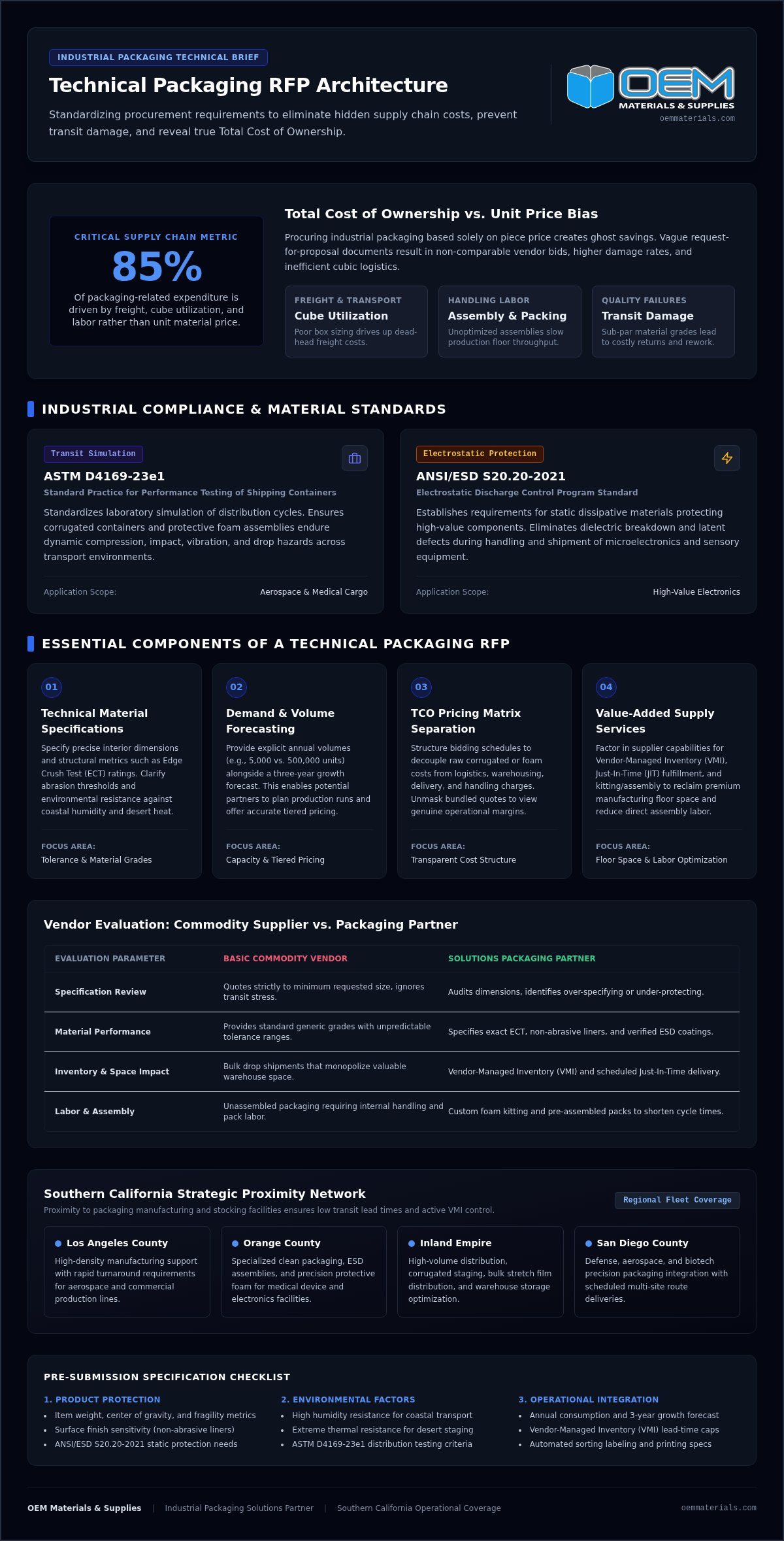
Up to 85 percent of total packaging-related supply chain expenditure is driven by freight, cube utilization, and handling labor rather than the unit price of the materials. When procurement teams receive non-comparable bids from different suppliers, it usually indicates a lack of technical detail in the initial request. You likely recognize the frustration of choosing a low-cost vendor only to see your total cost of ownership spike due to high product damage rates or inefficient inventory management. Learning how to write a packaging RFP that prioritizes technical material performance and logistical integration is the most effective way to protect your bottom line.
This article provides a roadmap to draft a professional packaging RFP that eliminates hidden costs, reduces transit damage, and secures a reliable industrial supply partner. We will cover how to standardize your bidding process using current standards like ASTM D4169-23e1 for transit simulation and ANSI/ESD S20.20-2021 for sensitive electronics. You will learn to gain clear visibility into total costs while positioning your company to partner with a dependable Southern California supplier. From Los Angeles County to San Diego, we examine the specific requirements that ensure your custom corrugated boxes and foam inserts meet the rigorous demands of aerospace, medical, and electronics manufacturing.
Key Takeaways
- Learn to distinguish between standard commodity vendors and custom design partners by identifying specific operational failures in your current packaging strategy.
- Discover how to write a packaging RFP that uses precise dimensions and material tolerances to ensure accurate, comparable bids from every supplier.
- Structure your pricing matrix to separate material costs from logistics, revealing the true total cost of ownership rather than just the unit price.
- Incorporate specific delivery requirements and surge capacity into your request to leverage local Southern California services like vendor-managed inventory.
- Evaluate potential partners based on technical responsiveness and proximity to your facilities to ensure long-term supply chain stability.
Defining Operational Goals Before Writing Your Packaging RFP
Successful procurement starts with a clear objective. If you’re wondering how to write a packaging RFP that delivers actual value, you must first define what success looks like for your operation. Many manufacturers treat this as a simple price comparison; however, a technical request for proposal (RFP) process should address specific failures in your current supply chain. Whether you’re dealing with high return rates or excessive warehouse clutter, the document must reflect your operational reality. Start by auditing your current waste. Identify if your primary goal is to reduce material spend, lower labor hours, or eliminate transit damage.
Decide if you need a basic vendor for stock items or a partner for custom packaging design. A commodity supplier provides exactly what you ask for, but a partner identifies where you’re over-specifying or under-protecting. Establish clear key performance indicators (KPIs) such as on-time delivery percentages and damage-free shipment rates. You also need to provide accurate annual usage volumes. Suppliers can’t offer competitive tiered pricing without knowing if you’re moving 5,000 or 500,000 units per year. Providing a three-year growth forecast helps potential partners scale their production capacity to match your needs.
Identifying Product Protection Needs
Your RFP should document every known vulnerability in your shipping cycle. If your aerospace components are arriving with surface abrasions, specify the need for non-abrasive foam packaging or specialized liners. List the exact weight and fragility of your items. High-value electronics often require ANSI/ESD S20.20-2021 compliant materials to prevent static discharge during transit. By providing these technical details upfront, you ensure bidders aren’t guessing on material grades. This level of detail forces an apples-to-apples comparison between different suppliers.
Setting Logistical Performance Standards
In Southern California, industrial real estate is at a premium. Your RFP should evaluate how a supplier can help you reclaim floor space through just-in-time delivery or vendor-managed inventory (VMI). Define your required lead times for both stock corrugated boxes and custom assemblies. If your team spends too much time building boxes, ask about kitting and assembly services. These value-added options often reduce internal labor costs more effectively than a small reduction in material price. Specify if you need delivery to multiple sites across Orange County or the Inland Empire to ensure the supplier has the fleet capacity to meet your schedule.
Determining Technical Material Specifications for Accurate Bidding
Vague specifications are the primary cause of inaccurate bids. If you provide a supplier with only general dimensions, you risk receiving quotes based on sub-par materials that won’t survive your shipping cycle. When learning how to write a packaging RFP, you must define exact dimensions and tolerances for every component. This level of precision ensures that every respondent is bidding on the same structural integrity. It also prevents the “ghost savings” that occur when a low-cost vendor quotes a lighter material grade that leads to increased product damage.
Your document should also account for the environmental stressors your goods will encounter. High humidity in coastal transit or extreme heat in desert warehouses can compromise adhesive and corrugated strength. Specify if your outer packaging requires specialized printing or labeling for automated sorting systems. Integrating these details into a Total Cost of Ownership (TCO) analysis helps you identify the most efficient partnership rather than just the lowest piece price.
Corrugated and Material Grade Requirements
Request bids based on standardized testing metrics to ensure an apples-to-apples comparison. You should specify whether you require an Edge Crush Test (ECT) rating or a Mullen Burst Strength rating. For example, heavy industrial parts often need 44 ECT or 48 ECT double-wall construction to maintain stackability. Specify flute sizes such as B, C, or E flute depending on whether you prioritize cushioning or print quality. You can explore specific material options on our corrugated boxes page. You should also clarify if your operation requires specific post-consumer recycled content to comply with California SB 54 regulations.
Custom Foam and Internal Protection Specs
Internal protection is where engineering expertise becomes critical. Mastering how to write a packaging RFP involves specifying internal protection with the same rigor as the outer box. Define the required foam density and material types, such as closed-cell polyethylene for heavy items or open-cell polyurethane for lighter, fragile components. If your product has complex geometry, specify die-cut requirements for engineered foam inserts to ensure a snug fit that prevents movement. For help selecting the right material for your application, refer to our industrial guide to foam inserts. If you need assistance defining these technical parameters for your next project, you can request a quote for a technical consultation.
Incorporating Logistics and Supply Chain Requirements
Industrial packaging isn’t just about the physical box; it’s about how that box reaches your assembly line. When determining how to write a packaging RFP, you must move beyond material costs and evaluate the supplier’s logistical infrastructure. Manufacturers in Los Angeles and Orange County often face tight production schedules that require high-frequency deliveries. Your RFP should clearly detail your delivery frequency and specific drop-off locations, such as designated warehouse bays or cleanroom staging areas. Providing this data allows suppliers to calculate accurate freight costs and route efficiency.
Ask potential partners about their surge capacity. A supplier that can’t handle a 20 percent spike in demand during your peak season can cause a complete production halt. Additionally, require a description of their quality control and inspection processes. This ensures that every shipment of corrugated boxes or foam inserts meets the ASTM packaging performance standards you established in your technical specs. For companies in the aerospace or medical sectors, rapid prototyping is another essential requirement. You need to know how quickly a supplier can turn around a new design for a product launch or an engineering change without delaying your time-to-market.
Vendor Managed Inventory and JIT Logistics
Warehouse space in the Inland Empire and San Diego is expensive. You should specify if you require the supplier to monitor and replenish your stock levels automatically. Inquire about their inventory reporting systems to ensure full transparency and data accuracy. Many manufacturers find that packaging VMI services significantly reduce their administrative burden and eliminate the risk of stockouts. A reliable partner will provide real-time data on usage rates, allowing you to maintain lean inventory levels without compromising production uptime.
Kitting and Assembly Efficiency
Labor is often the most significant hidden cost in packaging. When considering how to write a packaging RFP, define your requirements for pre-assembled kits. If your warehouse team is manually folding boxes and inserting foam, you are likely losing money on internal labor. Ask for pricing that compares material-only supply with labor-inclusive kitting services. Suppliers should provide documentation on how they manage complex kits that involve multiple components, such as custom wood crates paired with specialized cushioning. This approach streamlines your production line and ensures that every component is ready for immediate use upon arrival.
Structuring the RFP Document to Reveal the Total Cost of Ownership
A well-structured document is the primary tool for uncovering the total cost of ownership (TCO) in industrial procurement. At OEM Materials & Supplies, we believe the goal of finalizing how to write a packaging RFP is to create a framework that forces transparency. Many suppliers hide administrative or logistics fees within the unit price of a box. By requiring a granular breakdown, you can see exactly where your capital is going. This structure allows you to compare a local Southern California supplier with a national vendor on an equal basis, accounting for the reality that a lower material price might be offset by higher freight costs or longer lead times.
Include a specific section that encourages suppliers to propose cost-saving design alternatives. Experienced partners often identify ways to reduce material waste or improve pallet density that your internal team might overlook. For example, a minor adjustment in the dimensions of custom foam packaging can sometimes lead to significant savings in shipping volume. You should also define the contract duration and the specific mechanism for price adjustments. In the corrugated industry, it’s standard practice to peg adjustments to a third-party benchmark, such as the Fastmarkets RISI index, to ensure fairness during market fluctuations.
The Pricing Matrix and Cost Transparency
Your pricing matrix must be highly detailed to prevent unexpected expenses later. Require unit pricing at multiple volume breaks to understand how the supplier handles scalability. This is particularly important for growing manufacturers in the Inland Empire or Orange County who may need to ramp up production quickly. You must also ask for a clear breakdown of one-time tooling costs for custom dies, molds, or printing plates. Ensure that all freight and delivery charges are itemized separately from the material cost. This transparency is essential for calculating the true value of your packaging contract and ensuring there are no hidden surprises during the fulfillment phase.
Submission Timelines and Selection Criteria
Establish a firm schedule for the RFP process. Provide a clear deadline for technical questions and final proposal submissions to keep your procurement timeline on track. You should also outline the weighting of your selection criteria. While price is always a factor, industrial sectors like aerospace and medical devices must prioritize quality and service reliability. Include a phase for on-site audits or facility tours for your finalists. Seeing a supplier’s production and kitting area in person provides a level of confidence that a written proposal cannot match. If you’re ready to start your procurement process, you can request a quote and technical consultation to help define your specific requirements.
Evaluating Southern California Suppliers for Long Term Partnership
Evaluating a potential partner requires more than reviewing a spreadsheet. When you understand how to write a packaging RFP, you realize that the best technical specifications only matter if the supplier can execute within your specific geographic constraints. For manufacturers in Los Angeles County or Orange County, proximity is a critical risk mitigation factor. In a just-in-time environment, distance equals risk. A supplier located hundreds of miles away cannot respond to a sudden line-down situation as effectively as a local partner. You should evaluate the responsiveness of the local account management team by requesting a site visit or a technical consultation before finalizing your decision.
Confirm that the supplier has deep experience with Southern California shipping hubs and the specific logistical pressures of the Inland Empire. Specialized knowledge in high-reliability sectors like aerospace, medical devices, and electronics is also non-negotiable. These industries often require specific material handling protocols that a generalist catalog reseller simply cannot provide. A partner who understands the nuances of the Port of Long Beach or LAX logistics is better positioned to help you navigate supply chain interruptions. Check for a proven track record of managing complex inventory needs for manufacturers in San Diego and Riverside to ensure they can handle your specific scale.
Local Logistics and On-Site Support
Prioritize suppliers who offer same-day or next-day delivery within your local service area. The ability to receive a shipment of stretch film or custom crates on short notice prevents costly bottlenecks. You should also ask about the availability of local technical experts who can provide on-site design consultations. Having an engineer walk your production floor often reveals opportunities for optimization that a remote vendor would miss. For more detailed advice on vetting your options, read our guide on choosing a wholesale industrial packaging supplier.
Requesting a Quote and Finalizing the Agreement
The final stage of learning how to write a packaging RFP is managing the transition. Ensure your chosen partner has a clear plan to migrate your current specs and inventory without disrupting your operations. Verify that the final contract explicitly includes the VMI and JIT service levels you defined during the bidding process. This protects your facility from stockouts and ensures that your cost-saving goals are met. If you have your requirements ready, contact us to request a professional quote based on your RFP data. We recommend providing product dimensions, weights, and annual usage to facilitate an accurate recommendation.
Optimizing Your Industrial Supply Chain
A technical approach to procurement ensures that your packaging protects both your products and your profitability. By focusing on material performance standards and total cost of ownership rather than simple unit pricing, you eliminate the hidden expenses of transit damage and inefficient labor. Learning how to write a packaging RFP allows you to vet potential partners based on their engineering capabilities and logistical reliability. It’s essential to transition from a vendor-based model to a strategic partnership, particularly for manufacturers in high-reliability sectors like aerospace, medical devices, and electronics.
OEM Materials & Supplies provides the local Southern California support and VMI programs needed to maintain a lean, responsive operation. Our team offers custom design and rapid prototyping services to ensure your packaging is engineered for your specific shipping profile. If you are ready to secure a more dependable supply chain, Request a Quote for Your Industrial Packaging Needs today. Please provide your product dimensions, unit weights, and annual usage volumes so our experts can deliver a precise evaluation for your Orange County or Los Angeles facility. We look forward to helping you optimize your packaging strategy.
Frequently Asked Questions
What should be the primary focus of a packaging RFP?
The primary focus of a packaging RFP should be the total cost of ownership rather than the lowest unit price. When you learn how to write a packaging RFP, you must evaluate how a supplier’s design expertise and logistical capabilities impact your bottom line. Look for partners who offer custom engineering and rapid prototyping rather than just commodity sales. This approach ensures your packaging is optimized for your specific product weight and fragility.
How do I compare bids from different packaging suppliers?
Use a standardized pricing matrix to ensure you are conducting an apples-to-apples comparison between vendors. Demand that suppliers itemize material costs, tooling fees for custom dies, and freight charges separately. This transparency prevents vendors from hiding administrative fees in the unit price. When learning how to write a packaging RFP, you must require bids based on identical material grades and volume breaks to identify the most cost-effective long-term partnership.
What technical specs are most important for corrugated boxes?
Specify the Edge Crush Test rating or Mullen Burst Strength to ensure structural integrity during transit. You should also define the required flute size, such as B, C, or E flute, and provide exact interior dimensions with tight tolerances. For industrial applications in sectors like aerospace, it’s critical to verify the Box Maker’s Certificate requirements. These technical details ensure that the corrugated boxes meet the stacking and protection needs of your specific distribution environment.
How can a packaging RFP help reduce product damage?
A detailed RFP reduces damage by establishing rigorous technical performance standards based on your product’s specific vulnerabilities. You should include data on past damage incidents and specify the use of engineered foam packaging or custom wood crates for high-value items. By requiring suppliers to adhere to ASTM packaging performance standards, you ensure they utilize materials capable of withstanding the shocks and vibrations common in the Southern California logistics network.
Should I include logistical services like VMI in my RFP?
You should absolutely include logistical services like vendor-managed inventory (VMI) to maximize warehouse efficiency. In regions like Los Angeles and the Inland Empire, industrial floor space is expensive. A supplier who monitors and replenishes your stock levels reduces your internal labor and prevents costly stockouts. Including these requirements in your RFP helps you identify partners who can provide just-in-time delivery and pre-assembled packaging kits for your production line.
How long does the packaging RFP process typically take?
The typical timeframe for a comprehensive RFP process ranges from four to eight weeks. This schedule allows for initial technical questions, proposal drafting, and a phase for on-site facility audits. If your project involves complex custom design or rapid prototyping, the timeline may extend to accommodate sampling and transit simulation testing. Establishing a firm deadline for final submissions ensures your procurement team stays on track for a seamless transition between vendors.
Why is local supplier proximity important for Southern California manufacturers?
Local proximity is vital for Southern California manufacturers because it enables same-day or next-day response times. Suppliers in Orange County or Riverside can offer lower freight costs and more flexible delivery schedules compared to national vendors. Proximity also facilitates on-site technical consultations, where engineers can evaluate your packing line in person. This local support is essential for maintaining lean inventory levels and responding quickly to sudden spikes in production demand.