
If your shipping department is consistently hitting its throughput targets, why is the company still losing money on every pallet that leaves the dock? Most operations managers view corrugated boxes and stretch film as necessary evils or line-item expenses to be minimized. It’s frustrating to watch high-value components reach customers in Orange County or across the country only to be rejected due to transit damage. You’re likely facing the challenge of justifying investment in better packaging to stakeholders who only see the upfront material cost.
This guide demonstrates how to pivot from a commodity-buying mindset to a strategic approach that reduces the Total Cost of Ownership. We’ll examine a practical framework for calculating TCO, methods for improving shipping department efficiency, and how custom foam or engineered crates can eliminate the hidden costs of damage claims. By treating packaging as a technical asset rather than a simple consumable, you can stabilize your supply chain and protect your bottom line.
Key Takeaways
- Shift your focus from the per-unit price of materials to the Total Cost of Ownership (TCO), which accounts for procurement, labor, and logistics expenses.
- Calculate the true cost of product damage by identifying hidden expenses such as return shipping, inspection labor, and the impact on your reputation as a reliable OEM.
- Improve shipping department throughput by utilizing engineered packaging designs and kitting services that minimize the time required to assemble each shipment.
- Build a data-driven business case for stakeholders by justifying investment in better packaging through measurable metrics like reduced damage rates and lower material waste.
- Utilize local Southern California partnerships to implement Just-in-Time delivery and Vendor-Managed Inventory, effectively freeing up warehouse space and improving cash flow.
Beyond the Unit Price: Understanding Total Cost of Ownership (TCO)
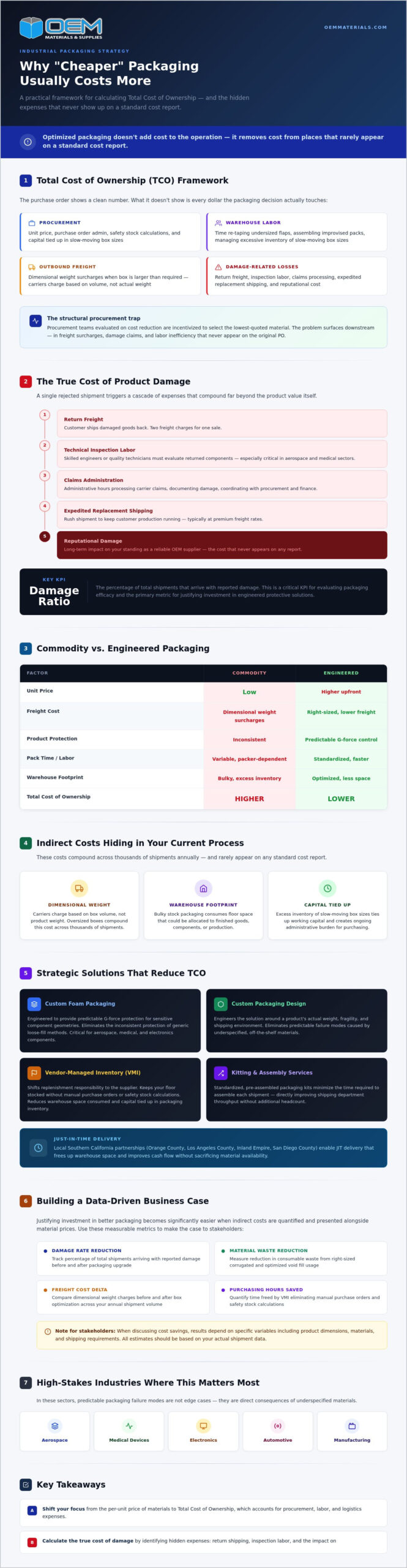
The purchase order for corrugated boxes shows a clean number. What it doesn’t show is the labor spent re-taping undersized flaps, the freight surcharges from oversized dimensions, or the write-off when a product arrives damaged. That’s the core problem with evaluating packaging on unit price alone. The concept of total cost of ownership reframes the conversation entirely, accounting for every dollar the packaging decision touches: procurement, inbound logistics, warehouse labor, outbound freight, and damage-related losses. When you stack all of those figures together, the “cheaper” box frequently costs more than the engineered alternative.
The Price vs. Value Disconnect in Industrial Procurement
Procurement teams are often evaluated on cost reduction, which creates a structural incentive to select the lowest-quoted material. The problem surfaces downstream. A corrugated box with a lower basis weight may fail the stack strength requirements of a multi-pallet shipment, leading to crushed product at the bottom of a load. A generic foam insert that doesn’t conform to the component’s geometry shifts in transit, concentrating impact forces on the most vulnerable points. These aren’t edge cases in aerospace, medical device, or electronics distribution; they’re predictable failure modes that follow directly from underspecified materials. Custom packaging design addresses this at the source by engineering the solution around the product’s actual weight, fragility, and shipping environment rather than selecting from a commodity catalog.
Identifying Indirect Costs in Your Current Packaging Process
Dimensional weight pricing is one of the most direct ways that non-optimized packaging inflates freight costs. When a box is larger than the product requires, carriers charge based on the calculated volume rather than the actual weight, and that gap compounds across thousands of shipments annually. Bulky stock packaging also consumes warehouse footprint that could be allocated to finished goods or components. Excess inventory of slow-moving box sizes ties up capital and creates an ongoing administrative burden for your purchasing team.
Justifying investment in better packaging becomes significantly easier when these indirect costs are quantified and presented alongside material prices. A packaging VMI program reduces the administrative overhead further by shifting replenishment responsibility to the supplier, keeping your floor stocked without requiring manual purchase orders or safety stock calculations. The result is less warehouse space consumed, less capital tied up in packaging inventory, and fewer purchasing hours spent managing routine reorders.
Taken together, these factors establish a clear premise: optimized packaging doesn’t add cost to the operation. It removes it from places that rarely appear on a standard cost report.
Mitigating the Financial Impact of Product Damage and Returns
Product damage is more than a line item for scrap; it represents a total failure of the shipping cycle. When a high-value component reaches a customer in San Diego County or the Inland Empire in a non-functional state, the financial recovery process is exhaustive. You must account for return freight, the labor hours required for technical inspection, administrative time for processing claims, and the cost of expedited replacement shipping. In high-stakes sectors like aerospace and medical manufacturing, protective packaging is the primary defense against these cascading expenses.
Improvised packing methods, such as using excessive loose-fill or oversized boxes with air pillows, offer inconsistent protection. These methods rely on the discretion of the packer rather than an engineered standard. Justifying investment in better packaging becomes straightforward when you compare the cost of a single rejected shipment against the price of a standardized, custom solution. Damage Ratio is defined as the percentage of total shipments that arrive with reported damage, and it serves as a critical KPI for evaluating packaging efficacy.
Engineering Protection with Custom Foam Inserts
Industrial components often have sensitive geometries that generic cushioning cannot protect. Foam packaging is specifically engineered to provide predictable G-force protection by absorbing impact energy before it reaches the product. Unlike loose-fill materials that shift during transit, custom inserts hold the item in a fixed orientation. This precision is vital for sensitive electronics and calibrated instruments. For a deeper look at material specifications, you can refer to our industrial guide to foam inserts to understand how density and cell structure impact performance.
The Compound Cost of Shipping Failures
Beyond the immediate replacement cost, shipping failures create friction in the supply chain. Customer service departments spend hours resolving disputes, while warehouse teams must interrupt their workflow to process RMAs. For OEMs, the stakes are even higher. A single damaged shipment can jeopardize a multi-year manufacturing contract if the buyer loses confidence in your logistical reliability. If you are seeing an uptick in your damage ratio, requesting a technical consultation can help identify the failure points in your current configuration.
Optimizing Operational Efficiency Through Design and Kitting
Operational efficiency is often mistakenly viewed only through the lens of expensive automation machinery. While robots have their place, the design of the packaging materials themselves dictates the baseline speed of your packing line. If a warehouse associate spends thirty seconds assembling a standard box and another twenty seconds stuffing it with loose-fill paper, your throughput is artificially capped. Custom corrugated boxes engineered to fit your product’s specific footprint remove the need for secondary void fill entirely. This transition reduces the “seconds per pack” across every station on the floor. Justifying investment in better packaging becomes a matter of simple labor math: reducing pack time by thirty percent allows your current staff to process significantly more volume without increasing headcount.
Reducing Labor Costs with Pre-Assembled Kits
Kitting services provide a streamlined workflow where all necessary components arrive as a single, pre-staged unit. Instead of a packer pulling a box from one pallet, foam from another, and labels from a third location, they receive a complete kit. This approach minimizes “touches” and eliminates the time wasted on material retrieval. In precision industries like medical device or electronics manufacturing, kitting also serves as a quality control measure. When the kit is empty, the packer knows every required protective element and label has been used, which drastically reduces errors and ensures a consistent standard of protection for every shipment leaving your Southern California facility.
Maximizing Pallet Density and Load Stabilization
Warehouse throughput depends heavily on how effectively you utilize vertical space and pallet footprints. Standardized box dimensions, engineered specifically for a 48×40 pallet, eliminate the “chimney effect” and overhang that lead to load failure. To ensure these loads remain stable during transit through the Inland Empire or across the country, proper stretch film for pallet wrapping is essential. It provides the necessary containment force to prevent shifting. Additionally, integrating edge and corner protectors allows you to stack pallets higher without risking the collapse of the bottom layer. This optimization directly improves warehouse density, reducing the total number of pallet positions required for your inventory and lowering your overall logistics spend per unit.
Building the Business Case for Premium Packaging
Moving from a theoretical understanding of Total Cost of Ownership to a formal budget approval requires a data-driven narrative. Stakeholders in finance and operations need to see how a higher material price translates into a lower operational spend. Justifying investment in better packaging is most effective when you present a comparison of current baseline costs against projected savings in damage claims, labor hours, and freight surcharges. Rapid prototyping plays a vital role here; it allows you to test a physical sample of a custom foam insert or corrugated design to prove its performance before committing to a high-volume production run.
To calculate the Return on Investment (ROI) for a packaging upgrade, use this straightforward formula: (Current Annual Operational Costs – Proposed Annual Operational Costs) / Total Investment in Design and Implementation. This calculation should include the reduction in “hidden” expenses identified in previous sections, such as the labor spent on RMAs and the cost of excess void fill.
Key Performance Indicators (KPIs) for Packaging Performance
Tracking specific metrics allows you to quantify the efficiency of your current system. Cube Utilization is a primary KPI that measures the percentage of a shipping container’s volume actually occupied by the product. High rates of empty space indicate you are paying to ship air, which inflates your freight spend. Pack Time per Unit measures the labor efficiency of your shipping department; if this number is high, it suggests your materials are difficult to assemble or require too much secondary cushioning. Finally, monitor Material Yield to identify waste. If your team is using twice the necessary amount of stretch film or packaging tape to stabilize a load, your material yield is poor and your costs are unnecessarily high.
Leveraging Professional Packaging Design Services
A wholesale industrial packaging supplier should act as more than a vendor; they should function as a technical consultant. This partnership typically begins with a packaging audit, where an expert analyzes your current materials, packing process, and damage history to find efficiency gaps. We recommend starting with a pilot program for your highest-volume or most damage-prone SKU to gather real-world data before a full-scale rollout across your entire inventory. This phased approach minimizes risk while providing the hard evidence needed for executive buy-in. If you are ready to identify the specific savings available for your operation, you can request a technical consultation and quote to begin the audit process.
Strategic Partnership: How OEM Materials & Supplies Delivers Value
Selecting a supplier is the final hurdle in justifying investment in better packaging. A partner who understands the specific logistical pressures of the Southern California market can turn your packaging strategy into a strategic asset. At OEM Materials & Supplies, we prioritize operational reliability by offering services that go beyond simple material delivery. By integrating Just-in-Time (JIT) packaging, we support lean manufacturing initiatives that require precision timing and minimal on-site inventory. This approach ensures your production lines never stall while simultaneously freeing up valuable warehouse floor space for your core manufacturing activities.
Vendor-managed inventory (VMI) programs further reduce the administrative burden on your purchasing team. Instead of manually tracking stock levels for stretch film or corrugated boxes, our team manages the replenishment process. This prevents stockouts and eliminates the costs associated with emergency reorders or expedited shipping fees. It’s a system designed to stabilize your supply chain and provide predictable results month after month.
Local Expertise for Southern California Manufacturers
Proximity is a critical factor for manufacturers in Orange County, Los Angeles, and San Diego. Being local allows us to offer rapid prototyping and short-run production that distant suppliers can’t match. When an aerospace component requires a new custom foam insert, we can iterate on the design quickly to ensure a perfect fit. Local delivery also significantly reduces lead times and shipping costs for heavy or bulky items like wood crates. This regional focus helps manufacturers in Riverside and the Inland Empire maintain a lower carbon footprint by minimizing the distance materials travel before reaching the facility.
A Solution-Oriented Approach to Industrial Supplies
We don’t just sell boxes; we solve supply chain problems. Our inventory spans the full spectrum of industrial requirements, from protective mailing tubes for sensitive documents to heavy-duty pallets for overseas shipping. This broad range allows us to evaluate your total system costs rather than looking at individual components in isolation. We encourage a technical consultation to review your current damage rates and packing speeds.
To provide an accurate recommendation and a custom quote, our team requires specific data points. Please be prepared to provide product dimensions, item weight, and your estimated annual usage. Our role is to provide the data and design expertise you need when justifying investment in better packaging to your internal stakeholders.
Transforming Your Packaging Into a Strategic Operational Asset
Transitioning from a commodity-buying mindset to a technical, value-based approach is the most effective way to eliminate hidden operational drains. By focusing on the Total Cost of Ownership, you can address the secondary expenses of product damage, excessive labor, and inefficient freight utilization that frequently exceed material costs. Justifying investment in better packaging isn’t just about protecting a single shipment; it’s about stabilizing your entire supply chain and ensuring your manufacturing output reaches its destination in perfect condition.
OEM Materials & Supplies serves high-precision sectors like aerospace, medical devices, and automotive manufacturing across Southern California, including Orange County and San Diego. We specialize in custom-engineered protective solutions and vendor-managed inventory programs that reduce overhead and improve warehouse throughput. Our team is ready to help you quantify the potential savings for your specific application.
To receive a recommendation tailored to your logistical requirements, please provide your product dimensions, weight, and annual usage. Contact OEM Materials & Supplies for a Custom Packaging Quote today to start optimizing your shipping operations.
Frequently Asked Questions
How do I calculate the ROI of custom packaging?
ROI is calculated by subtracting your proposed total operational costs from your current baseline and dividing that figure by the total implementation investment. This calculation must account for more than material prices; it includes the reduction in damage claims, lower labor hours, and decreased freight surcharges. By presenting a multi-year savings projection based on these variables, you provide a clear financial justification for shifting from commodity supplies to engineered solutions.
What are the most common hidden costs in industrial packaging?
The most common hidden costs include dimensional weight surcharges, excessive material waste, and high labor requirements for assembly. Many Southern California manufacturers lose significant capital by paying to ship air in oversized stock boxes. Additionally, the labor spent on applying extra tape or stuffing void fill into non-optimized containers creates a recurring operational drain. These indirect expenses often remain invisible on standard procurement reports but impact the bottom line directly.
Does custom packaging always cost more than stock boxes?
Custom packaging often results in a lower total cost even if the per-unit material price is higher. When justifying investment in better packaging, you must factor in the elimination of secondary supplies like air pillows or foam peanuts. Custom corrugated designs also improve pallet density, which reduces the total number of shipments required. For many OEMs in Orange County, the freight and labor savings alone justify the transition to tailored solutions.
How can better packaging reduce my freight costs?
Better packaging reduces freight costs by optimizing the dimensional weight (DIM) of every shipment. Carriers charge based on the volume a package occupies; therefore, a box that is even one inch larger than necessary can trigger higher rates. By using custom-sized corrugated containers and stabilizing loads with high-performance stretch film, you maximize pallet utilization and reduce the risk of surcharges for oversized or unstable shipments during transit.
What is the role of foam density in protecting sensitive electronics?
Foam density dictates the material’s ability to absorb shock and protect sensitive electronics from specific G-forces. High-density foams provide the structural integrity needed for heavy components, while lower densities offer better cushioning for lighter, fragile items. Our engineering team selects material based on cell structure and density to ensure impact energy is dissipated before it reaches the product, which is critical for aerospace and medical device manufacturers in San Diego.
How does a Vendor-Managed Inventory (VMI) program save money?
A Vendor-Managed Inventory (VMI) program saves money by shifting the responsibility for stock replenishment to the supplier. This eliminates the administrative labor required to generate purchase orders and track inventory levels. For manufacturers in Los Angeles and Riverside, VMI also frees up warehouse floor space and improves cash flow by ensuring you only hold the stock you need for immediate production, effectively preventing costly stockouts and emergency reorders.
Can custom packaging design help with labor shortages?
Custom design directly addresses labor shortages by simplifying the packing process and reducing the “seconds per pack” on the warehouse floor. Pre-assembled packaging kits and easy-to-fold corrugated boxes allow associates to work faster with fewer errors. This efficiency means your existing team can handle higher volumes without the need for additional headcount, which is a significant advantage in the competitive Southern California industrial labor market.
What data do I need to justify a packaging upgrade to my CFO?
To build a case for your CFO, you need data on your current damage ratio, total freight spend, and labor hours per packed unit. CFOs prioritize the impact on the company’s net income, so focus on how better materials reduce RMAs and administrative overhead. Providing a pilot program’s results or a prototype comparison can also demonstrate a tangible reduction in waste, making the long-term financial benefits of the upgrade undeniable.