
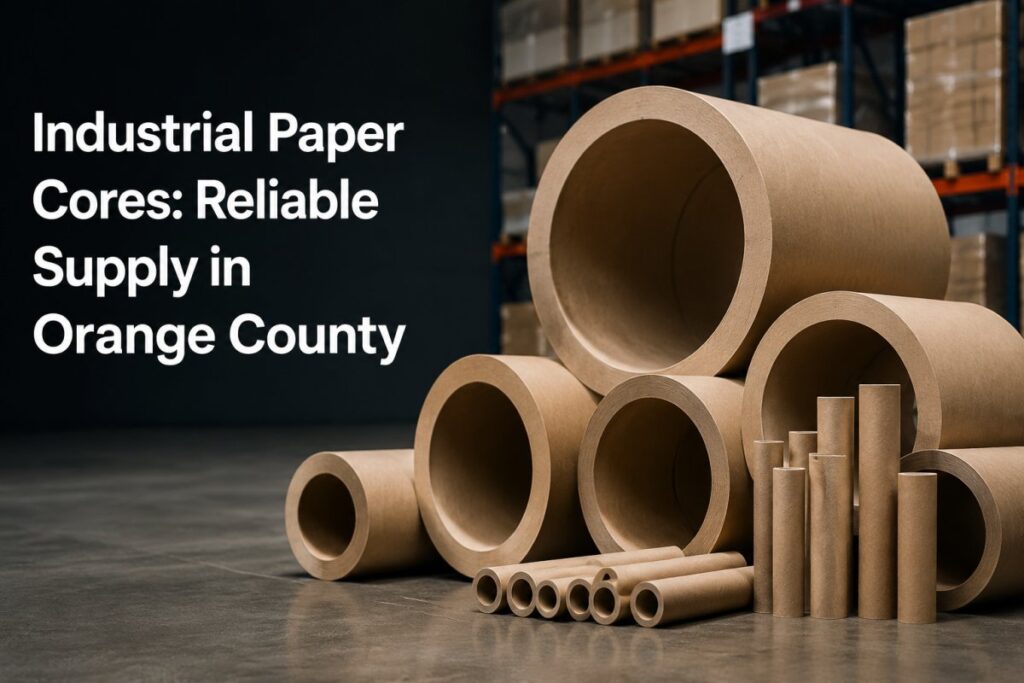
A failed industrial paper core is never just a piece of cardboard; it is a total production stoppage that compromises thousands of dollars in finished material. When a core collapses under the tension of high-speed winding or the weight of heavy-gauge films, the resulting downtime and product loss quickly erode your margins. You need more than a commodity vendor. You need a partner that understands the engineering requirements of your specific application and the logistical pressures of the local market.
Consistent crush strength and dimensional accuracy are the only factors standing between a successful manufacturing run and a warehouse full of unsalable inventory. This guide explains how to specify industrial paper cores for maximum structural integrity and streamline your Southern California supply chain. We will examine the technical variables of wall thickness and beam strength. We also look at how localized vendor-managed inventory can eliminate the high shipping costs and warehouse footprint issues often associated with bulky core orders in Orange County and Los Angeles.
Key Takeaways
- Learn how to specify wall thickness and crush strength to prevent core collapse and protect high-value materials during manufacturing.
- Understand the engineering differences between standard mailing tubes and high-performance industrial paper cores used in aerospace and medical applications.
- Discover how local vendor-managed inventory (VMI) programs can reduce your warehouse footprint and eliminate costly line shutdowns.
- Optimize your Southern California supply chain with just-in-time delivery strategies that lower shipping costs for bulky core orders.
- Identify the specific technical requirements needed for equipment compatibility, focusing on inner and outer diameter precision.
What Are Industrial Paper Cores and Why Does Engineering Matter?
Industrial paper cores are precision-engineered cylinders designed to withstand extreme radial and axial pressure during manufacturing processes. They aren’t just tubes; they’re engineered components. These cores function as a critical interface between winding equipment and the raw material being processed. They are typically constructed from multiple layers of high-grade recycled paperboard, bonded together with specialized adhesives to create a rigid, durable structure.
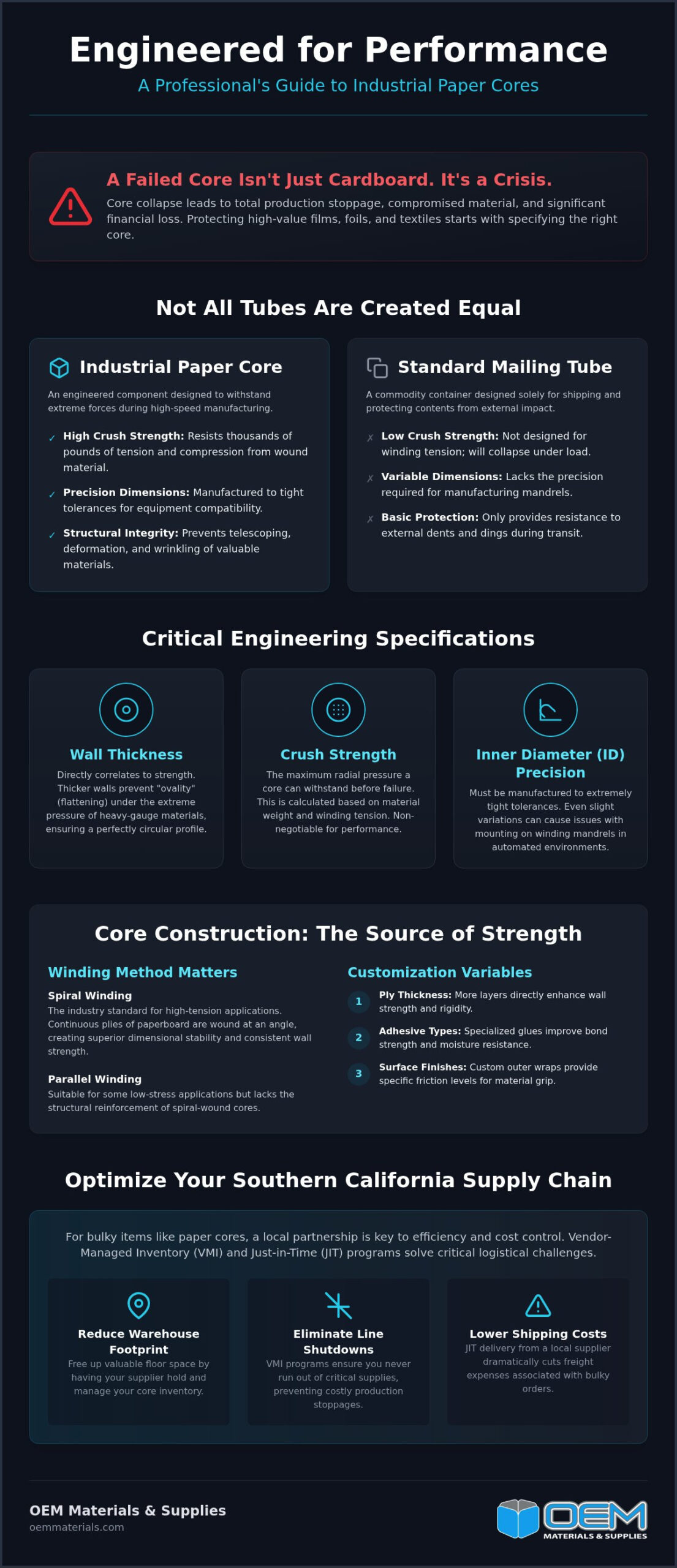
It’s a common mistake to confuse these with standard mailing tubes and cores. While a mailing tube only needs to protect its contents from external impact, an industrial core must maintain its shape while supporting thousands of pounds of tension. If the core lacks the necessary structural integrity, the wound material can suffer from telescoping or internal deformation, leading to significant waste and equipment downtime.
The Structural Role of Cores in Manufacturing
In many production environments, industrial paper cores serve as the internal skeleton for flexible materials like textiles, plastic films, and metallic foils. They provide the necessary resistance to keep the material taut and aligned during high-speed winding. If a core fails under load, the resulting collapse can damage the winding mandrel or cause the material to wrinkle, rendering the entire roll unusable.
Crush strength is the maximum pressure a core sustains before deforming. Engineers must calculate this requirement based on the weight of the material and the tension applied by the winding machinery. Selecting a core with insufficient crush strength often leads to catastrophic failure mid-run, which is why technical specifications are non-negotiable for Southern California OEMs.
Spiral Winding vs Parallel Winding
The manufacturing method determines the core’s ultimate performance. Spiral winding is the industry standard for high-tension applications because it involves wrapping continuous plies of paperboard at a specific angle. This technique creates a consistent wall thickness and superior dimensional stability across the entire length of the core.
Parallel winding, while useful for some low-stress applications, doesn’t offer the same level of structural reinforcement. Manufacturers can customize industrial paper cores by adjusting specific variables to meet their operational needs:
- Ply Thickness: Increasing the number of paperboard layers directly enhances the core’s wall strength.
- Adhesive Types: Specialized glues can improve moisture resistance or increase the bond strength between plies.
- Surface Finishes: Custom outer wraps can provide specific friction levels to ensure the material grips the core instantly during the start of a wind.
Technical Specifications: Wall Thickness and Crush Strength
Precise technical specifications are the foundation of a reliable winding operation. When selecting industrial paper cores, engineers must prioritize the relationship between wall thickness and the specific radial forces exerted by the material. A core that performs perfectly for lightweight plastic film will likely fail under the compressive force of heavy-gauge copper foil or industrial textiles. These specifications aren’t arbitrary; they’re the difference between a stable roll and a catastrophic collapse.
Environmental factors also play a critical role in core performance. Since paperboard is a hygroscopic material, moisture content directly influences its structural integrity. In high-humidity warehouse environments, cores can absorb moisture, which softens the fibers and reduces overall crush strength. Maintaining a controlled storage environment or specifying cores with moisture-resistant barriers is essential for preserving performance from the delivery truck to the winding line.
Calculating the Right Wall Thickness
Determining the ideal wall thickness requires an analysis of the total roll weight and the winding tension. Thicker walls are designed to prevent “ovality,” a condition where the core flattens or becomes elliptical under pressure. This deformation makes it impossible to remove the core from the mandrel or causes uneven unwinding at the customer facility. As a general framework, high-density materials require high-density cores with increased wall thickness to maintain a perfectly circular profile under load.
Inner Diameter (ID) Precision
The inner diameter must be manufactured to extremely tight tolerances, especially in automated manufacturing environments. Even a slight variation in ID can prevent a mandrel from seating correctly, leading to excessive vibration at high speeds. This vibration doesn’t just damage the material; it causes premature wear on your winding equipment’s bearings and drive systems. Standard sizes like 3-inch or 6-inch IDs are common, but custom large-format industrial paper cores are often required for heavy industrial applications in the aerospace and metal sectors.
High-torque winding machines demand cores with exceptional beam strength and torque resistance. If the core slips on the mandrel or shears during a high-speed start, the entire production run is compromised. Specifying the correct adhesive and ply-bond strength ensures the core remains a rigid, single unit under the most demanding mechanical stresses. If you are unsure of the exact specifications required for your machinery, our team can help you evaluate your application data to ensure maximum performance.
Industry Applications for Southern California Manufacturers
Southern California’s diverse industrial landscape requires more than a one-size-fits-all approach to winding components. From the aerospace hubs in Los Angeles to the life science clusters in San Diego, the technical demands on industrial paper cores vary significantly by sector. A core that works for a textile manufacturer in Riverside might fail the rigorous cleanliness standards of an Orange County medical lab. Understanding these localized requirements is essential for maintaining production efficiency across the region.
Aerospace and Defense Applications
Manufacturers in the Los Angeles and Orange County aerospace corridors often deal with high-value composite materials and carbon fiber. Winding these materials exerts immense radial pressure on the core, necessitating extreme crush strength. These applications require precision tolerances to ensure the material remains perfectly aligned for automated layup processes. Using a generic core in these environments risks structural failure and the loss of expensive raw materials. We integrate these specific engineering requirements into our custom packaging design process to ensure the core supports the demands of military-grade production and specialized composite winding.
Medical and Electronics Packaging
In San Diego and the Inland Empire, medical device and electronics manufacturers face unique challenges. Life science companies use cores for producing sterile barrier systems and specialized medical-grade films. These environments demand low-linting materials to prevent particulate contamination in cleanrooms. Standard cores often shed fibers that can compromise a sterile environment, making high-performance industrial paper cores with treated surfaces a necessity.
Electronics manufacturing introduces the need for ESD (electrostatic discharge) considerations. Sensitive components can be damaged by static build-up during the winding or unwinding process. Specifying cores that work within an ESD-safe packaging protocol is a critical step for manufacturers in the electronics sector. By choosing the right material composition, companies can protect their products from both physical deformation and electrical damage.
Textile and Film Winding in Riverside
Riverside and the Inland Empire house massive distribution and converting centers focused on high-volume textile and stretch film production. These operations prioritize speed and equipment uptime. High-speed winding machines require cores with exceptional dimensional stability to prevent vibration that can lead to machine wear. Reliable local supply ensures that these high-throughput facilities don’t face line shutdowns due to inventory gaps, allowing them to maintain the fast-paced delivery schedules expected in the Southern California logistics market. To further streamline these workflows, many converters also utilize professional color label printers and finishing equipment from OptiMediaLabs Canada to ensure every finished roll is professionally branded and tracked.
Managing the inventory of industrial paper cores presents a unique logistical challenge. Because they are rigid and hollow, these components occupy significant warehouse volume while contributing relatively little to product density. Shipping these items from a national distributor often results in high freight costs and extended lead times that don’t account for the volatility of local manufacturing. Local Southern California suppliers provide a distinct advantage by offering more frequent, smaller deliveries that align with actual production cycles.
Implementing packaging VMI services removes the administrative burden of inventory tracking from your operations team. In a Vendor-Managed Inventory model, OEM Materials & Supplies monitors your usage levels and replenishes stock automatically. This system eliminates the risk of stockouts that could otherwise shut down a high-speed winding line. By integrating our logistics with your production schedule, we ensure you always have the necessary components without the need for constant manual oversight.
Reducing Warehouse Overhead
Warehouse floor space in regions like Orange County and Los Angeles is at a premium. Storing multiple pallets of bulky cores is an inefficient use of valuable square footage that could be dedicated to manufacturing or finished goods. Utilizing just-in-time (JIT) delivery solves this by moving the storage burden to our facility. We deliver the exact quantity needed for your next shift, freeing up your floor for revenue-generating activities. VMI shifts the burden of inventory tracking to the supplier, allowing your warehouse staff to focus on higher-value tasks.
Lowering Total Cost of Ownership
The price of a core is only one component of its total cost. Freight expenses for bulky items can significantly inflate the landed cost if the supplier is located outside of Southern California. Sourcing locally from a partner in the Inland Empire or San Diego reduces these transit costs and provides a more agile response to sudden demand spikes. Additionally, the hidden costs of using inferior cores can be devastating. A single core failure that causes machine downtime or material loss far outweighs any marginal savings on the unit price.
When a line stops in a high-cost labor market like Orange County, the financial impact of idle workers and missed delivery windows accumulates rapidly. Efficiency in the supply chain is about more than just unit price; it is about reliability and precision. Strategic sourcing ensures that your technical requirements are met while your logistical footprint remains lean. To see how these programs can work for your facility, you can request a quote for a customized logistics plan tailored to your specific annual usage and delivery requirements.
Sourcing Industrial Paper Cores in Southern California
Selecting a supplier for industrial paper cores is a decision that impacts every stage of your production and shipping cycle. National distributors often treat these components as low-priority commodities, resulting in generic specifications and unpredictable delivery schedules. OEM Materials & Supplies operates as a primary partner for manufacturers across Orange County, Los Angeles, and the Inland Empire. By maintaining local expertise and regional delivery networks, we provide the responsiveness that national vendors simply can’t match. Our proximity to major manufacturing hubs in San Diego and Riverside ensures that your facility receives direct support and a transparent chain of custody for every order.
Integrated Packaging Solutions
In a complex manufacturing environment, cores don’t exist in a vacuum. Once a material is wound onto industrial paper cores, it often requires additional layers of protection for transit or storage. We offer an integrated approach where your cores are designed to work in tandem with our other offerings. For example, high-value films wound on precision cores can be protected by custom mailing tubes or secured within heavy-duty corrugated boxes for bulk distribution.
Kitting these components together offers significant advantages for your procurement team. Instead of managing multiple vendors for cores, foam inserts, and shipping containers, you can utilize a single wholesale industrial packaging supplier. This consolidation reduces administrative overhead and ensures that every piece of the packaging system fits together perfectly. Whether you’re shipping aerospace components or medical devices, having a single source for all protective materials eliminates compatibility issues and streamlines your Southern California supply chain.
Requesting a Technical Consultation
Optimizing your winding process starts with accurate technical data. We encourage purchasing managers and operations engineers to contact us for a comprehensive technical consultation. To provide the most accurate recommendations and quotes, please have the following data points available:
- Inner diameter (ID) and outer diameter (OD) requirements
- Total core length and required wall thickness
- Maximum roll weight and winding tension (PSI)
- Annual usage and typical order frequency
- Environmental storage conditions (humidity and temperature)
For specialized applications, we offer rapid prototyping. This allows your team to test custom core specifications on your actual winding equipment before committing to a high-volume production run. Southern California manufacturers can rely on our team for on-site evaluations and engineering support to solve recurring issues like core collapse or equipment vibration. Contact OEM Materials & Supplies today to discuss your specific requirements and learn how a localized, engineered approach can stabilize your manufacturing output.
Stabilize Your Production with Engineered Core Solutions
Precision engineering is the only way to ensure your winding lines remain operational and your high-value materials stay protected. By prioritizing specific technical variables like wall thickness and crush strength, you eliminate the recurring risks of core collapse and product deformation. Integrating these technical requirements with localized logistics, such as vendor-managed inventory and just-in-time delivery, further optimizes your facility by reducing warehouse footprint and minimizing freight expenses. High-performance industrial paper cores are not just supplies; they are a strategic investment in your manufacturing stability.
The team at OEM Materials & Supplies brings specialized custom engineering expertise to the aerospace, medical, and electronics sectors, ensuring every component meets rigorous industry standards. With reliable local delivery across Orange County, Los Angeles, and San Diego, we provide the regional agility your supply chain demands. To get started, contact OEM Materials & Supplies for an industrial core quote. Please provide your specific product dimensions, weight requirements, and annual usage so we can develop a tailored solution for your facility. We look forward to helping you streamline your operations and secure your production schedule.
Frequently Asked Questions
What is the difference between a paper tube and a paper core?
The primary difference lies in the engineering and intended application. While a mailing tube is designed to protect its contents from external impact during transit, industrial paper cores act as the internal structural support for materials being wound under high tension. Cores require significantly higher crush strength and dimensional stability to prevent deformation when supporting heavy loads of film, foil, or textiles during high-speed manufacturing processes.
How do I determine the necessary wall thickness for my application?
Determining the correct wall thickness depends on three main variables: the total weight of the wound material, the specific winding tension of your machinery, and the material’s density. Heavier materials or those wound with high radial pressure require thicker walls to prevent the core from becoming elliptical or collapsing. We recommend analyzing your equipment’s PSI settings and the finished roll’s weight to calculate a thickness that maintains structural integrity.
Can industrial paper cores be recycled after use?
Yes, most industrial paper cores are constructed from recycled paperboard and are fully recyclable within standard industrial waste streams. Because they are made from organic fibers bonded with specialized adhesives, they can be processed by most paper mills. This makes them a more sustainable choice compared to plastic or metal alternatives, provided they remain free from heavy chemical contamination or non-recyclable coatings after their initial use.
What are the standard lead times for custom paper core orders in Los Angeles?
Lead times vary based on the complexity of your technical specifications and current production volumes in our Southern California facilities. Local sourcing in Los Angeles and Orange County generally offers a significant time advantage over national distributors by eliminating long-distance freight transit. For custom specifications, we recommend contacting our team with your annual usage and delivery frequency to establish a reliable replenishment schedule that prevents inventory shortages.
How does moisture affect the strength of industrial paper cores?
Moisture significantly impacts the structural integrity of paperboard because it is a hygroscopic material. When industrial paper cores absorb moisture from a humid warehouse environment, the paper fibers soften and the bond strength between the plies weakens. This absorption can lead to a drastic reduction in crush strength, potentially causing the core to fail under load. Storing cores in a climate-controlled area or using moisture-resistant barriers is essential for performance.
What is the maximum diameter available for industrial paper cores?
Maximum diameters are determined by the capacity of the spiral winding equipment used during manufacturing. While 3-inch and 6-inch inner diameters are the standard for most winding mandrels, custom large-format cores can be manufactured with much larger dimensions for heavy industrial applications. If your process requires a non-standard size for specialized aerospace or metal winding, we can evaluate your equipment specs to provide a core with the necessary precision.
Are there specific cores designed for high-speed winding machines?
High-speed winding requires cores with exceptional torque resistance and dimensional stability to prevent vibration. These specialized cores use high-strength adhesives and specific ply-bonding techniques to ensure the structure remains rigid when the winding mandrel accelerates. Any variation in the inner diameter can cause machine wear or material misalignment at high RPMs, so tight tolerances are a non-negotiable requirement for these demanding automated manufacturing environments.
How does a VMI program work for industrial packaging supplies?
A Vendor-Managed Inventory (VMI) program shifts the responsibility of inventory tracking and replenishment from your team to the supplier. We monitor your stock levels on-site or through usage data and automatically trigger deliveries to prevent stockouts. This program is particularly effective for bulky items like cores, as it allows you to maintain a smaller warehouse footprint while ensuring you always have the necessary supplies to meet your production schedule.