
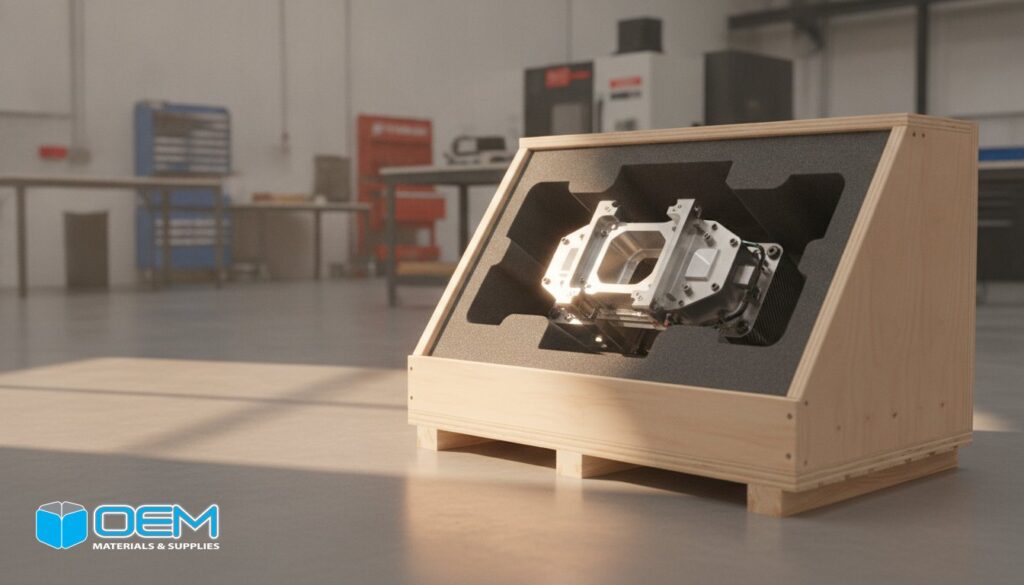
Shipping damage is not an inevitable cost of doing business, yet many manufacturers treat it as a recurring line item. When sensitive industrial components fail to reach their destination intact, the true cost extends far beyond the physical product to include replacement logistics and strained client relationships. If you are managing a supply chain in Southern California, you likely understand the frustration of receiving damaged goods or waiting weeks for prototypes from out-of-state vendors. High damage rates often stem from generic packaging that fails to account for the specific vibration and impact requirements of your equipment.
Securing reliable custom foam inserts Los Angeles manufacturers can depend on is the first step toward achieving zero-damage shipping and streamlined assembly. This article provides a technical guide on selecting the appropriate foam densities and design parameters to protect sensitive components throughout the regional supply chain. We will examine how integrated kitting reduces labor costs on the factory floor and why a local partner is essential for maintaining just-in-time delivery schedules. This overview provides the framework needed to optimize your protective packaging for both durability and operational efficiency.
Key Takeaways
- Identify the technical differences between polyethylene and polyurethane foams to ensure your material selection matches the weight and fragility of your specific components.
- Learn why custom foam inserts Los Angeles aerospace and electronics firms rely on are engineered to withstand the specific rigors of the regional supply chain.
- Evaluate how integrated kitting and assembly services reduce warehouse labor costs and streamline your production line throughput.
- Recognize the logistical advantages of local Southern California sourcing for rapid prototyping and vendor-managed inventory programs.
Protecting High-Value Components in Los Angeles Manufacturing
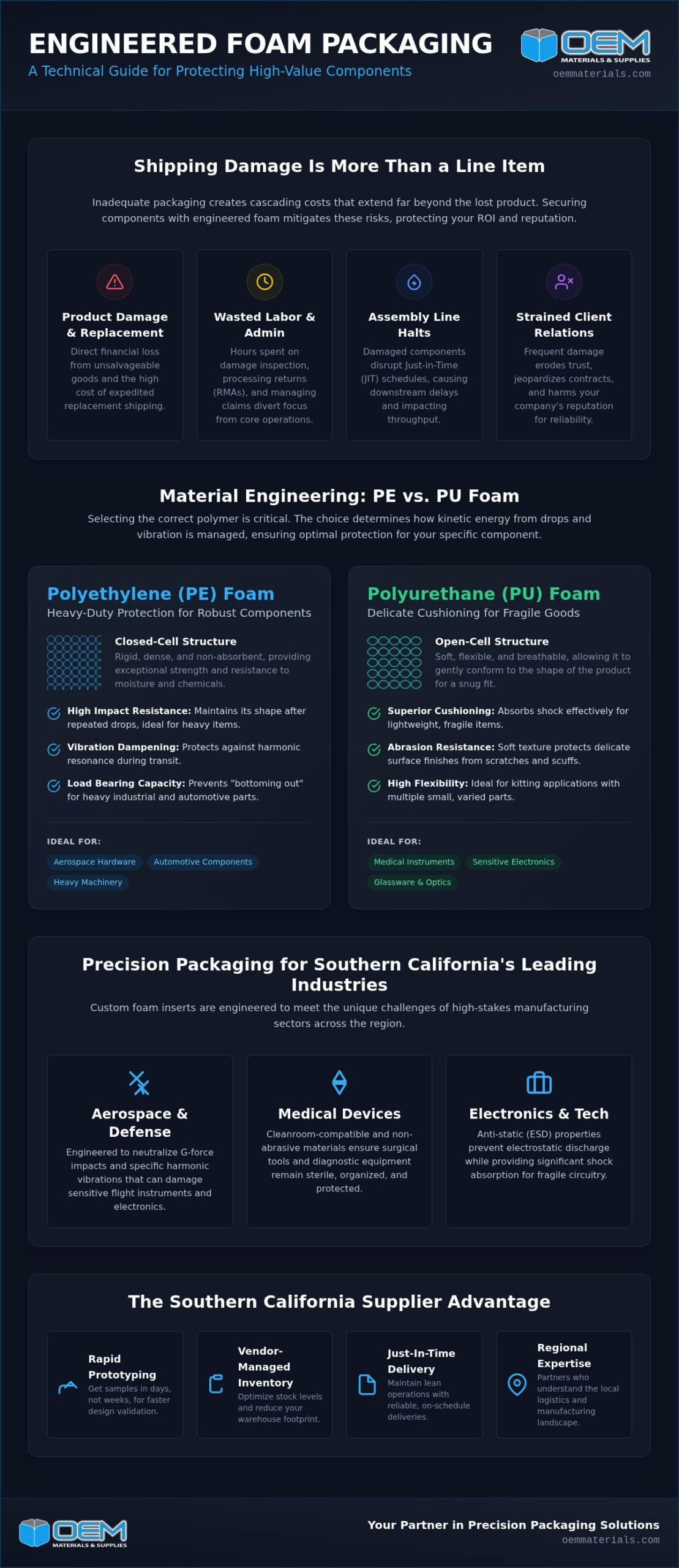
Custom foam inserts Los Angeles manufacturers utilize are not merely secondary materials; they are precision-engineered components designed to immobilize and protect sensitive hardware. Within the Southern California manufacturing corridor, high-value aerospace and medical parts navigate complex logistics networks that demand high-performance packaging. Generic cushioning often fails because it lacks the specific cell structure and density required to neutralize the unique G-force impacts and harmonic vibrations encountered during transit. Engineered foam packaging provides a repeatable, reliable barrier that generic bubble wrap or loose fill cannot match.
Sectors Requiring Precision Foam Engineering
Aerospace and defense contractors in the Inland Empire and Los Angeles County require foam with superior vibration dampening properties to protect delicate flight instruments. These components are often susceptible to specific frequencies that only custom-cut foam can effectively mitigate. Medical device manufacturers prioritize organized, cleanroom-compatible packaging that ensures surgical tools or diagnostic equipment remain stationary and protected from contamination. For the electronics sector, packaging must incorporate anti-static properties to prevent Electrostatic Discharge (ESD) while providing significant shock absorption for fragile circuitry.
The Impact of Product Damage on Industrial ROI
Calculating the return on investment for protective packaging requires looking beyond the initial unit price of the materials. The true cost of shipping damage includes labor hours for damage inspection, the administrative burden of processing returns, and the high expense of expedited replacement shipping. Implementing custom foam inserts Los Angeles businesses trust helps mitigate these risks by ensuring that components arrive ready for the assembly line without delay. By reducing the frequency of RMAs (Return Merchandise Authorizations), companies protect their profit margins and maintain their reputation for reliability.
Precision-engineered foam inserts are a fundamental tool for maintaining supply chain stability and operational continuity. Sourcing these materials from a local partner allows for rapid prototyping and immediate adjustments to design parameters. Los Angeles factories benefit from significantly reduced lead times compared to out-of-state vendors, supporting just-in-time (JIT) delivery models that minimize warehouse footprints. This proximity ensures that packaging design evolves alongside product development, maintaining a seamless integration between the component and its protective housing.
Material Engineering: Selecting Polyethylene vs Polyurethane Foam
Selecting the correct polymer for protective packaging is a matter of physics rather than preference. The choice between polyethylene and polyurethane determines how a package manages kinetic energy during a drop or vibration event. For high-volume production of custom foam inserts Los Angeles engineers must match the material’s load-bearing capacity to the product’s static loading requirements. Using a foam that is too soft leads to “bottoming out,” while foam that is too rigid transfers damaging shock directly to the component.
Polyethylene Foam for Heavy Duty Protection
Polyethylene (PE) is a closed-cell foam characterized by its rigidity and impressive strength-to-weight ratio. Because the cells are sealed and packed closely together, PE foam resists moisture, chemicals, and microbial growth. This durability makes it the preferred choice for automotive components, heavy industrial machinery, and aerospace hardware. As these sectors often rely on high-value tooling, manufacturers may also explore Tungsten Hard Scrap recycling to recover value from their industrial waste. PE foam excels in multi-drop shipping environments. It maintains its shape and protective qualities even after repeated impacts, ensuring that heavy items remain stationary within the corrugated container throughout the entire journey.
Polyurethane Foam for Fragile and Lightweight Goods
Polyurethane (PU) is an open-cell foam known for its exceptional cushioning and flexibility. It’s significantly softer than PE and is used primarily for lightweight electronics, medical instruments, and fragile glassware. PU foam is highly effective at controlling abrasion and protecting delicate surface finishes from scratches during transit. Many manufacturers utilize convoluted or egg-crate PU designs to provide a versatile solution for kits containing various small parts. This material is ideal for items that require a gentle “cradle” rather than the firm immobilization provided by closed-cell alternatives.
To determine the ideal material, you must calculate the static loading by dividing the weight of the product by the total surface area in contact with the foam. Light loads require lower-density PU foam to allow for sufficient deflection, while heavy loads require high-density PE to prevent the product from crushing the cushioning entirely. If you are currently experiencing damage or are unsure which polymer suits your specific application, you can speak with a packaging specialist to review your technical requirements and product dimensions. Achieving the right balance between material density and thickness is the only way to guarantee zero-damage delivery for sensitive industrial goods.
Design Parameters for Industrial Foam Packaging Kits
Industrial packaging is most effective when viewed as a cohesive system rather than a collection of separate parts. While internal cushioning absorbs shock, the outer container provides the structural integrity required for stacking and palletization. Integrating custom foam inserts Los Angeles factories rely on with tailored corrugated boxes creates a protection system that eliminates internal movement. This systems-based approach is a core element of professional custom packaging design, where engineers account for outer dimensions, closure methods, and internal layout simultaneously to maximize safety and minimize shipping volume.
Kitting and Multi-Component Organization
Warehouse labor remains one of the highest variable costs in any distribution center. Designing foam inserts with kitting in mind allows your team to move through the packing process with significantly higher velocity. Instead of sourcing multiple components from different bins, a packer receives a single, pre-assembled unit ready for the product. Implementing shadow boarding techniques within the foam layout also provides immediate visual confirmation that all parts are present. This reduces packing errors and ensures that end users in the aerospace or medical sectors receive complete, organized sets of equipment every time.
Specialized Additives and Coatings
The physical shape of a foam insert is only one part of the engineering equation; the chemical properties of the material are equally critical for industrial compliance. For electronics manufacturers in Orange County and Los Angeles, anti-static (ESD) foam is essential to prevent latent damage to sensitive circuit boards. This foam is typically pink or charcoal and treated to dissipate static charges safely. Medical device manufacturers often require cleanroom-compatible foams that don’t outgas or shed particulates, ensuring the sterility of the packaging environment. Additionally, fire-retardant additives are frequently specified for aerospace applications to meet rigorous FAA safety standards for internal cargo.
Focusing on these design parameters ensures that your packaging does more than just “fit” the product. It streamlines your internal operations and provides a professional presentation to your customers. High-volume assembly lines benefit most from these integrated solutions, as the reduction in labor hours and the elimination of packing errors provide a measurable impact on the bottom line. When your packaging is designed for the specific needs of your assembly line, you transform a logistical necessity into a tool for operational efficiency.
Evaluating Custom Foam Insert Manufacturers in Southern California
Foam is a high-volume, low-weight product. This physical characteristic makes logistics the primary driver of cost after material selection. When sourcing custom foam inserts Los Angeles manufacturers require, procurement teams should prioritize proximity to the manufacturing site. Shipping air across state lines is an expensive inefficiency that adds zero value to the final product. A local partner in the Southern California region eliminates these excessive freight costs and provides the agility required for modern manufacturing schedules.
Local Logistics and JIT Delivery
Operating in the Los Angeles County, Orange County, and Inland Empire corridor requires a lean approach to inventory. High real estate costs make it impractical to store months of bulky packaging materials on-site. By utilizing a local supplier, you can implement just-in-time delivery models that reduce your warehouse footprint. This allows you to allocate valuable floor space to production rather than storage. Local manufacturing also facilitates face-to-face design consultations, ensuring that prototypes are adjusted and approved in days rather than weeks.
From Prototype to High-Volume Production
Scalability is the benchmark of a reliable industrial partner. Your supplier must possess the technical capability to transition from a single CAD-designed prototype to high-volume CNC or die-cut production without quality degradation. This process requires a deep understanding of manufacturing tolerances and material behavior at scale. For long-term contracts, managing the flow of these materials is just as important as the manufacturing itself.
Implementing packaging VMI (Vendor-Managed Inventory) programs is the most effective way to prevent stockouts while maintaining low inventory levels. Under a VMI model, your supplier monitors your usage and replenishes stock automatically based on pre-set thresholds. This eliminates the administrative burden of constant purchase orders and ensures your assembly line doesn’t stop due to a lack of protective inserts. If you need to stabilize your supply chain and reduce logistical overhead, you can request a technical consultation to review your annual usage and delivery requirements.
Scaling Production with OEM Materials & Supplies
OEM Materials & Supplies functions as a seasoned industry partner for manufacturers throughout Southern California. We specialize in the comprehensive design and production of engineered foam inserts tailored for the aerospace, medical, and automotive sectors. Implementing the custom foam inserts Los Angeles industrial firms require ensures that every component is protected by materials that match its specific fragility and weight profile. Our team doesn’t just sell packaging; we engineer protection that integrates seamlessly with your existing production flow. By sourcing custom foam inserts Los Angeles companies can rely on, you gain access to rapid prototyping and high-volume production capabilities that keep your supply chain moving.
Custom Solutions for Complex Logistics
We reduce the total cost of ownership by designing integrated packaging systems rather than isolated components. Our engineering team integrates custom corrugated boxes, foam inserts, and plastic pallets into a single, cohesive kit. This integration simplifies your procurement process and reduces the time spent on the assembly line. Instead of managing multiple vendors for different packaging elements, you receive a complete solution that is optimized for both protection and shipping efficiency. This methodical approach ensures that your logistics are as precise as the components you manufacture.
Contact Us for a Packaging Consultation
Stabilizing your supply chain starts with a technical review of your current packaging performance. We encourage purchasing managers and engineers to contact us for an engineering consultation to discuss material selection and design optimization. To provide the most accurate recommendation and pricing, please have the following information ready:
- Exact product dimensions including length, width, and height
- Total product weight and fragility concerns
- Estimated annual usage for high-volume production pricing
- Specific environmental requirements such as ESD or cleanroom compliance
Whether you need a prototype for a new medical device or a high-volume VMI program for automotive parts, our team provides the dependability your operation requires. Contact OEM Materials & Supplies today to request a custom quote and learn how our engineered solutions can eliminate shipping damage and reduce your warehouse labor costs. We serve all of Southern California, including Los Angeles, Orange County, San Diego, and the Inland Empire.
Optimizing Your Southern California Supply Chain
Effective protective packaging requires a balance between material science and logistical efficiency. By selecting the correct foam density and integrating it with custom corrugated containers, you eliminate the high costs associated with transit damage and assembly line delays. Sourcing custom foam inserts Los Angeles manufacturers trust allows your operation to maintain lean inventory levels while benefiting from rapid prototyping and CAD based design. These engineered solutions provide the stability needed for sensitive aerospace and medical components throughout the regional distribution network.
OEM Materials & Supplies has supported the specific requirements of aerospace and medical manufacturers since our inception. Our local inventory and assembly capabilities in Southern California ensure that your production line remains consistent and your overhead remains low. If you’re ready to improve your packing speed and secure your high-value assets, Contact OEM Materials & Supplies for a Custom Foam Quote today. We look forward to helping you stabilize your supply chain and achieve zero-damage shipping goals.
Frequently Asked Questions
What is the best foam material for protecting heavy industrial parts?
Polyethylene (PE) is the industry standard for protecting heavy industrial components. This closed-cell foam provides the structural rigidity required to support significant weight without bottoming out. Its moisture resistance and chemical stability make it ideal for the automotive and heavy machinery sectors. For those in the energy or petrochemical industries, you can discover OG VALVES LTD. and their range of industrial valves, which represent the type of heavy, high-precision equipment that requires this level of robust transit protection. Unlike softer alternatives, PE foam maintains its shape throughout multiple impacts, ensuring that heavy items remain stationary within their corrugated containers during long-distance transit or multi-drop shipping routes.
Custom foam inserts Los Angeles factories utilize reduce labor costs by streamlining the kitting and assembly process. Instead of packers sourcing various loose cushioning materials, they receive a single, pre-engineered insert ready for the product. This reduces the time spent per package and minimizes training requirements for new staff. Intuitive layouts also prevent packing errors, which reduces the administrative burden of processing returns and shipping replacements for incorrectly packed goods.
Can custom foam inserts be made with anti-static properties?
Yes, we provide specialized anti-static (ESD) foam inserts designed specifically for sensitive electronic components. These materials are treated with chemical additives that dissipate static charges, preventing latent damage to circuit boards and delicate sensors. ESD foam is typically identifiable by its pink or charcoal color. Incorporating these materials into your custom packaging design ensures compliance with rigorous electronics manufacturing standards while providing the necessary physical shock absorption for fragile hardware.
What information is needed to get a custom foam insert quote?
To provide an accurate quote, we require the product’s external dimensions, total weight, and fragility level. You should also specify any environmental requirements, such as cleanroom compatibility or ESD protection. Providing your estimated annual usage helps us calculate high-volume pricing and determine if a vendor-managed inventory (VMI) program is appropriate for your operation. Sharing a CAD file or a physical sample often results in a more precise design and faster prototype turnaround.
How does foam density affect the protection of my product?
Foam density determines the material’s ability to support weight and absorb impact energy. High-density foam is necessary for heavy products to prevent the item from crushing the cushion and striking the outer box. Conversely, lightweight items require lower-density foam that deflects easily to absorb shock without transferring it to the product. Selecting the correct density ensures that the G-force experienced during a drop remains below the product’s specific fragility threshold.
Do you provide foam inserts for medical device packaging?
We specialize in engineering foam inserts for the medical device sector, focusing on organization and cleanliness. These inserts are often designed for surgical kits or diagnostic equipment, utilizing materials that meet strict standards for particulate shedding and outgassing. Our design process ensures that every component is easily accessible and remains sterile within its secondary packaging. This level of organization supports healthcare professionals by providing a clear visual inventory of all necessary tools.
Can I get a prototype of my custom foam design before a full production run?
Yes, rapid prototyping is a standard part of our engineering process. We use CAD-driven CNC or die-cutting equipment to produce physical samples for fit-testing and drop-validation before you commit to a full production run. This step is critical for identifying potential design flaws or material mismatches early in the development cycle. Prototyping ensures that the final custom foam inserts Los Angeles manufacturers receive perform exactly as intended under real-world shipping conditions.
How does a local Los Angeles supplier improve my packaging lead times?
A local Los Angeles supplier significantly reduces lead times by eliminating the logistical delays associated with out-of-state shipping. Proximity allows for same-day or next-day deliveries through just-in-time (JIT) programs, which helps you maintain a smaller warehouse footprint. Additionally, being local means our engineers can perform on-site consultations and deliver prototypes faster. This agility is essential for manufacturers in Orange County and the Inland Empire who operate on tight production schedules.