
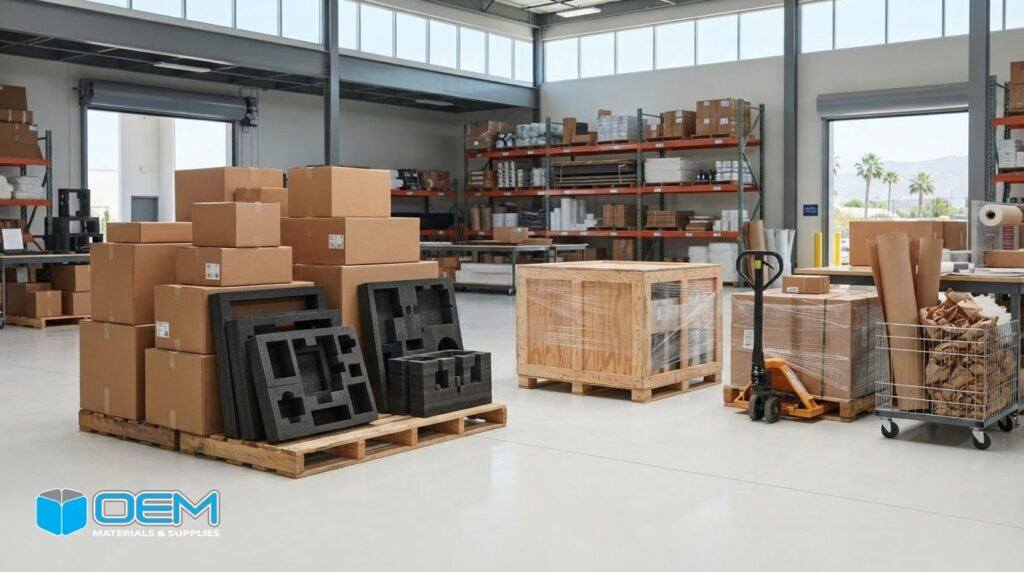
A nearby packaging supplier can still be the wrong fit if its materials do not protect your product or its replenishment process disrupts production. When comparing local packaging companies near me, look beyond location: assess packaging performance, production requirements, and how materials will flow into your operation.
For manufacturers and distributors, product damage, extra packing labor, and inventory gaps can affect operations well beyond the shipping dock. This guide explains how to evaluate a packaging partner based on protection, workflow, and supply needs. It compares how custom corrugated boxes, foam packaging, and crates can serve different products and shipments, and how packaging design, kitting, assembly, just-in-time delivery, and vendor-managed inventory can support supply continuity. It also covers practical considerations for sourcing packaging across Orange County, Los Angeles County, the Inland Empire, and San Diego County.
Key Takeaways
- Compare local packaging companies near me by product protection, production fit, and supply support, not location alone.
- Base packaging decisions on product dimensions, weight, shipping conditions, and the risks the materials need to address.
- Match materials to the application: corrugated boxes, foam, crates, cushioning, and pallets serve different needs.
- Plan replenishment around usage patterns, storage capacity, order variability, and delivery coordination across Southern California.
- Prepare a project brief with annual usage and current packaging challenges to support a tailored recommendation.
What Local Packaging Companies Near Me Should Provide for Industrial Operations
A nearby packaging source is only a starting point. Manufacturers need materials that protect products in transit and fit the pace, handling requirements, and replenishment needs of their operations. When comparing local packaging companies near me, evaluate the full operating fit, not just convenience.
An industrial packaging partner aligns materials, packaging design, fulfillment, and replenishment with the product and the workflow used to make, store, and ship it. Manufacturing procurement involves repeatable packaging requirements, coordination with production or warehouse teams, and supply planning based on actual usage. That differs from buying household moving supplies or consumer shipping materials.
Packaging provides physical protection and containment. A useful overview of packaging and labeling fundamentals offers general context, but industrial buyers also need to assess how materials perform under their specific handling and shipping conditions.
Match packaging support to the product and shipment
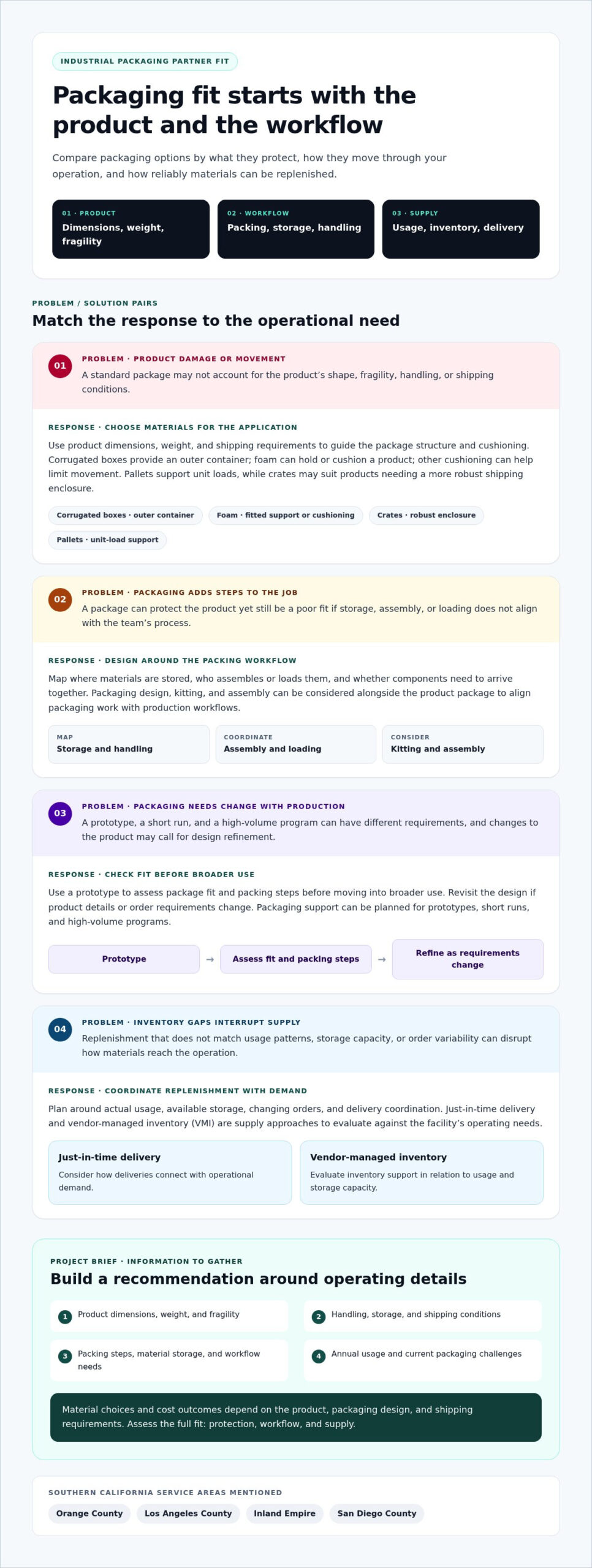
Start with the product’s dimensions, weight, fragility, and likely shipping conditions. These details influence package size and structure, cushioning needs, and how the load will be handled. Corrugated boxes provide an outer container; foam packaging can hold or cushion a product; other cushioning materials can help limit movement. Pallets support unit loads, while crates may suit products that need a more robust shipping enclosure. Choose the combination based on the application rather than a standard assumption.
For a product-specific fit, consider custom corrugated boxes alongside other packaging components. Foam packaging is another option when a fitted protective insert is needed. The design should reflect the product’s shape and shipping requirements.
Look beyond proximity to operational fit
Local support can make coordination and replenishment more practical for facilities across Orange County, Los Angeles County, the Inland Empire, and San Diego County. Regional reach matters most when it supports the way a business orders and uses packaging. Just-in-time delivery and vendor-managed inventory can connect material supply to operational demand, while packaging design, kitting, and assembly can align packaging work with production workflows.
OEM Materials & Supplies supports manufacturers across these Southern California areas with packaging design, materials, just-in-time delivery, and vendor-managed inventory. Its foam packaging solutions can be tailored to product and shipping needs. To assess fit, ask whether the packaging protects the product, supports the workflow, and meets the facility’s supply requirements.
How to Evaluate Local Packaging Companies Near Me for Custom Packaging
A custom packaging project works best when it starts with operating requirements, not a preferred material. When comparing local packaging companies near me, use a consistent process: define the product, identify the risks it faces, map how packaging moves through the operation, and align supply with expected demand. This gives recommendations a practical basis and helps avoid designs that protect the product but add unnecessary steps for the team.
Material and design choices depend on product dimensions, weight, fragility, handling, and shipping requirements. Cost outcomes depend on those project details, too. Describe the conditions the package must address, such as movement during transport or repeated handling, instead of making a general request for a “stronger” package.
Start with product dimensions, weight, and shipping conditions
Accurate measurements and weight help establish the space and support a package needs. Include how the product is packed, stored, handled, and shipped, and identify areas especially vulnerable to impact or movement. For a fragile item, evaluate how corrugated packaging, foam, and cushioning can work together. Engineered foam packaging options can provide fitted support when the product and shipping demands call for it.
Check whether the supplier can support changing production volumes
Packaging needs can differ between a prototype, a short run, and a high-volume production program. A prototype can help assess fit and packing steps before a design moves into broader use. If product details or order requirements change, the packaging design may need refinement as well. OEM Materials & Supplies supports prototypes, short runs, and high-volume programs, with custom packaging design tailored to project needs.
Map the packing process as carefully as the package itself. Note where materials are stored, who assembles or loads the packaging, and whether components need to arrive together for a specific workflow. These details connect design decisions to fulfillment and replenishment planning. For additional background on professional packaging practice, the Institute of Packaging Professionals provides a resource for people working across the packaging field.
For more manufacturer evaluation criteria, consult a guide to corrugated packaging box manufacturers. To discuss a custom packaging project, share product dimensions, weight, shipping requirements, and anticipated usage through the packaging quote request.
Compare Local Packaging Companies Near Me by Services and Supply Support
Comparing local packaging companies near me is easier when you assess product options and operational services separately. A box, foam insert, crate, cushioning material, or pallet addresses a packaging need. Design, kitting, assembly, vendor-managed inventory (VMI), and just-in-time (JIT) delivery support how packaging is specified, prepared, and replenished.
The right service combination depends on the product being protected and the workflow the packaging needs to support. Use this comparison to identify capabilities that match your operation instead of assuming every project requires every material.
| Buyer need | Relevant capability | Operational consideration |
|---|---|---|
| Contain and ship a product | Custom corrugated packaging | Consider product fit, handling, and shipment requirements. |
| Support a fragile or sensitive item | Engineered foam and cushioning | Design around product shape and the protection required in transit. |
| Package a product requiring a more robust enclosure | Wood crates | Assess the shipment and handling needs before selecting the structure. |
| Prepare or move unit loads | Pallets | Account for how loads are handled and staged at the facility. |
| Coordinate packaging tasks or replenishment | Kitting, assembly, JIT delivery, or VMI | Match the service approach to packing steps, usage patterns, and inventory needs. |
Compare packaging design and product protection capabilities
Custom corrugated packaging can be designed around product dimensions and shipment needs. Foam inserts provide shaped support, while wood crates offer a different enclosure option for applications that call for one. These materials are not interchangeable, so select the design for the product and shipment. OEM Materials & Supplies supports aerospace, automotive, medical, electronics, and general manufacturing programs. For more background on foam inserts, consult an industrial foam insert design guide.
Compare replenishment and labor-support services
Kitting and assembly can bring packaging components or preparation steps together in a defined workflow. VMI and JIT delivery support supply planning in different ways: VMI connects inventory oversight to usage, while JIT coordinates delivery with operational demand. Both approaches should account for actual consumption, storage, and order variability. For an overview of how to evaluate packaging suppliers, the Foodservice Packaging Institute offers a sourcing guide. Apply its criteria to your industrial requirements.
OEM Materials & Supplies provides just-in-time packaging support alongside packaging products and operational services. Compare capabilities against your product, packing process, and supply plan, not simply the length of a product list.
Assess Southern California Coverage, Inventory, and Project Coordination
For manufacturers with facilities across Orange County, Los Angeles County, the Inland Empire, and San Diego County, packaging supply planning involves more than the distance between a supplier and one site. Facilities may use different materials, hold different inventory, or have different order patterns. When comparing local packaging companies near me, consider how supply support fits the full operating footprint.
OEM Materials & Supplies serves manufacturers in these Southern California regions and across the United States. For a multi-site operation, map the packaging materials each location uses, where inventory is held, and how demand changes with production schedules. This information gives replenishment planning a practical starting point.
Plan replenishment around real usage and storage constraints
Bring a clear picture of packaging consumption and facility constraints to the planning process. Useful details include materials used, approximate usage over a typical period, available storage space, order variability, and receiving requirements. These details connect supply planning to the operation instead of relying on a single estimate for every site.
With vendor-managed inventory, the buyer and supplier coordinate around packaging inventory needs. The arrangement should reflect actual usage and storage conditions. OEM Materials & Supplies provides vendor-managed packaging inventory to structure that support.
Coordinate packaging across production and distribution
Packaging can involve several components and work steps. Kitting groups items needed for a packing task, while assembly supports packaging preparation within a defined workflow. These services can help when teams handle multiple materials or need components organized for production and warehouse operations. The right approach depends on the process and requirements at each facility.
Just-in-time delivery can coordinate packaging supply with operational demand. Plan it alongside usage patterns, storage limits, and delivery needs, since the same schedule may not fit every site. Aligning these factors helps teams plan material flow, but supply planning cannot guarantee uninterrupted availability.
For a broader Southern California sourcing perspective, a wholesale industrial packaging supplier guide can help frame regional requirements. To discuss packaging supply across your facilities, request a packaging quote and include the locations involved, materials used, usage patterns, and storage constraints.
Choose a Local Packaging Company Near Me and Prepare a Project Brief
Choosing among local packaging companies near me comes down to how well a supplier aligns product protection, production workflow, supply support, and regional coordination. A useful project brief gives the packaging team the information needed to understand the application and develop a relevant recommendation. It also helps distinguish a design question from a replenishment or labor concern.
Prepare information for a useful packaging consultation
Gather the core details before requesting a recommendation. Include product dimensions and weight, the current packaging format, shipping conditions, and annual usage. Note how the product is handled and packed, as well as the locations that need packaging support. If measurements or usage vary by product or facility, describe those differences instead of relying on a single estimate.
Describe the operating challenge clearly. Product damage, extra packing steps, limited storage, and inconsistent inventory each point to different areas for review. Explain what the current packaging does well and where it creates difficulty. Recommendations and cost outcomes depend on project-specific materials, dimensions, and shipping requirements, so accurate inputs matter.
Project scale also affects planning. A prototype may focus on checking package fit and design, while a short run or high-volume program brings different usage and supply considerations. Share the project stage and any known changes to product or order requirements.
Request a tailored recommendation from OEM Materials & Supplies
OEM Materials & Supplies supports industrial packaging needs in Orange County, Los Angeles County, the Inland Empire, and San Diego County, as well as nationwide when a company’s production or distribution footprint extends beyond Southern California. Custom packaging design can address product-specific requirements. Depending on the workflow, kitting or assembly can organize packaging tasks, while just-in-time delivery or vendor-managed inventory can support replenishment planning.
A clear brief connects the packaging approach with the way your team produces, stores, and ships products. Include dimensions, weight, packaging format, annual usage, shipping conditions, facility locations, and current damage, labor, or inventory challenges. Request a packaging quote with those details to start a tailored recommendation.
Build Packaging Support Around Your Operation
The right packaging partner does more than supply materials. It aligns product protection and packaging design with production workflows, replenishment needs, and the locations your operation serves. When comparing local packaging companies near me, focus on those practical measures rather than proximity alone.
Prepare product dimensions, weight, annual usage, and shipping requirements to make the next discussion more useful. Include current damage concerns, packing labor constraints, and inventory challenges. These details help shape recommendations for prototypes, short runs, or high-volume production programs. Material choices and cost outcomes depend on the specific product, packaging materials, and shipping conditions.
OEM Materials & Supplies supports custom packaging projects alongside kitting, assembly, just-in-time delivery, and vendor-managed inventory. The right combination depends on your product and workflow. Request a packaging quote with your project details, including dimensions, weight, annual usage, and shipping requirements, to start a tailored conversation about packaging for your operation.
Frequently Asked Questions
How do I find a local packaging company for industrial products?
Start by matching packaging capabilities to your product, shipping conditions, and production workflow. Compare local packaging companies near me based on custom packaging design, protective materials, and supply support, not location alone. OEM Materials & Supplies serves manufacturers in Orange County, Los Angeles, San Diego, and Riverside. Share product dimensions, weight, and current packaging challenges to help identify an approach suited to your operation.
What should I provide when requesting a packaging quote?
Provide product dimensions, weight, current packaging format, shipping requirements, and estimated annual usage. Include details about how products are handled and packed, along with any damage concerns, labor constraints, or inventory challenges. If you have multiple products or facility locations, identify differences in requirements and usage. These details help shape a recommendation around the application. Material selection and cost outcomes depend on project-specific dimensions, materials, and shipping conditions.
Can a local packaging company design custom boxes and protective packaging?
Yes. OEM Materials & Supplies provides custom packaging solutions, including custom corrugated boxes, die-cut packaging, and engineered foam inserts designed around product and shipping requirements. The company supports prototypes, short runs, and high-volume production programs. A project discussion can begin with the product’s dimensions, weight, handling needs, and shipping conditions. Those details inform packaging design rather than relying on a one-size-fits-all format.
What is the difference between a packaging supplier and a packaging partner?
A packaging supplier provides materials, while a packaging partner can also connect packaging choices with design and operational requirements. Corrugated boxes or foam packaging address product needs, while kitting, assembly, vendor-managed inventory, and just-in-time delivery may support packing and replenishment workflows. The useful distinction is how well the materials and services align with your product, production process, and supply needs.
Do local packaging companies support manufacturers outside their immediate city?
Yes. Regional support can extend beyond one city to facilities across Orange County, Los Angeles, San Diego, and Riverside. OEM Materials & Supplies serves manufacturers throughout Southern California and across the United States. For companies with multiple sites, share each location’s packaging needs, usage patterns, and storage constraints. Include the broader footprint when production or distribution extends beyond the region.
Can packaging services reduce labor or inventory work?
Packaging services can help organize tasks and inventory responsibilities, though the effect depends on the operation. Kitting and assembly may consolidate packaging-related steps in a workflow. Vendor-managed inventory can support coordination around packaging stock, while just-in-time delivery can align supply planning with operational demand. Discuss current labor steps, material usage, storage limits, and order variability to determine which approach fits. Outcomes depend on project and operating requirements.
For a recommendation based on your operation, request a packaging quote with product dimensions, weight, annual usage, and shipping requirements.