
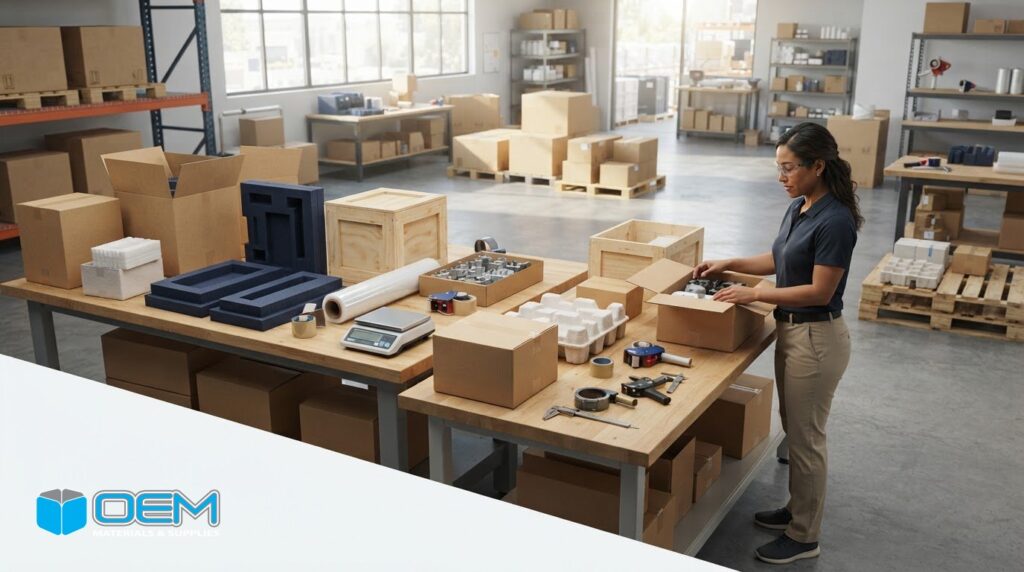
A lower-priced box can cost more per shipment if it takes longer to pack, uses more storage space, or provides less protection in transit. A TCO calculator for packaging supplies helps reveal those tradeoffs by comparing purchase price with operating costs that may not appear in procurement records alone. For example, a team can review the costs of packaging replenishment alongside the supplies used for each shipment.
Unit price is a practical starting point, but labor, damage, inventory, and handling data often sit in separate purchasing, warehouse, and shipping systems. A consistent cost-per-shipment model brings those inputs together so you can compare packaging alternatives using the same assumptions.
This article explains how to structure that model, identify the cost drivers with the greatest effect, and assess corrugated boxes, foam packaging, cushioning materials, and crates against product and shipping requirements. It also shows how packing workflows and inventory practices affect the comparison. Use the results to support an internal decision or prepare for a packaging quote or design consultation with useful details such as product dimensions, weight, and annual usage.
Key Takeaways
- Compare packaging options by cost per shipment, not unit price alone, to account for purchase and operating costs consistently.
- Build a TCO calculator for packaging supplies using attributable costs divided by comparable shipments, and document each input and assumption.
- Evaluate materials, packing labor, product protection, storage, and replenishment together while keeping packaging requirements comparable.
- Use operating records that reflect a normal shipment mix, with units and time periods aligned across purchasing, warehouse, and shipping data.
- Translate the comparison into practical sourcing requirements for packaging performance and supply continuity based on product and workflow needs.
Why a Packaging Supplies TCO Calculator Should Measure Cost per Shipment
A packaging unit price is easy to compare. Its effect on the full packing operation is harder to see. Total cost of ownership considers purchase and operational costs over a defined period, rather than treating purchase price as the complete expense. The broader Total Cost of Ownership (TCO) concept provides a useful foundation. For packaging, cost per shipment gives teams a consistent way to compare alternatives used to protect and ship comparable products.
A TCO calculator for packaging supplies should include expenses that can be tied to packaging use and shipment activity. A lower-cost box, for example, may require more cushioning or additional packing steps. Foam packaging may affect protection, packing time, or storage. The comparison is useful only when it captures those operating effects alongside material cost, using evidence from your own operation.
What belongs in packaging total cost of ownership?
Include material purchases and attributable inbound freight, receiving, storage, and replenishment expenses. Add packing labor, consumables, and handling steps when records or a repeatable measurement process support the calculation. To compare labor fairly, observe the time required to prepare and pack the same product with each design. OEM Materials & Supplies provides foam packaging for product-specific packaging applications.
Damage-related costs also require care. Use documented expenses, such as replacement or rework costs, when there is a reasonable basis for linking them to packaging performance. Don’t assign every damage incident to packaging by default. General facility overhead or delays with multiple possible causes may not be reliably attributable. Allocating those expenses without a consistent method can distort the result.
Set a fair comparison boundary
Compare alternatives across the same period, shipment volume, and product mix. Use the same cost categories and allocation method for each option, and keep units consistent. If one design is evaluated using actual labor records and another using an estimate, label the difference clearly rather than presenting both as equally measured results.
Separate measured data from estimates, assumptions, and excluded costs. Then divide attributable packaging costs by comparable shipments. This boundary makes the cost-per-shipment result easier to interpret and update. It also helps teams in Southern California, from Orange County and Los Angeles to Riverside and San Diego, distinguish a packaging cost difference from changes in shipment mix, handling practices, or data quality.
How to Build a TCO Calculator for Packaging Supplies
A spreadsheet is enough to build a useful model. Set up one row for each packaging cost category and one column for each alternative, such as the current box-and-cushioning combination and a redesigned option. The TCO calculator for packaging supplies should make assumptions visible so purchasing, warehouse, and operations teams can review the same inputs.
Use two views. The annual view shows total attributable costs over a defined period and supports budgeting and sourcing decisions. The per-shipment view normalizes those costs against shipment volume, making alternatives easier to compare.
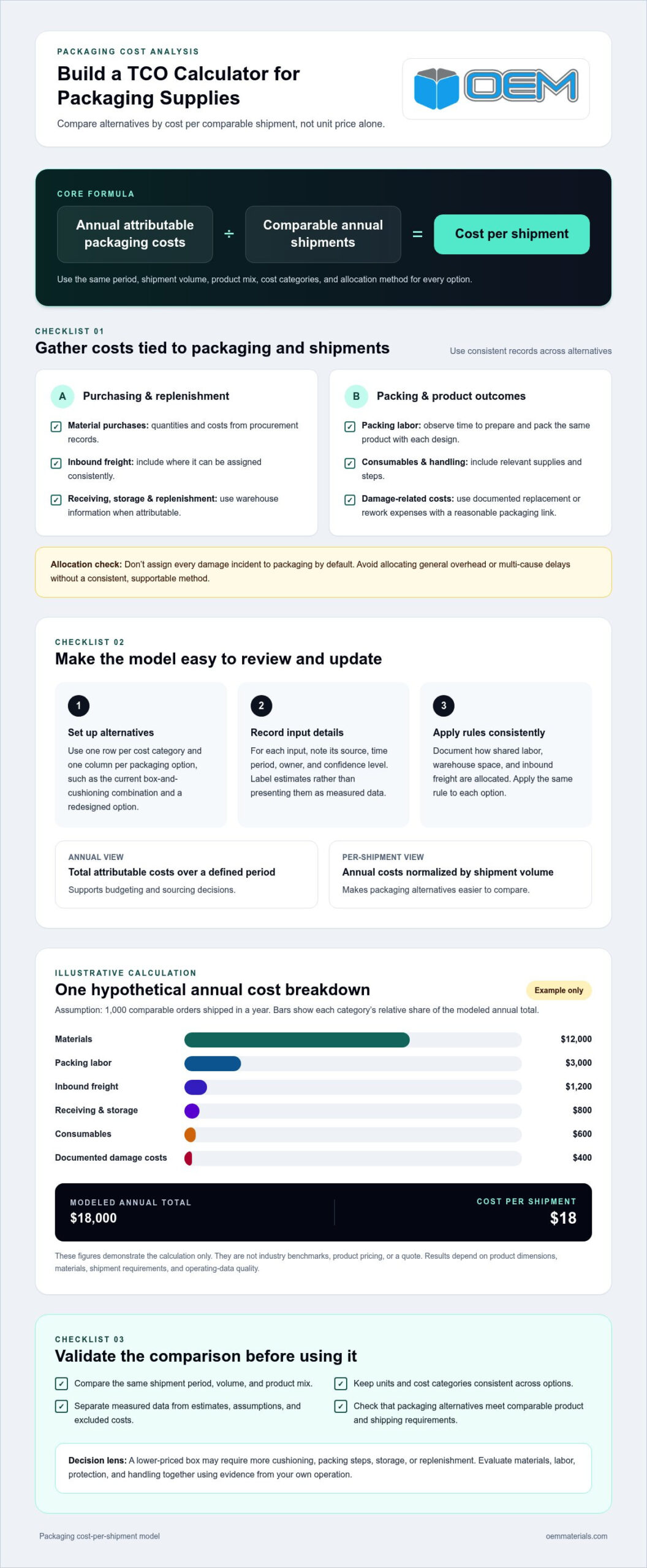
Core formula: Annual attributable packaging costs ÷ comparable annual shipments = cost per shipment.
Collect the inputs your calculator needs
Pull purchase quantities and material costs from procurement records. Add inbound freight and receiving information where those costs can be assigned consistently. From warehouse and shipping records, gather shipment volume, storage use, replenishment activity, and documented damage costs. Also record packing time, the labor assumption used to value that time, consumables, and relevant handling steps.
Identify the source and owner for each input. If a figure is estimated rather than measured, label it. That distinction matters when teams update the model or test a different packaging design.
Structure the formulas and assumptions
Calculate each annual category cost first, then divide the total by the same annual shipment count. For shared expenses such as warehouse space, labor, or inbound freight, document the allocation rule and apply it consistently to every option. Don’t assign a full shared expense to one packaging alternative unless the data supports that treatment.
For each spreadsheet input, note its source, time period, owner, and confidence level. This makes the model easier to audit and helps separate recorded costs from estimates and exclusions.
Hypothetical example: Assume an operation ships 1,000 comparable orders in a year. Its illustrative annual inputs for one packaging option are $12,000 in materials, $1,200 in inbound freight, $800 in receiving and storage, $3,000 in packing labor, $600 in consumables, and $400 in documented damage-related costs. The modeled total is $18,000, or $18 per shipment. These figures demonstrate the calculation only. They are not industry benchmarks, product pricing, or a quote. Your results depend on product dimensions, materials, shipment requirements, and the quality of your operating data.
For a project-specific review of packaging materials and workflow, request a packaging quote with product dimensions, weight, shipment volume, and annual usage.
Compare Packaging Options Beyond Material Price
A useful comparison holds the packaging job constant. Evaluate options for the same product, shipment profile, and protection requirements. Then record where the design changes packing steps, handling, or storage. A custom corrugated box may need different cushioning than a standard configuration, while foam inserts or a crate may change both protection and workflow. The right comparison depends on the product’s dimensions, materials, and shipping requirements.
Use the table to compare each alternative with the current configuration. Enter measured results where available, and note assumptions separately.
| Cost area | What to compare | Useful evidence |
|---|---|---|
| Material | Packaging components and quantity used per shipment | Purchase and usage records |
| Labor | Packing steps, handling touches, and time required | Observed workflow or time records |
| Damage | Documented damage costs associated with comparable shipments | Damage and claims records, with product and route context |
| Storage | Space used by packaging inventory and replenishment quantities | Warehouse location and inventory records |
| Replenishment | Order frequency, stock levels, receiving effort, and supply process | Purchase orders and receiving data |
Assess packing labor, protection, and handling
Time the full packing sequence, not just the final assembly step. Note whether a configuration adds folding, trimming, taping, positioning, or repeated handling. Review damage records alongside product type, shipping route, handling conditions, and packaging changes. Don’t attribute a change in damage outcomes to packaging alone if other factors changed at the same time.
Match protective materials to the application. Foam inserts, cushioning, and crates serve different product and shipment needs. A fragile component, for example, may need a configuration that controls movement, while a larger item may require a different handling approach. Compare each option with the documented protection requirement, not just the material list.
Account for inventory and replenishment effects
Packaging choices also affect how much inventory occupies warehouse space and how often teams receive and replenish it. Compare order frequency, stock levels, receiving workload, and storage needs for each configuration. For operations in Orange County, Los Angeles, Riverside, and San Diego, these considerations can be important to warehouse planning and production schedules.
Vendor-managed packaging inventory and just-in-time packaging services are replenishment approaches to compare alongside material alternatives. For corrugated applications, assess custom corrugated boxes against the full packaging configuration and its workflow requirements. A TCO calculator for packaging supplies is most useful when it captures these operational differences without treating unlike solutions as equivalent.
Use Real Operating Data to Validate the TCO Comparison
A spreadsheet is only as reliable as its inputs. Choose a baseline period that reflects the operation’s normal product and shipment mix, including routine variations in order size and packaging configuration. A short period dominated by an unusual product run or shipping pattern may not represent ongoing costs. Use the same time window for purchasing, warehouse, and shipping records so the comparison doesn’t mix incompatible snapshots.
Keep units consistent, too. Match material quantities to the shipments they supported, and use the same labor and storage allocation methods across packaging options. If an input is uncertain, don’t present it as a measured fact. A TCO calculator for packaging supplies should make uncertainty visible and show how it affects the result.
Check data quality before relying on the result
Reconcile purchasing invoices with receiving records. This can catch materials counted twice, purchases received in a different period, or freight charges omitted from the model. Confirm that the shipment count covers the same period as the costs being compared.
Review damage records in context. Separate evidence tied to packaging from incidents associated with other known causes, such as product condition or handling outside the packing process. Flag missing inputs and describe their likely effect. Incomplete labor observations, for example, weaken confidence in a labor comparison, while missing storage data may hide inventory tradeoffs.
Test scenarios and operational tradeoffs
Use sensitivity analysis to test assumptions rather than treating estimates as facts. Change one input at a time, such as shipment volume, packing time, storage use, or replenishment frequency. Note which changes move the comparison most. This shows where better measurement would help and prevents a single uncertain input from driving an overconfident decision.
Keep the pilot focused. Select a defined product or shipment group, use the same comparison rules for each packaging configuration, and record workflow or handling changes during the test. A contained pilot can make results easier to interpret without disrupting a broader operation. A manufacturer in Southern California, for example, could assess a packaging change for one product family before applying the findings across facilities. The result should still be evaluated against each operation’s actual conditions.
Use validated findings to refine packaging requirements before making a sourcing decision. Results and potential savings depend on product dimensions, materials, shipping requirements, and operating conditions. OEM Materials & Supplies provides custom packaging design reviews grounded in your application. Share product dimensions, weight, shipment mix, and annual usage to support the discussion.
Turn the Packaging TCO Result into a Practical Sourcing Decision
A cost comparison is useful when it leads to requirements the packaging must meet. Translate the model into specific priorities: product protection, packing steps, handling needs, inventory levels, and replenishment. A lower modeled cost matters only if the packaging remains suitable for the product and shipping conditions. Potential savings depend on product dimensions, materials, and shipping requirements.
OEM Materials & Supplies evaluates packaging design, materials, and workflow together. Looking beyond a single component helps show how a complete configuration fits your operation, from packing through shipment and replenishment. The TCO result can guide the review, while documented requirements keep recommendations tied to the application.
Prepare a useful packaging brief
Share product dimensions and weight, along with fragility, handling constraints, and protection requirements relevant to the application. Include shipment methods, the typical product or order mix, the current packaging configuration, and the steps employees follow to pack each shipment.
Add annual usage or shipment volume, plus available damage, labor, inventory, and replenishment data. Include the period covered by each record so the information can be compared consistently. A concise brief is most useful when it distinguishes measured data from estimates and identifies gaps in operating information.
Evaluate a packaging recommendation against the model
Compare proposed materials and designs using the same cost categories, shipment volume, and assumptions applied to the current configuration. Review how design changes affect protection, packing labor, storage, and receiving workload. If a recommendation changes the packing sequence, account for that workflow difference rather than relying on material cost alone.
Consider how services fit the operation as well. Kitting and assembly can help when packaging components or product items need to be prepared together. Vendor-managed inventory (VMI) and just-in-time delivery can be evaluated against replenishment frequency, stock levels, and receiving processes. Their fit depends on your inventory practices and production schedule, so include those requirements in the sourcing decision.
Bring your product dimensions, weight, shipment requirements, current packaging details, and annual usage to the next review. Request a packaging quote or consultation to discuss an approach grounded in your product, workflow, and TCO comparison.
Make Your Next Packaging Decision with Confidence
A practical TCO comparison looks beyond material price to measure attributable costs per shipment. Use consistent data, document assumptions, and compare packaging options against the same product, shipment, and protection requirements. This gives procurement and operations teams a clearer basis for deciding which cost drivers deserve attention.
A TCO calculator for packaging supplies can also turn operating data into a focused packaging brief. OEM Materials & Supplies evaluates custom packaging design, materials, and workflow for industrial applications. Kitting, assembly, vendor-managed inventory, and just-in-time delivery can also be part of the operational review. Potential savings depend on your product dimensions, materials, and shipping requirements.
For a useful review, provide product dimensions and weight, shipment requirements, current packaging details, and annual usage. Request a packaging quote or consultation to discuss an approach built around your operation. Clear inputs are a strong first step toward a packaging decision you can support with confidence.
Frequently Asked Questions
What is a TCO calculator for packaging supplies?
A TCO calculator for packaging supplies is a structured way to estimate packaging costs over a defined period and compare options using a consistent measure, such as cost per shipment. It can include material purchases, freight, storage, packing labor, consumables, and documented damage-related costs. Identify assumptions and exclusions clearly. For manufacturers in Orange County, Los Angeles, San Diego, or Riverside, the model can support sourcing decisions, but it cannot guarantee that one option will reduce costs.
How do you calculate the total cost of packaging per shipment?
Add the packaging costs that can reasonably be attributed to the shipments being compared, then divide by the number of comparable shipments. Use the same time period and cost categories for each packaging option. Document how shared expenses, such as labor or freight, are allocated, and keep estimates separate from measured inputs. The result depends on the underlying records and assumptions, including the shipment mix used for the comparison.
What costs should a packaging TCO calculator include?
Start with packaging materials, inbound freight, receiving, storage, replenishment, packing labor, and related consumables. Include documented damage-related expenses only when records support a reasonable connection to packaging, rather than assuming every incident has the same cause. The right categories depend on the operation and available data. Reconcile records to avoid counting an expense twice, and note exclusions so teams in Los Angeles, San Diego, and elsewhere can interpret the comparison accurately.
Is the cheapest packaging option always the lowest-cost choice?
No. A lower purchase price may be offset by added packing time, storage needs, handling steps, or documented damage expenses. A higher-priced design may also fail to improve total cost if it doesn’t address a real operational need. Compare options using the same shipment volume, product requirements, cost categories, and measurement period. This is useful for operations across Orange County and Riverside, where packaging choices should be assessed against each facility’s actual workflow.
How can I compare custom corrugated boxes with other packaging supplies?
Define the product, shipment, and protection requirements before comparing materials. Evaluate purchase and freight expenses alongside packing labor, handling, storage, and relevant damage records. Then consider whether cushioning, foam packaging, or a crate suits the application. Don’t assume one material works best for every shipment. An electronics manufacturer in San Diego, for example, should compare each configuration against its product and shipping needs using consistent inputs and documented design differences.
What information do I need before requesting a packaging quote?
Prepare product dimensions and weight, shipment methods, current packaging, packing steps, and expected usage over a defined period. Include relevant handling requirements and available labor, damage, or inventory records. These details help frame a practical discussion and support a recommendation tailored to the application. Manufacturers in Orange County, Los Angeles, San Diego, and Riverside can request a packaging quote or consultation with this information.
Can vendor-managed inventory or just-in-time delivery affect packaging TCO?
Yes. Vendor-managed inventory and just-in-time delivery can affect stock levels, replenishment frequency, receiving workload, and how packaging supplies move through an operation. Include only process effects and costs that can be measured or reasonably documented, and compare consistent assumptions across options. For a manufacturer in Riverside or Los Angeles, the value of these approaches depends on inventory practices, production schedules, and replenishment requirements. OEM Materials & Supplies can discuss both as part of a sourcing review.