
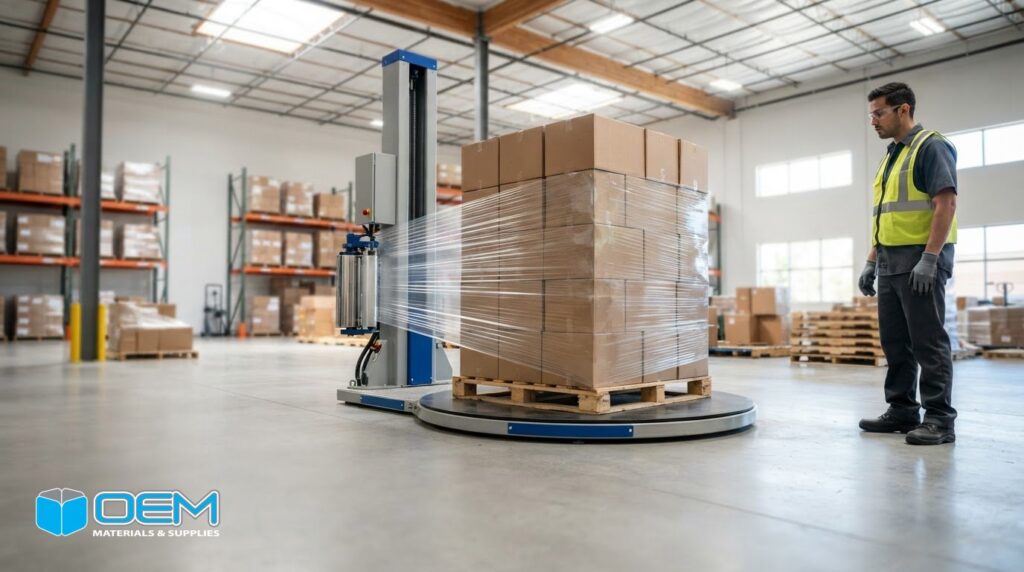
More film tension or extra revolutions won’t automatically make a pallet more secure. For Orange County operations, choosing a machine grade stretch film supplier orange county teams can work with is one part of a larger decision: the film, load, and wrapper settings need to perform together.
Inconsistent containment, torn or wrinkled film, and damaged shipments can lead to material waste, rework, and interruptions to warehouse operations. Rather than changing settings by guesswork, use a controlled evaluation to see how tension, pre-stretch, and wrap count affect load stability. Confirm that the film is suitable for the wrapper and the application before making changes.
This article outlines a practical, documented approach to evaluating film and calibrating a stretch wrapper. You’ll learn what to observe across a load, how containment force measurements can inform adjustments, and what to confirm with equipment documentation and a supplier. For manufacturers and distribution teams, supply planning matters alongside film requirements. OEM Materials & Supplies serves Orange County and Southern California with stretch film and offers vendor-managed inventory programs to discuss in relation to your operation’s needs.
Key Takeaways
- Use a controlled, documented evaluation to connect wrapper performance with film and load requirements.
- Check the machine manual, approved operating limits, and equipment condition before changing settings.
- Compare one adjustment at a time, recording its effect on containment, film breaks, load movement, and repeatability.
- When searching for a machine grade stretch film supplier orange county operations can work with, verify film specifications and machine compatibility before ordering.
- Share machine details, load dimensions and weight, shipping conditions, and annual usage to support a more relevant film and replenishment discussion.
Why Calibrating Stretch Wrap Machine Settings Matters for Orange County Operations
Calibration is a controlled process for matching a stretch wrapper’s operation to the film and load being secured. The goal isn’t simply to use less film or run the machine faster. It’s to apply film consistently and keep each load stable through handling and shipment. The basic role of stretch wrap is to unitize and secure products, but the result depends on how the film, machine, and load work together.
For manufacturers and distribution teams in Orange County, inconsistent wrapping can mean wasted film, rework, or loads that shift in transit. These issues can interrupt production and shipping schedules. A machine grade stretch film supplier orange county operations evaluate should be part of a practical discussion about film requirements, machine compatibility, and supply continuity, not just a source for rolls.
What machine calibration should accomplish
A calibrated process should produce repeatable film application and appropriate load containment under documented operating conditions. Start with the wrapper’s instructions and established safety procedures. Stay within the machine’s authorized limits, and don’t change settings without an approved process. Settings that work for one wrapper, film, or load may not transfer to another.
How film, load, and equipment interact
Pre-stretch describes how much the machine elongates film before applying it. Film tension is the pulling force applied as film moves through the carriage. Wrap force refers to the force used to apply the film around the load, while containment is the film’s holding effect on the unitized pallet. These factors influence one another, so a change intended to improve one part of the wrap can affect film integrity or load stability.
Load shape matters, too. Tall or uneven stacks, unstable products, and exposed corners can make consistent coverage more challenging. A setting that works on a uniform, stable load may not suit a different profile or product. Equipment condition and operation matter as well, so don’t assume a film issue can be solved by increasing tension or adding wraps. Evaluate the complete application and follow machine-specific guidance.
For buyers in Orange County, Los Angeles, San Diego, and Riverside, reliable packaging performance also depends on having suitable material available as production needs change. OEM Materials & Supplies serves manufacturers throughout Southern California with stretch film. Buyers can review the stretch film offering and discuss film requirements alongside machine, load, and replenishment needs. Confirm compatibility and specifications with the supplier or equipment documentation before changing materials.
Which Stretch Wrap Machine Variables Should You Check First?
Begin with the machine manual, current approved settings, and documented operating limits. Before adjusting anything, record the wrapper model, current settings, film details, and the load used for testing. This baseline helps distinguish a machine or process issue from a change in film or load conditions.
Inspect the full application path before comparing settings. Check that film is loaded and threaded as instructed, the carriage moves consistently, and the turntable or rotary arm operates as intended. Position the pallet consistently for each test. Follow the manufacturer’s maintenance and safety procedures, and don’t operate equipment with an issue that needs correction.
Review machine controls and operating condition
Identify which controls govern film delivery, carriage movement, rotation, and the cycle sequence. Check for visible wear, obstructions, or uneven movement that could affect film application. If a control’s function or permitted range isn’t clear, consult the equipment manual or manufacturer instead of testing an assumed setting. Keep maintenance concerns separate from process adjustments so test results remain useful.
Confirm film and load requirements before adjustment
Record the film type and any specification details available from the packaging or supplier. Film properties can affect how it responds to machine settings, so confirm compatibility rather than relying on appearance alone. ASTM D5459 describes a test method for evaluating stretch film’s elastic properties, but a lab property does not establish the correct wrapper setting for a specific operation.
Document the test load’s pallet dimensions, overall shape, weight, and vulnerable areas, such as exposed corners or products that could be compressed. Use the same representative load for each comparison. After each cycle, note coverage, visible film damage, and whether the load remains contained. These observations give you a consistent basis for deciding what to investigate next.
- Machine: model, current approved settings, and any operating concerns.
- Film: type and supplier-confirmed specifications.
- Load: dimensions, weight, shape, and areas needing protection.
- Result: film breaks or damage, coverage, and load movement.
Orange County buyers assessing a machine grade stretch film supplier orange county can share these records to make the film discussion more specific. Review the stretch film product information alongside your machine and load requirements, then request a quote with the relevant details. Confirm film specifications and compatibility with the supplier or equipment documentation before changing materials.
How to Compare Machine Settings Without Guessing
A useful comparison starts with a documented baseline. Keep the test load, film, machine, and wrap pattern consistent, then change only one approved setting at a time. If you change the film and a machine setting together, you won’t be able to tell which change affected the result. Follow the equipment manual and safety procedures throughout testing.
After each cycle, record coverage, visible film damage, load movement, and whether the result repeats on another comparable load. Treat film breaks, uneven application, or shifting as signs to investigate, not as a reason to make several adjustments at once.
Evaluate film delivery and pre-stretch
Depending on the wrapper, available controls may affect film delivery, carriage movement, or pre-stretch, which elongates film before it reaches the load. Compare the film’s application and integrity with equipment instructions and supplier guidance. If tearing or inconsistent application occurs, pause and check the threading path, equipment operation, and confirmed film specifications before changing settings. Standardized stretch-wrap film packaging testing can assess film properties, but testing information alone doesn’t determine a machine’s operating parameters.
Assess wrap pattern and load containment
Inspect the wrapped unit at the top, middle, and base. Note gaps or uneven coverage, film tails, crushed packaging, shifting, and unstable product layers. A pattern that looks consistent may still fail to control movement, so assess the load’s stability as well as the film’s appearance. Use the same load profile for comparisons and document vulnerable edges or areas needing protection.
Use a simple log to connect each adjustment with its observed result:
| Variable | Observation | Adjustment rationale | Result to record |
|---|---|---|---|
| Film delivery or pre-stretch | Application consistency and visible film damage | Investigate only within approved machine and supplier guidance | Breaks, coverage, and repeatability |
| Wrap pattern | Coverage at top, middle, and base | Address a documented coverage issue | Coverage consistency and film tails |
| Load handling | Movement, crushed packaging, or unstable layers | Review the load and wrapping approach before further adjustment | Containment and product condition |
Keep film changes separate from setting changes, and confirm suspected compatibility issues with the supplier or equipment documentation. A machine grade stretch film supplier orange county buyers consult should be able to review available film information alongside the machine and application. OEM Materials & Supplies provides stretch film information for buyers assessing supply options. Efficiency depends on the film, load, and shipping requirements, so compare results rather than assuming that less film or faster cycles are automatically better.
How to Calibrate a Stretch Wrap Machine: A Repeatable Test Sequence
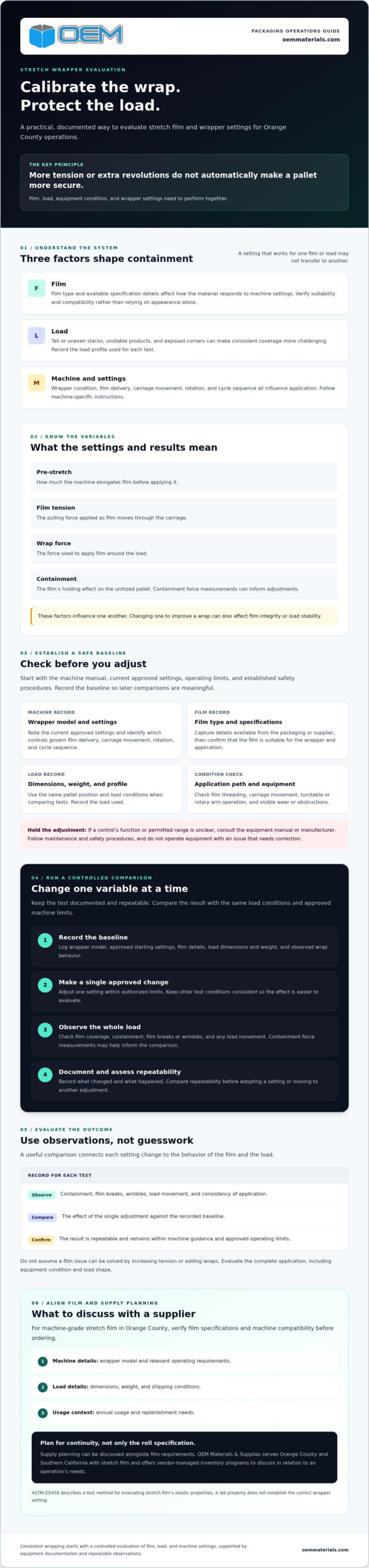
A reliable calibration process follows the same sequence each time: establish a baseline, inspect the equipment, adjust one permitted variable, test under consistent conditions, document the result, and confirm the chosen configuration. This makes it easier to identify what changed and whether the result is repeatable.
Machine-specific instructions and safety procedures come first. Keep operators within documented operating limits, and don’t reach into or adjust equipment while it’s running. If the wrapper behaves unpredictably, stop the test and consult qualified support rather than trying additional settings.
Run a controlled baseline test
Record the machine model, film details, existing approved settings, and load characteristics, including dimensions, shape, and weight. Use a representative load and the documented starting configuration. Keep the film, load, and test conditions consistent so the baseline gives you a meaningful point of comparison.
After wrapping, inspect the load and note coverage, containment, film breaks or visible damage, and any product or packaging damage. Include operator observations, such as irregular carriage movement or difficulty maintaining consistent film application. These notes establish how the process performs before you make a change.
Adjust, retest, and document the outcome
Choose one variable that the machine manual permits operators to change. Retest using the same load and film, then compare the result with the baseline. Record both the setting change and its observed effects. If the result is inconsistent, don’t treat a single successful cycle as confirmation. Repeat the test under the same conditions before standardizing the configuration.
- Baseline: Capture machine, film, load, and approved setting details.
- Inspect: Check the equipment and confirm the test conditions are suitable.
- Adjust: Change one permitted variable only.
- Test and document: Compare coverage, containment, breaks, and damage with the baseline.
- Confirm: Retain the configuration only after results are repeatable and within authorized limits.
If problems continue, share the test record with the equipment manufacturer or film supplier. A machine grade stretch film supplier orange county operations consult can review documented film details and application needs, while the equipment manufacturer can address machine-specific questions. Confirm film compatibility and specifications before changing materials. Results depend on the machine, film, load, and shipping requirements.
For a stretch film quote, send your film and application requirements, including relevant load and machine details.
Source Machine-Grade Stretch Film in Orange County With the Right Support
Choosing a supplier involves more than identifying a film category. Buyers need documented specifications, confirmation that the film suits their wrapper and application, and a replenishment approach that fits packaging demand. A machine grade stretch film supplier orange county operations evaluate should be prepared to discuss the equipment, load, shipping conditions, and supply requirements together. Confirm specifications and compatibility before ordering rather than relying on assumptions.
What Orange County buyers should provide a supplier
Give the supplier enough operational context to assess your request. Useful details include:
- Machine make and model, current film details, and any documented settings or application problems.
- Pallet and load dimensions, product weight, load shape, and areas needing additional protection.
- Shipping conditions, including how loads are handled and the routes or distribution steps they encounter.
- Annual film usage and replenishment patterns, including recurring supply concerns.
Ask which film specifications are available and request confirmation of suitability for the wrapper and load. If you have records from a controlled test, share the results. This information can focus the discussion on observed application issues instead of guesswork.
Connect film supply with packaging operations
Film planning also affects inventory continuity. Vendor-managed inventory may help coordinate packaging stock when the program fits a facility’s usage and replenishment needs. Review vendor-managed packaging inventory services as one option, and discuss your operation’s requirements before deciding whether this approach is suitable.
Efficiency and material-use outcomes depend on the product, load dimensions, packaging materials, machine, and shipping requirements. A change that works for one load profile may not suit another, so evaluate recommendations against documented operating conditions and repeatable test results.
OEM Materials & Supplies serves manufacturers in Orange County, Los Angeles, San Diego, and Riverside, as well as across Southern California. For a quote, share your machine model, current film details, load dimensions and weight, shipping conditions, and annual usage through the stretch film quote request. These details support a more informed discussion of film requirements and replenishment needs.
Build a More Consistent Wrapping Process
Reliable wrapping depends on matching the machine, film, and load, then verifying the result through controlled tests. Start with approved machine settings, keep test conditions steady, and change one permitted variable at a time. Document coverage, containment, film damage, and load movement so operators can repeat a configuration verified for the application.
For operations in Orange County, Los Angeles, San Diego, and Riverside, sourcing film is part of the same process. Confirm available specifications and machine suitability with the supplier or equipment documentation, and consider replenishment needs alongside packaging performance. OEM Materials & Supplies lists stretch film among its industrial packaging supplies and serves manufacturers throughout Southern California. Vendor-managed inventory is also available to discuss. Efficiency and material-use outcomes depend on the product, packaging materials, and shipping requirements.
If you’re evaluating a machine grade stretch film supplier orange county operations can work with, share your machine model, load dimensions and weight, shipping conditions, and annual usage. Request a stretch film quote and share your machine and load details. A clear application profile is a practical first step toward a better-informed film and supply discussion.
Frequently Asked Questions
How do you calibrate a stretch wrap machine for efficiency?
Start with the machine manual and a documented baseline. Record the film, load, and current approved settings, then wrap a representative load under consistent conditions. Change one permitted variable and repeat the test. Compare containment, film integrity, coverage, and repeatability with the baseline. Keep only a configuration that produces verified results within equipment limits. If instructions or results remain unclear, consult the machine manufacturer or film supplier.
What machine settings affect stretch wrap performance?
Relevant controls depend on the wrapper, but may include film delivery or pre-stretch, carriage movement, rotation, and wrap sequence. Their effects also depend on the film and load. Check the equipment manual to identify available controls and authorized adjustments. Then assess any change using a consistent test load, recording coverage, containment, film damage, and load movement. A setting that works for one machine or load may not suit another.
How do you know if a stretch wrap machine is using too much film?
Compare film use with a documented baseline while also checking load containment and shipment performance. Film quantity alone doesn’t show whether the wrap is appropriate. Record the film, machine configuration, load conditions, and observed results before and after a change. If using less film leads to breaks, shifting, or inadequate protection, don’t treat the reduction as an improvement. Consult the equipment manufacturer or film supplier about unresolved issues.
Does machine-grade stretch film work with every stretch wrap machine?
No. Confirm compatibility for the specific machine and application. Wrappers differ in controls and operating limits, and film specifications can vary. Share the machine make and model, current film information, and load details with a supplier. Check equipment documentation before testing a different film. OEM Materials & Supplies lists stretch film among its industrial packaging supplies, but buyers should verify available specifications and suitability before ordering.
What should I provide when requesting a machine-grade stretch film quote in Orange County?
Provide the machine make and model, current film details, pallet dimensions, product weight, load shape, and shipping conditions. Include annual usage and the application issue you’re trying to address, such as inconsistent coverage or film breaks. These details help a supplier review your requirements and confirm available specifications. For an Orange County operation, sharing this information helps guide a focused discussion of film suitability and replenishment needs.
Can a packaging supplier help improve stretch wrap machine efficiency?
A supplier can help review film requirements and sourcing needs, while machine settings should follow equipment documentation. Share film details, load conditions, and test observations so the supplier can assess whether available material options suit the application. For machine-specific operating questions, consult the equipment manufacturer. OEM Materials & Supplies serves Orange County, Los Angeles, San Diego, and Riverside, and offers vendor-managed inventory among its packaging services, subject to program fit. Contact OEM Materials & Supplies for a stretch film quote with your machine and load details.