

What if a supplier review showed not only who missed a delivery, but what that miss meant for production, packing, and inventory? A packaging supplier performance scorecard template can make reviews more consistent by replacing impressions with documented evidence. Packaging performance involves more than price and delivery. Fit, damage prevention, defects, and replenishment reliability can all affect operations.
Supplier reviews are most useful when measures are clear and fair. A corrugated box supplier and a foam packaging supplier may need different quality checks, while delivery and communication measures can apply to both. Build the scorecard around the packaging category and the supplier’s role rather than forcing every relationship into identical criteria.
This guide explains how to define practical metrics, identify evidence sources, and compare performance consistently. It also shows how to turn review findings into assigned improvement actions, so recurring issues such as late orders, packaging defects, or inventory gaps have a clear path to follow-up.
Key Takeaways
- Use a packaging supplier performance scorecard template to compare suppliers using clearly defined measures and documented evidence.
- Tailor metrics to the packaging category, including delivery, quality, responsiveness, inventory, and packaging fit.
- Record each metric’s target, actual result, evidence source, and owner so ratings are traceable and reviewable.
- Set review periods according to order frequency, operational risk, and available data.
- Discuss exceptions with suppliers and assign owners to improvement actions before the next review.
Why Use a Packaging Supplier Performance Scorecard?
A packaging supplier performance scorecard provides a repeatable way to evaluate a supplier against measures agreed on by both parties. Instead of relying on general impressions, buyers can review records for delivery, quality, communication, and continuity over a defined period. The result is a more consistent basis for identifying problems and deciding what needs to change.
The approach reflects the broader Balanced Scorecard framework, which considers performance beyond financial measures alone. For packaging, that means reviewing operational fit and product protection as well as commercial terms. A packaging supplier performance scorecard template can organize these measures, but it should support sound decisions, not replace contracts, approved specifications, or technical requirements.
Scorecards also serve a different purpose from initial qualification. Qualification helps determine whether a supplier can meet requirements before work begins. Ongoing performance measurement tracks how well the supplier meets expectations as orders, production needs, and replenishment continue. It gives procurement, engineering, and operations a shared record for reviews.
What should a packaging supplier scorecard help buyers decide?
Use results to determine whether supplier performance supports production continuity, protects products in transit or storage, and keeps packaging available when needed. Look for recurring patterns rather than reacting to a single exception. A late shipment may have a documented cause, while repeated delays or unresolved defects may warrant corrective action, a deeper review, or a sourcing discussion.
Evidence makes these decisions more practical. Compare order records with delivery commitments, then review documented damage or quality issues against the packaging requirements. Agree on next steps with the supplier and assign an owner to each action.
Why generic supplier scorecards can miss packaging risks
Packaging performance depends on the product, application, and shipping conditions. A corrugated box supplier may be evaluated on fit, condition, and delivery. A foam packaging supplier may also need review against the cushioning design and product-protection requirements. Buyers assessing foam packaging can consider whether the material and design suit the application, as described in foam packaging options.
A crate supplier and a provider responsible for replenishment have different operational roles, so identical targets may lead to misleading comparisons. Apply shared measures only when they make sense, and document the reason for category-specific targets. Review results in context before drawing conclusions. A scorecard supports clearer discussion and decisions, but it cannot replace understanding the work each supplier performs.
Which Metrics Belong in a Packaging Supplier Performance Scorecard?
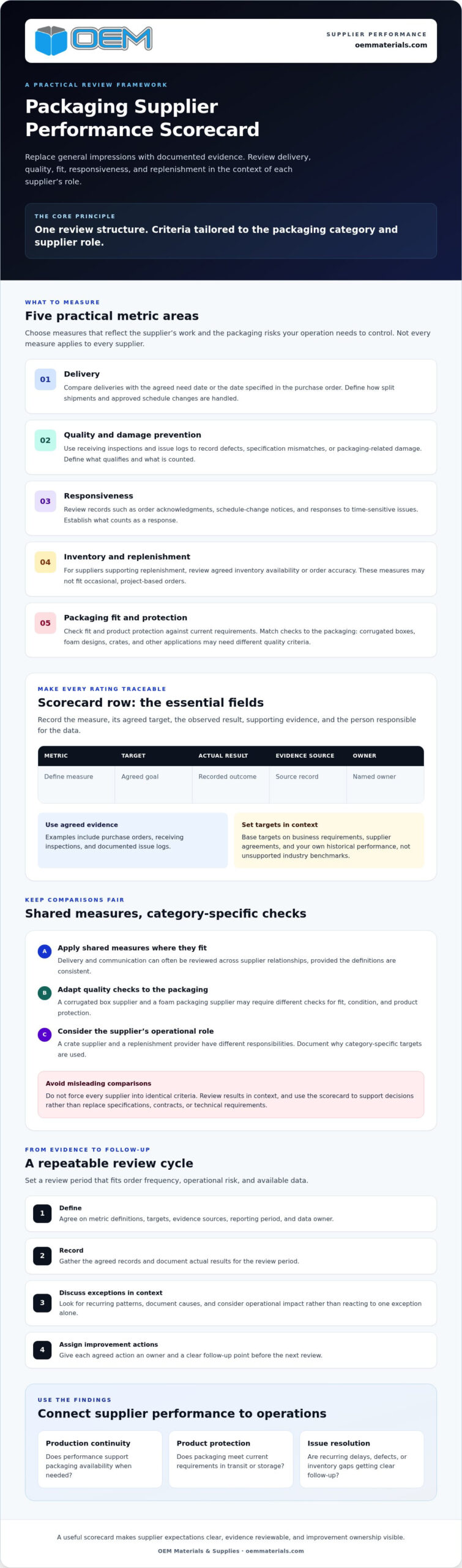
Choose measures that reflect the supplier’s role and the packaging risks your operation needs to control. A useful packaging supplier performance scorecard template groups metrics into delivery, quality, responsiveness, inventory, and packaging fit. Not every supplier needs every measure. For example, a supplier providing replenishment support may need inventory-availability measures that do not apply to a supplier handling occasional, project-based orders.
Define each metric before collecting results. Record what counts, how it is calculated, which records provide evidence, the reporting period, who owns the data, and the target. Use agreed sources such as purchase orders, receiving inspections, and documented issue logs. Set targets based on business requirements, supplier agreements, and your own historical performance, not on an unsupported industry-wide benchmark.
How to define delivery and responsiveness measures
Measure delivery against the agreed need date or another date specified in the purchase order. Document how to handle split shipments, buyer-approved schedule changes, and other exceptions so they are treated consistently. Specify which purchase orders and delivery events fall within the review period. For responsiveness, track records such as order acknowledgments, notice of schedule changes, and responses to time-sensitive issues. Define what counts as a response before scoring.
How to measure packaging quality and operational fit
Use receiving inspections and issue logs to document defects, specification mismatches, or packaging-related damage. Define what qualifies as a defect and whether the measure counts affected units, shipments, or incidents. Include fit and protection checks against current requirements, since dimensions or application needs can change. For replenishment services, measure agreed inventory availability or order accuracy using the records available for that program.
Each metric should be clear enough that another reviewer can reach the same result from the same evidence. For example, define an on-time delivery as an order received by its agreed need date, identify purchase order and receiving records as evidence, and name the procurement owner. Set the target with the supplier agreement and operational need in mind, then check it against historical results.
Keep measures relevant to the scope. A corrugated box supplier may be assessed on specification conformity and delivery, while a foam supplier may also be reviewed for fit with product-protection requirements. If inventory management is part of the supplier’s scope, include the agreed replenishment measures. To align packaging requirements with supplier scope, you can request a packaging quote.
Packaging Supplier Performance Scorecard Template: Fields and Scoring
A useful packaging supplier performance scorecard template makes each rating traceable to a defined requirement and a source record. Keep the format simple enough for procurement, engineering, and operations teams to use consistently. Use one row per metric, and identify the supplier and packaging scope so results stay connected to the work being reviewed.
Copyable scorecard fields
Supplier: [name] | Packaging category: [category] | Review period: [dates]
Metric: [measure] | Definition: [what counts and calculation] | Target: [agreed requirement] | Actual: [result]
Evidence: [record or source] | Score: [rating or pending] | Reviewer notes and exceptions: [context]
Corrective action: [next step] | Action owner: [name or role] | Follow-up date: [date]
Keep comments concise and factual. Note a buyer-approved schedule change beside a delivery rating, for example, or identify the inspection record associated with a defect. This context helps reviewers interpret the score without changing the underlying requirement.
Set a clear rating scale
Choose a buyer-defined scale and explain it before scoring begins. For example, a team might define “meets” as satisfying the documented target, “partially meets” as a shortfall that needs review, and “does not meet” as a result outside the agreed requirement. Match the precise criteria to the metric and supplier agreement. Use “pending” or “insufficient data” when evidence is missing. Do not treat missing records as a failure or guess at a rating.
Weight scores without hiding the details
If you combine ratings into a total, set category weights according to operational impact and document why they differ. A measure tied directly to production continuity may carry more weight for one supplier relationship than a lower-impact measure. Explain how ratings convert to points and how the weights affect the total. Avoid excessive decimal precision, which can imply more certainty than the evidence supports.
Review data quality and exceptions before comparing suppliers or review periods. Confirm that the same definitions, scope, and evidence rules were applied. Keep individual results visible alongside any summary score so a strong total does not conceal a recurring issue that needs action. Buyers assessing packaging requirements with a supplier can also request a packaging quote.
How to Run a Fair Packaging Supplier Scorecard Review
Choose a review period that fits the supplier’s order frequency, operational risk, and available records. A supplier shipping packaging regularly may need more frequent reviews than one supporting occasional orders. Set the period before evaluating results and use the same boundaries when comparing periods. This helps the team distinguish a developing pattern from an isolated exception.
Use the packaging supplier performance scorecard template to share the scope, metric definitions, review period, and supporting records with the supplier in advance. Confirm that purchase orders, receiving records, and issue logs are complete. Separate verified events from assumptions, then invite the supplier to explain relevant context, such as an approved schedule change. Context informs the review, but it should not erase the original evidence or change agreed requirements retroactively.
Prepare and lead the review
Keep the meeting focused on evidence and decisions. For each concern, confirm the record, discuss its operational effect, and agree whether the rating stands or needs further validation. Capture the decision, accountable owner, due date, and evidence required for closure. For delivery coordination, teams can assess whether just-in-time packaging support aligns with their replenishment requirements.
Turn findings into improvement actions
A low rating should lead to a documented decision, even if the decision is to monitor rather than open a corrective action. For each action, state the issue, its effect on production or packing, the expected correction, who owns it, and when it will be reviewed. Prioritize actions by operational consequence, recurrence, and evidence, not by the score alone.
Then verify that the action addressed the cause, not just the immediate symptom. If a packaging shipment arrives late, document the missed commitment and its operational effect, then track whether the agreed change prevents repeat delays. For recurring inventory concerns, review ordering patterns, agreed stock responsibilities, and replenishment communication. Where it fits the supplier relationship, vendor-managed packaging inventory may be one approach to assess.
Close the loop in the next review. Confirm whether the action was completed, check the supporting evidence, and record whether performance changed. If the issue remains unresolved, assign a next step or escalate it for a sourcing discussion. A scorecard review should document what was found, what was decided, and who will follow through. To discuss packaging requirements and replenishment needs with a supplier, you can request a packaging quote.
Choosing a Packaging Partner and Applying the Scorecard
Use the scorecard during sourcing to compare a supplier’s documented capabilities with your packaging requirements. Then adapt it for recurring reviews as order patterns, products, or production needs change. A packaging supplier performance scorecard template is most useful when its criteria reflect the work in scope, not a generic ranking applied to every supplier.
Evaluate engineering support, production capacity, relevant packaging materials, replenishment methods, and communication against specific business needs. A supplier supporting a prototype or short run, for example, may need different capabilities from one supporting a high-volume production program. For manufacturers in Orange County, Los Angeles, San Diego, and Riverside, delivery coordination across the region may also be part of the sourcing discussion. See the industrial packaging supplier selection guide for related evaluation criteria.
Tailor criteria to the packaging scope
For corrugated boxes, assess alignment with documented specifications, delivery results, and receiving issues. For protective packaging, review whether the packaging fits product-protection requirements and consider any recorded damage concerns. If the scope includes vendor-managed inventory or kitting, include agreed measures for inventory accuracy, replenishment, assembly, and coordination. Tie each rating to requirements and evidence relevant to the supplier’s role.
For additional box-sourcing context, consult the corrugated packaging manufacturer guide. Use sourcing criteria to identify questions for suppliers, then carry relevant requirements into the scorecard so performance reviews stay connected to the original need.
Share the right information when requesting recommendations
Provide product dimensions and weight, the packaging application, and shipping requirements when available. Approximate annual usage and production or replenishment needs help suppliers understand the scope. If current packaging creates fit, damage, or handling problems, describe what is happening and invite discussion of packaging design or material options. Recommendations depend on the product and shipping conditions, so clear inputs support a more relevant evaluation.
A packaging supplier may be able to discuss options for prototypes, short runs, or high-volume programs as requirements change. Corrugated boxes, foam packaging, and crates serve different applications, so evaluate them against the product, protection needs, and handling process rather than assuming one format fits all.
For a packaging recommendation or quote, share the packaging type, product dimensions, weight, and approximate annual usage, along with relevant shipping and replenishment requirements. These details give a supplier a practical starting point for evaluating fit and scope.
Put Your Supplier Scorecard to Work
A packaging supplier performance scorecard template works best when it connects clear metrics to reliable evidence and specific follow-up actions. Tailor the criteria to each supplier’s packaging scope, and review results in context before making sourcing or performance decisions. A consistent process helps procurement, engineering, and operations focus on issues that affect production continuity, product protection, and replenishment.
OEM Materials & Supplies supports manufacturers in Southern California and across the United States with corrugated boxes, foam packaging, and crates. Kitting, assembly, vendor-managed inventory, and just-in-time packaging services may also fit a program’s needs. The right recommendation depends on the product and operational requirements.
For a packaging discussion, share the packaging type, product dimensions, weight, and approximate annual usage. Request a packaging quote or consultation to review your requirements with the team. Clear information is a practical first step toward a packaging plan that supports your operation.
Frequently Asked Questions
What should a packaging supplier performance scorecard include?
A packaging supplier performance scorecard should identify the supplier, packaging category, review period, and agreed performance measures. For each metric, record its definition, target, actual result, evidence source, rating, and reviewer notes. Include exceptions, corrective actions, an accountable owner, and a follow-up date. A packaging supplier performance scorecard template is most useful when each rating can be traced to a clear requirement and supporting record.
How do you measure packaging supplier performance?
Measure performance against agreed requirements using consistent records and calculations. Common measures include delivery against the purchase order’s need date, receiving defects, specification mismatches, response to schedule changes, and packaging-related damage. If replenishment is part of the supplier’s scope, track agreed inventory or order-accuracy measures. Define what counts, which records provide evidence, and the review period before scoring so reviewers use the same method.
What is a good supplier scorecard rating scale?
A good rating scale is simple, defined in advance, and tied to documented targets. For example, teams can use “meets,” “partially meets,” and “does not meet,” with written criteria for each rating. Add “pending” or “insufficient data” when evidence is unavailable. Do not treat missing information as poor performance. Set thresholds using historical results, operational requirements, and supplier agreements rather than assuming one scale fits every packaging category.
How often should you review packaging suppliers?
Set review frequency according to order frequency, operational risk, and available records. A supplier supporting frequent production replenishment may warrant closer monitoring than one handling occasional orders. Keep review periods consistent enough to identify changes and recurring issues. You can also schedule a review after a material change in packaging requirements or a documented disruption, while keeping that event distinct from the regular performance period.
How do you compare packaging suppliers fairly?
Compare suppliers using consistent definitions and evidence, while accounting for differences in packaging category, scope, and operational role. A corrugated supplier and a foam packaging supplier may require different quality measures. Compare like with like, and document the reason for different targets or weighting. For manufacturers coordinating supply across Orange County, Los Angeles, San Diego, and Riverside, include relevant delivery and replenishment needs without assuming every supplier has the same role.
What should a supplier do after receiving a low scorecard rating?
The supplier and buyer should first confirm the evidence and discuss relevant context. Then document the issue, its operational effect, the expected correction, an accountable owner, and a follow-up date. Where possible, the action should address the cause, not just the immediate symptom. At the next review, check the agreed evidence to determine whether the action was completed and whether the issue has recurred.
Can a supplier scorecard help reduce packaging costs?
A scorecard can help identify conditions that contribute to avoidable expense, such as recurring damage, packaging that does not fit the application, delivery problems, or inventory gaps. It does not guarantee savings. Any cost impact depends on product dimensions, materials, shipping requirements, and operational needs. Use documented findings to assess potential changes with the supplier, then verify that any proposed adjustment continues to meet product-protection and production requirements.