
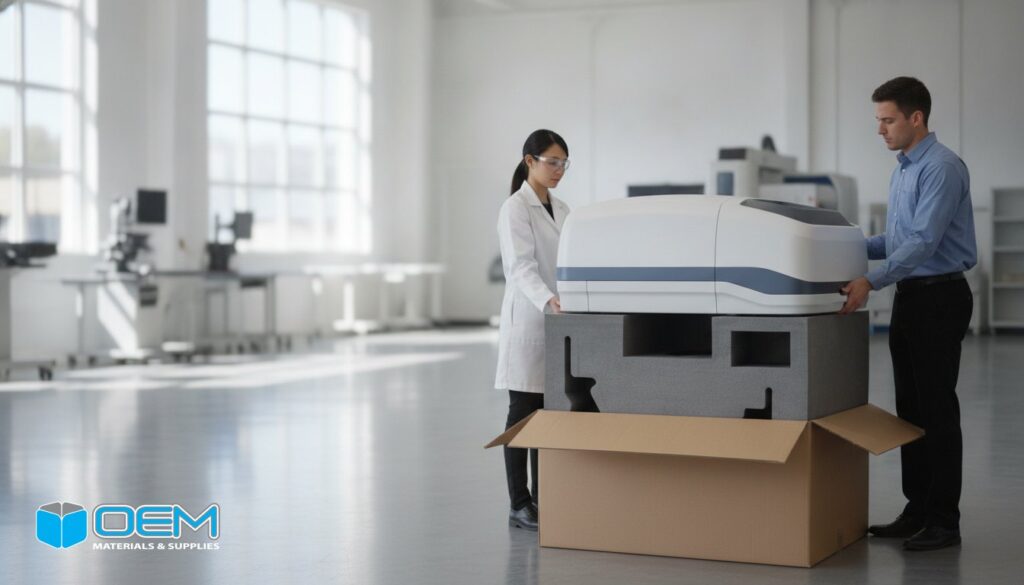
A single damaged shipment of high-value diagnostic equipment can negate months of manufacturing gains and compromise critical patient care timelines. For manufacturers across Southern California, the primary challenge lies in balancing rigorous protection with the high operational costs associated with this premium market. Securing reliable medical device packaging San Diego services requires more than just sourcing standard containers. It demands a technical partner capable of engineering industrial protective solutions for fragile, high-stakes technology that must arrive in perfect condition.
You understand that bulky packaging inventory and excessive labor costs in the assembly process are constant drains on your bottom line. This guide provides a practical roadmap to optimize your protection strategies and streamline your supply chain through custom material selection and local logistics. We will examine how custom-engineered foam, specialized corrugated designs, and vendor-managed inventory (VMI) programs work together to reduce transit damage and minimize your warehouse footprint. By aligning your packaging design with regional logistics, you can achieve the precision and speed required by the modern medical sector.
Key Takeaways
- Identify high-performance cushioning and custom foam materials that protect sensitive diagnostic equipment from vibration and impact during long-distance transit.
- Streamline your medical device packaging San Diego operations by implementing vendor-managed inventory (VMI) to reduce warehouse overhead and ensure stock availability.
- Learn structural protection strategies using edge protectors and specialized palletization techniques to eliminate costly shipping damage and product losses.
- Discover how custom kitting and assembly services can lower labor costs and improve throughput for high-volume manufacturing facilities in Southern California.
- Understand the advantages of local just-in-time delivery to maintain a lean supply chain while meeting the rigorous quality standards of the medical technology sector.
The Role of Industrial Packaging in the San Diego Medical Device Sector
Industrial medical packaging is the structural defense system protecting high-value instrumentation during distribution. While the primary sterile barrier ensures the device remains uncontaminated, the industrial outer layer manages the physical hazards of the supply chain. In a major hub like San Diego, where diagnostic innovation is a primary economic driver, securing robust medical device packaging San Diego services is a logistical necessity for firms moving sensitive equipment through Southern California freight corridors. These solutions must address mechanical shock, constant transit vibration, and vertical compression from warehouse stacking.
The San Diego Life Science Ecosystem
San Diego life science operations require specialized support to maintain their global standing. California life sciences industry generated nearly $394 billion in economic activity in 2025, with San Diego serving as a focal point for this growth. Local manufacturers operate in a high-stakes environment where proximity to shipping hubs requires packaging that can withstand rapid handling and frequent cross-docking. Transit damage is a significant risk to manufacturer reputations and patient outcomes. Reliability begins with industrial protection that adheres to the established regulations for medical device packaging and safety standards.
Secondary vs. Tertiary Packaging Requirements
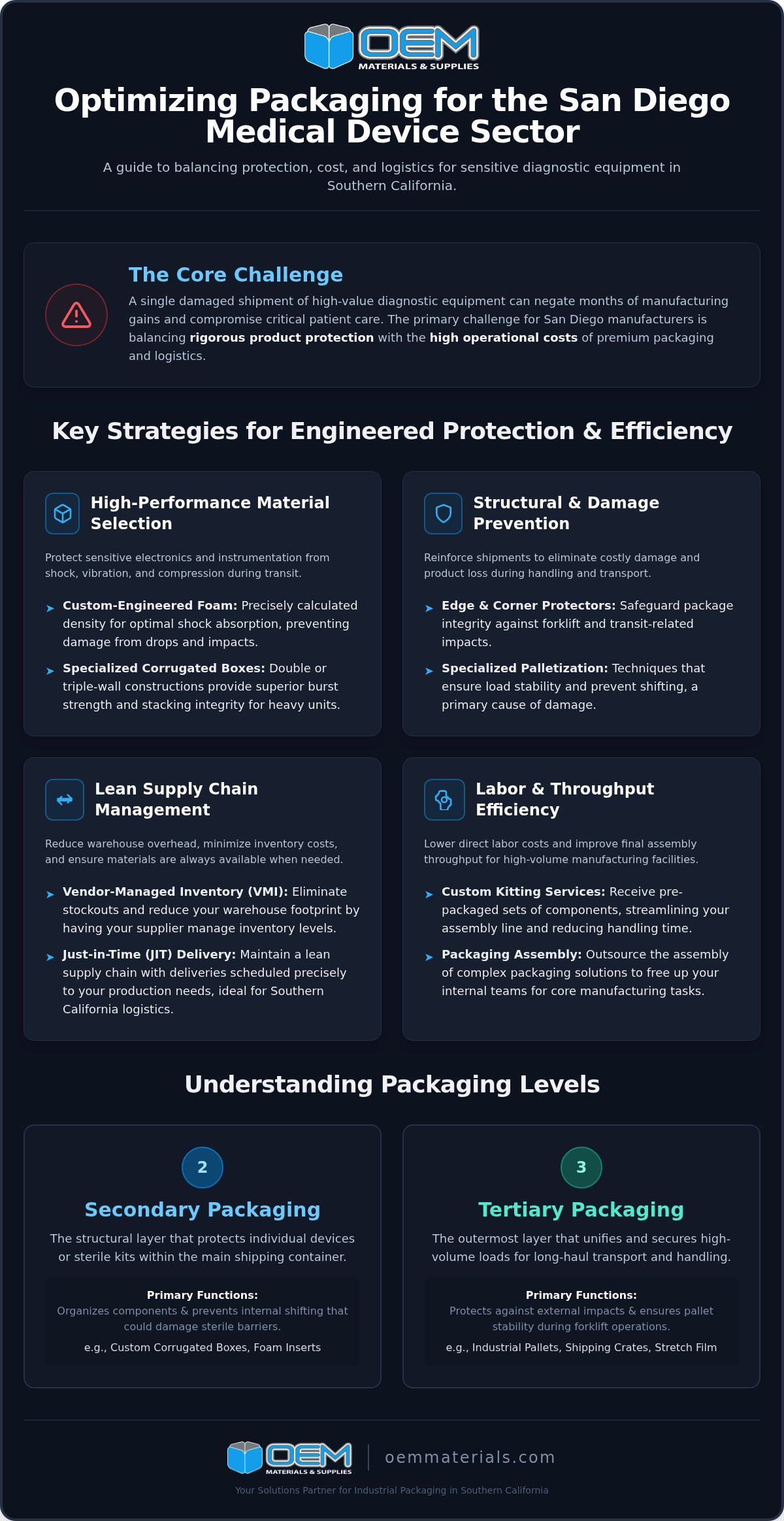
Effective logistics requires a clear distinction between packaging levels to prevent over-engineering or under-protection. Secondary packaging, often consisting of custom corrugated boxes, provides the structural support for individual sterile kits. Tertiary packaging involves industrial pallets and shipping crates that secure high-volume loads for long-haul transport.
- Secondary Packaging: Organizes components and prevents internal shifting that could puncture sterile barriers.
- Tertiary Packaging: Protects against external impact and ensures pallet stability during forklift operations.
Material compatibility is essential for maintaining product safety. Secondary layers must not compromise the integrity of the primary sterile barrier through chemical interaction or physical abrasion. Utilizing high-quality cushioning materials ensures that devices remain stationary during the most rigorous transit cycles, protecting the manufacturer’s investment from factory to the clinical environment.
Material Selection for Sensitive Medical Instrumentation
Selecting the correct substrate is a technical decision that dictates the survival of high-value diagnostic equipment. While commodity shippers focus on cost per unit, medical device packaging San Diego requires a focus on material density and structural integrity. Standard stock materials often lack the specific burst strength and shock dissipation needed for sensitive sensors or heavy imaging components. Compliance with the FDA regulation for device packaging mandates that the chosen materials must protect the device throughout the entire distribution cycle, including handling and storage. Custom-engineered solutions allow engineers to match the packaging durability to the specific fragility rating of the device.
Material density is the primary variable in effective shock absorption. Low-density materials may bottom out under heavy loads, while excessively high-density foams can be too rigid, transferring impact directly to the device. Engineering a solution involves calculating the exact density required to keep G-forces within safe limits during a drop or sudden shift in transit. Utilizing technical foam packaging ensures that these performance variables are controlled and repeatable across every shipment.
Custom Corrugated Solutions
Corrugated structures are the backbone of secondary packaging, but not all boards are equal. Heavy medical units often require double or triple-wall corrugated boxes to prevent sidewall compression and puncture. Die-cut designs are superior to standard slotted containers because they provide a precise fit. This precision eliminates internal movement, which is the leading cause of cosmetic damage and component misalignment. Custom inserts can be integrated directly into the box design to create a unified protective system that simplifies the packing process.
Engineered Foam Inserts
Foam inserts provide the critical deceleration zone for fragile instruments. The choice between polyethylene (PE) and polyurethane (PU) depends on the weight and sensitivity of the device. PE foam is a closed-cell material that offers high load-bearing capacity, making it ideal for heavier surgical tools or laboratory equipment. PU foam is open-cell and softer, providing better cushioning for lightweight, highly fragile components. For electronic medical devices, static dissipative (ESD) foam is essential to prevent electrostatic discharge from damaging internal circuitry during handling.
- Polyethylene (PE): Resists moisture and provides excellent multi-impact protection for heavy devices.
- Polyurethane (PU): Offers superior vibration dampening for delicate optical or electronic sensors.
- ESD Foam: Prevents static buildup in cleanroom or assembly environments.
Complex device geometries require custom fabrication techniques, such as CNC routing or water-jet cutting, to ensure every contour of the device is supported. This level of detail prevents “point loading,” where pressure is concentrated on a single weak point of the device. For a technical assessment of your current material performance, you can request a quote for a custom design consultation.
Structural Protection and Damage Prevention Strategies
Industrial distribution is a high-stress environment that requires structural reinforcement beyond the individual box level. While internal cushioning protects the device, structural protection strategies ensure the entire shipment survives the rigors of forklift handling, truck transit, and warehouse stacking. For medical device packaging San Diego manufacturers, this means designing for the specific hazards of the Southern California supply chain, where rapid transit and frequent reloading are common. Effective protection focuses on the entire unitized load rather than just the individual unit.
Consistent material quality is non-negotiable in high-precision industries. Variations in board strength or foam density can lead to catastrophic failures during transit. To stabilize palletized loads, industrial-grade edge and corner protectors are essential. These components prevent vertical compression and stop the strap or film from crushing the corners of secondary corrugated containers. This reinforcement allows for higher stacking heights without risking the integrity of the devices at the bottom of the load, maximizing trailer cube utilization.
Load Stabilization with Stretch Film
Proper load stabilization prevents the shaking effect that can loosen internal components of medical supply kits. Simply wrapping a pallet is insufficient; operators must select the correct gauge of stretch film based on the total load weight and profile. A film that is too thin will stretch beyond its elastic limit, causing the load to shift during a sudden stop. Conversely, excessive tension can crush fragile corrugated boxes. Referencing a technical stretch film guide helps warehouse teams determine the optimal wrap pattern and tension settings for uniform medical shipments.
Crates and Heavy-Duty Pallets
When medical devices exceed the weight limits of corrugated board or require absolute rigidity, manufacturers must transition to custom wood crates. These are particularly effective for heavy diagnostic machinery or large-scale laboratory equipment that cannot tolerate any structural flexing during movement. Using a crate provides a puncture-resistant shell that corrugated materials cannot match.
- Wood Crates: Provide maximum puncture resistance and vertical strength for long-haul or international shipping.
- Plastic Pallets: Ideal for controlled environments and cleanrooms where wood dust or contaminants are prohibited.
- Custom Bases: Integrated shock-dampening bases can be built into crates to further isolate heavy equipment from floor vibrations.
Selecting the right foundation is as important as the box itself. High-performance industrial pallets provide a stable, level surface that ensures weight is distributed evenly. This prevents the tipping or leaning that leads to shipping losses in high-volume distribution centers.
Optimizing the San Diego Medical Supply Chain
Operational efficiency in Southern California requires a logistics strategy that addresses the high costs of floor space and labor. For companies managing medical device packaging San Diego, the objective is to transform packaging from a storage burden into a streamlined component of the production line. By integrating procurement with local distribution, manufacturers can reclaim warehouse space and reduce the administrative burden of inventory management. This is especially critical as the regional life sciences sector expands, requiring faster turnaround times and more precise delivery windows to maintain a competitive edge.
Vendor Managed Inventory (VMI) for Medical Facilities
Vendor Managed Inventory (VMI) shifts the responsibility of stock levels to the supplier. This model is particularly effective for high-volume San Diego labs and manufacturing plants that cannot afford a stockout of critical shipping materials. By monitoring real-time usage data, an industrial partner can automate the replenishment of packaging VMI services. This prevents production delays while ensuring that capital is not tied up in excess inventory. While many organizations see significant packaging cost savings through the elimination of emergency orders and expedited freight, it’s important to clarify that actual results depend on specific variables like product dimensions, material selection, and annual shipping requirements.
Just-In-Time (JIT) Delivery Models
Just-In-Time (JIT) delivery models allow facilities to receive packaging materials exactly when they are needed for the assembly line. With the industrial vacancy rate in San Diego reaching 7.2% in the second quarter of 2026, maximizing every square foot of production space is a financial priority. Utilizing JIT packaging services means you don’t have to store bulky pallets of empty boxes or foam on-site. Instead, local Southern California delivery schedules are synchronized with your production runs. This improves cash flow and operational flexibility by moving materials directly from the delivery truck to the packing station.
Labor costs in kitting and assembly are another area for significant optimization. Receiving pre-assembled packaging kits allows your team to focus on device manufacturing rather than folding boxes or inserting foam. These kits arrive ready for the device to be placed inside, which significantly reduces the time required per unit. This approach minimizes the physical footprint of the packing station and ensures a consistent, high-quality result for every shipment. To evaluate how these logistics strategies can benefit your specific facility, you can request a quote for a supply chain audit.
Partnering with a San Diego Industrial Packaging Supplier
Selecting a partner for medical device packaging San Diego requires a shift from a vendor-client relationship to a technical partnership. A reliable supplier must demonstrate a deep understanding of industrial protection beyond basic corrugated boxes. In the high-stakes Southern California medical corridor, your partner should act as a consultant who can identify vulnerabilities in your current transit cycle. This includes evaluating how your secondary packaging interacts with tertiary pallets and crates to ensure a unified protective system. Reliability is defined by the ability to provide consistent material quality and responsive local support.
Working with a supplier that understands multiple industrial sectors, such as aerospace and electronics, provides a significant advantage. These industries share similar requirements for precision, electrostatic discharge (ESD) protection, and high-performance cushioning. A partner with this breadth of experience can apply proven protective strategies from one sector to solve complex challenges in another. For a deeper look at selection criteria, you should reference our wholesale industrial packaging supplier guide to understand what to look for in a regional partner.
Prototyping and Custom Engineering
Effective protection begins with a functional prototype. Moving from device dimensions to a physical sample allows your engineering team to verify the fit and ease of assembly. This stage is critical for testing how different foam densities and corrugated wall thicknesses perform under stress. Our custom packaging design process involves collaborative sessions where we analyze the fragility of your device and engineer a solution that prioritizes safety while minimizing material waste. Testing these prototypes before high-volume production prevents costly redesigns and ensures your equipment is protected from the first shipment.
Requesting a Quote for Medical Packaging
To provide an accurate recommendation, your supplier needs specific technical data. Providing comprehensive information at the start of the project leads to more precise prototypes and faster lead times. Essential data points include:
- Product dimensions (L x W x H) and total weight.
- Fragility rating or specific sensitive components like optical sensors.
- Estimated annual usage and typical order quantities.
- Transit destination and expected shipping conditions, such as air freight or local Southern California truck delivery.
Specifying these variables allows us to select the most efficient materials for your specific application. Contacting OEM Materials for local San Diego expertise ensures you receive a solution tailored to the unique logistics of Southern California. By providing these data points, you enable us to engineer a protective system that balances durability with operational cost. We focus on delivering a solution that integrates seamlessly into your existing production and distribution workflows.
Strengthening Your Southern California Medical Supply Chain
Protecting high-value medical instrumentation requires a technical approach that integrates structural engineering with regional logistics. By prioritizing custom foam density and multi-wall corrugated board, you eliminate the physical risks of transit vibration and mechanical shock. Simultaneously, implementing a vendor-managed inventory program allows your facility to reclaim valuable floor space while ensuring that critical supplies are always available. These operational improvements reduce both material waste and administrative overhead.
Effective medical device packaging San Diego solutions aren’t just about the container; they’re about the reliability of the entire distribution cycle. We serve manufacturers across San Diego, Orange County, and Los Angeles with a focus on precision and operational speed. Our team specializes in custom foam and corrugated engineering designed to meet the rigorous standards of industrial OEMs. We prioritize functional remedies that address the specific logistical challenges of the Southern California market.
Contact OEM Materials & Supplies for a custom medical packaging consultation to optimize your shipping protection today. We look forward to helping you build a more efficient and secure supply chain.
Frequently Asked Questions
What is the best material for protecting fragile medical electronics?
Static dissipative (ESD) foam is the most effective material for protecting fragile medical electronics from physical impact and electrostatic discharge. For lightweight sensors, open-cell polyurethane provides superior vibration dampening. For heavier diagnostic equipment, closed-cell polyethylene offers the load-bearing strength required to prevent bottoming out during a drop. Selecting the correct density ensures that G-forces stay within safe limits for delicate internal circuitry and optical components during transit.
Does OEM Materials & Supplies offer custom foam inserts for medical devices in San Diego?
Yes. OEM Materials & Supplies designs and manufactures custom-engineered foam inserts for medical manufacturers throughout San Diego and the surrounding Southern California counties. Our capabilities include rapid prototyping for new diagnostic tools and high-volume production runs for established lines. By specializing in medical device packaging San Diego requirements, we ensure that every foam component provides the precise density and shock absorption needed to protect your specific instrumentation throughout the industrial supply chain.
How can Vendor Managed Inventory (VMI) help my medical device company?
Vendor Managed Inventory programs allow medical device companies to lower their administrative burden and reclaim valuable warehouse space. Instead of managing complex procurement schedules, you rely on your supplier to monitor stock levels and automate replenishment. This is particularly effective for high-volume San Diego labs that need to maintain a lean inventory of bulky supplies like corrugated boxes and stretch film without the risk of emergency stockouts or production shutdowns.
What is the difference between primary and secondary medical packaging?
Primary medical packaging refers to the sterile barrier system that directly contacts the device to maintain its safety and efficacy. Secondary packaging is the protective industrial layer, such as die-cut corrugated boxes and engineered foam inserts, that shields the primary barrier from mechanical hazards. While the primary layer ensures sterility, the secondary layer manages the physical stress of distribution, including vibration, stacking compression, and impact hazards in the supply chain.
Are custom corrugated boxes strong enough for heavy medical machinery?
Custom corrugated boxes are highly effective for heavy medical machinery when engineered with double-wall or triple-wall construction. These materials provide the vertical stacking strength and puncture resistance necessary for industrial environments. For equipment that exceeds standard corrugated weight limits, we often design hybrid solutions that combine heavy-duty corrugated shells with custom wood crates or industrial pallets. This ensures the machinery remains rigid and secure during forklift handling and long-haul transport.
How do I reduce shipping damage for sensitive diagnostic tools?
Reducing damage requires a combination of internal cushioning and external load stabilization. Using custom foam inserts prevents the device from shifting inside the box, while edge protectors and high-gauge stretch film secure the unitized load on the pallet. These strategies eliminate the vibration and movement that often lead to component misalignment or cosmetic damage. A technical assessment of your current transit cycle can identify the specific structural reinforcements needed for your diagnostic tools.
Can you provide kitting and assembly services for medical kits in Southern California?
Yes. OEM Materials & Supplies provides comprehensive kitting and assembly services for medical kits throughout Southern California, including San Diego and Orange County. By receiving pre-assembled packaging components, your team can focus on manufacturing rather than manual box folding and foam insertion. This service significantly reduces on-site labor costs and improves throughput by delivering ready-to-use packaging solutions directly to your assembly line or cleanroom environment for immediate product placement.
What information is needed to get a custom packaging quote for a new device?
To generate a precise quote for a custom packaging project, we need the exact dimensions and weight of the device. It is also critical to provide the estimated annual volume and any specific sensitivity requirements, such as ESD protection or shock limits. Detailing the destination and typical transit mode allows us to select materials that balance durability with shipping costs. Providing this data ensures we can engineer a prototype that meets your performance and budgetary goals.