
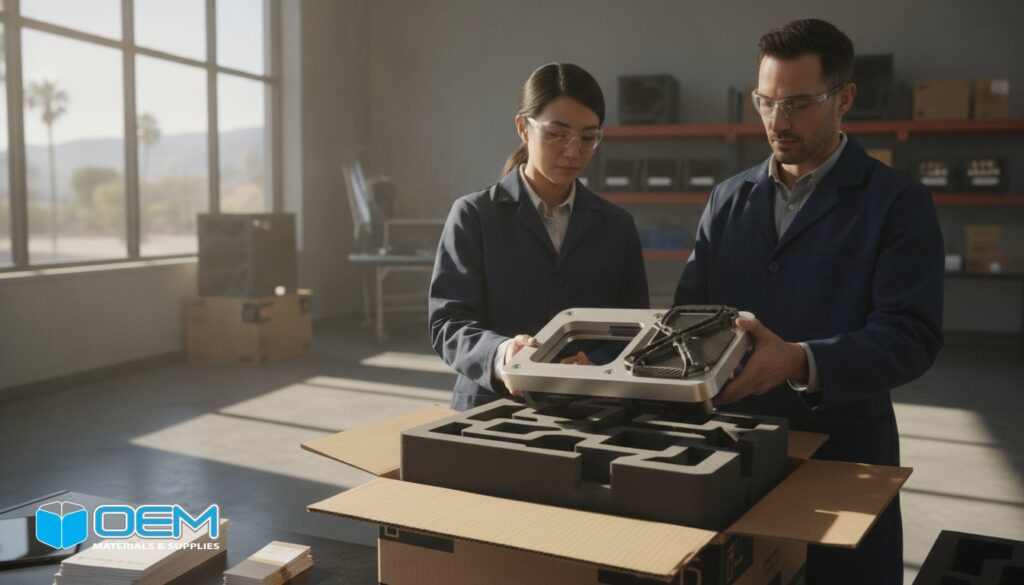
A medical device manufacturer in Orange County recently discovered that a minor flaw in a foam insert could lead to a total loss of a high-value imaging component during cross-country transport. This scenario highlights why choosing the right medical packaging design company in Los Angeles is a critical operational decision rather than a simple procurement task. Your packaging must survive the rigors of the supply chain while maintaining the physical integrity of sensitive, expensive equipment.
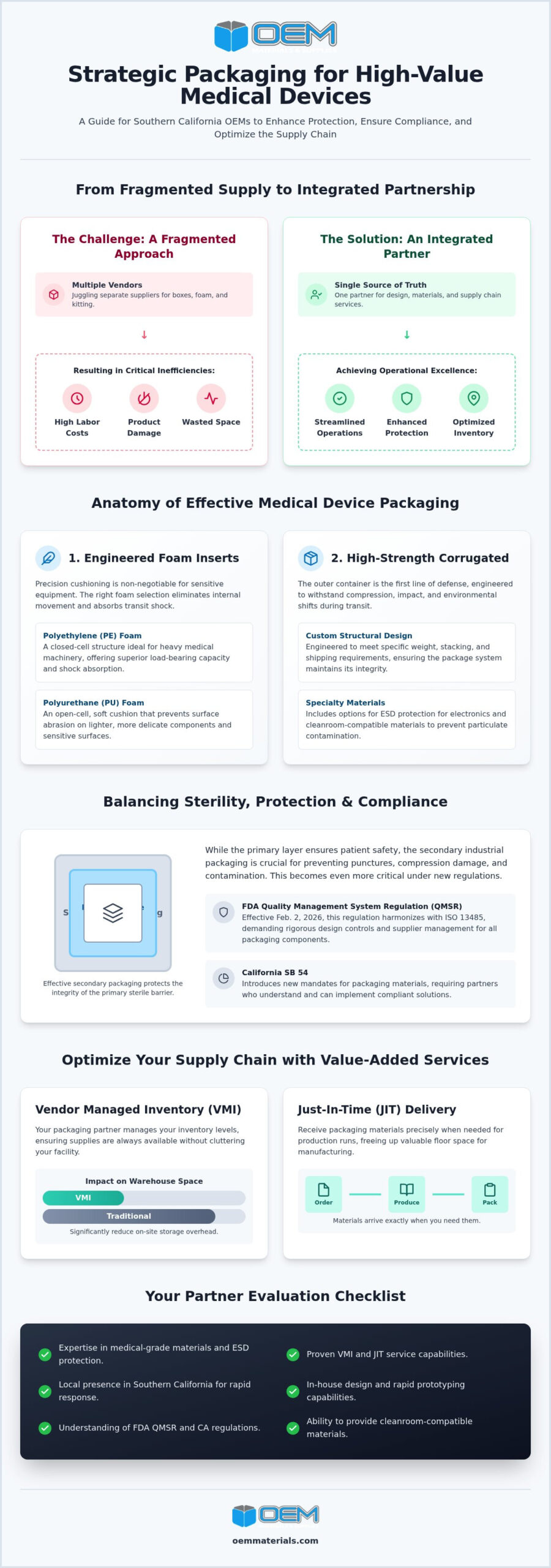
You likely deal with the daily friction of managing separate vendors for corrugated boxes, custom foam, and kitting services. This fragmented approach often results in high labor costs and inefficient use of warehouse space. This guide explains how to select a packaging partner that balances technical protection with the latest regulatory demands. You will learn how to evaluate design capabilities that reduce shipping damage and streamline your operations through integrated supply chain services.
We will cover the essential steps for auditing a local partner, focusing on their ability to comply with the FDA Quality Management System Regulation (QMSR) that took effect in February 2026 and the new California SB 54 packaging mandates. This overview provides a roadmap for implementing vendor managed inventory and custom engineered protection to stabilize your distribution process.
Key Takeaways
- Selecting a local medical packaging design company in Los Angeles facilitates rapid prototyping and ensures faster design iterations for time-sensitive medical device launches.
- Effective protection for expensive medical equipment requires a strategic combination of custom-engineered foam inserts and high-strength corrugated boxes to mitigate transit damage.
- Evaluating a partner based on their expertise with medical-grade materials and ESD protection ensures your packaging meets the technical requirements of sensitive electronic components.
- Implementing value-added services like Vendor Managed Inventory (VMI) and Just-In-Time (JIT) delivery can significantly reduce warehouse overhead and streamline production for Southern California OEMs.
Navigating the Los Angeles Medical Device Packaging Landscape
Los Angeles serves as a critical junction for global medical trade and domestic manufacturing. According to a June 2026 report, California’s life sciences sector generated nearly $394 billion in economic activity. For local OEMs, this density means high competition for logistics resources and warehouse space. Relying on generic shipping supplies often fails to account for the specific vibrations and humidity levels encountered at the Port of Los Angeles or during long-haul transit across the Inland Empire. Transitioning to engineered solutions is necessary to protect the high-value equipment that defines the region’s output.
Why Local Expertise Matters for SoCal Manufacturers
Working with a local medical packaging design company los angeles allows engineers to move from concept to physical prototype in days rather than weeks. Proximity facilitates rapid design iterations, which is vital when fitting complex, multi-component medical kits. Local partners understand the specific stress points of Southern California logistics, from the heavy-duty handling at regional hubs to the stop-and-go transit conditions that increase vibration damage. This insight allows for the design of custom foam packaging that precisely dampens shock for sensitive diagnostic electronics.
A regional partner also supports more efficient supply chain models. By leveraging just-in-time delivery, manufacturers in Orange County or Los Angeles County can reduce the footprint of their on-site packaging inventory. This approach frees up expensive floor space for production lines rather than storing empty boxes.
Balancing Sterility and Physical Protection
There is a sharp distinction between the primary sterile barrier and the secondary industrial packaging. While the primary layer ensures patient safety, the secondary layer ensures the integrity of that sterile environment. If the outer container fails, the inner barrier is often compromised. Effective secondary packaging must provide:
- Shock absorption to prevent microscopic punctures in sterile pouches or trays.
- Anti-static properties for electronic medical devices to prevent circuit failure.
- Cleanroom-compatible materials that don’t introduce particulate matter during the kitting process.
This balance is especially relevant under the FDA Quality Management System Regulation (QMSR) that became effective on February 2, 2026. The regulation harmonizes U.S. standards with ISO 13485:2016, placing a greater emphasis on rigorous design controls and supplier management. Your custom corrugated boxes and protective inserts must be documented and tested to meet these heightened expectations for industrial protection.
Key Components of Effective Medical Packaging Design
Industrial medical equipment demands more than a generic box. It requires a system engineered to withstand compression, impact, and environmental shifts. While many focus on the aesthetics of packaging, a professional medical packaging design company los angeles prioritizes the physical properties that ensure a device arrives in factory condition. This process involves a strategic selection of materials that provide both structural integrity and vibration dampening.
Engineered Foam Inserts for Sensitive Equipment
High-value diagnostic tools and surgical instruments require precise cushioning. Selecting the right material is the first step in engineering. Polyethylene (PE) foam is the industry standard for heavy medical machinery because its closed-cell structure offers superior load-bearing capacity and shock absorption. For lighter, more delicate components, polyurethane (PU) foam provides an open-cell, soft cushion that prevents surface abrasion. Using custom foam packaging allows for a precision fit that eliminates internal movement during transit.
Precision is achieved through different manufacturing methods. CNC routing is ideal for complex, low-volume prototypes or highly intricate geometries. For high-volume production, die-cutting provides a cost-effective and consistent solution. Both methods ensure that every insert matches the exact dimensions of your device, which is a requirement for maintaining the reliability of sensitive electronic components.
Custom Corrugated Solutions for Medical Logistics
The outer container is the first line of defense against the rigors of the global supply chain. For heavy surgical robots or imaging components, double-wall or triple-wall corrugated is necessary to provide the required stacking strength. Utilizing custom corrugated boxes allows engineers to optimize pallet patterns, which can reduce shipping costs and improve trailer utilization. In the Southern California climate, moisture barriers and protective coatings are often added to prevent humidity from compromising the structural integrity of the box during port storage.
Consistency in high-volume production is critical for medical OEMs. Every batch of corrugated must meet the same burst strength and edge crush test (ECT) specifications to ensure predictable performance. If your current packaging isn’t meeting these technical standards, you can request a quote for a custom design evaluation to identify and fix potential vulnerabilities.
Sustainability is also becoming a mandatory design factor. With California SB 54 regulations requiring a 25% reduction in single-use plastic packaging by 2032, manufacturers must rethink their material choices. Transitioning to recyclable corrugated and optimizing the volume of foam used helps meet these state mandates. This approach ensures compliance with environmental laws while maintaining the high safety standards required for medical device distribution.
Criteria for Selecting a Medical Packaging Design Partner
Selecting a medical packaging design partner requires looking beyond basic price lists. In an industry where a single failure can compromise patient safety or lead to significant equipment losses, your partner must function as a technical consultant. A qualified medical packaging design company in los angeles should offer a seamless transition from engineering to high-volume production without outsourcing critical design steps. This integration ensures that the protective qualities of the initial prototype are maintained throughout the entire manufacturing lifecycle.
Beyond Aesthetics: Prototyping and Performance Testing
Protective packaging is a precise engineering discipline. Effective custom packaging design focuses on the physical variables of the supply chain, such as drop height, vibration frequency, and compression strength. Relying on professional prototypes allows your engineering team to conduct iterative testing. This process ensures the final solution survives the rigors of global distribution and meets ISTA or ASTM shipping standards. It’s better to identify a structural weakness during the prototyping phase than after a product has shipped to a hospital or clinic.
High-fidelity prototypes also serve a dual purpose in the corporate environment. They provide tangible proof of concept for stakeholder approval and offer the necessary documentation for regulatory filings. When you can demonstrate that a custom foam insert has been tested against specific g-force thresholds, you build confidence in the product market readiness. For manufacturers in the Inland Empire or Orange County, having a partner capable of producing these prototypes locally reduces the time spent in the design loop.
Regulatory Alignment and Material Traceability
The regulatory environment for medical devices shifted significantly on February 2, 2026, with the FDA adoption of the Quality Management System Regulation (QMSR). This update harmonizes U.S. standards with ISO 13485:2016, placing more weight on supplier management and material consistency. Your packaging partner must understand these documentation needs to ensure your supply chain remains compliant. They should be able to provide detailed specifications for materials, including ESD protection for sensitive electronics and cleanroom-compatible corrugated options.
Material traceability is not optional. Every batch of corrugated or foam must maintain specific density and strength characteristics to ensure predictable protection. A partner that prioritizes quality control will provide the necessary data sheets to support your compliance audits. Scalability is equally important. Your provider should handle short-run prototypes for clinical trials while possessing the capacity to scale to high-volume production as your product gains market share. This flexibility is essential for Southern California OEMs who need to move quickly from R&D to full-scale distribution.
Optimizing the Supply Chain for LA Medical Manufacturers
Industrial real estate in Southern California, particularly near the Port of Los Angeles and the Inland Empire, is among the most expensive in the nation. For a medical device OEM, using this high-cost square footage to store stacks of empty corrugated boxes is a logistical inefficiency. Optimizing the supply chain requires shifting from a storage-heavy model to a flow-based model. This transition allows manufacturers to focus on their core competency of device production while offloading the complexities of inventory management to a specialized partner.
Implementing VMI and JIT for Medical Supplies
Partnering with a professional medical packaging design company los angeles allows you to implement packaging VMI (Vendor Managed Inventory). In this model, your supplier monitors your stock levels and replenishes materials before a shortage occurs. This proactive approach eliminates stockouts of critical shipping materials that could otherwise halt a production line. It’s a functional remedy for the common headache of manual inventory counts and emergency order fees.
For high-growth medical startups in Orange County, JIT packaging (Just-In-Time) delivery provides a strategic advantage. Instead of receiving a month’s worth of inventory at once, packaging arrives in smaller, frequent batches aligned with your specific production schedule. This approach frees up floor space for additional manufacturing equipment, allowing you to scale operations without increasing your physical footprint. It’s an efficient way to manage cash flow by reducing the capital tied up in unused packaging materials.
Kitting and Assembly Services to Reduce Labor Costs
Labor remains one of the highest variable costs in medical device manufacturing. You can reduce this burden by utilizing kitting and assembly services. Instead of having warehouse staff pull individual components like foam inserts, boxes, and labels from different locations, you receive pre-assembled kits. These kits are ready for immediate use in cleanroom or assembly environments, which significantly reduces the number of touchpoints in the packing process. Fewer touches mean fewer opportunities for error or damage.
Integrating custom labels and printing supplies directly into the packaging kit ensures that all necessary components are present for every unit. This level of organization improves consistency across different production shifts. Consolidating your procurement through a single partner who handles both the design of custom foam packaging and the final assembly of the shipping container streamlines your accounts payable. Managing one vendor instead of four reduces administrative friction and improves overall procurement efficiency.
If your current warehouse layout is cluttered with packaging inventory, request a quote for a supply chain audit to see how VMI or JIT services can reclaim your floor space.
Strategic Packaging Solutions with OEM Materials & Supplies
Industrial manufacturers require a partner that understands the technical requirements of high-stakes sectors. OEM Materials & Supplies functions as a dedicated resource for Southern California OEMs, providing more than just boxes and tape. We offer a comprehensive suite of industrial packaging products tailored to the rigorous standards of the medical, aerospace, and electronics industries. By focusing on durability and operational efficiency, we help manufacturers maintain their reputation for quality while optimizing their logistics spend. Our approach ensures that every component of your packaging system works in harmony to prevent damage and reduce waste.
Custom Design Capabilities for Medical OEMs
Every medical device has unique physical vulnerabilities that require a customized engineering approach. As a specialized medical packaging design company los angeles, we move beyond off-the-shelf solutions to create systems that address specific g-force thresholds and vibration frequencies. This process begins with an analysis of your product’s dimensions, weight, and fragility. We then integrate the appropriate cushioning materials and edge protection to create a secure environment for the device.
Our design philosophy focuses on lowering the total cost of ownership within your supply chain. We don’t just look at the price per unit; we evaluate how the design affects labor time during assembly and shipping costs related to dimensional weight. By optimizing the footprint of your custom corrugated boxes and the volume of foam used, we help you meet both financial targets and the sustainability requirements mandated by California SB 54. This engineering-first mindset ensures that your packaging is as advanced as the medical technology it protects.
Scaling Your Production in Southern California
We are positioned to support the entire Southern California manufacturing corridor, from the R&D labs in San Diego to the high-volume assembly lines in Los Angeles and Riverside. Our local presence allows for a level of responsiveness that national catalog vendors cannot match. We understand the logistical pressures of the region and provide the flexibility needed to match your growth trajectory. Whether you are launching a pilot program or scaling to full-market distribution, our production volumes can adjust to meet your requirements.
Reliability in the medical sector is non-negotiable. We maintain strict quality controls to ensure that every production run matches the specifications of the approved prototype. This consistency is vital for maintaining compliance with the FDA Quality Management System Regulation (QMSR) and ensuring that your devices arrive safely at their final destination. To begin a consultation, contact us with your product dimensions, weight, and annual usage. Our team will provide a custom quote and design evaluation to stabilize your distribution process and protect your high-value assets.
Advancing Your Medical Distribution Strategy
Protecting high-value medical equipment requires more than standard shipping supplies. It demands engineered solutions like custom foam inserts and high-strength corrugated boxes that withstand the specific stresses of Southern California logistics. By integrating VMI and JIT services, OEMs can reclaim valuable warehouse floor space and eliminate the risk of stockouts during critical production runs. These operational improvements directly impact your bottom line by reducing damage claims and labor costs.
Selecting an experienced medical packaging design company los angeles ensures your distribution strategy remains compliant with evolving FDA and state regulations. OEM Materials & Supplies provides the technical expertise and localized support necessary to move your products safely from the assembly line to the hospital. We specialize in custom foam and corrugated design for the medical and aerospace sectors, focusing on reliability and supply chain efficiency.
We are ready to help you optimize your packaging system. Contact OEM Materials & Supplies for a Medical Packaging Design Consultation. Please provide your product dimensions, weight, and annual usage to receive a precise technical recommendation. We look forward to supporting your production goals.
Frequently Asked Questions
What are the main requirements for medical device shipping packaging?
Medical device shipping packaging must provide physical protection, environmental stability, and full material traceability. It acts as the secondary barrier that ensures the primary sterile pouch remains uncompromised during transit. Requirements often include meeting ISTA or ASTM testing standards to prove the container can withstand specific drop heights and vibration frequencies. A professional partner ensures these technical specifications are documented to support your regulatory filings and quality audits.
How does custom foam design protect sensitive medical electronics?
Custom foam design provides a precision fit that eliminates internal movement and dampens harmful vibrations during transit. A medical packaging design company los angeles typically utilizes polyethylene or polyurethane foam to create tailored cavities for sensitive diagnostic tools. These inserts are engineered to absorb shock at specific g-force thresholds. Anti-static foam options are also available to protect electronic circuits from electrostatic discharge, ensuring devices arrive in perfect working condition.
Can a Los Angeles packaging company help with ISO compliance?
Yes, a local partner helps align your packaging with the FDA Quality Management System Regulation (QMSR) that became effective on February 2, 2026. This regulation harmonizes U.S. requirements with ISO 13485:2016, placing heavy emphasis on design controls and supplier management. Your packaging provider supports compliance by maintaining material consistency and providing the necessary documentation for your quality management system, which is essential for successful FDA inspections and international distribution.
What is the difference between primary and secondary medical packaging?
Primary medical packaging is the layer in direct contact with the device, often serving as the sterile barrier like a pouch or blister pack. Secondary packaging is the industrial shipping system, such as custom corrugated boxes and foam inserts, that protects the primary barrier from physical damage. While the primary layer ensures sterility, the secondary layer ensures structural integrity. Both must work together to maintain the safety and efficacy of the medical device throughout the supply chain.
How does Vendor Managed Inventory (VMI) benefit medical manufacturers?
Vendor Managed Inventory (VMI) allows medical manufacturers to reclaim expensive floor space by offloading the burden of inventory tracking to their supplier. Your partner monitors stock levels and replenishes shipping materials automatically, which prevents production halts caused by stockouts. This model is particularly effective for OEMs in Los Angeles and Orange County where warehouse costs are high. It stabilizes your supply chain and improves cash flow by reducing the capital tied up in unused inventory.
Why is custom corrugated better than stock boxes for medical devices?
Custom corrugated boxes are engineered for specific stacking strengths and dimensions, whereas stock boxes often lead to wasted space and inadequate protection. Custom solutions utilize double-wall or triple-wall materials to meet exact Edge Crush Test requirements for heavy medical machinery. This precision allows for optimized pallet patterns, which reduces shipping costs and minimizes the risk of box failure during long-haul transit or port storage in Southern California.
What information is needed for a medical packaging design quote?
To provide an accurate quote, a packaging partner needs the exact dimensions, weight, and fragility of your medical device. You should also provide your estimated annual usage and any specific requirements for ESD protection or cleanroom compatibility. Providing data on your current shipping methods and known damage points helps the design team identify structural improvements. This information allows for a precise calculation of material costs and engineering time for prototypes.
How do kitting services reduce labor costs for medical OEMs?
Kitting services reduce labor costs by delivering pre-assembled packaging components directly to your production line or cleanroom. Instead of warehouse staff pulling boxes, foam, and labels from separate locations, they receive a single kit ready for immediate use. This process reduces the number of touchpoints and the potential for human error during the packing phase. It allows your highly skilled labor force to focus on device assembly rather than basic logistics tasks.