
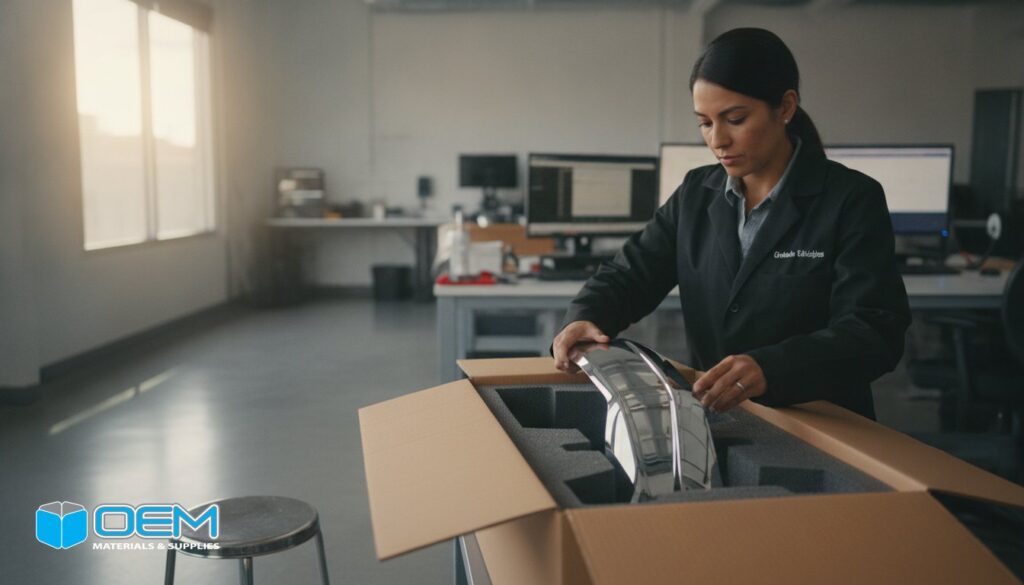
A single scratch on a Class A surface can turn a precision engineered part into expensive scrap before it even reaches the assembly line. For Southern California manufacturers, the logistics of moving sensitive parts through the Inland Empire or across Los Angeles County requires a strategy that goes beyond basic cushioning. You know that the true cost of damage includes lost production time, the administrative burden of freight claims, and the risk of a stalled assembly line. These failures are often the result of packaging that is either insufficient for the vibration of transit or too bulky for efficient handling.
Implementing effective protective packaging for automotive components is a technical challenge that balances material physics with supply chain synchronization. This guide will show you how to select the correct protective materials and logistics strategies to prevent damage to precision parts while reducing your overall labor costs. We will examine the roles of custom foam inserts, vapor corrosion inhibitors, and specialized kitting processes. You will learn how to optimize your packaging design to achieve zero-defect arrivals and reduce your warehouse footprint, ensuring your operations remain lean and efficient from the warehouse floor to the final installation.
Key Takeaways
- Understand how to match specific material properties to the physical vulnerabilities of your parts, ensuring both structural integrity and surface protection for Class A finishes.
- Discover how the prototyping phase in custom packaging design maximizes cube utilization and prevents damage during high-density multi-pack transit.
- Learn how to integrate kitting and vendor-managed inventory into your supply chain to streamline assembly lines and optimize protective packaging for automotive components.
- Identify the logistical benefits of partnering with a local Southern California supplier to support just-in-time delivery and reduce warehouse inventory overhead in Los Angeles and Orange County.
Critical Challenges in Automotive Component Protection
Managing the movement of precision parts from Tier 2 suppliers to final assembly requires more than just a sturdy box. The automotive supply chain is a high stakes environment where the margin for error is nearly zero. When protective packaging for automotive components fails, the consequences ripple through the entire production schedule. Parts often travel through multiple climate zones and handling facilities, facing humidity, extreme temperature shifts, and rough handling at every transfer point. This journey demands a material strategy that accounts for both environmental degradation and physical stress.
Efficiency often clashes with the need for robust protection. Manufacturers must balance the weight and volume of packaging against shipping costs and environmental mandates. Many OEMs now integrate reusable packaging systems to reduce material waste while maintaining high protection standards. This approach requires precise engineering to ensure the dunnage remains effective over hundreds of cycles, protecting parts without creating excessive landfill waste at the destination.
The Cost of Shipping Damage in OEM Logistics
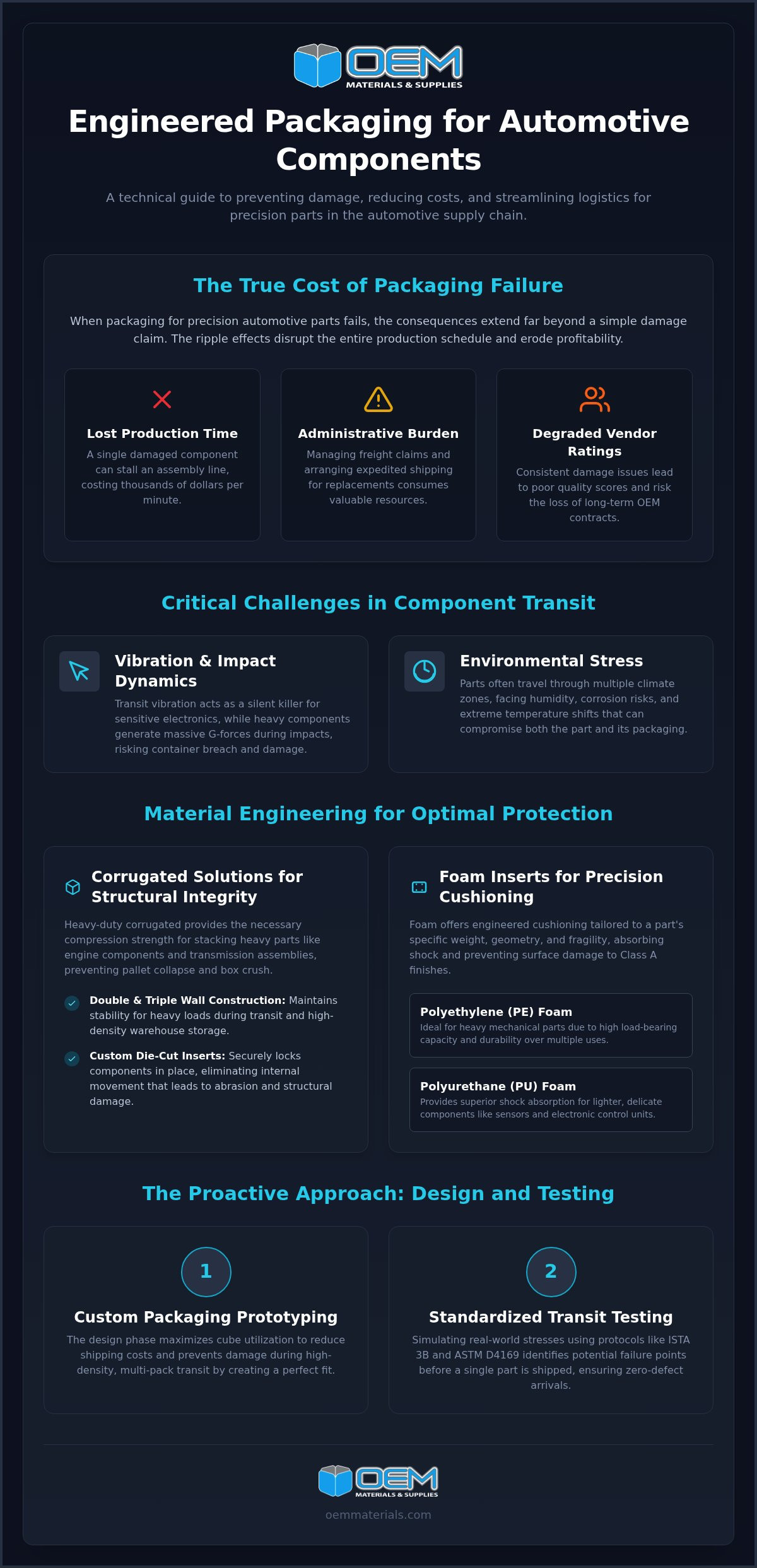
Damage claims represent only the surface of the total cost. While the direct replacement of a component is a clear line item, the indirect costs are often far higher. An assembly line shutdown can cost thousands of dollars per minute. Expedited shipping for replacement parts further erodes profit margins and disrupts logistics planning. Beyond the immediate financial loss, consistent damage issues degrade vendor ratings. In the competitive OEM landscape, poor quality scores can lead to the loss of long term contracts and future program awards.
Vibration and Impact Dynamics
Transit vibration is a silent killer of precision parts. For sensitive electronic sensors and control units, specific vibration frequencies can cause internal fatigue or mechanical resonance, leading to out of box failures. Heavy mechanical assemblies, such as engine blocks or transmissions, present a different challenge. These high mass items generate massive G forces during sudden stops or impacts. Without engineered foam packaging or custom crates, these components can shift, breaching the outer container and damaging adjacent parts.
Standardized testing, such as ISTA 3B or ASTM D4169, helps engineers simulate these stresses before a single part is shipped. By identifying failure points during the design phase, Southern California manufacturers can implement protective packaging for automotive components that withstands the rigors of the Inland Empire logistics hubs and beyond. This proactive testing ensures that the selected materials provide the necessary damping and structural support for the specific weight and geometry of the part.
Material Engineering for Diverse Automotive Parts
Selecting protective packaging for automotive components involves more than picking a container off a shelf. It requires an engineering approach that aligns material properties with the physical vulnerabilities of the part. Standards established by the Automotive Industry Action Group (AIAG) guide these selections, ensuring that materials provide sufficient dampening and structural support while remaining compatible with global shipping protocols. For high volume programs, the goal is to maximize protection while minimizing material volume and weight.
Corrugated Solutions for Structural Integrity
Heavy duty corrugated solutions provide the necessary compression strength for stacking heavy engine components and transmission assemblies. For these high mass items, standard single wall containers often fail during long haul transit or when stored in high density warehouses across the Inland Empire. We utilize corrugated boxes with double or triple wall construction to maintain pallet stability and prevent box crush. Custom die cut inserts can be integrated to lock oddly shaped components in place, eliminating the internal movement that leads to structural damage and container breaches.
Foam Inserts for Precision Cushioning
Foam inserts offer precision cushioning tailored to a part’s weight and fragility. Polyethylene foam is ideal for heavy mechanical assemblies due to its high load bearing capacity and durability. Conversely, softer polyurethane foam provides better shock absorption for lighter, more delicate assemblies. When designing foam inserts, engineers account for part migration, ensuring the component remains suspended in its protective sweet spot throughout the shipping cycle. For electronics manufacturers in Orange County and San Diego, anti static or ESD foam is essential to prevent electrostatic discharge from compromising sensitive vehicle control units (VCUs).
Surface Protection for Class A Components
Class A surfaces, such as painted body panels and polished interior trim, require non abrasive protection. Even minor friction during transit can cause scuffing that necessitates expensive rework or part rejection. Soft touch foam laminates and protective films create a barrier against surface marring. To prevent chipping on vulnerable perimeters, edge and corner protectors are applied before parts are secured with stretch film or strapping. This multi layered approach ensures that high visibility components arrive in showroom condition regardless of the distance traveled.
High volume automotive programs demand a balance between performance and material cost. By matching the specific engineering requirements of each part to the most efficient material, manufacturers can reduce waste without sacrificing protection. If you’re looking to optimize your current material selection, you can request a quote for a technical material analysis to identify potential cost savings and performance improvements.
Custom Packaging Design for Precision Assemblies
Precision assemblies require a surgical approach to packaging. Standard boxes rarely suffice for complex components like wiring harnesses, instrument clusters, or sensor arrays. The design must account for static protection, physical shock, and the orientation of the part for rapid assembly. Effective protective packaging for automotive components starts at the drawing board, where engineers evaluate the interaction between different materials. By combining corrugated outer shells with custom foam inserts and plastic dividers, we create a multi layered defense system that secures the part while optimizing the shipping footprint.
The Prototyping and Testing Process
Automotive development cycles are notoriously aggressive. Waiting weeks for a packaging sample can stall a program and delay market entry. Our rapid prototyping capabilities allow Southern California manufacturers to test fit and function using actual component samples within days. This iterative process is crucial for identifying potential friction points or structural weaknesses before mass production begins. Refining the design during this phase ensures we aren’t over engineering the solution. Reducing material usage without compromising safety helps control costs and aligns with the Automotive Packaging Handling Guidance regarding waste reduction and material efficiency throughout the supply chain.
Maximizing Container Density
Logistics costs are often driven by volume rather than weight. Shipping empty space is a significant drain on profitability for Tier 1 and Tier 2 suppliers. Through custom packaging design, we engineer multi pack configurations that maximize cube utilization. This involves calculating the optimal part density within a container to fit standardized pallet footprints used in Los Angeles and Orange County distribution centers. By minimizing the air inside a box, we lower dimensional weight charges and reduce the number of truckloads required for high volume production runs.
Ergonomics also play a vital role in the design process. A package must be easy for assembly line workers to open, unload, and dispose of. If a kit is too bulky or difficult to navigate, it increases labor hours and the risk of worker injury. We focus on creating intuitive layouts that present parts in the correct orientation for the next step in the manufacturing process. This holistic approach ensures that the protective packaging for automotive components supports both the safety of the part and the efficiency of the people handling it on the plant floor.
Optimizing Logistics with Kitting and JIT Delivery
High quality materials and precision design are only effective if the packaging arrives exactly when the production line needs it. In the automotive sector, the assembly line operates on tight margins where any delay translates into significant financial loss. If packaging supplies are late, disorganized, or out of stock, the entire manufacturing schedule collapses. Effective protective packaging for automotive components must be integrated into a broader logistics strategy that prioritizes speed and organizational clarity. By moving beyond simple material supply and into managed logistics, manufacturers can eliminate the bottlenecks that typically slow down the transition from the warehouse to the final installer.
The Benefits of Packaging Kitting
Assembly line workers shouldn’t spend their shifts wrestling with bulk rolls of cushioning or searching for the right sized container. Packaging kitting solves this by pre assembling all necessary protective elements into a single, ready to use unit. For example, a kit for a complex headlight assembly might include a custom corrugated box, die cut foam inserts, and specialized surface protection films, all organized in the specific order of use. This consolidation drastically reduces the time spent unpacking individual components and eliminates the risk of missing a protective layer. By standardizing the process, companies in Orange County and Los Angeles County ensure consistent protection across every shift, which is vital for maintaining zero defect arrival rates.
Just-In-Time (JIT) Supply Chain Integration
Floor space in a Southern California manufacturing facility is expensive and should be reserved for production, not bulk storage. Storing weeks of inventory for large corrugated boxes or wooden crates creates unnecessary overhead and logistical friction. JIT packaging services allow OEMs to operate with minimal on site stock by synchronizing deliveries with specific production runs. This lean approach ensures that packaging arrives exactly when the run starts, reducing the warehouse footprint and improving overall flow.
This level of synchronization is further supported by packaging VMI (Vendor Managed Inventory) programs. By monitoring your usage levels and lead times, we prevent stockouts of critical supplies like stretch film or edge protectors. This proactive management removes the administrative burden from your procurement team and ensures that a sudden spike in production doesn’t lead to a logistics crisis in your Inland Empire or San Diego facility. When your packaging supply is managed as a service rather than a commodity, you can focus your labor resources on core manufacturing tasks.
Organized packaging supplies do more than just protect parts; they streamline the entire facility. When materials are delivered in kits and managed through a VMI program, the time spent on inventory counts and material handling is significantly reduced. This creates a more predictable and efficient environment for your operations team. If you are ready to reduce your warehouse footprint and improve line efficiency, you can request a quote for a custom kitting and VMI analysis to see how these logistics strategies apply to your specific component dimensions and annual usage.
Selecting a Southern California Packaging Partner
Choosing a partner for protective packaging for automotive components involves evaluating more than just a price list. While unit cost is a factor, the total cost of ownership (TCO) is a much more accurate metric for high volume programs. TCO accounts for the price of the materials, the labor required for assembly, the storage costs of inventory, and the catastrophic expense of damaged parts. A partner that offers a lower price but lacks technical design support often costs more in the long run through higher scrap rates and production delays. You need a guide that understands how material selection impacts your bottom line.
Local Support for SoCal Manufacturing Hubs
Distance is a critical variable in packaging logistics. Bulky items like corrugated boxes and wood crates are expensive to ship over long distances. Partnering with a local Southern California supplier reduces lead times for facilities in Riverside, San Diego, and the Inland Empire. When a production schedule shifts, a local partner can pivot quickly to ensure you don’t run out of critical supplies. Local presence also allows for on site consultations. Our engineers can walk your plant floor in Los Angeles or Orange County to identify bottlenecks in your kitting process or suggest material changes that improve part safety.
What to Look for in a Solutions Partner
A true solutions partner provides a comprehensive range of materials and services. You shouldn’t have to manage multiple vendors for pallets, stretch film, and custom foam. Consolidating your spend with a single expert simplifies your procurement and ensures material compatibility. For example, the stretch film you use must be compatible with the pallet type and the weight of the load to ensure maximum stability during transit. This integrated approach reduces the risk of load failure during the frequent stops and turns of local delivery routes.
Experience in adjacent high precision sectors like aerospace and medical devices is also a significant advantage. These industries demand the same zero defect standards as automotive manufacturing. A partner with this diverse background brings a higher level of technical expertise to your protective packaging for automotive components. They don’t just sell you a commodity; they provide a consultative approach that focuses on solving your specific operational problems. This reliability is what builds long term trust and ensures your supply chain remains resilient.
Optimizing Your Automotive Supply Chain with Engineered Packaging
Securing precision parts for transit is a technical challenge that requires a deep understanding of material physics and logistical flow. Successful protective packaging for automotive components relies on matching material properties to part vulnerabilities and utilizing custom design to maximize container density. By adopting specialized kitting and vendor-managed inventory, you can eliminate assembly line bottlenecks and reduce unnecessary warehouse overhead. These strategies ensure your components arrive in zero-defect condition while keeping your manufacturing costs predictable.
OEM Materials & Supplies serves as a dedicated partner for Southern California manufacturers, providing the technical expertise needed for high-volume production and rapid prototyping. Our local distribution centers support just-in-time delivery and flexible VMI programs across Orange County and the Inland Empire. If you’re ready to streamline your packing process and reduce damage claims, contact OEM Materials & Supplies for a custom automotive packaging quote. Please include your product dimensions and annual usage to help our engineers provide a precise recommendation. We look forward to supporting your next program.
Frequently Asked Questions
What is the best material for protecting heavy automotive engine parts?
Heavy automotive engine parts require high compression strength and structural support. Triple-wall corrugated boxes are the standard for these high-mass components, often paired with custom wood crates to ensure stability during transit. These materials prevent box crush and provide the necessary load-bearing capacity for stacking. When shipping through Southern California hubs, using heavy-duty plastic pallets also reduces the risk of moisture absorption and contamination compared to traditional wood options.
How do foam inserts prevent damage to sensitive electronic components?
Foam inserts provide a precision-engineered cushion that suspends sensitive electronics in a neutral position. This suspension prevents the part from migrating toward the outer walls of the container where impact forces are highest. For vehicle control units and sensors, anti-static or ESD foam is used to dissipate electrical charges that could damage internal circuits. This combination of physical shock absorption and electrostatic protection is essential for zero-defect delivery of high-value automotive electronic assemblies.
What are Class A surfaces in automotive packaging?
Class A surfaces refer to high-visibility automotive components that must remain pristine for the final consumer. These include painted body panels, polished interior trim, and chrome accents. Because even microscopic scratches can lead to part rejection, protective packaging for automotive components with Class A finishes utilizes non-abrasive materials. Soft-touch foam laminates and protective films are applied to create a barrier against friction and surface marring during the vibration of transit.
How can kitting services reduce labor costs in automotive assembly?
Kitting services consolidate all necessary protective packaging materials and component parts into a single unit. This approach eliminates the time assembly line workers spend searching for specific items or unpacking bulk rolls of cushioning. By presenting parts in the correct orientation for installation, kitting reduces the total touch-time per vehicle. This process lowers labor costs and minimizes the footprint of packaging waste on the manufacturing floor in facilities across Los Angeles and Orange County.
Why is VCI packaging used for metal automotive components?
Vapor Corrosion Inhibitor (VCI) packaging protects bare metal automotive components from oxidation and rust during shipping and storage. VCI materials release a molecular layer of corrosion-inhibiting vapor that settles on the metal surface, creating a protective shield. This is particularly important for brake rotors, engine blocks, and gears that travel through humid environments. Using VCI films or papers eliminates the need for messy oils or greases that require expensive and time-consuming cleaning.
How does custom packaging design improve shipping density?
Custom packaging design improves shipping density by engineering containers that precisely match the dimensions of the part while fitting standardized pallet footprints. By eliminating empty space inside the box, manufacturers can fit more units per truckload. This optimization reduces dimensional weight charges and lowers the total number of shipments required. Efficient cube utilization is a key factor in reducing the total cost of ownership when selecting protective packaging for automotive components for high-volume programs.
What is the difference between polyethylene and polyurethane foam for auto parts?
Polyethylene (PE) foam is a closed-cell material known for its high load-bearing capacity and durability, making it ideal for heavy mechanical parts. It resists moisture and provides excellent structural support. Polyurethane (PU) foam is an open-cell, softer material used for lighter components that require superior shock absorption. While PE foam is best for blocking and bracing heavy items, PU foam is often preferred for delicate items like instrument clusters that need a softer touch.
How do vendor-managed inventory programs work for packaging supplies?
Vendor-managed inventory (VMI) programs involve a packaging partner monitoring your stock levels and automatically replenishing supplies based on pre-set thresholds. This system prevents stockouts of critical items like stretch film, edge protectors, and corrugated boxes. By outsourcing inventory management, your procurement team can focus on production rather than tracking packaging quantities. VMI programs are especially effective for Southern California manufacturers looking to maintain lean operations without the risk of a stalled assembly line.