
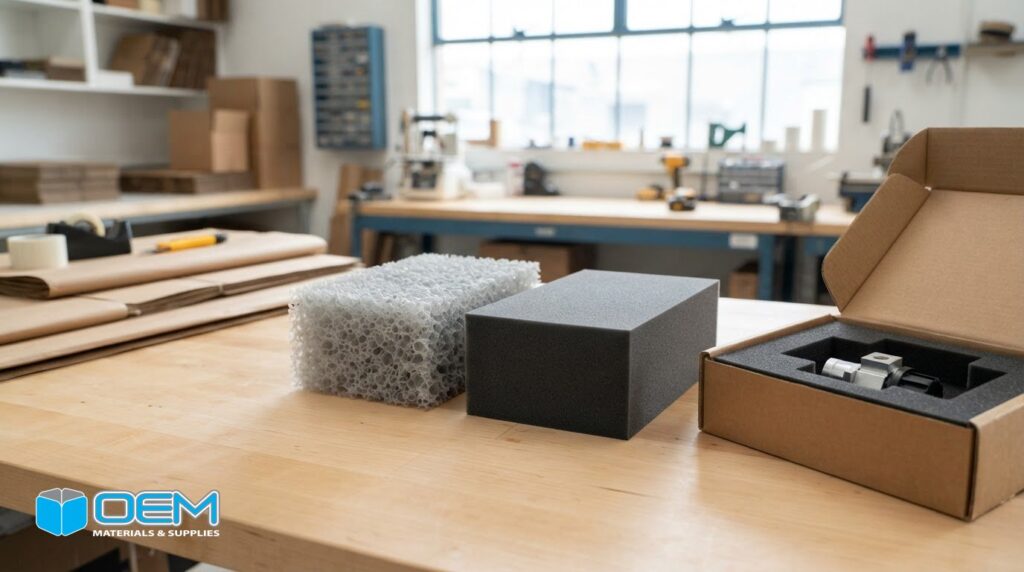
Firmer, denser foam isn’t automatically the better cushion. Open-cell foam is soft, flexible, and breathable, making it common in seating. Closed-cell foam is a better fit when moisture resistance and rigidity matter more than airflow. For closed-cell vs. open-cell foam for cushioning, choose based on how the finished cushion will be used.
Choosing foam involves more than feel. The right balance of comfort, support, moisture resistance, permeability, and affordability depends on the application. This comparison explains how each foam type responds to pressure, where open-cell foam fits in seating, and when closed-cell foam may be useful. Use the decision criteria to assess a sample before specifying cushioning for a product or project.
Key Takeaways
- Choose foam based on the cushion’s support needs, exposure to moisture, and expected use, not softness alone.
- Compare moisture resistance and airflow to determine how the foam’s cell structure fits the environment.
- Account for material and application requirements when comparing affordability; lower material cost alone may not determine overall fit.
- Open-cell foam is commonly used in seating, including cushions, sofas, and car seats, where flexibility and breathability matter.
- Use the decision guide to narrow your choice, then match cushioning with protective packaging suited to the product and shipping needs.
Open Cell vs Closed Cell Foam: Which Should I Choose?
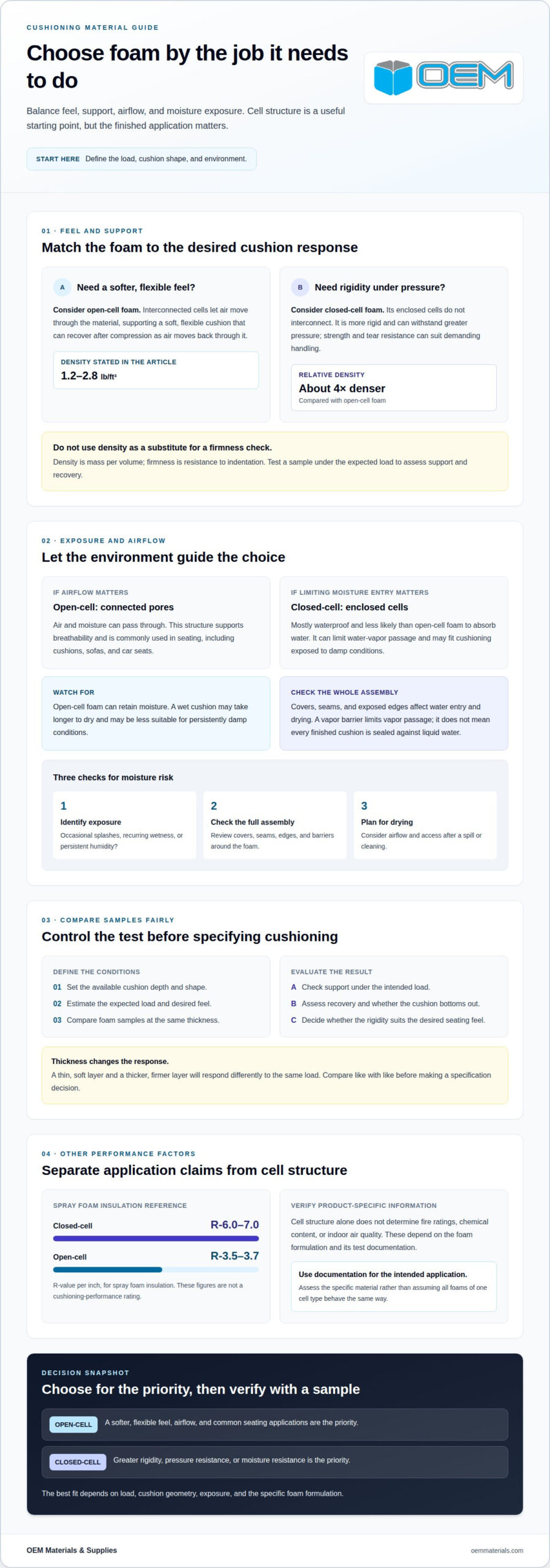
Start with the load, cushion shape, and environment. Open-cell foam typically weighs 1.2 to 2.8 pounds per cubic foot, while closed-cell foam is about four times denser.
Open-Cell Foam Cushioning Performance
Open-cell foam has interconnected cells that let air move through the material. That structure supports soft, flexible cushioning and helps foam recover after compression as air moves back through it. Its density range is 1.2 to 2.8 pounds per cubic foot. Compare firmness under the intended load, then evaluate the cushion’s thickness and shape to judge whether it provides enough support without bottoming out.
Closed-Cell Foam Cushioning Performance
Closed-cell foam has enclosed cells that do not interconnect. It is about four times denser than open-cell foam, more rigid, and able to withstand greater pressure. Its strength and tear resistance can make it suitable for durable cushioning exposed to compression and demanding handling. Density alone does not determine firmness, so assess the foam under the intended load and decide whether its rigidity suits the desired seating feel.
For insulation and temperature control, closed-cell spray foam provides an R-value of 6.0 to 7.0 per inch, compared with 3.5 to 3.7 per inch for open-cell spray foam. Open-cell acoustic foam absorbs sound effectively; cushioning performance still depends on the specific material and application.
Cell structure alone does not determine fire ratings, chemical content, or indoor air quality. These properties depend on the foam formulation and its test documentation, so compare product-specific information for the intended use.
Density is mass per volume; firmness is resistance to indentation. Compression describes how foam responds under load. Test a sample at the expected seating pressure to assess its support and recovery.
To choose thickness and firmness, define the available cushion depth, expected load, and desired feel. Then compare samples at the same thickness. A thin, soft layer and a thicker, firmer layer will respond differently to the same load.
Cutting foam to shape is separate from bonding or repair. Choose a profile that fits the seat, use an adhesive compatible with the foam, and replace material if damage prevents it from providing the required support.
| Option | Structure | Density | Cushioning fit |
|---|---|---|---|
| Open-cell | Interconnected cells | 1.2 to 2.8 lb/ft³ | Soft, flexible feel |
| Closed-cell | Enclosed cells | About four times denser | Rigid, pressure-resistant support |
Choose open-cell foam for a softer, flexible feel; choose closed-cell foam when rigidity and pressure resistance matter more.
Moisture resistance and vapor barrier properties
Cell structure affects how foam handles water and vapor. Before choosing a seating or cushioning material, consider exposure to spills and humidity, as well as how the cushion will dry.
Water Absorption and Moisture Resistance
Closed-cell foam is mostly waterproof because its enclosed cells leave little room for water to enter. It is less likely than open-cell foam to absorb water and can limit water-vapor passage. This makes it a stronger candidate for cushioning exposed to damp conditions, such as equipment stored in a humid area.
Closed-cell foam also acts as a vapor barrier and is described as unharmed by water damage. Still, seams, covers, and exposed edges matter because water can reach parts beyond the foam itself. Evaluate the complete cushion or assembly, not just the foam’s internal structure.
Open-Cell Foam Moisture Retention
Open-cell foam has connected pores that let air and moisture pass through. It can absorb moisture, so a wet cushion may take longer to dry and may be less suitable for persistently damp conditions. In thermal applications, absorbed water can reduce insulating effectiveness.
Open-cell foam is not automatically unsuitable outdoors. Some formulations, such as Dryfast, can be used outdoors and may retain little to no moisture. Assess the specific foam’s intended environment rather than assuming all open-cell materials behave the same way.
For a seating cushion near frequent spills, consider how easily moisture can be removed from the cover and surrounding construction. Removable covers, exposed seams, and limited airflow can affect drying even when the foam resists water. For humid storage, compare closed-cell construction with the actual exposure conditions.
Use these steps to assess moisture risk:
- Identify the exposure. Distinguish occasional splashes from recurring wetness or persistent humidity.
- Check the full assembly. Review covers, seams, edges, and any barriers around the foam.
- Plan for drying. Consider airflow and access to the cushion after a spill or cleaning.
A vapor barrier limits water-vapor passage; it does not mean every finished cushion is sealed against liquid water. An uncovered edge or stitched seam, for example, can let moisture reach the cushion despite the foam’s cell structure. Match the material to both the foam and its installed design.
For cushioning, closed-cell foam generally offers greater moisture resistance, while open-cell foam allows more airflow. The better fit depends on whether the priority is limiting water entry or letting air move through the material.
Open-cell foam structure and permeability
Cell structure determines how air moves through foam and how the material responds to pressure. More than half of the cells in open-cell foam are open, while closed-cell foam has enclosed cells that do not interconnect.
In open-cell foam, connected pores let air pass through the material. This permeability is useful where airflow matters, including air filtration. An engine air filter, for example, can capture dust and pollutants while allowing air to pass through the foam. The same open structure helps acoustic foam absorb and reduce sound waves.
Open-cell foam is generally more effective at absorbing sound than closed-cell foam. Its permeable structure lets sound waves enter, where the foam can dampen them. This can make it a practical choice for acoustic cushioning when sound absorption is required. Closed-cell foam’s enclosed cells limit this pathway, making it less suited to that specific function.
Closed-cell foam favors rigidity. Its cells remain enclosed rather than forming connected air passages, and the material can withstand greater pressure than open-cell foam. This resistance can help cushioning retain a defined shape under load. But greater rigidity does not automatically make it the better choice: designs requiring airflow or sound absorption call for different properties.
Prioritize the cell structure based on the application. For an acoustic panel or an airflow-dependent filter, permeability is central. For a protective pad that must resist compression, rigidity may matter more. In seating, consider whether the foam should flex and conform or retain a firm profile. These criteria clarify the material’s function beyond its general label.
A practical selection review can follow three steps:
- Identify the required pathway. Decide whether air or sound needs to pass into the foam, as with a filter or acoustic application.
- Define the load response. Establish whether the cushion must flex, conform, or resist pressure.
- Match structure to function. Favor open-cell foam for permeability and sound absorption, or closed-cell foam where greater rigidity is needed.
These structures serve different performance goals; they are not interchangeable versions of the same material. An engine filter needs airflow, an acoustic pad benefits from sound absorption, and a pressure-bearing cushion may need a firmer response. Identify the primary requirement first, then assess whether the foam’s cell structure supports it.
More than half of a foam’s cells must be open for it to be classified as open-cell. Its permeable structure lets air pass through, supporting filtration, and helps it absorb and reduce sound more effectively than closed-cell foam.
Relative affordability
Open-cell foam is generally more economical than closed-cell foam and uses less plastic to make. It can be a practical starting point when its support, flexibility, and airflow suit the application. The closed-cell vs. open-cell foam for cushioning comparison should account for the finished design, not just the material category.
Material use depends on the cushion’s dimensions and shape. A broad, thick component requires a different amount of foam than a shallow pad. Cutouts and contours also affect how efficiently a sheet can be used. A simple rectangular insert, for example, may leave a different amount of excess material than one shaped around several product features.
Performance requirements also affect value. A seating cushion may need a flexible feel, while a protective pad may need to hold a firmer profile. If the material cannot meet the intended load or support requirements, the design may need revision or replacement, changing the overall economics beyond the initial foam selection.
Include shipping requirements in the comparison. Finished cushion dimensions, package fit, and handling during transit affect the overall configuration. Assess the cushioning and outer package together. A material that seems economical on its own may not fit the design efficiently or provide the required protection once assembled.
Use this review before approving a specification:
- Define the application. Record the cushion’s dimensions, shape, and expected load.
- Set performance priorities. Identify whether flexibility, airflow, firmness, or pressure resistance matters most.
- Review material use. Compare how each option fits the design and how cutting affects unused material.
- Include shipping needs. Consider package dimensions and handling alongside the foam choice.
For a comfort-focused seat cushion, open-cell foam may offer a suitable balance if it meets the design requirements. For a protective application, consider closed-cell foam when rigidity is a priority. Weigh product dimensions, material requirements, and shipping conditions together. Evaluate the full application rather than treating material cost as the only measure of affordability.
Open-cell foam uses for cushions and seating
Open-cell foam is commonly used in cushions, sofas, mattresses, car seats, pet beds, and pillows. Its flexibility suits seating that needs to conform to a person’s shape, and its connected structure allows air to move through. This makes it a practical option for comfort-focused applications where a rigid profile is not the priority. To explore finished seating styles that balance supportive cushioning with home aesthetics, acaciahome.co.uk offers a wide selection of dining, tub, and occasional chairs.
Polyurethane foam is a broad material family, and open-cell grades are used in many seating applications. Memory foam is also polyurethane-based; it conforms under pressure, but its slower response may not suit every cushion. Polyethylene foam is typically closed-cell and firmer, so it can suit protective cushioning, though its rigid feel may be less comfortable for everyday seating.
For a sofa cushion, consider how the seat feels after repeated use. For a car seat, account for the required profile and the foam’s response to pressure. A pillow has different support needs than a pet bed, so do not assume one foam type suits every product in the same category.
Match the foam to the job by assessing three factors:
- Contact and comfort: A sofa or mattress needs a feel suited to sustained contact.
- Shape and support: A car seat needs cushioning that fits its designed contours.
- Use conditions: A pet bed may need a different balance of flexibility and support than a decorative cushion.
Open-cell foam’s permeability can support airflow through a cushion, but the complete seating design matters too. Covers, seams, cushion thickness, and internal construction affect how the finished product feels and performs. A thick sofa cushion and a thin seat pad, for example, place different demands on the same material.
Evaluate a sample in its intended form before setting a production specification. Place it under the expected load, assess its feel, and check whether it returns to shape as required. Then test the cover and foam together. A cover that restricts movement can change perceived firmness compared with an uncovered sample.
Open-cell foam is a strong candidate for seating when flexibility, conformity, and airflow suit the design. Consider closed-cell foam when its greater rigidity better serves a protective or pressure-bearing application than a comfort-focused seat. The useful comparison is how the material performs in the actual cushion, sofa, mattress, car seat, pet bed, or pillow.
OEM Materials & Supplies: Corrugated Boxes
OEM Materials & Supplies can connect cushioning choices with protective packaging for shipping and handling. Select cushioning based on the product’s support needs, then consider how it fits inside the corrugated box. Foam Protective Packaging and Assembled Packaging Kits can support a coordinated setup, while Mailing Tubes & Cores suit products that need a different package format.
A product with a defined shape, for example, may need cushioning that holds it securely inside its box, while a flexible item may need a different arrangement. Product dimensions and shipping requirements help determine the packaging combination. Contact OEM Materials & Supplies to discuss cushioning and packaging for your application in Orange County, Los Angeles, San Diego, or Riverside.
Turn Your Foam Selection Into a Packaging Specification
Use the foam decision to define the full product-protection requirement. Record the item’s dimensions, weight, contact points, and expected handling conditions. Then consider how the cushioning fits inside the shipping package, including available space and how the item must be positioned. These details help turn a material preference into a workable packaging specification.
Your closed-cell vs. open-cell foam for cushioning decision should serve the finished application, not just the material comparison. A clear specification gives purchasing and engineering teams a shared basis for evaluating samples, packaging fit, and shipping needs. OEM Materials & Supplies can help align foam packaging, corrugated boxes, and packaging kits with those requirements.
To discuss the application and next steps, contact OEM Materials & Supplies. Bring your product dimensions, weight, and intended use to start a focused packaging conversation.
Frequently Asked Questions
What Do All These Terms and Ratings Actually Mean?
Foam ratings describe different properties, so compare each with the application. Density measures foam mass per volume; firmness describes resistance to indentation. Compression set refers to deformation that remains after compression. R-value describes thermal resistance, not cushioning comfort. A higher R-value matters for insulation, for example, while a seating specification should focus on support and feel. Fire ratings are product-specific, so use the applicable product documentation.
What is the difference between closed-cell and open-cell foam?
The key difference is how the cells connect. Open-cell foam has interconnected spaces, while closed-cell foam has enclosed cells. This distinction affects airflow, moisture movement, and rigidity. A design that requires air to pass through the material points toward open-cell foam, while an application needing a firmer profile may favor closed-cell foam. Choose based on required performance, not the cell label alone.
How do closed-cell and open-cell foam compare for cushioning and comfort?
Open-cell foam generally suits softer, more conforming cushioning, while closed-cell foam feels firmer and more rigid. Comfort also depends on cushion shape, thickness, cover, and intended load. For a seating prototype, compare samples inside the intended cover and support structure. Assess the feel in the actual use position, since a loose foam sample may behave differently from an assembled cushion.
Which foam type is better for seat cushions, mattresses, and upholstery?
Open-cell foam is commonly used for seat cushions and mattresses because its flexibility can support a comfort-focused design. The best upholstery choice also depends on the furniture’s support structure and the desired feel of the finished cushion. Compare a sample in the actual seat frame, for example, rather than choosing based on a material description alone. Closed-cell foam is more appropriate when the design prioritizes rigidity over a soft seating feel.
How durable are open-cell and closed-cell foam cushions, and how do they resist compression set?
Closed-cell foam is strong and tear-resistant, which can support durability during demanding handling. Compression set means foam retains some deformation after compression. Resistance to compression set is a material performance property, not something determined by cell structure alone. For a cushion used repeatedly, compare samples under the expected load and check whether they recover their profile. The foam formulation and application matter.
How do the two foam types compare for water absorption, breathability, and drying?
Open-cell foam lets air move through, but some formulations can absorb moisture. Closed-cell foam is less likely to take in water. In a finished cushion, the cover and seams also affect moisture exposure and drying. After a spill, for example, an accessible cushion insert may be easier to air out than one enclosed in fixed upholstery.
What are typical prices per sheet or cubic foot for open-cell versus closed-cell foam?
There is no single price per sheet or cubic foot that applies across foam types and specifications. Cost depends on the foam material, dimensions, thickness, and shipping requirements; a specific price is provided after a quote request. Manufacturers in Orange County, Los Angeles, San Diego, and Riverside can use these project details to scope a cushioning requirement and compare suitable material options.