

What if a supplier’s quality paperwork looks complete, but the packaging still fails on your production line or during shipment? A packaging supplier quality audit checklist should go beyond generic questionnaires. It should test whether the supplier’s quality controls, packaging performance, and supply processes meet the needs of your product and operation.
Packaging variation can lead to rework, line interruptions, or product damage. Procurement teams also need evidence to support inventory and delivery commitments. A focused audit connects a supplier’s claims to records, samples, and practices that can be reviewed.
This guide provides a packaging-specific framework for reviewing materials, specifications, inspection controls, change management, and delivery readiness. It explains how to compare evidence, assess packaging across packing and shipping steps, rank findings by operational impact, and agree on follow-up actions. Use ongoing performance reviews to address recurring risks before they disrupt production.
Key Takeaways
- Define the audit scope around the packaging families, product needs, and operating processes that matter to your team.
- Use a packaging supplier quality audit checklist to review management controls, material and process controls, packaging performance, and supply continuity.
- Request specifications, work instructions, inspection records, and revision history to support supplier claims with evidence.
- Record each finding with its operational risk, an accountable owner, and a due date so follow-up is clear.
- Translate audit results into packaging requirements and review points for corrugated boxes, foam, crates, and related programs.
Why a Packaging Supplier Quality Audit Matters to Manufacturing Operations
A packaging supplier quality audit is a structured review of the controls, capabilities, and performance evidence that affect packaging used in your operation. It goes beyond confirming that a supplier can provide a box or insert. The review checks whether packaging requirements are documented and understood, production processes are controlled, changes are managed, and supply practices support how your team packs, stores, and ships product.
That distinction matters on the floor. Variation in box dimensions can slow packing or interfere with equipment. Foam that does not fit a product consistently can leave it inadequately supported. Unclear revision control can lead employees to use different packaging instructions. A delivery interruption can leave a line short of required materials. Each issue can affect labor, production flow, product protection, or shipment readiness.
A supplier search helps identify potential sources. An incoming inspection checks a particular shipment or sample. An audit examines the system behind repeat performance, including how requirements are documented, production is monitored, and problems are corrected. Use the packaging supplier quality audit checklist to focus the review on operational risks, rather than treating it as a general questionnaire or one-time product check.
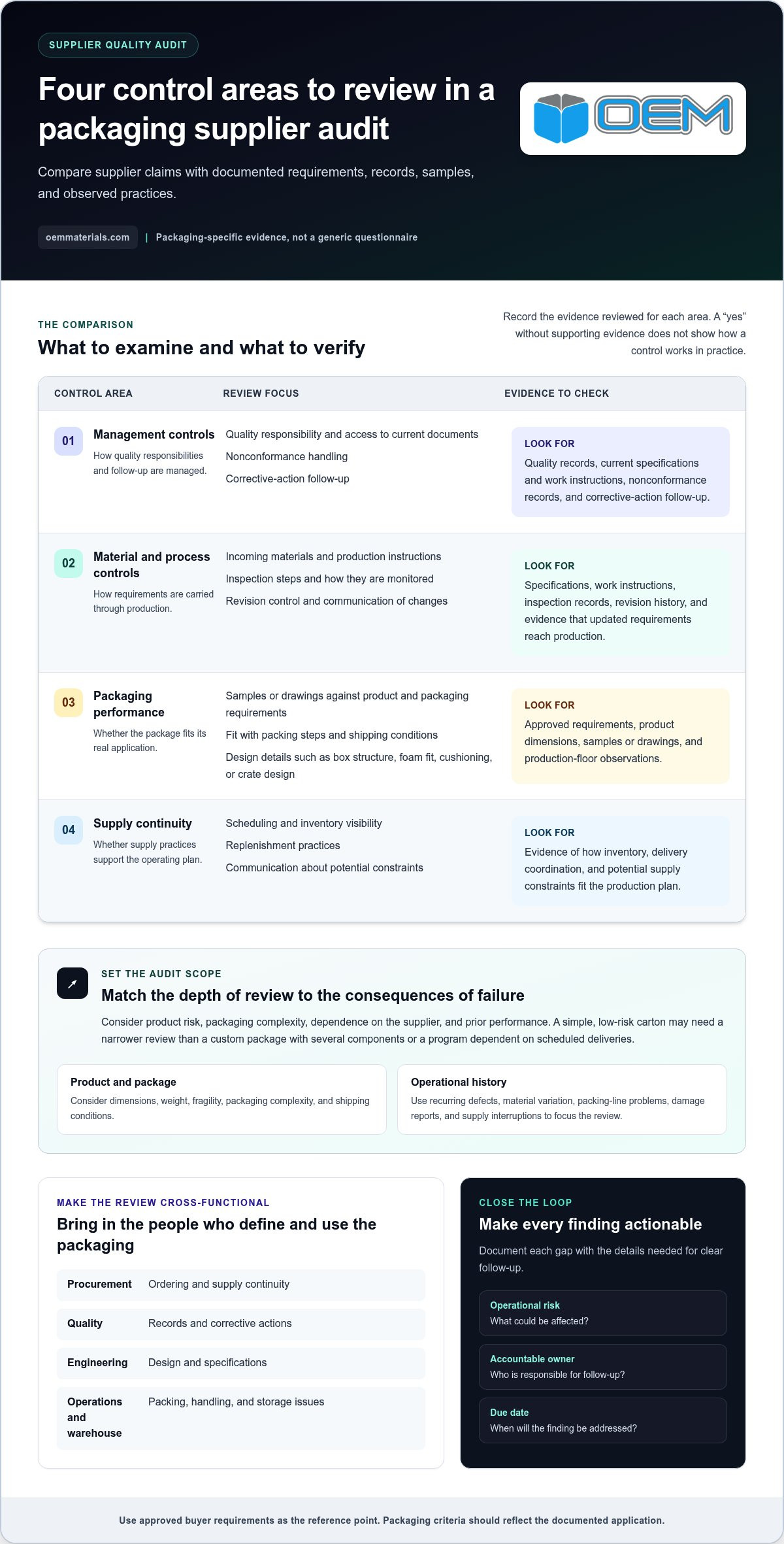
Scope the audit according to the consequences of failure. Consider product risk, packaging complexity, dependence on the supplier, and prior performance. A simple, low-risk carton may call for a narrower review than a custom package with several components or a process that depends on scheduled deliveries. For Southern California operations using just-in-time packaging, review how inventory and delivery coordination fit the production plan. OEM Materials & Supplies provides just-in-time packaging support, which buyers can evaluate against their operating requirements.
Packaging and labeling can involve product protection, package testing, and requirements that vary by application. For a broad overview of these topics, see this reference on packaging and labeling. Set audit criteria using the requirements that apply to your specific product and program.
Which packaging risks should trigger a focused audit?
Start with issues already visible in operations: recurring defects, material variation, packing-line problems, damage reports, or supply interruptions. Separate product-protection risks, such as inadequate cushioning, from process risks, such as inconsistent assembly, documentation gaps, or delivery failures. Then define the review around the product’s dimensions, weight, fragility, and shipping conditions. A delicate component moving through several handling steps warrants different scrutiny than a routine protective carton.
Who should participate in the supplier audit?
Include the functions that define or use the packaging. Procurement can address ordering and supply continuity; quality can review records and corrective actions; engineering can assess design and specifications; operations and warehouse staff can identify packing, handling, and storage issues. Involve employees who work with the packaging in routine production or fulfillment. Assign one audit owner to coordinate evidence requests, record findings, and track follow-up.
Packaging Supplier Quality Audit Checklist: What to Examine
A useful packaging supplier quality audit checklist connects documented controls to the packaging your team actually uses. Organize the review into four areas: management controls, material and process controls, packaging performance, and supply continuity. For each question, record the evidence reviewed, such as a specification revision, inspection record, production-floor observation, or unresolved gap. A “yes” without supporting evidence does not show how a control works in practice.
- Management controls: Review responsibility for quality, document access, nonconformance handling, and corrective-action follow-up.
- Material and process controls: Check how incoming materials, production instructions, inspection steps, and revisions are managed.
- Packaging performance: Compare samples or drawings with product needs, packing steps, and shipping conditions.
- Supply continuity: Examine scheduling, inventory visibility, replenishment, and communication about potential constraints.
Use the buyer’s approved requirements as the reference point. Do not assume one universal material or packaging specification applies to every program. Assess a corrugated box, foam insert, cushioning material, or crate against its defined role and the product it protects. Inspection criteria should reflect the documented application, not a generic checklist.
Review quality controls, traceability, and change management
Check that current specifications and work instructions are available to the employees doing the work. Review how the supplier records material lots, document revisions, nonconformances, and corrective actions. Then trace a packaging change through its communication and approval steps. How does the supplier ensure updated requirements reach production? How are superseded instructions kept from guiding current work? Record the specific documents or observations that support each answer.
Assess packaging design, materials, and protection
Compare a sample or drawing with the buyer’s documented product dimensions and packaging requirements. Review how the corrugated structure, foam fit, cushioning, or crate design relates to handling and shipping conditions. Check the inspection criteria for fit, assembly, consistency, and intended protection. When requirements need development or refinement, custom packaging design can connect product protection needs with the packing and shipping process.
Check production readiness, inventory, and delivery controls
Review how production schedules are planned and how constraints are communicated before they affect supply. Examine inventory visibility, replenishment practices, and methods for preventing shortages or material mix-ups. Assess kitting, assembly, vendor-managed inventory, or just-in-time delivery against your ordering and production workflow. Establish what information is shared, who owns each action, and how exceptions are escalated.
For each category, keep the requirement, evidence reference, observation, and open question together. This helps distinguish a documented control from a practice observed during the review or an unsupported verbal assurance. If you are evaluating packaging requirements for a program, share the product and packaging details to discuss a practical approach.
How to Evaluate Audit Evidence and Compare Supplier Findings
Collecting documents is only the first step. The review should determine whether the supplier’s stated controls are current, used in practice, and relevant to the packaging requirements. Apply the same evidence expectations to each supplier. Consistent criteria make findings easier to compare and help prevent a polished presentation from receiving more weight than verified performance.
For each item in the packaging supplier quality audit checklist, label the evidence as documented, observed, or verbal. A current inspection record is documented evidence. Watching an employee follow a work instruction is an observation. A verbal explanation without a record or direct observation is an assurance, not proof that a control operates consistently.
What counts as useful evidence during a packaging audit?
Review current specifications, inspection records, process instructions, and relevant corrective-action records. Compare them with samples, process observations, and the buyer’s approved packaging requirements. Note each document’s date, revision, and scope. An inspection record may apply to one packaging family but not another. If a document is missing, record the evidence gap precisely. Do not assume the process itself has failed without further evidence.
Use a consistent comparison record. The following layout captures the information needed to assess a finding and assign follow-up:
Use this as a recording format, not a universal rating system. Set requirements from the buyer’s specifications and define risk terms internally before comparing results.
How can teams prioritize and compare audit findings?
Define categories such as critical, significant, and minor using your organization’s risk criteria. Consider the potential effect on product protection, production continuity, and delivery commitments. A documented issue that could expose product to damage or stop a packing process deserves different attention from a recordkeeping gap with no demonstrated operational effect.
Compare suppliers against the same requirements, evidence expectations, and risk definitions. Keep confirmed process failures separate from evidence gaps and improvement opportunities. A corrective action should address a demonstrated nonconformance and have an owner, due date, and closure evidence. An improvement opportunity may be monitored through routine reviews. If evidence is incomplete, record what was requested and what remains unresolved before assigning a final risk level.
How to Conduct a Packaging Supplier Audit and Close Findings
A well-run audit has a defined scope, a clear record of evidence, and a closeout process that continues after the review meeting. Use the packaging supplier quality audit checklist to guide the review, and maintain one shared corrective-action log so procurement, quality, and operations work from the same status.
Before scheduling, agree on the audit’s purpose, the packaging families or processes in scope, the participants, and the evidence needed. Review current specifications, prior issues, samples, and relevant delivery or damage records. Share the agenda and evidence request early so the supplier’s team can prepare relevant records and the review can focus on requirements that affect your operation.
- Define the scope. Identify the products, materials, processes, or services being reviewed and the business requirements they must support.
- Prepare focused questions. Use prior findings and operating records to target areas that need closer review, rather than asking broad questions without context.
- Review evidence. Compare documents with samples, process observations, and the requirements for the packaging program.
- Document findings. State the requirement, the evidence observed, the gap, and the operational effect without relying on vague labels.
- Assign and verify follow-up. Name an accountable owner, set a target date, define acceptable closure evidence, and verify completion before closing the item.
Prepare a focused supplier audit
Keep the review tied to actual packaging use. An assembly finding may affect packing work, while a material or delivery issue may affect product protection or production continuity. Invite people who understand the relevant requirements and workflow. Confirm who will record decisions, manage open questions, and update the corrective-action log after the audit.
Document corrective actions and verify closure
Describe each finding in observable terms. For example, identify the applicable instruction and the specific step that differed, rather than writing only “process not followed.” Agree on an action that addresses the underlying cause, not just the immediate defect. Record the owner, target date, and proof needed for closure, such as a revised instruction, a production observation, or an evaluated sample. Close a finding only after reviewing the agreed evidence.
Maintain a practical review cadence
Set reassessment timing according to risk, changes, and performance history, rather than using one schedule for every supplier. Revisit priorities after material, design, process, or demand changes. Recurring issues, overdue actions, and supply interruptions may justify earlier follow-up. For programs that depend on coordinated deliveries, include the operating requirements for just-in-time packaging in the review.
Keep corrective actions visible across procurement, quality, and operations. If you are developing or refining a packaging program, request a packaging consultation and share product dimensions, weight, and annual usage to support a practical discussion.
Apply the Audit Checklist to Packaging Programs in Southern California
An audit creates value when findings become requirements the operating team can use. For manufacturers in Orange County, Los Angeles County, the Inland Empire, and San Diego County, regional coordination can also shape delivery planning and communication. Keep buyer-defined acceptance criteria at the center of the review. An audit can inform supplier decisions, but it does not establish certification or guarantee future performance.
Turn audit findings into packaging specifications
Convert confirmed needs into clear dimensions, material expectations, packing instructions, and revision controls. Tie each protection requirement to the product and its handling process. For example, a corrugated box specification should reflect product fit and packing method, while foam or a crate may need to address different product or shipping conditions. Refer to corrugated box options when documenting box requirements. Keep approved drawings and instructions aligned so production teams use the current version.
Connect supplier controls with operational support
Evaluate services against the workflow they are meant to support. Kitting or assembly may be useful when components must be grouped or presented in a defined packing sequence. Review how the work is specified, how component accuracy is checked, and who owns discrepancies. For vendor-managed inventory or just-in-time delivery, align the review with inventory visibility, replenishment needs, delivery coordination, and the buyer’s production requirements. Assess these arrangements as operating processes, not as general assurances.
Translate audit findings into actions for your team. Assign ownership for maintaining specifications, approving changes, reviewing delivery performance, and escalating recurring issues. Procurement, engineering, quality, and operations should share the requirements that affect their work. This keeps packaging design, purchasing decisions, and line-side use aligned as product or demand needs change.
Prepare the information needed for a packaging consultation
Before requesting a quote or discussing a packaging revision, assemble the information that will guide the recommendation. Include product dimensions and weight, fragility, handling and shipping conditions, packaging volumes, annual usage, current damage or process issues, and known design constraints. Bring procurement, engineering, quality, and operations together to align priorities so the proposed packaging addresses both protection and practical packing requirements.
A packaging supplier quality audit checklist can organize these requirements, but the result should remain specific to the application. Share the relevant product and process details through a packaging consultation request to discuss an approach for your program.
Turn Audit Findings Into a Stronger Packaging Program
Use the audit as a decision tool, not a document to file away. Identify the finding that creates the greatest operational exposure, then determine what needs to change in the packaging program before the issue affects production or shipment readiness. A packaging supplier quality audit checklist is most useful when it informs decisions your team can revisit as requirements evolve.
Bring the relevant audit record and current packaging requirements into a focused discussion. This gives your team a practical basis for evaluating design changes, clarifying acceptance criteria, or planning a prototype. Share product dimensions, weight, annual usage, and relevant handling or shipping conditions so the discussion starts with the details that shape the application.
Request a packaging quote or consultation to discuss your program. Share your product and process requirements to start a practical conversation about the next step.
Frequently Asked Questions
What should a packaging supplier quality audit checklist include?
A practical checklist should reflect how packaging moves through your operation, not just what appears on a supplier’s forms. Assess whether a box or insert can be identified correctly at receiving, accessed at the packing station, and used as intended by employees. Include acceptance criteria your team can verify, such as an approved drawing or sample. This keeps checklist questions relevant to actual work rather than generic supplier capabilities.
How often should a packaging supplier be audited?
Set the review cadence according to risk and change, rather than using a fixed interval for every supplier. A stable program with no recent issues may need a different level of review than one with a revised package, repeated discrepancies, or changing demand. Document why the timing is appropriate. Revisit the decision after a product change, process transfer, delivery disruption, or another event that could affect packaging requirements.
How do you audit a packaging supplier?
Plan the review around a real packaging workflow. Select a representative product or order, then compare its approved packaging requirements with the materials and instructions used for preparation. Observe how employees identify and assemble the packaging, and note where the process relies on judgment rather than a defined instruction. This can reveal usability issues that documents may not show. Record the observation and discuss its relevance with the responsible team.
What documents should I review during a packaging supplier audit?
Review records that connect the approved design to purchasing and production, such as drawing approvals, purchase-order requirements, sample signoffs, and records showing how revisions reached the appropriate teams. For inventory programs, compare planned replenishment information with order or usage history. These records can reveal mismatches between what was approved and what is being ordered or used. Keep the review within the packaging families and processes in scope.
How do you score a supplier audit checklist?
Use a rating method your organization can apply consistently, and avoid assigning points that imply more certainty than the evidence supports. For each finding, record its operational consequence and the strength of the evidence. A directly observed mismatch with an approved requirement is different from a concern raised verbally but not yet verified. Keep the rationale beside the rating so decision-makers can see what needs action and what needs further review.
What should you do if a packaging supplier fails an audit?
First, determine whether the finding affects packaging currently in use or upcoming production, then follow your organization’s process for managing that exposure. Document the specific requirement and evidence, and agree on how the supplier will address the cause. For example, if a revision did not reach the packing team, the response should address document communication as well as any affected packaging. Verify the change in practice before closing the finding.
Can a packaging supplier audit guarantee damage-free shipments?
No. An audit reviews controls and evidence, but shipment outcomes also depend on product characteristics, packaging design, handling, and distribution conditions. If damage occurs, compare the affected shipment details with the approved package and packing method before deciding what to change. A pattern of damage in shipments serving Orange County, Los Angeles County, Riverside, or San Diego County may help your team identify where to investigate, but it does not establish the cause by itself.