
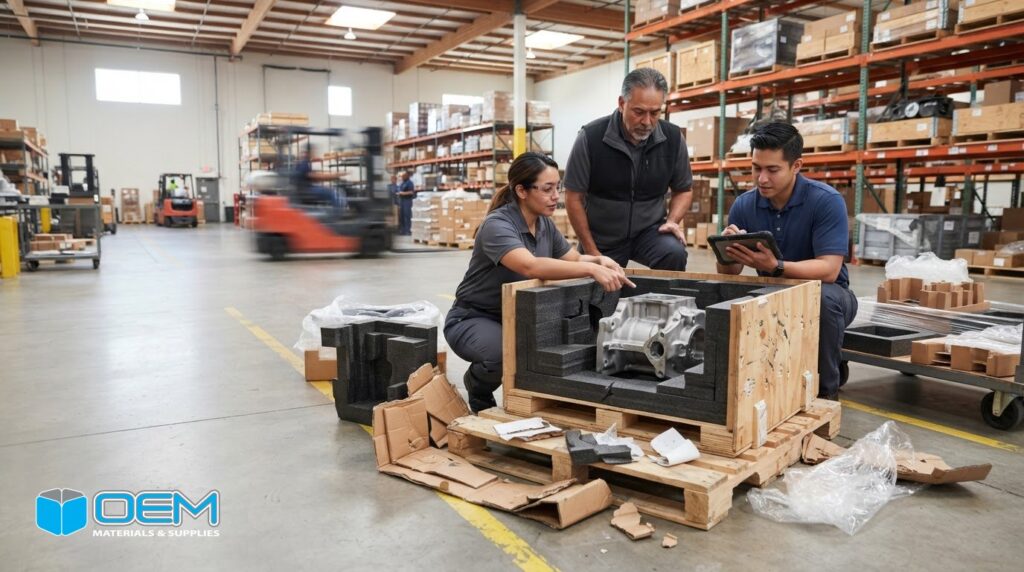
A damaged shipment rarely costs only the product it destroys. The hidden costs of transit damage can include return freight, replacement shipments, inspection and repacking labor, claims administration, and production delays while teams wait for usable product. Those expenses often land in separate departments, making the full impact difficult to see.
It’s easy to focus on the damaged item and the carrier claim. But a claim doesn’t account for every hour spent documenting the loss, coordinating a replacement, or restoring normal operations. And without tracing where damage occurs, teams can end up changing packaging when palletizing or handling is the real issue.
This article lays out a practical way to build a fuller picture of damage-related costs and identify where in the shipment journey losses begin. You’ll also see how to compare targeted packaging improvements with the current process, using product dimensions, weight, fragility, and shipping requirements to guide decisions. The goal is a clearer basis for reducing exposure, not a one-size-fits-all packaging change.
Key Takeaways
- Measure the hidden costs of transit damage beyond the product itself, including recovery work, delays, and customer impact.
- Trace damage across packing, staging, loading, transit, unloading, and receiving to help pinpoint where exposure begins.
- Combine damage records with labor, freight, and replacement data to compare the full cost of incidents with prevention options.
- Use photographs, packaging condition, shipment records, and recurring patterns to guide a structured damage investigation.
- Match packaging components and load stabilization to product dimensions, weight, sensitivity, and shipping conditions.
What Are the Hidden Costs of Transit Damage Beyond the Damaged Product?
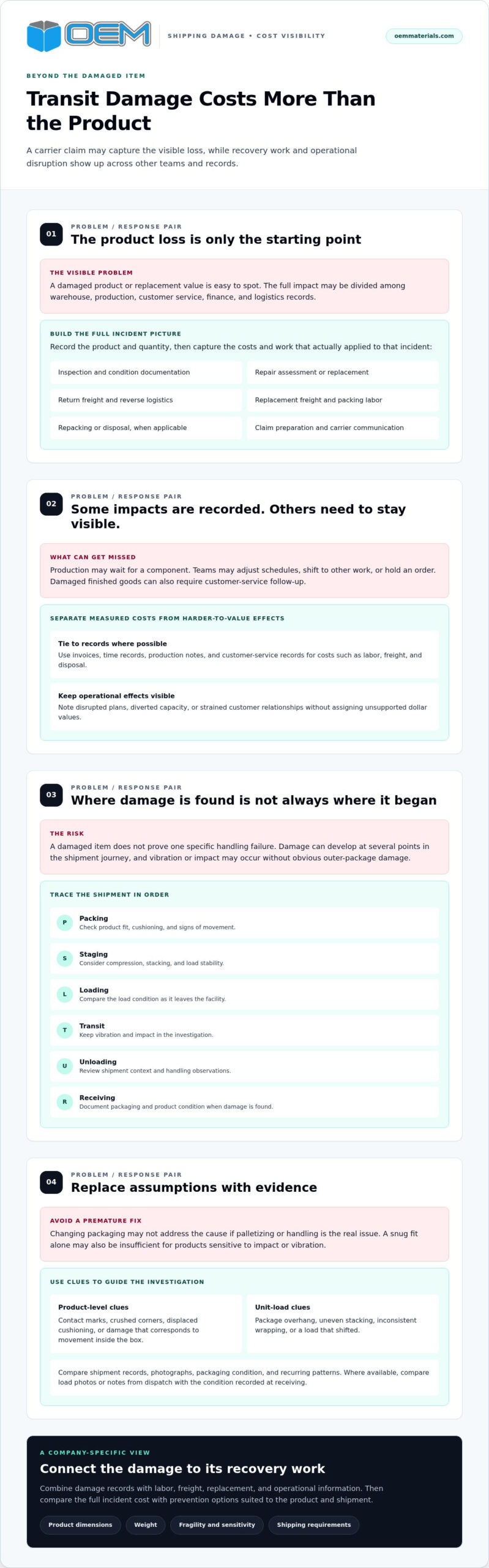
Hidden costs of transit damage are the expenses and operational disruptions that extend beyond a damaged product’s repair or replacement value. The product loss is visible. The total business impact may be spread across warehouse, production, customer service, finance, and logistics records, so no single claim or invoice captures it all.
For manufacturers shipping in Los Angeles, Orange County, San Diego, and the Inland Empire, the impact of an incident depends on the product’s value, damage severity, shipping requirements, and recovery steps. A unit that can be inspected and repacked creates a different cost profile from a component that must be replaced before production can continue. Not every incident leads to a return, expedited shipment, or customer delay. Identify which costs actually apply in each case.
Direct costs: replacement, repair, returns, and claims
Start with expenses tied directly to the damaged shipment. These may include inspection, condition documentation, repair assessment, and arranging a replacement or return. If the item goes back, include reverse logistics. If you send a replacement, record its freight, packing labor, and any repacking needed for either the original or replacement shipment.
Claims also use staff time. Employees may gather shipment records and photographs, prepare documentation, and communicate with the carrier. Track this work separately from the product loss so administrative effort doesn’t disappear inside general operating expenses.
Indirect costs: disruption, customer impact, and lost capacity
Damage can affect work beyond the shipment itself. If production is waiting for a component, teams may need to adjust schedules, shift to another task, or hold an order. Damaged finished goods can require customer-service follow-up and service recovery. A missed delivery commitment may strain a customer relationship, although the future effect on retention is harder to measure than labor or freight.
Separate recorded expenses from effects that are real but difficult to value precisely. Labor hours, replacement freight, and disposal charges can often be tied to a specific event. Lost confidence, disrupted plans, or capacity diverted from other work may not have a clean accounting entry. Keep these impacts visible without assigning unsupported dollar values.
A simple incident record can connect the costs: identify the damaged product and quantity, then note inspection, repair or replacement, return freight, reshipment, repacking, claim work, and operational delay as applicable. Use invoices, time records, production notes, and customer-service records to establish which costs occurred. This creates a company-specific view rather than relying on a generic damage estimate, and helps reveal which departments hold the relevant information.
The connection between a local failure and broader disruption is also discussed in the cybersecurity context of a supply chain attack. Transit damage is a different issue, but the useful parallel is that a disruption at one point can affect other parts of a supply chain. For physical shipments, the next step is to trace where the damage began and which recovery work it triggered.
Where Transit Damage Starts: Packaging, Unit Loads, and Handling
A damaged product shows where the problem ended, not necessarily where it began. Damage can develop while an item is packed, staged, loaded, transported, unloaded, or received. A box may be compressed in a stack, a product may shift inside its container, or a pallet load may become unstable during handling. Vibration and impact can also contribute, sometimes without obvious damage to the outer packaging.
Accurate damage diagnosis requires examining both the packaging condition and the shipment context, because the point where damage is discovered may differ from the point where it occurred. The hidden costs of transit damage are easier to address when teams consider the whole journey instead of assuming that a damaged item proves one particular handling failure.
Packaging fit and protection at the product level
Packaging should support the product and limit unwanted movement. An oversized box can leave space for an item to shift, while a poor fit may leave parts unsupported. A snug fit alone isn’t enough if the product is sensitive to impact or vibration. Engineered foam or other cushioning materials may help manage movement and protect vulnerable surfaces, corners, or components when selected for the product and shipping conditions.
For product-specific protection, custom foam packaging can be designed around an item’s dimensions, weight, and sensitivity. Inspect for contact marks, crushed corners, displaced cushioning, or damage that corresponds to movement inside the box. Those clues help distinguish a fit or cushioning issue from damage caused elsewhere in the shipment journey.
Pallet stability and handling through the shipment journey
Once packages are assembled into a unit load, pallet fit and load configuration matter. Package overhang, uneven stacking, or inconsistent wrapping can affect stability during staging and movement. A shifting load can expose cartons to impacts or compression. Stretch film can help secure a load, while edge protectors can add support at vulnerable edges, but neither is a universal fix. Suitability depends on the load, packaging, and handling conditions.
Check the load as it leaves the facility and compare its condition with photographs or notes made at receiving. Look for changes in stack alignment, wrap condition, pallet integrity, and carton damage. Lantech’s discussion of hidden costs of shipping damage and prevention also connects packaging choices with unit-load stability, a useful reminder to assess them together rather than in isolation.
For recurring damage, review the product, inner protection, carton, pallet configuration, and handling sequence as one system. OEM Materials & Supplies helps manufacturers assess packaging requirements for products and shipping conditions. A packaging quote request is more useful when it includes product dimensions, weight, and details about how the shipment is handled.
How to Compare the Full Cost of Damage With Prevention Options
A useful comparison starts with your own shipment and operating records, not an industry-wide average. Build a consistent view of what damage events cost, then compare that with the current packaging and handling process and a specific proposed change. The hidden costs of transit damage vary with the product, shipment requirements, and severity of each incident.
Choose a measurement period and shipment group that can be compared fairly. For example, analyze the same product family and shipment type over equivalent periods before and after a change. Don’t compare one product’s parcel shipments with another product’s palletized freight, or a high-volume period with a low-volume period, and treat the result as a packaging effect.
Build a practical damage-cost worksheet
For each event, record product value, repair or replacement, return freight, reshipment, and claims administration as separate categories. Add internal labor for inspection and repacking, production disruption, expedited recovery, and customer-service effort where records support an estimate. Mark each entry as confirmed or estimated, note its source, and state the period covered. This keeps missing data visible instead of treating it as zero.
Damage-cost category: Product repair or replacement
Internal data sources: Inventory, purchasing, repair, and quality records
Candidate prevention measure: Review product support and cushioning fit
Damage-cost category: Return freight and reshipment
Internal data sources: Freight invoices and shipment records
Candidate prevention measure: Reassess packaging configuration and shipment preparation
Damage-cost category: Inspection, repacking, and claims work
Internal data sources: Labor records, warehouse notes, and claim files
Candidate prevention measure: Improve pack consistency or streamline recovery steps
Damage-cost category: Production delay and customer recovery
Internal data sources: Production schedules and customer-service records
Candidate prevention measure: Investigate recurring product, route, or shipment-type patterns
Compare targeted prevention with the current process
Compare current material use, packing labor, and handling steps with the proposed design, including implementation requirements. Assess damage patterns by product, route, packaging configuration, and shipment type where records allow. Then match a proposed change to a diagnosed failure point. A packaging adjustment is less likely to address damage that originates in load handling.
Evaluate options against product dimensions, weight, materials, sensitivity, and shipping requirements. A change to cushioning or container design may affect material use and packing steps, so include those impacts in the comparison. A structured packaging cost review can account for both current expenses and the operational requirements of a proposed change without assuming a particular outcome.
Use the same definitions and accounting approach for the current process and proposed option. If records are incomplete, state what’s estimated and avoid presenting the comparison as a precise forecast. For a packaging review, share product dimensions, weight, and annual usage through a packaging quote request. Any cost effect depends on the specific product, materials, and shipping requirements.
How to Investigate Damage Patterns and Prioritize Corrective Actions
A repeatable investigation turns damage reports into evidence teams can act on. Record what arrived damaged, preserve the packaging and shipment details, and compare incidents using the same categories. Repeat patterns provide stronger evidence than isolated anecdotes. That distinction helps teams prioritize issues without treating one unusual event as proof of a widespread packaging or handling failure.
Include packaging, warehouse, operations, and procurement staff in the review. Each team may see a different part of the shipment journey, from pack-out and material selection to staging, handling, and receiving. Focus the discussion on the evidence and process, not on assigning blame before the cause is understood.
Document damage consistently and look for repeat patterns
Use a shared record for product type, packaging configuration, shipment context, observed damage, and recovery action. Add photographs of both the product and packaging, plus available shipment and receiving records. Consistent descriptions make it easier to compare events by product, route, shipment type, or packaging setup and distinguish a developing pattern from a single incident.
- Record: Capture the shipment, product, packaging configuration, date, destination, and recovery action. Take photographs before discarding or altering packaging.
- Classify: Use consistent damage categories, such as crushed packaging, shifted product, surface damage, or a damaged component. Note when the condition was first observed.
- Inspect: Examine the product and packaging together. Look for displaced cushioning, compression, punctures, or contact marks that may indicate how the item moved.
- Trace: Compare the evidence with packing, staging, loading, transport, unloading, and receiving records. Check for recurring links to a route, product, or shipment configuration.
- Test: Select a corrective action that addresses the likely cause, then evaluate a prototype or revised process against the product’s actual shipping requirements.
- Review: Compare results across a defined, comparable shipment set. Keep tracking the same damage categories and note any changes to products, routes, or handling conditions.
Test corrective actions against real shipping conditions
Change one relevant packaging or process variable at a time where practical. If several elements change together, it becomes harder to determine which adjustment affected the outcome. Evaluate product fit and protection in the context of actual dimensions, weight, materials, and shipping requirements. A custom packaging design can be developed around those project details.
Set the review period and shipment group before comparing results. Use comparable products and shipment types, and record exceptions that could influence the findings. A prototype or revised configuration is a way to test a reasoned change, not a guarantee of improved performance. The results help determine whether to adopt the change, adjust it, or investigate another point in the process.
If recurring damage points to a packaging-fit or protection issue, request a packaging quote with product dimensions, weight, and shipping requirements. This gives your team a practical starting point for evaluating a targeted packaging change.
How Packaging Design Can Reduce Transit-Damage Exposure
Packaging works as a system. The outer container, product-level cushioning, and unit-load configuration each play a role in protecting goods as they move through storage and transportation. A change to one component can affect fit, packing time, material use, and load stability, so design decisions should account for the full shipment rather than a single point of contact.
Start with the product’s dimensions, weight, sensitivity, and packing method. Then consider shipment conditions and handling requirements. This makes it easier to select protection that addresses the observed exposure without adding material or process steps that don’t serve a clear purpose. The right balance depends on the product and shipping requirements.
Match packaging components to the product and shipment
A corrugated box can provide appropriate outer protection when its dimensions and structure suit the product and packing method. Excess space may allow movement; a close fit still needs adequate support where the product is vulnerable. Corrugated boxes can be selected or designed around the item and its shipment requirements.
For sensitive products or items with areas that need tailored support, custom foam or cushioning may help limit unwanted movement and protect specific surfaces. The design should reflect the product’s shape and sensitivity, rather than relying on a generic insert. Foam packaging can be considered as part of that product-specific protection. The goal is a coordinated fit between the item, cushioning, and outer container.
Build a repeatable packaging program across operations
Protection may also need to extend beyond the individual carton. Crates can suit certain product forms or shipment configurations, while stretch film and edge protection can support palletized loads where appropriate. None is a universal fix. Select components based on the load’s shape, weight, stacking arrangement, and handling path.
Repeatability matters, too. A clearly defined pack-out can help warehouse teams use the intended materials and arrangement consistently. Kitting and assembly can support a standard process when several packaging components must be prepared together. Vendor-managed inventory can help align packaging supply with operational needs. Its value depends on how the program fits the manufacturer’s workflow.
For manufacturers in Orange County, Los Angeles, Riverside, and San Diego, packaging design can be evaluated against the products and shipping conditions used in the operation. Any material, labor, or damage-related cost effect depends on product dimensions, materials, and shipping requirements. Compare a proposed configuration with the current process, including material use, packing steps, storage needs, and observed damage patterns.
To discuss a packaging project, request a packaging quote and include product dimensions, weight, and annual usage. These details help frame a practical review of packaging options and operational requirements.
Turn Damage Findings Into a More Resilient Process
Packaging decisions can have a place in product planning, not just shipping preparation. Bringing packaging requirements into engineering, procurement, and operations discussions when a product or sourcing plan changes helps teams consider protection and pack-out needs before those decisions reach the warehouse. That forward planning gives manufacturers a clearer way to manage the hidden costs of transit damage as products and processes evolve.
OEM Materials & Supplies works with manufacturers on packaging tailored to product and shipping requirements, from prototypes through production programs. Start a packaging project discussion to explore options for your operation. Include product dimensions, weight, and annual usage to support a focused review of your packaging needs.
Frequently Asked Questions
What are the hidden costs of transit damage?
The hidden costs of transit damage can include recovery work beyond the product’s replacement value, such as internal labor, returns, reshipment, production disruption, and customer-service follow-up. For a useful review, assign each expense to a consistent cost category and department. Check for double-counting when the same employee time appears in both claim administration and recovery labor. The actual impact varies with the product and shipment.
Can a shipment be damaged if the outer box looks intact?
Yes. The carton’s appearance doesn’t confirm the condition of the contents, so receiving staff should follow the company’s inspection and quality procedures for the product itself. If inspection identifies a concern, record the affected quantity and keep the goods in the appropriate internal status until their disposition is decided. This creates a clear receiving record without treating an intact box as proof of either damage or cause.
How much does transit damage cost a business?
There’s no single reliable figure for every manufacturer. Instead of relying only on an annual total, compare damage-related expenses by product family or shipment type using the same accounting period. Separate costs that are directly recorded from estimates, and use a consistent method for allocating shared labor or recovery effort. The resulting view depends on product value, recovery needs, staff involvement, and shipping conditions.
Does transit damage always mean the carrier is responsible?
No. The discovery of damage alone doesn’t establish responsibility. A practical review can compare the shipment’s documented condition at each internal handoff with what receiving staff observed, including timestamps and any recorded exceptions. That may help narrow where the condition changed, but gaps in documentation can limit what the team can determine. Keep conclusions tied to available evidence rather than assigning blame based only on the delivery outcome.
What information helps identify the cause of shipping damage?
Along with the shipment identifier and product description, record the packaging revision and any relevant production lot or serial information. These details can help distinguish a packaging change or product variation from a broader shipment pattern. Note where the item was packed and the receiving inspection outcome if those records are available. Use the same fields for each incident so comparisons remain useful across teams and time periods.
When should a manufacturer redesign packaging after transit damage?
Review a redesign when the product’s shape or configuration changes, the existing package no longer fits consistently, or packers must make repeated adjustments to prepare shipments. These conditions can indicate that the current design no longer matches the product or packing process. Before adopting a new configuration, define what the team needs to evaluate, such as fit, pack-out consistency, or product condition after shipment, and document the trial results.