
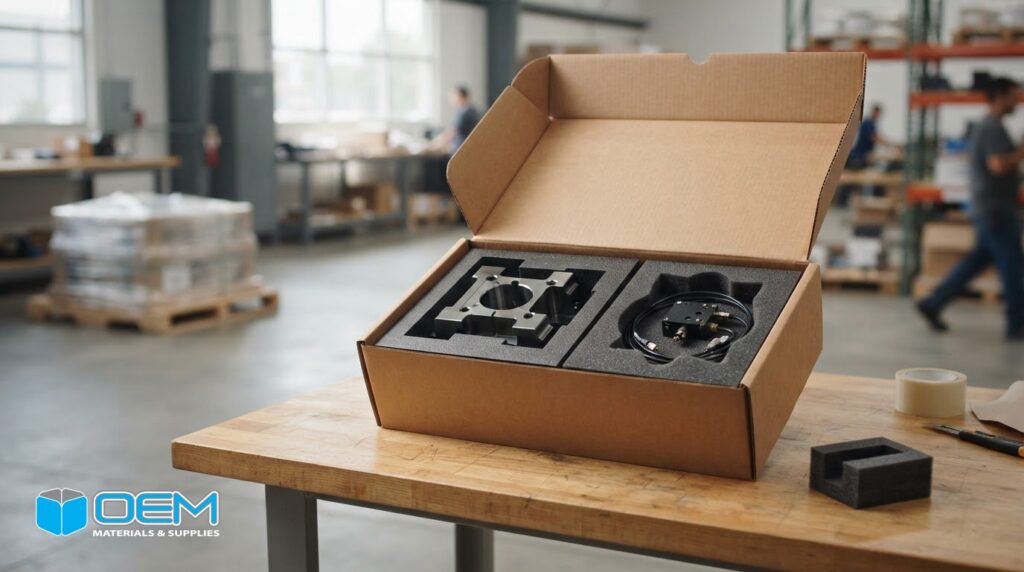
Softer foam isn’t always the safer choice. For polyurethane vs polyethylene foam for shipping, polyethylene is often a better fit for heavier products, sharp edges, moisture exposure, or longer shipping routes. Polyurethane is often a better fit when a delicate product needs conformable cushioning and surface protection.
Both materials can protect products in transit, but they respond differently to impact, pressure, and moisture. Choosing by feel or density alone can lead to a poor fit. The foam must also support the product’s weight and shape, protect its contact points, and suit the shipping conditions.
This comparison explains how foam structure affects strength and moisture resistance, and how to match cushioning to product size, fragility, and shipping distance. You’ll see when a shaped polyethylene insert, flexible polyurethane cushioning, or a combination may suit the application. Start by defining the protection your product needs during handling and transit.
Key Takeaways
- Choose polyethylene foam when the shipment calls for durable support, moisture resistance, or firm blocking and bracing.
- Consider polyurethane foam when delicate surfaces need flexible, conformable cushioning.
- Match the foam to product weight, shape, contact points, and shipping conditions rather than relying on density or feel alone.
- Use the box’s inside dimensions to plan insert fit and keep the product properly supported during handling.
- For demanding applications, a packaging design can combine foam types to provide different kinds of protection.
What Kind of Shipping Foam is Best for Your Application?
Choose foam based on how it supports the product, absorbs impact, and maintains contact during transit. Polyethylene and polyurethane differ in structure, flexibility, and performance, so match the material to the package’s actual load and handling conditions.
Polyethylene Foam Cushioning
Polyethylene foam cushions products by absorbing shock and supporting them inside the package. Its structure suits blocking and bracing, holding a component in place rather than letting it shift against the box walls. For example, shaped supports can cradle a bottle or jar while distributing pressure across stable contact areas. Prolonged pressure can cause compression set and reduce cushioning, so account for sustained loads when designing the insert.
Polyurethane Foam Cushioning
Polyurethane foam provides flexible cushioning that conforms to irregular shapes and helps absorb impact. It can suit delicate items that need contact across a broader surface, such as a camera body or a fragile instrument. Its softer feel does not automatically mean better protection: the foam must still support the item without allowing movement. Polyurethane is also used for thermal and noise insulation, making those functions relevant when packaging requirements include more than impact protection.
Cushioning, Fit, and Load Distribution
Fit determines where the product meets the foam and how impact loads travel through the package. A shaped polyethylene cavity can hold an item in a defined position, while flexible polyurethane can conform to contours. In either design, support the product at stable areas rather than concentrating force on a fragile edge, lens, or protrusion. Coordinate the insert with the box’s inside dimensions, then check that the product stays centered without excessive compression.
For a practical design review, map the product’s contact points, identify its heaviest areas, and note where movement could cause damage. Evaluate cushioning thickness and available support area together. Foam density alone cannot establish whether the finished package will protect the item.
Shipping Foam Costs and Regulations
How do polyurethane and polyethylene foam compare in cushioning and shock absorption? Both can cushion products and absorb impact. Polyethylene suits blocking and bracing, while polyurethane offers flexible, conformable cushioning. Foam cost depends on grade, thickness, material yield, cavity layout, fabrication, assembly, and quantity, so there is no useful universal price. Packaging requirements depend on the application; some shipments may need to account for UL or ISO safety standards.
| Foam option | Cushioning role | Fit and contact | Design consideration |
|---|---|---|---|
| Polyethylene | Shock absorption and bracing | Defined supports and cavities | Consider sustained pressure |
| Polyurethane | Flexible cushioning and damping | Conforms around product contours | Consider insulation needs |
Match the foam’s support, contact, and cushioning to the product’s shape and shipping conditions.
Polyethylene foam strength and water resistance
Polyethylene foam’s closed-cell structure provides strength, shock absorption, and moisture resistance. These properties can help protect products exposed to damp handling or repeated contact during storage and transit.
Water and Chemical Resistance
Closed-cell polyethylene resists water, moisture, and many chemicals, making it useful for packaging exposed to damp conditions. For example, a shaped foam support can cushion a component while limiting direct contact with moisture. Resistance varies by foam type and exposure conditions, so don’t treat it as protection from every chemical. Closed-cell construction also doesn’t make the complete package waterproof.
Closed-Cell Durability
In closed-cell foam, air pockets are sealed from one another. This structure helps polyethylene foam resist water and contributes to durability, tear resistance, and longer service than open-cell alternatives. These properties can help a reusable insert withstand repeated handling. However, prolonged pressure can cause compression set and reduce cushioning over time.
Strength matters most when the package must hold a product in position. A polyethylene cavity can support a heavy component or sharp-edged tool and help prevent it from shifting inside its carton. Contact surface and foam thickness influence how loads transfer through the insert. Concentrated force on a narrow edge can still stress the package, so extend support across stable areas of the product.
Polyethylene foam also absorbs shock during transit and handling. For example, an insert around a precision instrument can combine shaped supports with cushioning at vulnerable contact points. Polyethylene foam is also used for noise and vibration insulation, which can be useful when movement or equipment vibration is part of the shipping environment. The package still needs adequate cushioning and a secure fit.
Moisture resistance is not the same as a barrier against gases or liquids. Polyethylene foam doesn’t provide significant barrier properties against either, so it shouldn’t serve as the package’s only containment layer. For liquid-sensitive goods, evaluate the full packaging system, including the container and any barrier materials. Laminated polyethylene foam can incorporate barrier films or additional layers for specific packaging needs.
For a practical selection review, identify the shipment’s exposure to water, chemicals, vibration, and sustained pressure. Match the foam’s contact area and construction to the product’s weight and geometry. Polyethylene can offer durable cushioning and moisture resistance, but the complete package still needs evaluation.
Matching packaging foam to product size, weight, shape, and shipping distance
Start with the product’s dimensions, weight, geometry, and route. A compact instrument traveling a short domestic route needs a different insert design from a heavy machine component traveling farther. Foam selection depends on how the product contacts its supports, how much it can move, and the expected handling conditions.
Measure the product and the box’s inside dimensions before setting the insert layout. This helps account for the foam surrounding the product and the available cushioning space. There’s no universal weight cutoff for choosing polyethylene or polyurethane. Consider weight alongside contact area: a heavy item supported across broad surfaces places different demands on foam than a narrow component resting on small points.
Product shape helps narrow the material choice. Polyethylene foam can be formed into shaped supports and cavities that hold a defined position, making it a candidate for larger electronics, tools, or automotive parts. Flexible polyurethane is easy to cut and can conform around delicate contours. Glassware, ceramics, cameras, and precision instruments may need cushioning that limits movement without putting pressure on fragile surfaces.
Density alone doesn’t determine the right design. Assess the product’s weight, contact area, cushioning thickness, and shipping conditions together. For example, dense foam that compresses too little may not provide the intended cushioning, while softer foam may compact under sustained load. The insert should support the product without letting it shift or concentrating force on a lens, edge, or fragile fitting.
Fabrication also affects the application. Flexible polyurethane insert foam is cut from stock and shaped to fit the product. Foam-in-place packaging is different: it forms cushioning during packing and uses its own formulations and equipment. Polyethylene can be routed into complex designs, including multilayer layouts made from one piece. These methods affect how cavities, depths, and support surfaces are created.
Shipping distance influences the level of restraint and cushioning needed. Longer routes can involve repeated handling, so a defined cavity may help keep a product positioned throughout transit. For temperature-sensitive goods, polyethylene foam can provide thermal insulation. Laminated polyethylene can add insulation and moisture resistance during transport and storage. The appropriate structure depends on the product’s temperature and moisture requirements.
For a sound selection process, record product dimensions and weight, identify vulnerable contact points, and note shipping distance and exposure conditions. Coordinate the insert with the box’s inside dimensions and evaluate the complete design. This gives engineering and packaging teams a practical basis for comparing foam material, density, fabrication method, and fit.
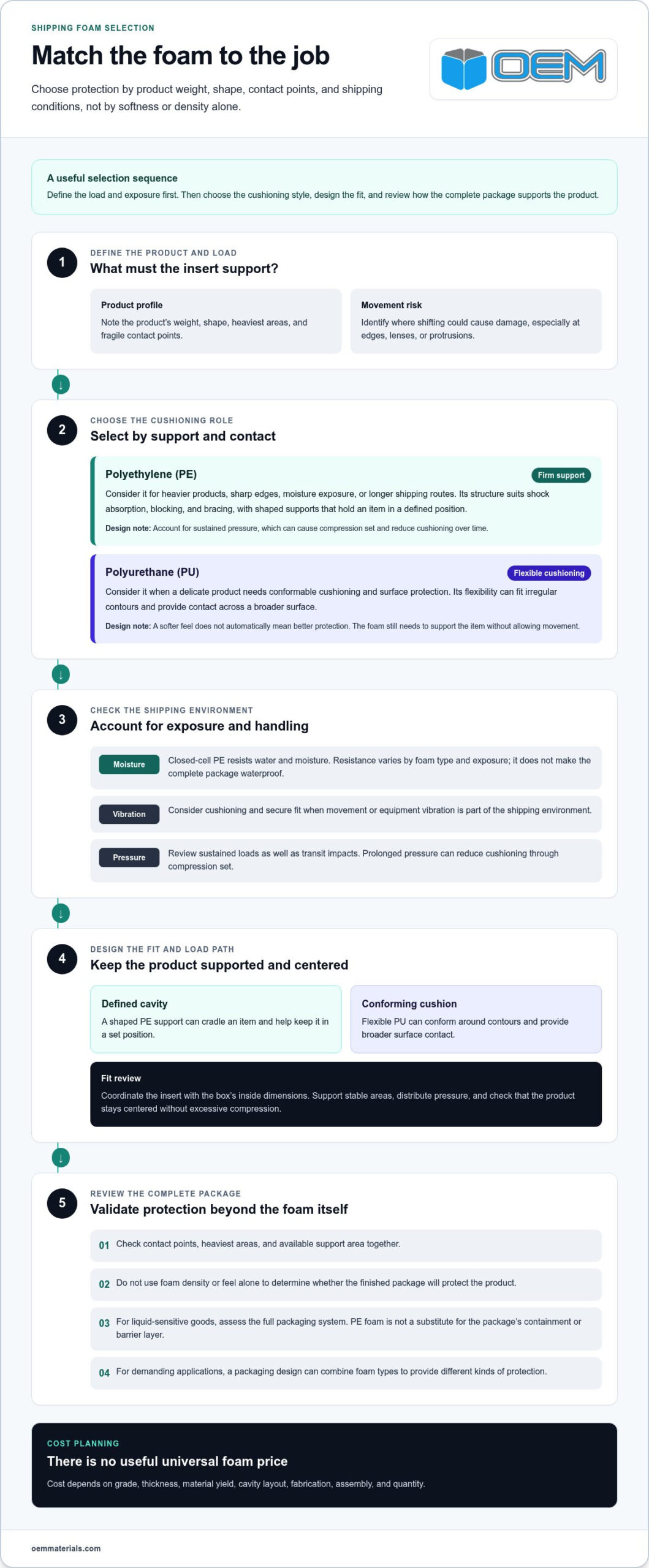
What are the main differences between polyurethane foam and polyethylene foam?
The main difference is cell structure: polyethylene is closed-cell, while flexible polyurethane is often open-cell or semi-closed-cell. This structure affects how each material responds to air, moisture, compression, and fabrication.
Closed-Cell Polyethylene Foam
In polyethylene foam, air pockets are sealed from one another. This closed-cell structure contributes to cushioning, durability, and resistance to water and chemicals. Polyethylene is extruded into forms such as sheets and planks, which can be cut or routed into packaging for products that need defined supports.
For example, a shaped polyethylene insert can hold an automotive part in a fixed position during storage and transit. Its more structured feel suits blocking and bracing, while its closed cells make it less breathable than open-cell polyurethane. That distinction matters when the design depends on airflow or conformable contact.
Polyethylene foam can also be routed into complex, multilayer designs from one piece of material. This lets different cavities support separate components within the same package. The finished layout still needs to fit the product and carton, with each support surface aligned to the item it holds.
Density, Firmness, and Compression Strength
Density describes mass per unit volume; firmness describes resistance to compression. These properties inform material selection, but density alone doesn’t determine how foam feels or performs. Polyurethane foam firmness can vary independently of density, so a denser grade isn’t automatically firmer.
Indentation Force Deflection, or IFD, measures the force needed to compress foam by 25% of its original height. It provides a way to describe firmness, not a complete measure of shipping performance. Product weight, contact area, cushioning thickness, and shipping conditions also affect how an insert responds to compression.
Polyethylene’s closed-cell construction generally provides more structured support than flexible polyurethane. Open-cell polyurethane has more air pockets, allowing air to move through the material and helping it conform around product contours. For a fragile electronic assembly, that flexibility may provide more surface contact. For a heavier component, a shaped polyethylene cavity may provide more defined positioning.
Polyurethane foam is made by mixing two components that expand into blocks, which can then be cut and shaped. It can also be convoluted into an egg-crate profile for cushioning. Polyethylene sheets and planks support routed forms and layered designs. These fabrication differences influence cavity depth, fit, and assembly, not just how the foam feels.
Compare the foam’s actual properties with the product and packaging requirements. A useful review considers cell structure, firmness, intended compression, and how the insert will be fabricated. These criteria help distinguish flexible cushioning from applications that need stronger blocking and bracing.
Foam selection by shipment weight and fragility
Shipment weight and product fragility create different packaging demands. Polyethylene foam often suits heavy machinery, sharp-edged tools, and industrial components that need stable support. Polyurethane foam may suit delicate items that benefit from flexible cushioning and surface protection. Start by assessing the item’s load, vulnerable areas, and expected handling.
A heavy automotive part places sustained force on its supports. Polyethylene foam’s structure can help block and brace the part, limiting movement inside the package. Polyurethane can compact more quickly under very heavy objects, making it less practical for that load. There is no universal weight cutoff, so also consider contact area, foam thickness, and how pressure reaches the insert.
For fragile products, surface contact matters as much as cushioning. Polyurethane foam absorbs shock and is unlikely to scratch items placed against it, including equipment with sensitive lenses or detectors. A camera or precision instrument may benefit from a flexible insert that supports its contours. The cavity still needs to hold the product securely without putting concentrated pressure on a lens or fragile fitting.
Choose polyethylene for a heavy or sharp-edged product when defined support is the priority. A shaped cavity can help hold a tool or machine component in place during handling. For small, delicate goods, polyurethane may offer more conformable cushioning. Glassware and ceramics, for example, need a layout that cushions exposed surfaces and prevents pieces from striking the package or one another.
Electronics introduce another criterion: static control. Polyurethane foam can be made to anti-static standards for shipping electronics. Specialty polyethylene or polyurethane grades may also be selected when they meet the project’s defined static-control requirements. Foam color alone doesn’t establish static-control performance. Specify the required function and use an appropriate grade rather than relying on appearance.
Use this practical review before selecting an insert:
- Record the product’s weight and identify its heaviest contact points.
- Mark fragile surfaces, sharp edges, lenses, and protrusions that need protection.
- Consider whether the shipment needs blocking, flexible cushioning, or static control.
- Evaluate foam thickness and support area together, not density or feel alone.
For example, a heavy assembly with exposed edges may need polyethylene supports, while a delicate instrument may need conformable polyurethane cushioning. When requesting a foam packaging quote, provide the product dimensions, weight, and handling requirements so the design can address the shipment’s specific protection needs.
OEM Materials & Supplies: Corrugated Boxes
OEM Materials & Supplies helps businesses match protective foam with the corrugated box around the shipment. A correctly sized box and insert work together to limit product movement and support the load during handling. For a fragile instrument, foam can hold the product in position while a corrugated box provides the outer container.
Turn to corrugated boxes when the current carton doesn’t fit the foam design or product dimensions. Foam Packaging and Packaging Kits can also support coordinated packaging needs, including applications that require protective inserts and a ready-to-use configuration.
Contact OEM Materials & Supplies to discuss your packaging requirements, or visit oemmaterials.com.
Turn Your Foam Choice Into a Packaging Specification
Move from material selection to a clear packaging specification. Record the product dimensions, weight, fragile contact points, moisture exposure, and expected shipping distance. Then use those details to assess the complete package, including the insert, box, and how the product is secured. This gives your engineering and operations teams a practical basis for reviewing the design and keeping packing requirements consistent.
The right polyurethane vs polyethylene foam for shipping depends on how the finished package must support the product in transit. A prototype or sample pack can help your team assess fit, loading, and handling before using a design for regular shipments.
Share your product and shipment requirements with OEM Materials & Supplies to discuss a packaging solution. Request a quote to start planning the next step with confidence.
Frequently Asked Questions
Which Foam Wins for Your Industry?
The best choice depends on the product and packaging process, not just the industry. An automotive supplier shipping a finished component may prioritize repeatable placement, while a medical-device team may need an insert layout that accommodates several parts in one kit. Electronics, aerospace, and manufacturing applications also vary by product geometry and handling workflow. Define the shipment’s specific requirements before choosing a foam grade.
Can PE and PU Foam Be Combined in One Insert?
Yes. A combined insert can assign separate functions to each material, such as positioning one component while cushioning another. Plan the assembly around the packing sequence: operators need to identify each layer, orient it correctly, and place the product consistently. A sample pack can reveal assembly problems, unclear orientation, or parts that shift when the package is closed.
Can PE and PU Inserts Be Recycled?
Recycling options differ by material and the insert’s condition. Polyethylene can be remelted and remolded into new items. Polyurethane can’t be melted and reformed, though shredded material may be used in products such as carpet padding or insulation. Adhesives, films, and mixed layers can affect processing, so document the insert’s materials and construction when planning end-of-life handling.
Can Either Material Be Used for Electronics Packaging?
Yes, both may be used when the selected grade meets the electronics project’s defined static-control requirements. Specify the performance requirement in the packaging documentation so purchasing, engineering, and packing teams follow the same criteria. For a kit containing a circuit board, cable, and connector, the package plan should identify which parts need controlled handling and how each is positioned.
Does Higher Density Mean Better Shipping Protection?
No. A density value alone can’t establish whether an insert will protect a product in its actual package. Compare candidate designs in representative packed shipments and inspect for product movement, damage, and changes to the foam after handling. This practical evaluation can reveal fit or performance issues that a material description alone won’t show.
Is PE Foam Always Firmer Than PU Foam?
No universal rule applies across every grade and construction. In procurement specifications, identify the exact foam grade and the method used to describe its firmness instead of relying on a broad PE or PU label. This makes sample comparisons more consistent and helps receiving or packing teams recognize the intended material.
What Is the Difference Between Polyurethane Foam and Polyethylene Foam for Shipping?
Materials also differ in the polyethylene options available. Expanded polyethylene and cross-linked polyethylene are distinct types with different properties and fabrication considerations, so “PE foam” alone may not fully describe an insert. Polyurethane grades also vary. Specify the material type and intended package function, then match the grade to the product and design requirements.
Which Foam Is Better for Shipping Fragile or Heavy Items?
For a product that is both heavy and delicate, design around its different risk points rather than treating it as one simple category. A metal assembly with an exposed display, for example, may need its main body retained separately from the sensitive surface. Map those components and their handling sequence, then specify protection for each in the same package design.