
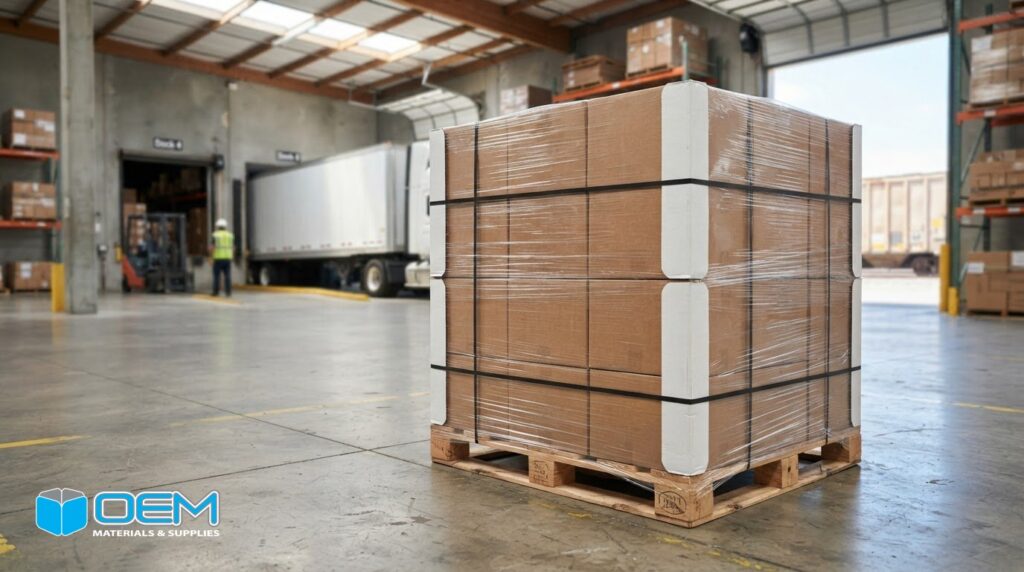
A secure pallet is only as reliable as its load pattern, wrap, and restraint. Preventing pallet load shifting in transit starts with inspecting the pallet and load before shipment, correcting instability, and using consistent wrapping that connects the load to the pallet. Securement must also account for the forces and handling involved in truck, rail, or intermodal transport.
It’s easy to focus on the wrap, but wrapping alone can’t correct uneven weight, unsupported edges, or gaps that let freight move. A repeatable process helps operators spot these risks before departure and choose containment suited to the load.
This article explains why pallet loads shift, what to inspect before wrapping, and how consistent film coverage supports unit stability. It also compares securement needs across transport modes, helping you assess when wrapping is enough and when additional restraint or bracing may be needed.
Key Takeaways
- Inspect pallets and load alignment before wrapping, and remove damaged pallets from service.
- Build stable loads by centering weight, keeping heavier products low, and minimizing unsupported edges.
- Use a repeatable wrap pattern with tension suited to the product and pallet configuration.
- Match added restraint to the transport mode, load shape, and gaps that could allow movement.
- Use shipment damage patterns to identify recurring stability problems and improve packaging practices.
Inspection and repeatable wrapping parameters
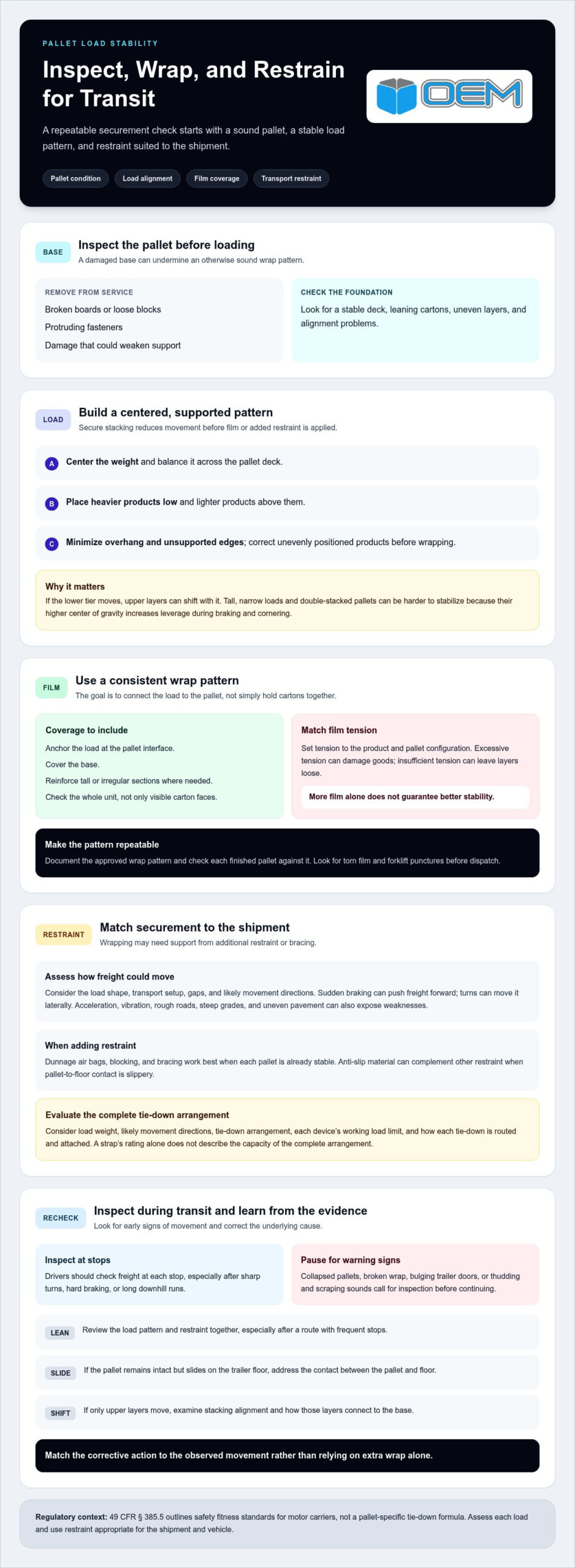
Start warehouse handling with a pallet inspection before loading products. Reject pallets with broken boards, loose blocks, protruding fasteners, or damage that could weaken support. Check the deck for a stable foundation, then look for leaning cartons, uneven layers, and alignment problems. A damaged base can turn an otherwise sound wrap pattern into a unit-load failure.
Before wrapping, correct overhang and stabilize unevenly positioned products. The film should connect the load to the pallet, not just hold cartons together. Use the same wrap pattern for repeat shipments, covering the base and reinforcing tall or irregular sections where needed. Match film tension to the product and pallet configuration: excessive tension can damage goods, while insufficient tension can leave layers loose. More film alone doesn’t guarantee better stability.
For repeatable operations, document the approved wrap pattern and check each finished pallet against it. Inspect coverage across the whole unit, including the pallet interface, rather than judging only the visible carton faces. Look for torn film or forklift punctures before dispatch. Record recurring problems by product or load pattern so teams can address the cause instead of wrapping every pallet more heavily.
U.S. cargo securement requirements depend on the freight and transport setup. 49 CFR § 385.5 outlines safety fitness standards for motor carriers, not a pallet-specific tie-down formula. For each load, assess how the freight could move and use appropriate restraint for the shipment and vehicle.
To calculate securement capacity, consider the load’s weight, likely movement directions, tie-down arrangement, and each device’s working load limit. Account for how each tie-down is routed and attached, then compare the available capacity with the restraint required for the cargo and transport setup. A strap’s rating alone doesn’t describe the capacity of the complete arrangement.
A shifted pallet can damage freight, affect vehicle handling, and contribute to trailer damage or a crash. Recovery, customer disruption, investigation, and reputational harm can follow. Reduce the risk by checking pallet condition before loading, inspecting tie-downs, and correcting unstable loads before departure.
Drivers should inspect freight at each stop, especially after sharp turns, hard braking, or long downhill runs. Collapsed pallets, broken wrap, bulging trailer doors, or thudding and scraping sounds call for an inspection before continuing. Leaning pallets, torn wrap, and an uneven-looking trailer may also draw attention at a weigh station. These checks help identify movement early, before a small containment failure becomes a larger transit problem.
Use a consistent, documented wrap pattern that anchors the load to the pallet, covers the base, and reinforces tall or irregular sections that need restraint. Match film tension to the product and pallet configuration, providing enough restraint to stabilize layers without damaging goods.
Why Are My Pallet Loads Shifting During Transit?
Pallet loads shift when movement forces meet unstable stacking, uneven weight, or gaps in restraint. Sudden braking, acceleration, turns, vibration, and rough roads can expose weaknesses that weren’t visible in the warehouse.
Stable Pallet Patterns and Weight Distribution
A stable pallet pattern keeps the load centered, supported, and connected across its layers. Place heavier products low and lighter products above them, balancing weight across the deck. Minimize unsupported edges and overhang. If the lower tier moves, upper layers can shift with it, so a pattern that looks secure at the top may still fail at the base.
Preventive Securement Practices
Preventive securement combines a sound pallet pattern with restraint suited to the load and trailer. Secure products to the pallet, remove unnecessary movement, and address gaps that could let freight travel sideways or forward. Dunnage air bags, blocking, and bracing work best when each pallet is already stable. For slippery pallet-to-floor contact, anti-slip material can complement other restraint.
Trailer Loading and Load Shifts
Trailer loading distributes pallet weight and positions freight so it can be restrained as a complete shipment. Plan around each pallet’s weight, placement, available space, and securement method. Position heavy pallets carefully throughout the trailer instead of concentrating them in one area. A leaning trailer or unusual handling can signal imbalance that warrants inspection.
Transport forces vary across a route. Hard braking pushes inadequately restrained freight forward; a fast turn can move it laterally. Steep grades and uneven pavement add further movement. Tall, narrow loads and double-stacked pallets can be harder to stabilize because their higher center of gravity increases leverage during braking and cornering.
Loading plans also need to account for changing cargo. A partially unloaded trailer can become unbalanced as freight is removed, so secure the remaining pallets for their new positions. Treat partial loads with the same care as full loads. Loose or uneven tie-downs, open spaces, and weak connections to the trailer can allow movement even when individual pallets appear intact.
Use shipment observations to pinpoint the failure. If freight leans after a route with frequent stops, review the load pattern and restraint together. If the pallet remains intact but slides on the trailer floor, address the contact between the pallet and floor. If only upper layers move, examine stacking alignment and how those layers connect to the base. Match the corrective action to the observed movement rather than relying on extra wrap alone.
Causes of pallet and freight load shifting
Freight shifts when transport forces meet weak contact points or unstable packaging. Braking loads cargo forward, acceleration can move it backward, and turns create sideways pressure. Repeated vibration can gradually loosen a stack that looked stable at dispatch. These forces expose problems in the pallet pattern, the product-to-pallet connection, or the trailer’s restraint. Proper loading addresses each interface, not just the outer layer of wrap.
Packaging shape affects how products interact during movement. Smooth cartons can slide against one another, while flexible bags may compress and leave gaps between layers. A mixed-SKU pallet can combine different sizes and weights, creating uneven support across a tier. Lightweight cartons may shift before heavier units do. When product dimensions leave edges unsupported, pressure can concentrate there and make a stack lean during handling.
Stacking defects often begin with the first layer. Cartons that bridge gaps instead of resting on supported surfaces can compress or tilt as the load vibrates. A column pattern keeps box edges aligned, but can create vertical weak points if the cartons or contents cannot withstand that pressure. Interlocking layers can improve contact between cartons, yet an irregular top layer may still leave the stack uneven. Choose a pattern suited to package strength and geometry.
Load movement can also start below the cartons. A pallet that rocks, has a damaged deck, or sits unevenly on the trailer creates an unstable base. Even an intact pallet load may slide across a slick floor with little resistance. Gaps between freight and trailer walls create room for movement; an air bag or brace that doesn’t contact the load correctly may leave that space uncontrolled.
Securement can fail even when the equipment seems adequate. A loose tie-down allows movement before it engages; a poorly positioned strap may press on cartons without restraining the pallet. An undersized dunnage air bag may slip or fail to fill the void, while an oversized one can be difficult to place. Inflation matters too: too little pressure reduces contact, and too much can damage the bag or distort freight.
Use the damage pattern to trace causes instead of treating every incident as a wrapping problem. Cartons displaced together may point to pallet-level movement; crushed corners can suggest concentrated contact or unsupported edges. A load that shifts after partial unloading may reflect changed trailer balance or newly opened gaps. Compare shipment photos, loading records, and damage reports by product and route. This review can help operations distinguish recurring pattern defects from restraint or handling problems.
Stretch wrap, banding, and unit-load containment
Stretch wrap, banding, and other restraints help keep a pallet load together, but they serve different roles. Choose the right combination for the product, pallet pattern, and shipment route.
Consistent Stretch-Wrap Application
Consistent wrapping applies containment across the load and connects the film to the pallet. If film only binds cartons together, the unit can still slide on the pallet deck. Uneven coverage or a break in the film can also let layers loosen during braking and turns. Inspect the full wrap, including the base, and repair punctures before dispatch. More film won’t automatically correct an unstable pattern.
Manual and Machine Wrapping
Manual wrapping relies on operator technique, while semi-automatic and automatic wrappers can repeat a set pattern and control film tension. Either approach requires a stable load and a suitable wrap method. For manual work, document the pattern and train operators to apply it consistently. For machine wrapping, set the pattern and tension to the product and pallet configuration, then inspect finished loads for loose layers or damaged film.
Wrap Patterns and Stabilization Methods
A suitable wrap pattern covers the load and anchors it to the pallet; no single pattern or film specification suits every shipment. Select film and tension based on product shape, pallet configuration, and required containment. Compare methods by the movement they control: wrap and banding help maintain unit integrity, while blocking, bracing, or air bags address gaps and larger movements. Relative costs depend on materials, labor, load dimensions, and shipping requirements.
Match reinforcement to the part of the load that needs support. Tall or irregular pallets may need extra film in specific sections, while corner boards or a top cap can help protect edges and support containment. Banding can hold a unit together, but it won’t reliably fill a trailer void. A pallet that slides on the floor may need anti-slip material, even when its cartons are tightly wrapped.
Check the shipment after wrapping and after forklift handling. Forklift contact can puncture film before departure, so inspect for tears, loose tails, and exposed gaps at the pallet base. If damage repeatedly appears at the same height, review the wrap pattern and contact points. If cartons stay together but the whole unit moves, review floor contact and trailer restraint. These checks help identify causes instead of adding film by default.
For a project-specific review of stretch film options, consider the load shape, pallet configuration, and shipping conditions. Share shipment details for a packaging quote when evaluating a containment change.
Choosing securement for truck, rail, and intermodal transport
Choose containment based on route forces, load geometry, pallet contact, and open space in the trailer or container. Preventing pallet load shifting in transit starts with matching restraints to movement risks across each transport mode.
Straps and Corner Boards
Straps restrain palletized freight, while corner boards distribute strap pressure and protect carton edges. Use them when a unit needs added compression or edge support, especially if straps could damage exposed packages. Stabilize the load pattern before applying either. On flatbeds, securement needs can differ from those in enclosed trailers, so match restraint to the freight and its exposure.
For truck shipments, straps or load bars can help control movement from braking and cornering. Rail shipments face higher longitudinal impact than truckload shipments, so assess forward and backward restraint carefully. Intermodal freight encounters truck and rail forces, longer transit, and multiple handling points. A restraint plan should account for each mode rather than treating the container as the only protection.
Slip Sheets and Anti-Slip Mats
Slip sheets provide a layer between freight or handling surfaces, while anti-slip mats increase resistance where a pallet could slide. Use a mat when the pallet-to-floor interface presents a movement risk, even if dunnage controls a center gap. A slip sheet may suit a specific handling or layer-separation need, but it doesn’t replace blocking, bracing, or tie-downs.
Container locks hold the container in position, but don’t necessarily secure cargo inside. For a visible gap between pallet rows, choose void restraint based on gap width, load height and shape, and available contact area. Blocking, bracing, decking, anti-slip material, and unit-load containment can work together when one method leaves another path for movement open.
Compare methods by the movement they control and the work they require. Wrap and banding maintain unit integrity, while straps restrain freight and corner boards help protect contact edges. Mats address sliding at the floor; bracing or dunnage addresses voids. Material, labor, cargo weight, void size, and handling conditions shape the practical cost comparison. No single material replaces a stable pallet pattern and secure trailer arrangement.
For dunnage air bags, select a size and design suited to cargo weight, void dimensions, surface conditions, and impact exposure. Kraft and woven polypropylene designs serve different shipping environments and performance requirements. Correct inflation matters: underinflation reduces contact and restraint, while overinflation can damage the bag, distort freight, or create unsafe pressure. Set placement and inflation practices for the actual load configuration.
A route-specific load-stability plan should account for each transfer and handling point. Request a packaging quote for your shipment with its weight, dimensions, route, and known voids.
OEM Materials & Supplies: Corrugated Boxes
OEM Materials & Supplies provides corrugated boxes for businesses assessing how product packaging supports stable pallet loads. A well-fitted box helps contain products within each carton, while foam packaging can cushion items that need added protection inside the package. Neither replaces pallet-level restraint, but packaging suited to the product can help create more consistent units for wrapping and transport.
Consider packaging kits when operations need coordinated components for recurring shipments. The right configuration depends on product dimensions, weight, handling, and transport conditions. Reviewing these details can help identify where carton fit or internal cushioning may contribute to a more reliable shipping setup.
Contact OEM Materials & Supplies to discuss your packaging requirements, or visit oemmaterials.com.
Build Load Stability Into Your Next Shipment
Make load stability a recurring part of shipment review, not just a response to damage after delivery. Compare the packaging configuration with the route, handling points, and freight condition on arrival. When a shipment arrives leaning, torn, or displaced, document where movement appears and use that evidence to refine the next load plan.
For preventing pallet load shifting in transit, connect packaging decisions to product and shipping requirements. OEM Materials & Supplies provides corrugated boxes, foam packaging, and packaging kits to support product containment and protection. Share product dimensions, weight, and transport conditions when discussing your packaging needs, so recommendations reflect the shipment rather than a general template.
Start a focused review with the product that has recurring movement or damage. Contact OEM Materials & Supplies to discuss packaging for your shipment and identify a practical next step for your operation.
Frequently Asked Questions
What is a Load Shift in Trucking?
A load shift occurs when freight moves from its secured position inside a truck or trailer. Movement can be forward, backward, sideways, or between stacked layers. For example, a pallet sliding toward a trailer wall changes the vehicle’s load distribution, even if its cartons remain intact. A shifted load can also make unloading less predictable, since forks may no longer approach the pallet from the planned position.
How should goods be stacked and arranged on a pallet to prevent shifting?
Arrange goods so each layer has firm support and the pallet carries weight evenly. Keep carton edges within the pallet footprint, and avoid placing a small package across an unsupported gap. For mixed products, group packages with similar dimensions into stable sections instead of leaving isolated cartons at the edges. A practical check is to view the stack from each side: visible lean or irregular corners can reveal a pattern problem before wrapping.
How do you secure pallet loads inside a truck or shipping container?
Secure each pallet as a unit, then restrain it against movement inside the vehicle or container. A container lock holds the container in place, but doesn’t necessarily restrain its contents. For example, load bars or bracing can limit movement between pallet rows, while straps help restrain suitable freight. Choose the arrangement based on cargo shape, gaps, and handling route. For intermodal shipments, account for both truck and rail movement and handling transitions.
How do pallet load weight, height, and center of gravity affect stability?
Weight and height affect how strongly a pallet can tip or move during acceleration, braking, and turns. A tall, narrow stack concentrates more mass above its base, increasing leverage during lateral movement. Placing heavier cartons low and keeping the load centered helps reduce that leverage. For example, a pallet with a heavy bottom layer and lighter, aligned cartons above has a lower center of mass than the same products stacked with heavy cartons near the top.
What inspection steps should workers follow before shipping a pallet load?
Before release, verify that the pallet supports the shipment, cartons are aligned, and restraint is intact. Check the load from all sides, then inspect the pallet deck and accessible underside for damage or uneven support. Confirm that the finished pallet matches the shipment’s loading plan, and record visible issues for the next review. For manufacturers in Orange County, Los Angeles, San Diego, and Riverside, consistent inspection records can help warehouse teams compare recurring damage patterns across shipments.
Which stretch-wrap patterns and film specifications best secure pallet loads?
Use a consistent wrap pattern that anchors the load to the pallet, covers the base, and reinforces tall or irregular sections. Match film tension to the product and pallet configuration: too much can damage goods, while too little may leave layers loose.
What are the U.S. DOT cargo securement rules for palletized freight?
Securement depends on the freight and transport setup; 49 CFR § 385.5 outlines motor-carrier safety fitness standards, not a pallet-specific tie-down formula. Assess likely movement, load weight, tie-down routing and attachment, and each device’s working load limit, then compare the complete arrangement’s capacity with the restraint required.