

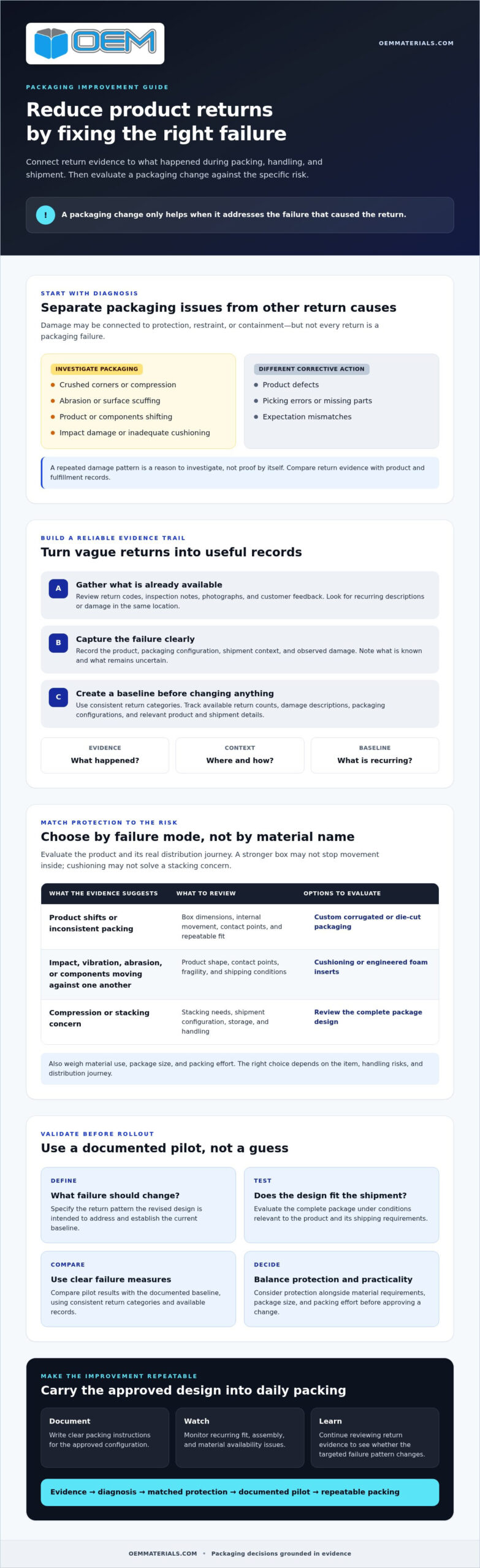
Packaging changes don’t reduce returns unless they address the failure that caused them. A crushed corner, shifted product, or inadequate cushioning can point to different problems, and the wrong fix may add material or packing labor without improving protection. Reducing product returns with better packaging starts by connecting return records to what happened during packing, handling, and shipment.
It’s difficult to trace a return to a specific packaging failure, especially when damage reports lack detail. Teams also need evidence that a proposed change fits the product and its actual shipping conditions. A stronger box or added cushioning may help, but the right choice depends on the item, handling risks, and distribution journey.
This guide explains how to identify packaging-related return causes, compare protection options such as corrugated boxes and foam packaging, and create a practical improvement plan. You’ll learn how to document failure patterns, weigh protection against material and labor requirements, and test a revised design using clear measures. The goal is a packaging change grounded in evidence, not guesswork.
Key Takeaways
- Review return codes, inspection notes, photos, and customer feedback to identify recurring packaging failures.
- Separate shipping damage from product defects, picking errors, missing parts, and expectation mismatches before changing the package.
- Compare corrugated boxes, foam packaging, and other protection options against product dimensions, fragility, handling, and shipping risks.
- Build a documented pilot with defined failure measures, then use the results to guide reducing product returns with better packaging.
- Turn the approved design into clear packing instructions and monitor recurring fit, assembly, and material availability issues.
Reducing Product Returns Starts with Diagnosing the Packaging Failure
Packaging-related return causes are defects or damage plausibly connected to how a product was protected, restrained, or contained during packing and shipment. They can include impact damage, abrasion, compression, or components shifting inside a package. Packaging may contribute to a return, but it doesn’t explain every problem. Product defects, picking errors, missing parts, and expectation mismatches require different corrective actions.
Start with the evidence already available: return codes, inspection notes, photographs, and customer feedback. Look for repeated descriptions or damage in the same location. A crushed corner paired with damage near that corner may warrant investigation of the package and shipment. It isn’t proof on its own, so compare the return evidence with product and fulfillment records before deciding what to change.
How to tell whether packaging contributed to a return
Check for repeatable signs such as crushed corners, abrasion, product movement, or displaced components. Compare the returned item’s condition with outbound inspection and packing records, when available. Ask warehouse and customer-service teams which descriptions are vague or incomplete. Terms like “damaged” may not identify the location, damage type, or whether the product was affected before packing.
Record each case in a concise failure log. Include the product, packaging configuration, shipment context, and observed damage. Note what is known and what remains uncertain. For example, a recurring surface scuff may justify reviewing how the product is separated from the box or other components. Foam packaging may be one option to assess when the evidence points to movement or inadequate separation, but the product and shipment requirements should guide the choice.
Build a useful baseline before changing the package
Use consistent return categories so the current pattern can be compared with results after a change. Track available return counts, damage descriptions, and packaging configurations alongside relevant product and shipment details. If a certain package appears more often in damage reports, treat that as a lead, not a confirmed cause. Other factors, including handling or product condition before packing, may also be involved.
Document the baseline before revising materials or packing steps. That record gives the team a reference point for evaluating a pilot and helps prevent packaging changes from being judged on impressions alone. For context on how protective performance can be assessed, see Package testing. A documented diagnosis gives the next design and test decisions a specific failure to address.
Match Better Packaging to the Product, Handling, and Shipping Risks
Choose packaging based on the failure it needs to prevent, not on material alone. A box that holds its shape may still leave a product free to shift; cushioning may reduce movement but not address a stacking concern. Start with product dimensions and weight, fragility, surface sensitivity, and how components fit together. Then consider the actual packing steps, storage conditions, shipment configuration, and handling from pack-out to delivery.
This evidence-based approach keeps reducing product returns with better packaging focused on a defined risk. A packaging change may also affect material use, package size, or packing effort, so weigh those considerations alongside protection and validate the design under conditions relevant to the shipment.
When corrugated packaging or engineered foam may fit
Review the box dimensions, internal movement, stacking needs, and points where the product contacts the package. If the item shifts or is difficult to pack consistently, custom corrugated or die-cut packaging may help establish a repeatable fit. Explore custom corrugated boxes as one packaging category to assess against the product and distribution requirements.
When cushioning and custom inserts deserve evaluation
If return evidence points to impact, vibration, abrasion, or components moving against one another, evaluate cushioning or engineered foam inserts. Foam type and geometry should be selected around the product’s shape, contact points, and shipping conditions, not assumed from the material name. Review foam packaging solutions as an option, then validate the complete package. ISTA’s ISTA Process Standards provide information on standardized package testing.
The comparison below is a starting point, not a substitute for testing the chosen configuration.
| Option to evaluate | Use case | Potential benefit | Trade-off to assess | Validation need |
|---|---|---|---|---|
| Corrugated box or die-cut fit | Package fit or repeatable packing is a concern | Can help control fit and establish consistent pack-out | Check box dimensions, material use, and packing steps | Verify fit, closure, and performance in the shipment configuration |
| Foam insert or cushioning | Evidence suggests impact, abrasion, or movement | Can help separate or restrain product components | Assess contact points, added materials, and loading effort | Test the insert with the actual product and package |
Compare options against documented failure modes and packing constraints. If a packaging review would help clarify the requirements, custom packaging design support can be considered using product dimensions, weight, handling, and shipping details.
How to Test Packaging Changes Before Rolling Them Out
A packaging change should be evaluated against a defined failure, not a general goal to “add protection.” Specify what the team wants to prevent, such as a product shifting in transit or a component arriving with abrasion. Then decide what evidence would indicate improvement: the product condition after evaluation, package condition, repeatable fit, and any relevant observations from handling or shipment testing.
A successful packaging test must reflect the actual product, package configuration, and shipping context the design is intended to withstand. A result from a different product or shipment setup may not answer the question your team needs to resolve.
Plan a controlled packaging pilot
Select a representative product and shipment configuration. Document the current package as a comparison point, including how it is assembled and packed. Where practical, change one meaningful design variable at a time, such as the internal fit or cushioning arrangement. This helps the team understand which change may have influenced the result. Record the test conditions and observations so others can review the same evidence.
Capture more than whether the product appears protected. Record packer feedback, package condition, product condition, and any fit or assembly issues. If the new design makes packing inconsistent or introduces a handling difficulty, include that finding in the evaluation rather than treating it as a separate concern.
Choose evidence that supports a rollout decision
Compare pilot observations with the return categories and damage patterns established earlier. Look for evidence that addresses the specific failure, while checking for new concerns such as difficult assembly, poor material handling, or added labor. A pilot can provide useful evidence without proving performance in every distribution condition, so document its scope and any additional verification needed before broader use.
Use internal procedures when they represent the shipment conditions being assessed. If a formal package test is appropriate, select a current method suited to the product and distribution environment, and use a qualified testing resource when needed. The International Safe Transit Association publishes process standards and testing resources, but the applicable method should be confirmed for the specific shipment rather than chosen by name alone.
For a rollout decision, summarize the original failure, the design change, test conditions, observations, unresolved limitations, and the criteria for monitoring results after implementation. That record helps engineering, operations, and procurement make a consistent decision about reducing product returns with better packaging. Teams evaluating a redesign can also review custom packaging design support in light of their product and shipment requirements.
Turn Packaging Improvements into a Repeatable Packing Process
An approved package only helps if each order is packed the same way. Convert the design into instructions that show the order of operations, component orientation, cushioning placement, closure method, and final checks. Use plain language and clear visual references so a packer can identify the correct arrangement without relying on memory or informal coaching.
Standardize packing without adding avoidable friction
Observe the process at the packing station before finalizing instructions. Note where workers pause, reposition components, or handle the product more than necessary. Those steps may point to unclear directions or a package that is difficult to assemble consistently. Packaging design coordination can help align the package components with the product and packing workflow. Review custom packaging design support when a design change needs to account for both protection and pack-out requirements.
Train the employees who pack, inspect, and handle the shipment. Invite them to report recurring fit problems, confusing steps, damaged packaging components, and material shortages. These observations can reveal a gap between the approved design and the conditions on the floor. Update instructions when the package changes, and make sure the current version is available at the point of use.
Keep packaging available as demand and designs change
Consistent packing also depends on having the correct materials available. Operations and procurement teams can review usage, replenishment needs, storage constraints, and changes in product or package design together. If a package component is frequently unavailable, workers may substitute materials or skip steps, weakening process consistency. Track those exceptions and resolve the supply issue rather than treating each one as an isolated packing error.
Just-in-time replenishment may fit operations with suitable demand visibility and inventory planning, but timing needs vary by program. Review just-in-time packaging services if coordinating packaging supply is part of the challenge. Kitting or assembly processes may also help organize components for pack-out when they match the operation’s requirements.
After implementation, review returns using the same categories established in the baseline. Compare damage descriptions and return counts for the relevant products and packaging configurations, while noting changes in shipment conditions or packing practices. If damage patterns continue, revisit the original diagnosis. If new issues appear, such as difficult assembly or recurring material shortages, record them as process findings and adjust the instructions or supply plan as needed.
For teams reducing product returns with better packaging, clear work instructions and a feedback loop help carry an approved design into daily operations. Request a packaging quote with product dimensions, weight, and shipment requirements to discuss options for your packing process.
Build a Packaging Improvement Plan with the Right Supply Partner
A practical packaging improvement plan follows a clear sequence: investigate return evidence, define the failure to prevent, compare designs against product and shipment requirements, pilot a change, and monitor results against the original baseline. This keeps decisions tied to observed problems rather than assumptions about which material should work.
Supplier recommendations should reflect the product’s dimensions, weight, fragility, handling needs, and shipping configuration. A box or insert that suits the product alone may not address how it is packed, stored, stacked, or transported. For manufacturers in Southern California, OEM Materials & Supplies provides custom corrugated boxes, die-cut packaging, and engineered foam inserts for packaging applications. The right configuration depends on the product and distribution requirements.
What information helps a supplier evaluate the packaging
Share product dimensions and weight, known fragility or surface concerns, and the locations and descriptions of reported damage. Include the current packaging configuration, packing steps, shipment details, and return observations. Photos of the product and package can help clarify fit or contact points. Expected annual usage and constraints on storage, handling, or assembly also help frame a recommendation.
What a collaborative packaging review can address
With those details, a supplier can evaluate corrugated, die-cut, foam, and related protective packaging options against the documented failure. Discuss whether the need is for a prototype, short run, or production-scale program, and identify how the proposed package will be assessed before wider adoption. Keep performance and cost expectations conditional: outcomes depend on product dimensions, materials, packing requirements, and shipping conditions.
Use the review to agree on the specific problem, design criteria, pilot approach, and measures for monitoring results. A change should not be considered successful solely because the package looks stronger or uses additional material. Compare return patterns with the same baseline categories and watch for new fit, assembly, handling, or supply issues after implementation.
For a packaging recommendation, provide product dimensions, weight, annual usage, current packaging details, and shipping context. Request a packaging quote or consultation to discuss options based on those requirements. A well-documented review gives your team a practical basis for reducing product returns with better packaging.
Make the Next Packaging Change Evidence-Based
Reducing product returns with better packaging starts with identifying which returns may be tied to packaging, then matching a design to the product and its shipping conditions. Test the proposed change against a defined failure, document the results, and give packing teams clear instructions so the approved package is used consistently.
OEM Materials & Supplies supports manufacturers with custom corrugated, die-cut, and engineered foam packaging, from prototypes and short runs to high-volume programs. Kitting, assembly, just-in-time delivery, and vendor-managed inventory can also support packaging programs where those services fit the operational need. Recommendations should reflect the product, handling, and shipment requirements, with performance and cost dependent on those variables.
Share product dimensions, weight, annual usage, current packaging, and shipping context to help assess options. Request a packaging quote or consultation to discuss your requirements. A measured improvement plan gives your team a practical path toward more reliable protection and fewer avoidable returns.
Frequently Asked Questions
Can better packaging reduce product returns?
Yes, packaging changes can help reduce returns when they address a verified cause of product damage. Start by distinguishing damage connected to the package from defects, order errors, missing components, or mismatched expectations. Then assess a design change against the specific issue and monitor the same return categories after implementation. This evidence-based process makes reducing product returns with better packaging a measurable operational goal rather than a material guess.
How do I know if packaging caused a product return?
Packaging may have contributed if the returned product shows damage that aligns with package condition or product movement. Photos of crushed corners, abrasion, or displaced components can help direct an investigation. Compare those observations with outbound inspection records, packing procedures, and customer descriptions. Look for repeated patterns, but consider other stages of production and fulfillment before treating packaging as the confirmed cause.
What type of packaging helps prevent shipping damage?
No single packaging type addresses every shipping risk. The appropriate design depends on the product, how it is packed, and the conditions it encounters in storage and transit. Corrugated boxes, cushioning materials, foam inserts, or crates may be considered for different requirements. Evaluate how the product fits, where it could contact the package, and what handling or shipment configuration the design must accommodate.
Is foam packaging always better for fragile products?
No. Foam is useful only when its design suits the product and shipping requirements. Consider the item’s shape, surfaces, contact points, and how components need to be positioned. A different cushioning approach or coordinated package may be more appropriate for a particular failure mode. Compare options based on the protection needed and how consistently workers can load and assemble the package.
How can I test a new packaging design before a full rollout?
Run a documented pilot using a representative product and shipment configuration. Record the current package as a comparison, define the damage or failure to prevent, and note the product and package condition after evaluation. Capture packing-team feedback and any fit or assembly concerns. Compare results with the baseline return categories, then document what the pilot did not verify before expanding the change to other shipments.
What information should I give a packaging supplier?
Share product dimensions and weight, fragility concerns, known damage locations, and the current packaging configuration. Describe packing steps, shipment conditions, return observations, annual usage, and any storage or assembly constraints. Photos can clarify the product’s fit and reported damage. OEM Materials & Supplies serves manufacturers in Orange County, Los Angeles, San Diego, and Riverside, with packaging recommendations informed by product and shipment requirements.
Can packaging changes reduce returns without increasing packing labor?
They may, but the effect depends on the design and packing operation. Include pack-out time and handling steps in a pilot, not just product condition. Observe whether workers can position components and close the package consistently, and identify any confusing or repetitive tasks. Clear instructions or a better-fitting package may support repeatable packing, but the result should be checked in the actual workflow.
For a packaging review, share your product dimensions, weight, annual usage, and shipping context. Request a packaging quote or consultation to discuss options for your operation.