
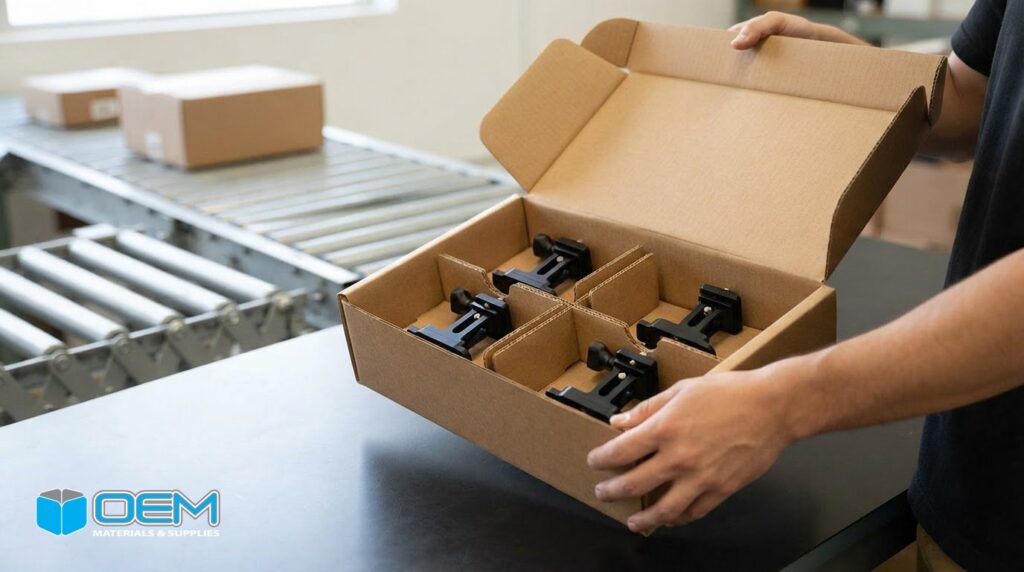
A shipping box can be correctly sized and still let a product shift in transit. For eCommerce shipments, corrugated retention inserts, partitions, and trays can hold items in position and help limit movement that leads to shipping damage. A supplier of retention packaging inserts in Los Angeles can pair an insert with a compatible corrugated box to create a more secure pack.
Choosing the right insert depends on the product’s shape, weight, and position inside the box. Corrugated retention inserts can also keep the product visible when the package is opened, without requiring the customer to remove loose cushioning first.
This guide explains how retention inserts work, how they differ from suspension packaging, and what to consider when matching inserts to products and outer boxes. It also covers assembly, storage, and how corrugated packaging can support an efficient eCommerce packing process.
Key Takeaways
- Use retention inserts to hold products in position and reduce shifting inside eCommerce shipments.
- Match insert design to the product’s shape, weight, and the level of separation or cushioning needed.
- Choose partitions or other dividers to keep multiple items organized and separated within one box.
- Pair inserts with compatible outer boxes so the assembled pack supports both product retention and shipping protection.
- Consider assembly steps and flat-pack storage needs when selecting a packaging format for warehouse operations.
Protection from movement, impact, and mishandling
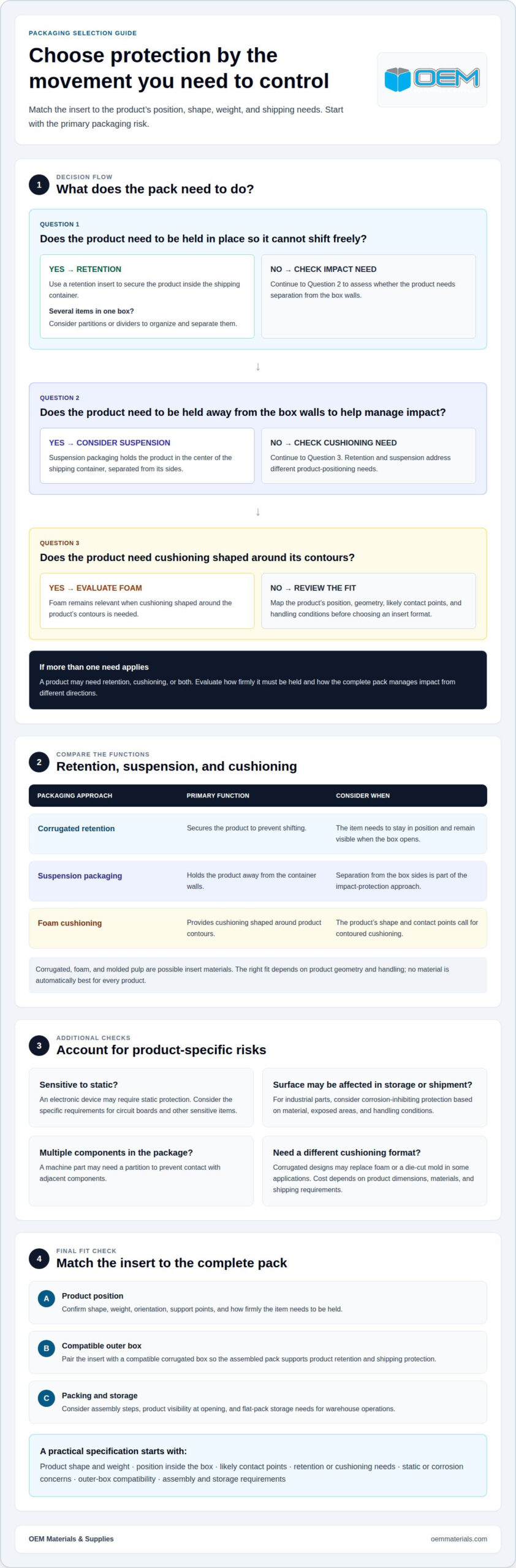
Retention packaging secures a product so it cannot shift freely inside its shipping container. Suspension packaging holds it away from the box walls to help manage impact.
In Los Angeles, choose an industrial packaging supplier that can match corrugated and foam formats to the product and shipping conditions. Molded pulp is another possible insert material; the right fit depends on product geometry and handling.
Drop and Impact Protection
Shipping containers may be dropped repeatedly and stacked in transit. An insert should restrain the product while keeping vulnerable surfaces away from the outer box and other contents. For a phone or laptop, that means supporting its shape without letting it slide against the box walls. Identify where the product needs support and consider how the complete pack manages impact from different directions.
Industrial Protective Packaging
Industrial protective packaging must account for the product and its handling environment. A machine part may need a partition to prevent contact with adjacent components, while an electronic device may require static protection. Circuit boards, machine parts, and vehicle components each need a layout that limits movement without obstructing packing or unpacking.
Insert systems can reduce reliance on loose packing peanuts, bubble bags, foam, or paper. Corrugated retention inserts hold products in place and keep them visible when the box opens, rather than burying them beneath cushioning. In some applications, replacing foam or a die-cut mold with a corrugated design may be more cost-effective. The result depends on product dimensions, materials, and shipping requirements.
Foam remains relevant when a product needs cushioning shaped around its contours. Compare foam-based protective packaging with corrugated retention by considering contact points, handling, and how firmly the item must be held. Neither material is automatically the best choice for every product.
For industrial parts, consider corrosion-inhibiting protection if surfaces could be affected during storage or shipment. Choose packaging based on the item’s material, exposed areas, handling conditions, and any static-protection requirements. During evaluation, map the product’s position inside the box, identify likely contact points, and determine whether it needs retention, cushioning, or both. This helps establish whether corrugated inserts, foam, or a combination is appropriate.
Keep the packaging choice tied to the product’s risks and handling needs. Phones and laptops, machine parts, and circuit boards may need different combinations of retention, cushioning, static protection, or corrosion-inhibiting protection. Define the priority, such as holding an item in place, cushioning it, replacing foam, or protecting a sensitive surface, when specifying the package.
Damage reduction during shipping
Reducing shipping damage takes more than selecting an insert. A useful review connects customer reports with the exact packing configuration used for each order. For Los Angeles businesses looking for a retention packaging inserts supplier, these records can help distinguish a packaging issue from product variation or a change in the packing process.
Start with the shipment record. Capture the product identifier, box and insert combination, packing date, and reported damage. Add photographs of the returned item and packaging when available. A crushed carton, torn insert, or damaged product may point to different stages of the shipment, so tie each observation to its order.
Look for patterns across orders. Damage limited to one product version may indicate a fit issue, while reports tied to one packing station may suggest inconsistent assembly. If claims begin after a packaging revision, compare the old and new configurations. These comparisons focus corrective action without requiring changes to every package at once.
Packaging instructions should match the pack operators use. A brief visual reference can show the correct product orientation, insert placement, and box-closing sequence. For example, a device packed with accessories needs a clear layout so the same components occupy their intended positions in every order. Review the instructions when product dimensions or order contents change.
Use returned packaging as evidence, not just as part of a damage claim. Check the carton, insert, and internal components before discarding them. Note whether the pack arrived open, compressed, or altered. These observations can help determine whether to adjust the packaging configuration, packing method, or shipment-handling process.
After making a change, compare subsequent reports with the same records. Track which configuration was used and whether the type of reported damage changes. Avoid treating a single claim as proof that an entire packaging format has failed. Consistent review gives procurement and operations teams a clearer basis for deciding when a targeted adjustment is warranted.
Share the product details, current packaging configuration, and documented damage examples to discuss a practical next step. Submit a packaging quote request to start that conversation with OEM Materials & Supplies.
The protective approach should match the movement the package needs to control. Suspension packaging holds products in the center of the shipping container, separated from its sides, and provides impact resistance. Retention packaging secures products to prevent shifting during shipment. These functions are distinct, so reviewing damage alongside the product’s position in the package can clarify which protection is relevant. This distinction also helps teams discuss a configuration change without assuming every damage report calls for the same solution.
Cost is another consideration when comparing packaging options. Retention and suspension packaging may be more cost-effective than shipping protection made with foam or die-cut molds, depending on the product, packaging materials, and shipping requirements. Retention packaging is lightweight, which may help minimize postal and shipping costs, depending on those same factors. Weigh the protection needed against shipping costs: does the product need to stay centered and separated from the container sides, be secured against shifting, or use an alternative to foam or die-cut molds? Shipment records can guide the decision.
Dunnage, load dividers, and airbags
Dunnage is material used to fill, separate, or support cargo inside a shipping container. Load dividers create distinct compartments, while inflatable airbags fill larger gaps between loads. Each serves a different need: a boxed appliance may need separation from accessories, while palletized cartons may need support against shifting in transit.
For eCommerce packs, corrugated dunnage can brace a product or keep smaller items organized. A divider between a device and its cables helps prevent direct contact during handling. This works best when compartments match the items’ arrangement, rather than leaving loose parts to move through open spaces.
Load dividers are useful when a shipment contains multiple products or components. In a kit with several machine parts, separate cells can keep metal pieces from rubbing against finished surfaces. Dividers can also simplify packing: workers place each item in its designated space, then close the box. The layout should account for the actual product mix, not just the outer carton.
Airbags address a different scale. They fill gaps between larger loads, such as palletized cartons, and help limit movement within a trailer or shipping container. They are not a substitute for a fitted insert around an individual product. For a small electronics order, a partition or retention insert is better suited to organizing the contents inside the box.
Choose the material by identifying the space that needs control. If items need separation, use dividers. If a product needs support in its individual carton, consider a fitted insert or other dunnage. If a larger load has gaps between units, airbags may be appropriate. Avoid using one material to solve a different packaging problem.
Inventory and packing methods also affect the choice. A warehouse shipping mixed orders may need adjustable dividers for changing product combinations. A stable, repeatable kit may benefit from a fixed layout that shows workers where each component belongs. Retention packaging is designed for straightforward assembly and packing, helping keep the sequence consistent across orders.
Before standardizing a pack, map the load from the individual item to the pallet or container. Note which parts must remain separated, where empty space occurs, and how workers load the shipment. This distinguishes a product-level insert requirement from a load-level void-fill need. The distinction can prevent unnecessary materials and make the packing process easier to repeat.
Retention inserts and compatible outer boxes
A retention insert works as part of a complete pack, not as a stand-alone cushion. It holds the product in position, while the outer box contains the assembly during shipment. Inserts can be supplied alone or paired with compatible corrugated boxes. Matching the components helps keep the insert seated and the product supported inside its shipping container.
Product dimensions, weight, and shape guide the fit. A laptop, vehicle part, and compact electronic device each need a different contact layout. Retention film conforms to the product, while the insert’s corrugated structure supports its position. Suspension and retention assemblies use durable memory multi-layer films laminated to corrugated paperboard. Variable-stretch options accommodate different product profiles and holding needs.
Assembly follows a defined sequence. Lift the film, place the product underneath, then fold the side flaps to form an arch. Fit the assembled insert into a pre-assembled outer box. For a small device with accessories, the insert can hold the primary item while a separate area keeps related components from pressing against it. The pack should close without displacing the product or distorting the insert.
Compatible outer boxes matter because the insert must fit the carton’s interior dimensions. Excessive clearance can let the insert shift, while a tight fit can make loading difficult. Consider the product’s position, insert footprint, and box interior as one assembly. Choose a corrugated box that supports the insert format and shipment requirements.
Retention and suspension assemblies can ship flat, reducing storage space before packing. This can help warehouse teams stage packaging components near the packing area without storing fully assembled inserts. Since the insert is assembled at the workstation, the pack sequence should be clear enough for operators to repeat across orders.
For an operation handling products in several sizes, a supplier can tailor inserts to different dimensions, weights, and shapes. Film stretch and insert geometry affect how the item is held. A product with a broad, flat face may need a different contact arrangement from a part with projecting edges. Define the supported surfaces and intended position before selecting the insert and box combination.
Specify the product, its orientation, and the outer carton together during packaging design. This gives the supplier the information needed to coordinate insert dimensions with box fit and assembly steps. A matched pack can help maintain consistent placement from the packing bench through shipment, while allowing the customer to see the product when opening the box.
Retention packaging inserts from Los Angeles suppliers
Retention packaging combines a holding film with a supporting structure, commonly corrugated paperboard. The film conforms around the product, while the structure keeps it positioned inside the shipping container. For buyers in Los Angeles, this format can suit computer peripherals, vehicle parts, laptops, electronic devices, and specialist components of different shapes and sizes.
One option is a corrugated insert with retention film, supplied on its own for use with a compatible outer box. Another is a complete pack that pairs the insert with an outer corrugated box. The combined format coordinates product support and container fit, while an insert-only option can work with an existing box suited to the pack design.
Film and insert geometry can be adapted to product dimensions, weight, and shape. Variable stretch options help accommodate different profiles. A flat electronic device and a component with projecting edges need different contact arrangements, so the design should match the product’s shape and intended position. Durable memory multi-layer films laminated to corrugated paperboard form one construction used in retention and suspension assemblies.
Suppliers may also offer suspension-style designs that hold the product in the center of the box, away from its sides. This differs from a retention insert that secures an item against shifting. The choice depends on the protection goal: a laptop may need separation from the container walls, while a small machine component may need firm restraint within its pack.
Assembly is straightforward: lift the film, place the product underneath, fold the side flaps into an arch, and fit the insert into a pre-assembled box. Retention assemblies can ship flat, reducing storage space before use. A repeatable sequence can help warehouse staff pack products consistently and keep materials organized at the workstation.
Compare formats by considering the product, required box, and assembly process. A matched insert and box can be designed together, while a standalone insert must fit the carton already in use. Product dimensions, weight, shipping conditions, and packing steps all inform the design. Custom packaging design can address these requirements as one system.
To develop a retention insert for a Los Angeles eCommerce shipment, provide product dimensions, weight, orientation, and the outer box requirements. These details help define the film fit and corrugated support. Request a packaging quote to discuss the application and packaging configuration.
OEM Materials & Supplies
OEM Materials & Supplies can help you consider how packaging components fit your eCommerce shipping requirements. Corrugated boxes provide the outer container, while foam packaging and cushioning materials can support products that need additional protection. Packaging kits can bring packaging components together for a defined packing application.
For a product that shifts during transit, share its dimensions, weight, orientation, and current box configuration. These details help define the protection needed and the packaging components suited to the shipment. Mailing tubes and cores are also available for products suited to a tube format.
Contact OEM Materials & Supplies to discuss your packaging requirements and next steps.
Plan Your Next Packaging Evaluation
A packaging review can start with a recurring issue: a product arriving shifted, marked, or damaged. Use that pattern to define what the next design needs to control, then assess the product, packing process, and shipment together. This gives your team a practical basis for evaluating retention packaging options in Los Angeles without selecting materials by guesswork.
If you are looking for a Los Angeles supplier of retention packaging inserts, prepare the product dimensions, weight, current box configuration, and annual usage. Include photos or a description of damage patterns and how items are packed. These details help frame a focused discussion about suitable packaging components and how they fit your operation.
Contact OEM Materials & Supplies to discuss your packaging requirements and take the next step toward a more considered pack design.
Frequently Asked Questions
Are these inserts suitable for eCommerce packaging?
Yes, retention inserts can suit eCommerce shipments when the product and pack layout are compatible. They can hold an item in place without loose fill and can be paired with an outer box for parcel shipping. For an order containing several components, plan how each piece will be placed and removed. A clear arrangement helps keep parts organized when the customer opens the package.
Which packaging inserts meet shipping, cushioning, or product-safety requirements?
The right insert depends on the protection needed. Corrugated retention inserts secure a product against shifting, while suspension designs hold it away from the box walls. Foam can cushion vulnerable surfaces, and dividers can separate components that might contact each other. For electronics, consider whether the application needs a static barrier. Product geometry, shipping conditions, and sensitive contact points guide the selection.
How can businesses compare Los Angeles packaging insert suppliers by quality, price, and service?
Compare how well each insert fits the product and outer box, supports shipping needs, and suits your assembly and storage process. Ask about design support, material options, and whether the supplier can provide low or high volumes cost-effectively.
Do Los Angeles packaging insert suppliers offer in-house design, prototyping, and testing?
Ask suppliers about their design, prototyping, and testing services, including which materials and processes they can support. Confirm capabilities directly to ensure they fit the application.
Which Los Angeles suppliers specialize in custom foam, cardboard, and molded pulp inserts?
Foam, corrugated, and molded pulp are options to consider when selecting inserts for a specific application. Ask suppliers which materials they offer and how they can meet the product’s protection and handling requirements.