
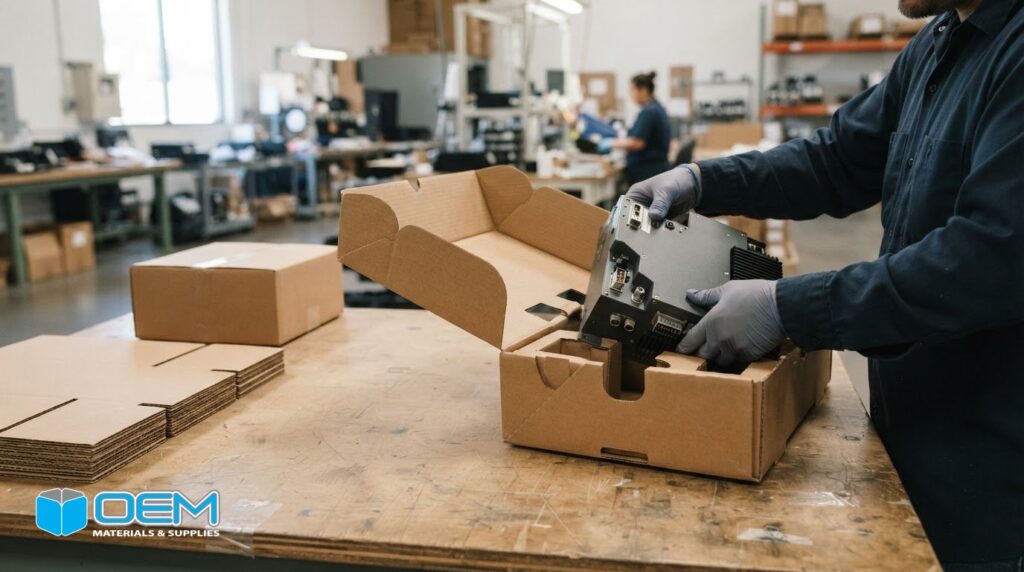
Why consider custom die-cut corrugated boxes in San Diego when a stock carton is easier to source? They’re useful when a product’s shape, weight, or fragility calls for a closer fit, more stable protection, or packaging designed around specific handling needs. The right design can reduce unused space and limit product movement, but it isn’t automatically the lower-cost option.
Choosing packaging involves more than comparing carton dimensions. Board strength, inserts, printing, order volume, and shipping conditions all affect the design and cost. A box suited to the product and its route can make packing more efficient while helping reduce the risk of damage in transit or storage.
This article explains when die-cut packaging is useful, how corrugated construction and local sourcing factor into cost, and what to consider when sizing, printing, and producing a box. You’ll also learn which design decisions matter most when balancing product protection, packing efficiency, and budget.
Key Takeaways
- Assess whether a die-cut design can improve product fit, reduce movement, or simplify packing compared with a stock carton.
- Match corrugated board construction to shipping and stacking demands, not appearance alone.
- Factor board grade, insert complexity, printing, and order volume into packaging cost decisions.
- Plan box dimensions, shape, and graphics around product protection, packing requirements, and brand presentation.
- Understand how flatbed and rotary die-cutting serve different design and production needs.
Need Custom Die-Cut Packaging?
Die-cut packaging makes sense when a product’s shape or handling needs make a standard carton inefficient. For San Diego businesses, the right design starts with the product, its shipping environment, and how it will be stored.
Product Protection in Transit and Storage
Packaging protects products by containing them, limiting movement, and distributing forces from handling or stacking. A shifting item can strike weak points in the box, increasing the risk of damage during shipping or storage.
For example, a product with a fragile edge may need a shaped insert that keeps it away from the carton walls. Board strength, closure, and internal support should suit the product’s weight and shipping route. Shipments in San Diego may pass through residential, office, or retail delivery environments, so design the package for its actual handling conditions.
Product-Specific Box Fit
A custom die-cut box is designed around a product’s dimensions and packaging requirements. Its folds, flaps, and openings can position the item while keeping the package practical to assemble.
Measure the product at its widest points, including attached parts or protective components. Then account for the space needed for inserts and cushioning materials. A snug fit can reduce excess movement, while a box that is too tight can complicate packing or put pressure on the contents. OEM’s corrugated box options can support packaging plans built around product dimensions and shipping needs.
Internal inserts provide additional control. Corrugated dividers can separate multiple items, while foam packaging can cushion a single product or protect vulnerable surfaces. Choose based on the product’s shape, fragility, and fit inside the box.
Production Workflow and Order Logistics
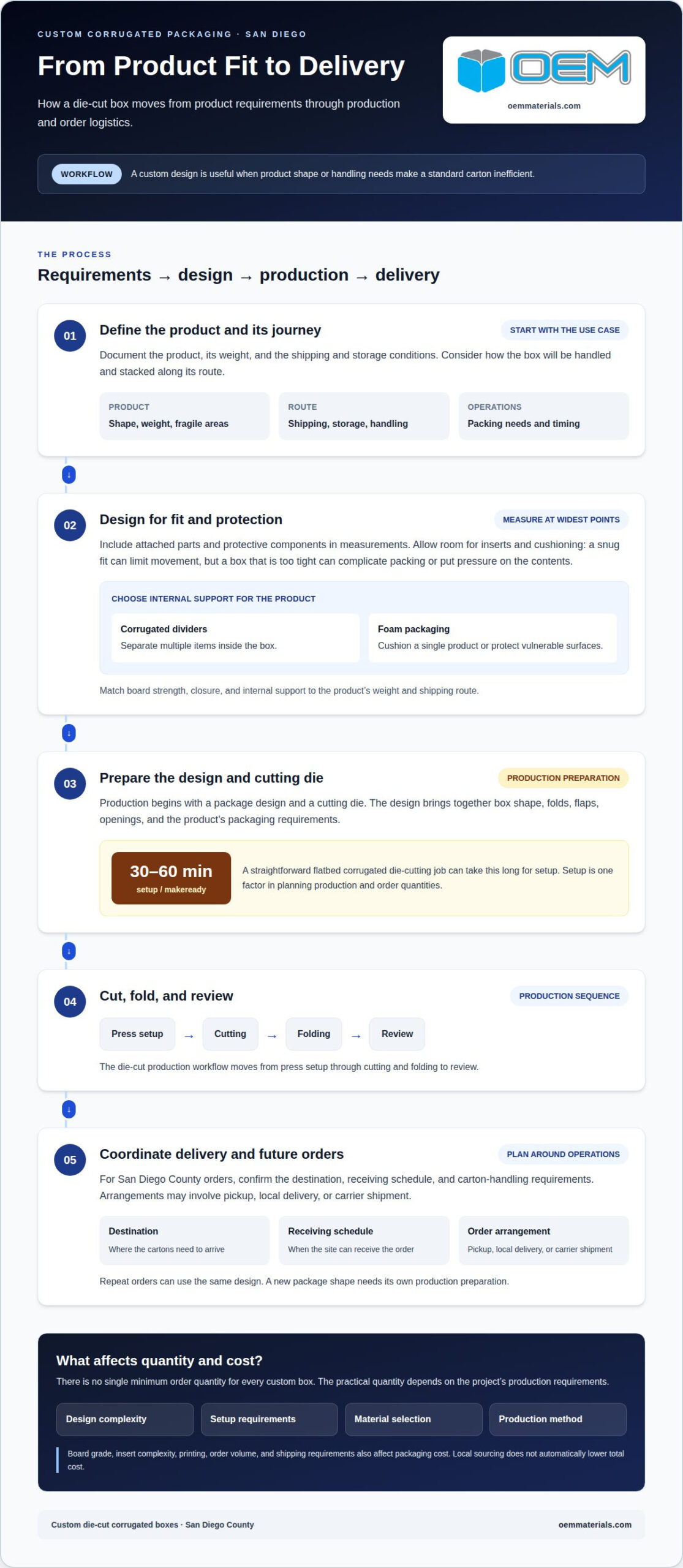
Die-cut production begins with a package design and a cutting die, then moves through press setup, cutting, folding, and review. A straightforward flatbed corrugated die-cutting job can take 30 to 60 minutes for setup, also called makeready. That setup time is one factor in planning production and order quantities.
There is no single minimum order quantity for every custom box. The practical quantity depends on design complexity, setup requirements, material selection, and production method. Repeat orders can use the same design, while a new package shape needs its own production preparation.
For orders in San Diego County, logistics may involve pickup, local delivery, or carrier shipment, depending on the order arrangement. Confirming the destination, receiving schedule, and carton-handling requirements helps coordinate delivery. These details matter when boxes need to arrive before a production run or scheduled packing shift.
Benefits of choosing a local box maker
A San Diego-area box maker can connect packaging decisions more directly with regional production and delivery needs. Shorter shipping distances can support faster delivery than sourcing from farther away, which matters when cartons must reach a warehouse before a scheduled packing run. Local coordination also gives purchasing and operations teams a practical way to discuss dimensions, board selection, print requirements, and order timing together. Those discussions help clarify the requirements before production begins.
Proximity can also make design changes easier to coordinate. For example, a San Diego manufacturer preparing a new product run may need to revise a carton after reviewing a sample or updating a component. A nearby supplier can discuss the change and its effect on the design without relying only on long-distance exchanges. The revision still needs to fit production requirements, but clear communication helps teams keep packaging decisions connected to current product specifications.
Local sourcing can support planning across a broader supply chain. Align box orders with receiving schedules, storage capacity, and production demand. For companies serving retail locations, a consistent carton format can simplify handling across packing stations and shipments. If quantities or product mixes change, communicate those changes early to help keep packaging inventory aligned with upcoming work.
San Diego businesses may also use custom packaging to distinguish products at regional events, trade shows, and retail displays. Printed brand elements can make a package easier to recognize, while its structure still needs to suit the product and shipping route. Bring marketing, engineering, and warehouse requirements into the same design discussion so appearance does not override function.
Material decisions matter too. If your business prioritizes recyclable or biodegradable packaging, consider those goals alongside durability, product weight, and handling needs. A material should suit the package’s actual purpose, not just its appearance. Local sourcing does not automatically lower total packaging costs: board grade, printing, order volume, and shipping requirements all affect the calculation. Compare these factors to understand the tradeoffs before choosing a design.
For a San Diego operation evaluating a new carton, a useful starting point is to outline the product, expected usage, delivery destination, and timing. A custom packaging quote can then be based on those project details, giving the team a clearer basis for discussing fit, materials, and production needs.
Corrugated engineering and cost efficiency
Corrugated design balances board construction, box geometry, and production needs. The right combination depends on the product, shipping conditions, and expected order volume.
Flute Types and Box Strength
Flute type describes the profile of the corrugated medium, while board construction affects how the box performs during handling and stacking. Options include E-flute, B-flute, and C-flute, as well as double-wall and triple-wall combinations.
No single flute or strength works for every shipment. A compact electronics package may need a close-fitting structure, while heavier products or demanding stacking conditions may call for stronger board construction. Match the material to shipping conditions, not just display appearance. Product weight, carton dimensions, stacking pattern, and handling route all inform the decision.
Strength ratings help compare board performance, but consider them alongside the complete package design. A strong panel cannot prevent damage if the product shifts inside the box or the closure separates during handling. For a San Diego shipment, assess the full route, including storage and final delivery, then select board construction and internal support together. This gives engineering and purchasing teams a better basis for comparing designs than flute names alone.
Dieline Templates and Cost Efficiency
A dieline is the flat layout showing a box’s panels, folds, and cuts before conversion. Structural designs and dielines help teams assess how a package forms, closes, and fits its contents. Prototypes make those decisions tangible before production. These tools can reveal fit issues, difficult folds, or excess material before a design is repeated.
Depending on the design, die-cutting can form tabs and locking features that reduce or eliminate the need for tape or glue. An efficient layout can also reduce corrugated material use. Weigh these potential benefits against board grade, insert complexity, printing requirements, and order volume. Custom packaging may cost more upfront than a stock box, while reduced product damage and returns can offset the initial investment.
For example, a box with integrated locking flaps may simplify assembly, but its board strength still needs to suit the product and shipping conditions. A display-ready package may need a different cut pattern from a closed shipping carton. Reviewing a custom packaging design alongside its dieline helps connect product fit, material use, and production requirements. The most cost-efficient design is the one that meets protection and packing needs without adding unnecessary structure.
Custom box sizes, shapes, and printing
Custom packaging aligns a box’s dimensions, opening, and printed design with its product and intended use. Each choice affects how the package is packed, handled, and presented.
Custom Box Dimensions
Custom box dimensions are developed around the product and its packaging configuration. Account for the item’s length, width, and height, along with any insert or cushioning inside the carton. For example, a component with a protruding connector needs enough clearance to avoid pressure during packing and storage.
Start with the product as it will actually be packed, not just its bare shape. Include protective sleeves, accessories, or components shipped together. Then consider how workers load and close the carton. Adequate internal space can make packing more consistent, while excess empty space may require additional material to stabilize the contents.
Dimensions also affect how cartons fit into storage areas and shipping configurations. A warehouse team handling several product families may need distinct box sizes to prevent components from being mixed or forced into unsuitable cartons. Custom sizing can address those differences, while shared dimensions across related products may simplify storage. Choose based on product geometry, packing method, and shipping requirements.
Die-Cut Box Shapes
Die-cutting forms custom panels, openings, tabs, and folds from corrugated sheets. These features create packaging shaped for a specific product, rather than relying on a basic rectangular carton. For example, a shaped insert or locking flap can position a part and help keep the package closed during normal handling.
Structural details should serve a clear purpose. A handhold can make handling easier, while a display opening can show part of the product at retail. Cutouts may reduce excess material, but their placement should not compromise support or product retention. Design for how the item enters, sits inside, and exits the box.
Printing adds identification and brand information to a package. Logos, colors, and other design elements can help products stand out at a trade show or retail display. Fit artwork to the available panels, clear of folds and cutouts that could interrupt important details. Coordinating the print layout with the dieline helps position labels, product information, and graphics as intended.
For example, an electronics kit could have a tailored carton with a shaped interior arrangement and printed identification on an exterior panel. This connects the package’s structure and presentation to its contents. Consider final dimensions, shape, and artwork together, since a change to one feature may affect the space or surface available for another.
Custom corrugated die-cutting process
Corrugated die-cutting turns a package design into formed blanks that fold into boxes. The process connects product requirements, board selection, tooling, press method, and production review.
A quote request should include the product’s length, width, height, and weight, plus any components packed with it. Add the expected order quantity, shipping conditions, preferred board construction, print requirements, and available artwork or dieline files. If you don’t have a dieline, a product drawing or sample can help define the package structure.
The first production decision is structural. A designer translates the required box shape into a flat layout, identifying cut lines, creases, tabs, and closure features. The layout must account for the selected corrugated board, since material thickness affects how panels fold and fit. For example, an electronics component with a connector may need a shaped opening and internal support to prevent pressure on the connection point.
Next, match the production method to the design and run size. Flatbed die-cutting suits complex shapes, heavy board grades, and shorter production runs. Rotary die-cutting suits high-volume production of standard box styles. This helps align tooling and production with the package’s geometry and quantity, rather than choosing a process based on volume alone.
Board and flute selection also affect the die-cutting plan. Corrugated board is available in standard profiles from E-flute through B- and C-flutes, including double-wall and triple-wall combinations. A package with intricate folds may need a different structural approach than a straightforward shipping carton. Consider material, cut pattern, closure, and packing sequence as one system.
Before a larger run, a prototype or sample can show whether panels fold correctly and products load as intended. Review cut accuracy, crease placement, closure function, and insert fit. If a flap interferes with loading, adjust the design before production. Once approved, die-cutting can produce consistent, repeatable results across large production runs.
Production review should also consider how finished blanks move into packing operations. A design that nests efficiently and folds in a clear sequence can support a consistent workflow. For shipping, confirm that the assembled package closes securely and holds its contents in the intended position.
To scope a die-cut project, request a custom box quote with product dimensions, weight, order quantity, artwork, and shipping requirements. Those details give the design and production teams a practical starting point.
OEM Materials & Supplies: Corrugated Boxes
OEM Materials provides custom corrugated boxes for San Diego businesses, designed around their products and shipping requirements. Turn to the team when a stock carton doesn’t fit your product or packing process, or when internal support is needed to stabilize its contents. Foam Protective Packaging can cushion delicate items, while Assembled Packaging Kits bring packaging components together for a specific application. Mailing Tubes & Cores suit products that need cylindrical packaging. To discuss a custom box, share the product dimensions, weight, packing configuration, and shipping environment. Contact OEM Materials to discuss your corrugated packaging needs.
Set Up Your Next Packaging Review
Use your next packaging review to connect design decisions with how your team actually packs and ships products. For a San Diego project, document product dimensions, packed weight, annual usage, internal components, and shipping conditions in one specification. Include artwork or a current dieline, if available, and note the issues the new package should address, such as movement inside the carton or difficult assembly. This gives the design discussion a clear operational starting point.
When developing custom die-cut corrugated boxes in San Diego, treat the first design as a working solution to evaluate against your product and packing process. Note any necessary adjustments before repeat production, and keep approved specifications accessible to purchasing, engineering, and warehouse teams. Clear records help align later orders with the package your operation has adopted.
Request a quote from OEM Materials & Supplies to discuss your packaging requirements and next steps.
Frequently Asked Questions
Does die-cutting work with all corrugated flute types?
Die-cutting works with different corrugated flute constructions, but not every die setup suits every board combination or cut pattern. A design with narrow slots and detailed folds places different demands on tooling than one with broad, simple panels. For reliable production, assess the flute construction and die together, including how the blank will feed through the selected press.
What Is Die-Cutting?
Die-cutting uses shaped tooling to create a package’s cut and crease pattern in corrugated board. The die is the physical production tool, while the dieline is the layout that communicates the pattern. This distinction matters during design reviews: changing a dieline changes the package layout, while producing it requires compatible tooling and press setup.
What custom die-cut corrugated box styles and sizes are available in San Diego?
Custom die-cut corrugated boxes in San Diego can be designed around product dimensions in configurations such as box-and-partition sets, bulk cargo boxes, and weather-resistant boxes. A buyer shipping several related components might choose partitions to keep them separated. The right style depends on how the product is packed and handled, with final dimensions based on the packaging configuration.
How much do custom die-cut corrugated boxes cost in San Diego?
There is no standard price for every custom die-cut box. A useful quote specifies board construction, printing, quantity, and project scope so purchasing teams can compare equivalent packages. Confirm which design and production elements each proposal includes, then evaluate the quote against the required package performance. Pricing is provided through a quote request, not as a general rate.
How long does custom box design, sampling, and production take?
The schedule depends on how complete the design information is, how many review changes are needed, and the production schedule for the approved package. If you have a required in-hand date, share it at the outset and allow time for internal artwork and sample approvals. Clear approval responsibilities help prevent avoidable pauses between design review and production.
How do local custom box suppliers compare on price, turnaround, and sustainability?
Compare proposals against the same written specification, then assess whether each supplier clearly explains delivery timing and material choices. For a sustainability review, request information about the proposed material’s recyclability and any relevant sourcing documentation. Record these alongside the quote scope and delivery commitments, then weigh them against purchasing priorities rather than judging proposals by unit price alone.
What should buyers check to ensure custom corrugated boxes protect products and meet shipping requirements?
Document how the product is oriented, loaded, closed, stored, and shipped. A carton designed for upright storage may not suit a shipment handled on its side. Note product contact points, protrusions, seals, and any handling labels required for the operation. These details help identify design risks that a dimension-only specification can miss.
Contact OEM Materials to discuss your corrugated packaging requirements.
Which San Diego companies make custom die-cut corrugated boxes?
OEM Materials & Supplies offers corrugated box options that can be designed around product dimensions and shipping needs.