
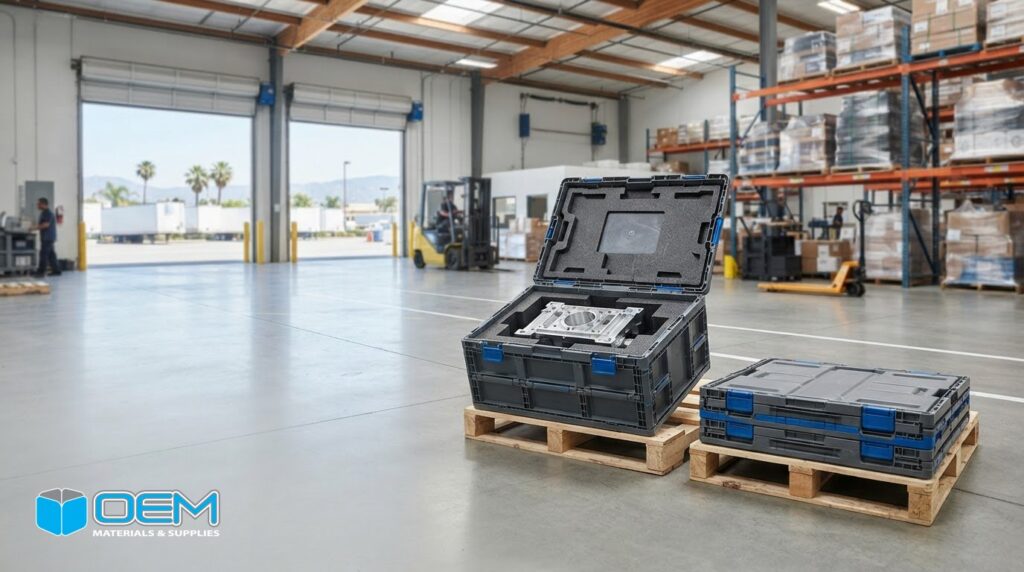
The crate that collapses most compactly may not be the right crate for your operation. For buyers comparing reusable and collapsible crates los angeles, the real test is whether the design protects the product, works with handling equipment, and fits a workable return loop. Foldability alone does not determine value.
Reusable packaging can make sense when shipments follow a predictable return path. Product fit, loading and unloading, storage space, and empty-crate handling all affect the decision. A crate that misses a protection or workflow requirement can create new handling problems instead of solving them.
This guide helps you define requirements before requesting a quote and compare reusable-crate workflows with other packaging approaches. It covers product dimensions and weight, protection needs, shipment frequency, destinations, returns, and operational questions to verify with a supplier. OEM Materials & Supplies serves manufacturers in Los Angeles and Southern California with crates and custom packaging design. Whether a collapsible configuration can meet your application must be confirmed with the supplier. Bring your shipping and usage details into that review to assess the proposed design.
Key Takeaways
- Assess reusable and collapsible crates los angeles against your product, protection needs, and actual shipping loop, not foldability alone.
- Document product dimensions, weight, fragility, orientation, and handling constraints before requesting a crate review.
- Compare return freight, folded storage, inspection, and damaged-crate handling to see whether reuse fits your operation.
- Align procurement, engineering, and warehouse teams on receiving, return ownership, and storage responsibilities.
- Share shipment frequency and return-flow details with an industrial packaging partner to help evaluate suitable crate options.
Reusable and Collapsible Crates in Los Angeles: What Buyers Need to Evaluate
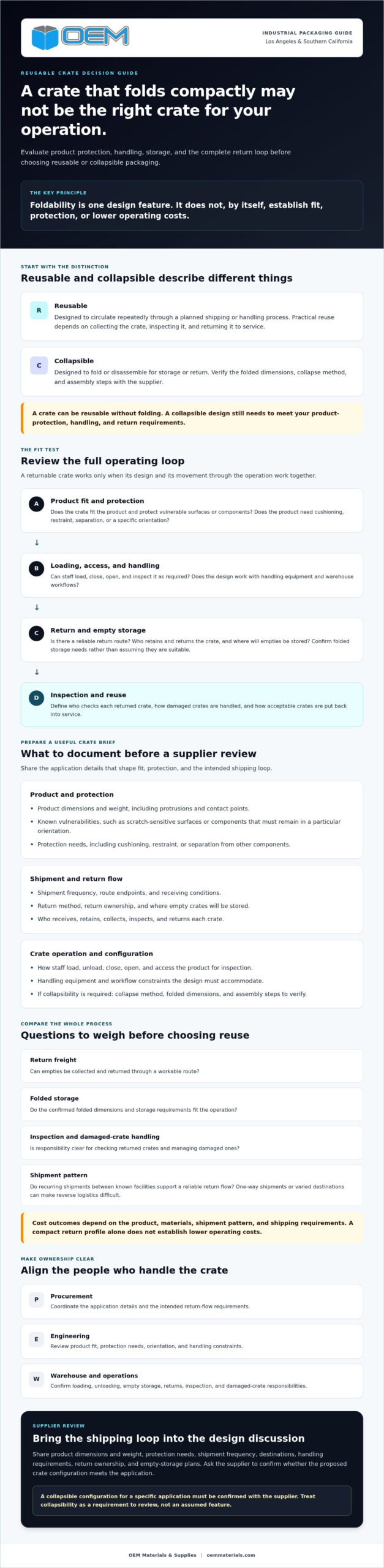
A reusable crate is packaging intended for repeated use in a planned shipping or handling process. It might travel between a manufacturer and a customer, move components between production locations, or support recurring deliveries to known facilities. The return route matters: repeated use is practical only when the crate can be collected, inspected, and put back into service as part of the operation.
Reusable packaging is also called returnable packaging in some supply-chain contexts. Collapsibility is a separate design attribute. A crate can be reusable without folding, while a collapsible design may reduce empty storage needs but still fail a product’s protection, handling, or return requirements. Confirm the proposed design’s folded dimensions, collapse method, and assembly steps. A compact return profile alone does not establish lower operating costs; results depend on the product, materials, shipment pattern, and shipping requirements.
What makes a crate reusable and collapsible?
Reusable packaging is designed for repeated circulation; collapsible packaging is designed to fold or disassemble for storage or return. The terms describe different characteristics, so evaluate each independently. Specify how the product sits inside the crate, what protection it needs, and how staff will load, close, open, and inspect the package. Then ask the supplier to confirm the collapse method and folded storage requirements. Do not assume that every crate collapses or that every collapsible crate suits repeated industrial use.
OEM Materials & Supplies offers crates and custom packaging design for manufacturers in Los Angeles and across Southern California, including Orange County, San Diego, and Riverside. Its confirmed offerings do not establish that a collapsible configuration is available for a specific application. Buyers considering industrial crate options should describe collapsibility as a requirement to review and verify, not an assumed product feature.
When does a Los Angeles operation need a returnable crate?
Start with the shipping loop. Recurring shipments between known facilities, customers, or production locations may support a returnable system when there is a reliable way to bring empty crates back. Map who receives the product, who retains the crate, how it returns, and who checks it before reuse. If shipments are one-way or destinations vary, managing the reverse flow may be difficult, even if the crate folds for storage.
Industrial buyers need packaging that fits product protection and business logistics, not residential moving-box pickup or rental services that may appear in local search results. For reusable and collapsible crates los angeles procurement, evaluate the intended product, handling conditions, return ownership, and storage process together. Those details give a supplier a stronger basis for review than collapsibility alone.
How to Specify a Reusable Crate for Los Angeles Shipments
A useful crate specification starts with the product and conditions it must withstand, then accounts for the full shipment and return process. For buyers in Los Angeles, Orange County, San Diego, and Riverside, a clear brief helps suppliers assess fit without guessing about protection needs, handling methods, or the intended configuration.
Which product and shipment details should you collect?
Record the product’s dimensions and weight, including protrusions or contact points that could affect how it sits in the crate. Describe known vulnerabilities, such as surfaces that can scratch or components that must stay in a particular orientation. Include shipment frequency, route endpoints, receiving conditions, return method, and where empty crates will be stored. These details frame the application. Do not assign load limits or material specifications without engineering review.
How should protection and crate access be specified?
Describe whether the product needs cushioning, restraint, or separation from other components. Note how warehouse staff load and unload it, where they need access for inspection, and any handling equipment or workflow constraints the design must accommodate. OEM Materials & Supplies offers custom packaging design for application-specific packaging discussions. Confirm any proposed crate configuration and its specifications with the supplier.
Use this numbered process to prepare a practical pre-quote brief:
- Define the product. Provide dimensions, weight, orientation, contact points, and known handling vulnerabilities.
- Describe protection needs. Explain where cushioning, restraint, or separation may be required, and identify concerns such as movement or surface contact.
- Map the shipment. List the shipping origin and destination, shipment frequency, receiving conditions, and how the crate moves through your operation.
- Plan the return loop. Identify who owns and arranges returns, how empty crates travel back, and where they are stored before reuse. If the crate must collapse, state that as a requirement and provide relevant storage constraints.
- Document handling and access. Explain loading, unloading, inspection, and equipment needs so the proposed design can be reviewed against actual warehouse practices.
Bring purchasing, engineering, and warehouse staff into the review before finalizing the specification. Their input can expose conflicts early, such as a protective insert that obstructs inspection or a return plan with no designated owner. Share the product and shipment details with OEM Materials & Supplies to discuss the application, and use the quote request form to submit the information for review.
Reusable vs. Collapsible Crates: Compare the Full Los Angeles Shipping Loop
Compare packaging across the entire shipment cycle, not only by how much space an empty crate occupies. A collapsible design may reduce return-storage needs, but the benefit depends on its actual folded dimensions, how empties are handled, and whether return freight fits the route. Weigh those factors against product protection and the work required to return, inspect, and prepare packaging for another shipment.
| Evaluation factor | Reusable crate | Collapsible crate | Corrugated packaging |
|---|---|---|---|
| Reuse suitability | Assess against the planned repeat-shipment and inspection process. | Confirm the proposed design is intended for the required handling and reuse. | Consider for one-way workflows, based on the application. |
| Collapsibility | May be rigid or collapsible. Reuse alone does not indicate folding capability. | Verify the collapse method, folded dimensions, and steps required. | Can be stored flat before use; account for setup and used-packaging handling. |
| Return freight | Determine who arranges returns and how empties move back. | Compare return handling using buyer-supplied full and collapsed dimensions. | Assess the one-way shipment and disposal or recovery workflow. |
| Storage | Plan space for empty crates awaiting return or reuse. | Measure space for collapsed units and allow for handling access. | Plan storage for flat stock and used packaging. |
| Product protection | Verify the design and interior protection against product requirements. | Confirm folding features do not conflict with protection, closure, or access needs. | Specify box construction and any cushioning required for the shipment. |
When does collapsibility help with return logistics?
Compare the buyer-supplied dimensions of a loaded crate with its proposed folded dimensions. Then review how empty units will be collected, staged, and moved back, including the labor and handling steps involved. Folded storage may help when return frequency and available space support the process. It may add complexity if staff must dismantle, organize, or handle crates in ways the operation cannot accommodate. Verify the design and workflow before assuming space or freight benefits.
How should buyers compare reusable crates with corrugated packaging?
Match the option to shipment patterns. Recurring routes with a workable return process may support reusable crates. For one-way deliveries, corrugated packaging may better fit the handling and disposal workflow. Protection, storage, and material requirements still need review in either case. Neither format is automatically cheaper or more sustainable; outcomes depend on the product, materials, and shipping requirements. Compare the alternatives against your actual operating conditions before selecting a packaging approach.
Los Angeles Buyer Checklist: Test Fit, Returns, Storage, and Handling
A crate specification is only useful if it works at the receiving dock and on the return trip. Before approving a reusable program, have procurement, engineering, and warehouse teams review the same requirements. This can uncover practical gaps, such as unclear responsibility for empty-crate returns or insufficient space to stage them.
What should a crate trial confirm?
If a trial is feasible, validate the proposed configuration with a representative shipment before broader adoption. Use the product and involve the staff who will handle it. Observe loading, closure, movement, unloading, inspection, and return preparation. Record fit problems, access limits, handling difficulties, and protection concerns. Use those findings to revise the specification with the supplier before approving a wider rollout.
- Product fit: Does the product sit in the intended orientation, with contact points and clearances addressed?
- Protection and access: Are cushioning or restraint needs met, and can staff load, unload, and inspect the product as required?
- Handling: Can warehouse staff move and manage the crate within their normal workflow and equipment constraints?
- Collapsing operation: If folding is requested, has the supplier confirmed the feature, the steps to collapse and reassemble it, and its folded dimensions?
- Return condition: Who inspects the crate, identifies damage, and decides whether it can return to use?
What should Los Angeles teams document before ordering?
Complete a shared pre-order record. Procurement can capture shipment volume and annual usage; engineering can confirm product and protection requirements; warehouse staff can document receiving, handling, and storage limits. Assign responsibility for returns and empty-crate storage, including what happens when a crate arrives damaged. If routes or destinations vary, record that too. A clear owner and process help prevent return logistics from becoming an unplanned task.
- Product dimensions, weight, orientation, and protection requirements
- Shipment volume, annual usage, frequency, and destination pattern
- Receiving conditions and the teams responsible for loading and unloading
- Return method, return ownership, inspection steps, and damaged-crate handling
- Available space for full and empty crates, including any folded-storage requirement
For buyers evaluating reusable and collapsible crates los angeles, OEM Materials & Supplies offers crates for industrial packaging applications. Discuss the product and operating requirements through the crates product page, and ask the supplier to confirm whether the requested collapsible configuration can be met. To submit dimensions, shipment details, and return-flow information for review, request a crate quote.
Request a Reusable Crate Review from an Industrial Packaging Partner
A suitable crate must protect the product, fit the planned handling process, and support repeat use through a workable return loop. For buyers evaluating reusable and collapsible crates los angeles, collapsibility is a requirement to assess, not a feature to assume. OEM Materials & Supplies serves manufacturers with crates and packaging solutions, but the supplier must confirm any requested collapsible configuration for the specific application.
What information helps a supplier assess your crate requirements?
Prepare product drawings or dimensions, weight, fragility concerns, and required shipment orientation. Describe how the product is loaded, handled, and received, including known protection or access needs. A clear operating picture helps the supplier assess the packaging application rather than review crate dimensions in isolation.
Include the shipment pattern: origin, destination or destinations, frequency, expected annual usage, and return process. Identify who arranges returns and where empty crates are stored. If collapsibility is required, say so directly and ask the supplier to confirm feasibility, the proposed configuration, and any operating steps or specifications that need validation. Do not treat unconfirmed load, stacking, durability, or reuse-cycle assumptions as established requirements.
What should happen after the initial packaging review?
The review should clarify the recommended packaging scope and identify open questions before a design or quote is finalized. Confirm product fit and protection requirements, along with the return and storage workflow. Verify any proposed material, load, stacking, durability, reuse-cycle, or collapsible-design details for the application. The review may also indicate whether cushioning materials or custom packaging design should be considered alongside the crate.
Share the information with OEM Materials & Supplies for an application-focused discussion. A complete request helps the supplier understand what needs protection and how the crate will move through your operation. Outcomes and costs depend on the product, materials, and shipping requirements, so provide accurate inputs rather than relying on general assumptions.
Los Angeles-area buyers can request a packaging quote with product dimensions, weight, shipment pattern, expected annual usage, and return-flow details. Include the collapsibility requirement so its feasibility can be reviewed before any configuration is presented as suitable.
Put Your Crate Requirements to Work
Choose a crate based on the full operating cycle, not its ability to collapse alone. Product protection, repeat-use conditions, return ownership, and empty-crate storage all affect whether a reusable design fits your operation. Compare it with one-way packaging using actual shipment patterns and handling requirements, not assumed savings.
For buyers assessing reusable and collapsible crates los angeles, OEM Materials & Supplies serves manufacturers in Los Angeles and Southern California with crates and custom packaging design. Collapsible configurations and their specifications must be confirmed for the application. A useful supplier review starts with product dimensions, weight, shipment pattern, and expected annual usage, as well as return-flow details that could affect the design.
Request a packaging quote and share those details to support a focused review. With clear requirements, your team can evaluate crate options against real product and logistics needs.
Frequently Asked Questions
Are collapsible crates suitable for repeated industrial shipments?
Yes, a collapsible crate can suit repeated industrial shipments if its design meets product protection, handling, and return requirements. Confirm how it is assembled, collapsed, inspected, and prepared for another shipment. Test the proposed configuration with a representative product and workflow before wider use. Suitability depends on the specific crate and application, so verify material, load, stacking, durability, and reuse-cycle specifications with the supplier rather than assuming them.
What is the difference between a reusable crate and a collapsible crate?
A reusable crate is intended for repeated use in a planned shipping or handling process. A collapsible crate is designed to fold or disassemble for storage or return. These terms describe different qualities: a reusable crate may not collapse, and collapsibility alone does not establish suitability for repeated industrial use. Evaluate protection, assembly steps, empty storage, return handling, and inspection needs for the specific design and shipping loop.
How do I choose a reusable crate for shipments in Los Angeles?
Choose a crate by matching product protection needs to your shipment and return workflow. Document product dimensions, weight, fragility, orientation, handling constraints, shipment frequency, destinations, and how empty crates will return. Manufacturers comparing reusable and collapsible crates Los Angeles should also assess storage space and who manages inspection and damaged units. These requirements apply across Los Angeles, Orange County, San Diego, and Riverside operations. Confirm proposed specifications with the supplier.
Can OEM Materials & Supplies provide collapsible crates?
OEM Materials & Supplies offers crates and custom packaging design, but its confirmed product information does not establish availability of a collapsible configuration. Share your product and logistics requirements, state that collapsibility is needed, and ask the supplier to confirm feasibility for your application. Verify any proposed configuration and its material, load, stacking, durability, and reuse-cycle specifications before relying on them in an industrial shipping process.
What information should I provide when requesting a crate quote?
Provide product drawings or dimensions, weight, fragility concerns, and required shipping orientation. Include origin and destination patterns, shipment frequency, expected annual usage, receiving and handling conditions, and how empty crates will return and be stored. Note whether collapsibility is required, along with protection, loading, unloading, or access needs. These details help a supplier review the application and identify which design or performance specifications need confirmation.
How can I determine whether returning empty crates makes operational sense?
Map the complete return process before selecting a reusable crate. Identify who collects and returns empties, how often shipments recur, where crates wait between trips, and who inspects them. Compare the space and handling required for full and empty crates, including folded dimensions if a collapsible design is proposed. Consider return freight, storage, labor, and product protection together. The operational result depends on your shipment pattern, materials, and requirements.
Can reusable crates be designed to protect fragile products?
Reusable crates can be evaluated for fragile-product applications, but protection must be specified for the item and shipment conditions. Describe vulnerable surfaces or components, required orientation, contact points, and any need for cushioning, restraint, or separation. OEM Materials & Supplies offers foam packaging, cushioning materials, crates, and custom packaging design. Ask the supplier to review the proposed combination and validate fit and protection against your handling and shipping process.