
The lower per-box quote can lead to a higher packaging-program cost. A useful digital vs litho-lam printing for boxes cost analysis looks beyond unit price: digital printing avoids conventional plate setup, while litho-lam’s setup investment can be spread across larger quantities. Neither comparison is complete until you account for artwork changes, inventory levels, and the risk that packaging becomes obsolete.
Comparing print methods can be difficult when suppliers present setup and per-unit charges differently. It is also easy to overlook costs created by changing designs or ordering more boxes than you can use. This article explains how each method’s cost profile shifts with run length, design needs, and ordering patterns, so you can evaluate the likely total cost for your program.
You’ll also see how box requirements and supply planning factor into the decision. Digital can suit short runs and changing graphics, while litho-lam’s per-unit cost may become more favorable as volume increases. Compare both methods against your actual order quantities, box dimensions, materials, and shipping requirements to make a practical sourcing decision.
Key Takeaways
- A useful digital vs litho-lam printing for boxes cost analysis compares the full program, not just the quoted price per box.
- Assess setup, repeat orders, artwork revisions, and separate design versions to understand how ordering patterns affect total cost.
- Compare supplier quotes using the same box specifications and ask suppliers to identify setup, converting, and minimum-quantity charges.
- Evaluate graphic presentation separately from structural performance. Print method alone does not determine box protection.
- Share dimensions, materials, shipping requirements, and demand forecasts when requesting a case-specific corrugated box quote.
Digital vs. Litho-Lam Printing for Boxes: What Drives the Cost?
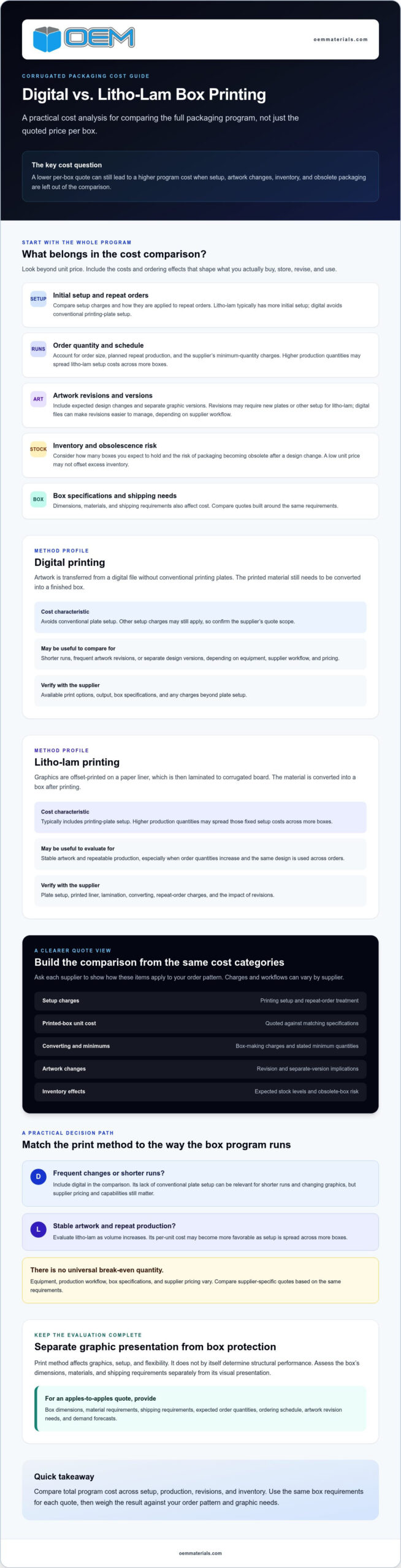
Start by comparing how the graphics are produced, then account for costs through ordering and use. Digital printing creates artwork directly from a digital file without conventional printing plates. Litho-lamination prints graphics on a paper liner, then bonds that printed layer to corrugated board. Printing and box converting are distinct steps, so ask suppliers to clarify which charges cover each part of the process.
Setup, order quantity, and repeat-order patterns all affect the economics. Litho-lam typically involves more initial setup, while higher production quantities can spread those fixed costs across more boxes. Digital avoids conventional plate setup, which can make it worth comparing for shorter runs or orders with frequent artwork revisions. There is no universal break-even quantity. Equipment, production workflow, specifications, and supplier pricing vary, so request supplier-specific quotes or learn more about how specialized packaging providers configure digital and litho capabilities.
What does litho-lam printing mean for a corrugated box?
The “litho” step uses offset printing to create graphics on a paper liner. That printed sheet is then laminated to corrugated board, and the material is converted into a box. This sequence separates graphic production from box formation. If your program requires custom corrugated boxes, make sure the quote clearly describes the printed liner and converting costs rather than presenting them as one unexplained unit price.
How does digital box printing differ?
Digital printing transfers artwork from a digital file without the conventional plate-making step. This can simplify artwork revisions, variable versions, or smaller order quantities because changes do not require new printing plates. Equipment, output, and availability vary by supplier. Before comparing quotes, confirm how the supplier will handle your graphics and box specifications.
A sound digital vs litho-lam printing for boxes cost analysis separates the cost of boxes ordered from the cost of running the packaging program. A lower unit price may not represent better value if you need to hold excess inventory, manage multiple versions, or discard boxes after a design change. Smaller repeat orders may also have different setup or unit-cost implications than one larger run.
Compare quotes against expected demand and your ordering schedule. Include setup, printed-box unit cost, converting, stated minimum quantities, artwork changes, and the inventory you expect to carry. Then assess structural needs separately from graphic presentation. Box dimensions, materials, and shipping requirements also affect cost, so provide those details when requesting a quote.
How Digital and Litho-Lam Box Printing Affect Quality, Setup, and Flexibility
Print choice affects more than the appearance of graphics. Corrugated material still needs to be converted into a finished box, so supplier workflow and quote scope matter. Compare your graphic requirements with your revision schedule and order pattern, then confirm the supplier’s capabilities for the specific box program.
| Factor | Litho-lam | Digital |
|---|---|---|
| Setup | Typically includes printing-plate setup. Ask how it is priced and applied to repeat orders. | Does not use conventional printing plates, though other setup charges may apply. |
| Repeat orders | Stable artwork and planned repeat production may allow setup costs to be spread across orders. | Can be useful for smaller quantities, depending on supplier pricing and equipment. |
| Artwork changes | Revisions may require new plates or other setup. Confirm the impact with the supplier. | Digital files can make changes or separate versions easier to manage, subject to supplier workflow. |
| Graphics | Can suit programs with demanding graphic presentation. Verify color and reproduction requirements. | Quality and available options vary by equipment, substrate, and supplier. |
When can litho-lam make sense for box programs?
Litho-lam is worth evaluating when artwork is stable and production is repeatable. If the same design will be used across orders, the initial setup can be allocated across production over time. That does not establish a universal break-even quantity. Ask suppliers to itemize printing setup, the printed liner, lamination, converting, repeat-order charges, and any minimum quantities so you can compare equivalent scopes.
When can digital printing make sense for corrugated boxes?
Digital may suit prototypes, short runs, frequent revisions, or programs with multiple artwork versions. Its flexibility can help limit commitments to designs or quantities that may change, but compare that operational value with any supplier-specific per-unit premium. Ask the supplier to assess your actual artwork and box application rather than assuming every digital system produces the same result.
Keep graphics separate from protection requirements. A printed surface establishes visual presentation; it does not by itself confirm that a box will perform as needed. Box dimensions, materials, construction, and shipping requirements still need to match the product and distribution conditions. A thorough digital vs litho-lam printing for boxes cost analysis considers the print workflow and corrugated converting, along with the inventory implications of revisions or uncertain demand.
To evaluate your program against its specifications, you can request a packaging quote with box dimensions, materials, artwork needs, and expected order patterns.
Digital vs. Litho-Lam Cost Analysis: Compare the Whole Box Program
A fair comparison uses equivalent quotes and the same demand assumptions. A low printed-box unit cost can be misleading if setup, converting, inventory, or artwork changes are excluded. The purpose of a digital vs litho-lam printing for boxes cost analysis is to compare what each option costs across the program, not just for one order.
Which cost inputs belong in a fair comparison?
Ask suppliers to quote the same box dimensions, materials, graphics, order quantity, and delivery schedule. Check whether the unit price includes printing and converting, and ask suppliers to separate one-time setup from recurring charges where possible. Record any stated minimum quantities and terms that affect repeat orders or artwork revisions.
Build a worksheet using your own quote and operating data:
- Quoted production cost: Setup charges, plus printed-box unit cost multiplied by the planned quantity, plus converting charges not already included.
- Change costs: Quoted charges for revisions or separate artwork versions.
- Inventory impact: Your estimates for storage, carrying excess stock, and boxes that may become unusable after a product or design change.
- Delivery: Quoted shipping or delivery charges based on the same schedule and requirements.
Use the same calculation for each method. Avoid counting a charge twice if the supplier has already included it in the unit price.
How do order changes and excess inventory affect the analysis?
Test the worksheet against three demand patterns. For stable demand and unchanged artwork, model planned repeat orders and any recurring setup. For uncertain demand, compare the cost of ordering to forecast with the risk of holding unused boxes. For frequent artwork updates or multiple versions, include revision charges and estimate how much existing inventory could be left over.
Keep assumptions consistent across quotes: dimensions, materials, graphics, quantity, shipping needs, and delivery schedule. Also record order frequency, storage assumptions, and revision terms. Base waste and holding-cost estimates on your own operation, not an assumed industry average. The result is an estimate for your program, not a universal break-even point.
Quotable summary: Total program cost depends on box specifications, production volume, and ordering pattern, including setup, converting, revisions, inventory, and delivery. Use your own inputs to test whether a quoted unit-price advantage still holds when demand or artwork changes.
How to Choose a Box Printing Method and Compare Supplier Quotes
Use a consistent sourcing process to compare print options without confusing graphic requirements with box performance. Printing affects presentation; the box’s dimensions, materials, and construction must independently meet product and shipping needs. Define those requirements first, then assess how each supplier’s quote supports your ordering plan.
- Define the use. Document what the box will contain, how it will be handled, and the shipping conditions it must accommodate. Set graphic requirements separately, including brand colors, imagery, and any distinct versions.
- Confirm specifications. Establish dimensions, materials, product weight, and delivery requirements. If the design needs development, custom packaging design support can help clarify requirements before you compare quotes.
- Forecast demand. Estimate annual usage, target order quantities, delivery schedule, and likely changes to artwork or product versions. Include prototype needs and delivery locations.
- Compare quotes consistently. Use one comparison sheet with identical assumptions for each supplier. Separate setup charges, printed-box unit costs, converting, packaging, and delivery where disclosed. Record minimum quantities, stated lead times, and exclusions.
- Review risk. Consider forecast reliability, artwork revision frequency, and what may happen to unused boxes after a product or design change. Evaluate these risks alongside quoted costs rather than treating unit price as the full program cost.
What information should buyers prepare before requesting quotes?
Prepare box dimensions, product weight, material requirements, shipping needs, and expected usage. Include artwork files or their current status, expected revisions, order quantities, delivery locations, prototype requirements, and production schedule. If the program includes multiple products or artwork versions, identify each one and its expected demand. This information helps suppliers define the scope and identify missing specifications.
How should procurement evaluate quote differences?
Check whether each quote covers the same printing and converting work, box specifications, packaging, and delivery assumptions. Ask suppliers to clarify setup charges, minimum quantities, lead times, and exclusions in writing. A quote that leaves out a cost or requirement is not directly comparable until you understand the difference. Keep the comparison sheet with your sourcing records so future orders can be evaluated against the same assumptions.
A practical digital vs litho-lam printing for boxes cost analysis depends on consistent inputs and your actual order pattern. Once specifications and assumptions are ready, request a corrugated box quote with those details to support a case-specific sourcing discussion.
Plan a Corrugated Box Printing Program With OEM Materials & Supplies
Choosing a print method is one part of a corrugated box program. Box specifications, graphics, order quantities, and replenishment plans need to work together. OEM Materials & Supplies supports manufacturers with custom packaging design and corrugated box programs ranging from prototypes and short runs to high-volume production. Discuss your program requirements with the team and confirm which print methods can be sourced for your specifications.
Review the program when product dimensions, artwork, shipping conditions, or demand patterns change. A box designed for an earlier product or forecast may no longer fit current requirements. For manufacturers in Orange County, Los Angeles, San Diego, and Riverside, it can be useful to assess box design alongside ordering and inventory plans, including vendor-managed inventory where appropriate.
When should a packaging partner review the box program?
Revisit the box program before a significant artwork revision, product update, or change in shipment profile. A review can help clarify whether dimensions and materials still fit the product, whether versions need separate forecasts, and how order timing affects inventory. OEM provides custom corrugated boxes and packaging design support, helping buyers consider the box and its role in the broader packaging workflow.
What should a buyer send for a useful quote?
Provide the information suppliers need to understand both the box and the purchasing plan. Include:
- Box dimensions, product weight, material requirements, and shipping conditions
- Annual usage, target order quantities, and expected delivery locations
- Artwork status, expected revisions, and any product or graphic versions
- Prototype needs, forecast context, and preferred production or delivery schedule
These details help suppliers identify gaps, clarify quote assumptions, and compare options on a consistent basis. Cost outcomes depend on box dimensions, materials, shipping requirements, volume, and order pattern. For broader planning, buyers can also assess how inventory exposure and design changes fit their packaging cost model.
A practical digital vs litho-lam printing for boxes cost analysis starts with your requirements, not a presumed winner. Share your specifications and ordering context with OEM Materials & Supplies to discuss a case-specific corrugated box quote. Request a quote with your dimensions, product weight, annual usage, and shipping requirements.
Build a Box Program That Fits Your Needs
The right print choice depends on more than the price per box. Compare setup and converting charges alongside order quantities, artwork changes, inventory exposure, and delivery needs. A practical digital vs litho-lam printing for boxes cost analysis uses consistent specifications and your actual demand pattern, since box dimensions, materials, and shipping requirements all affect cost.
OEM Materials & Supplies supports corrugated packaging programs from prototypes and short runs to high-volume production. Packaging design and vendor-managed inventory can also be considered as part of your broader program. Confirm print-method capabilities against your specific requirements.
For a case-specific quote, share your box dimensions, product weight, materials, annual usage, and shipping requirements. Request a quote for your corrugated packaging program to start a practical sourcing discussion. With clear specifications and order assumptions, you can evaluate options with greater confidence and plan packaging that supports your operation.
Frequently Asked Questions
Which is cheaper for corrugated boxes, digital or litho-lam printing?
Neither method is always cheaper. The better value depends on setup, quantity, specifications, and ordering pattern. Digital printing avoids conventional plate setup, which can suit shorter runs. Litho-lam often has higher initial setup, but its per-box cost may decrease as volume increases. A useful digital vs litho-lam printing for boxes cost analysis compares setup, printing, converting, revisions, and inventory exposure using supplier quotes for the same box requirements.
At what order quantity does litho-lam become more cost-effective than digital printing?
There is no universal order quantity at which litho-lam becomes the less expensive option. The crossover depends on supplier pricing, box dimensions and materials, setup charges, converting, and repeat-order terms. Request quotes at the quantities and delivery schedule you actually expect, including any artwork versions. Compare total program costs rather than relying on a general volume threshold or a unit price that excludes setup and other charges.
Can digital printing produce high-quality graphics on corrugated boxes?
Digital printing can produce high-quality graphics, but the result depends on the equipment, materials, artwork, and supplier capabilities. Output can vary between production systems and substrates. Share the actual artwork and explain the intended use of the box. Ask the supplier to confirm achievable color and image reproduction for the specified corrugated construction before making a sourcing decision.
Does litho-lam printing make a corrugated box stronger?
Litho-lam printing does not, by itself, establish that a corrugated box will provide greater protection. It applies a printed paper liner to corrugated board, while box performance depends on the box design, materials, product, and shipping conditions. Assess structural requirements separately from graphics. Provide product weight and shipping details so suppliers can evaluate the box specifications independently of the print method or visual presentation.
How do artwork changes affect digital and litho-lam box costs?
Artwork changes can affect setup charges, production planning, and leftover inventory. Digital printing avoids conventional plate setup, so it may simplify revisions or separate versions, subject to the supplier’s process and pricing. Litho-lam revisions may require new plates or other setup work, which you should confirm with the supplier. For either method, estimate the risk of printed boxes becoming unusable after a product or design change.
What information should I provide to compare digital and litho-lam quotes?
Provide identical specifications to each supplier: box dimensions, materials, product weight, artwork, order quantity, annual usage, delivery schedule, and shipping requirements. Include prototype needs, revision expectations, version counts, delivery locations, and forecast uncertainty. Ask suppliers to itemize setup, printed-box unit costs, converting, minimum quantities, lead times, and exclusions. Manufacturers in Orange County, Los Angeles, San Diego, and Riverside can use these inputs to support a consistent comparison with packaging suppliers.
Is digital printing a good choice for prototypes and short-run boxes?
Digital printing can suit prototypes and short runs because it avoids conventional printing-plate setup and can accommodate artwork changes. Confirm the supplier’s minimum quantity, print quality, available materials, and ability to meet your box specifications. OEM Materials & Supplies supports corrugated packaging programs from prototypes and short runs through high-volume production. Confirm which print methods can be sourced for your specific requirements.