
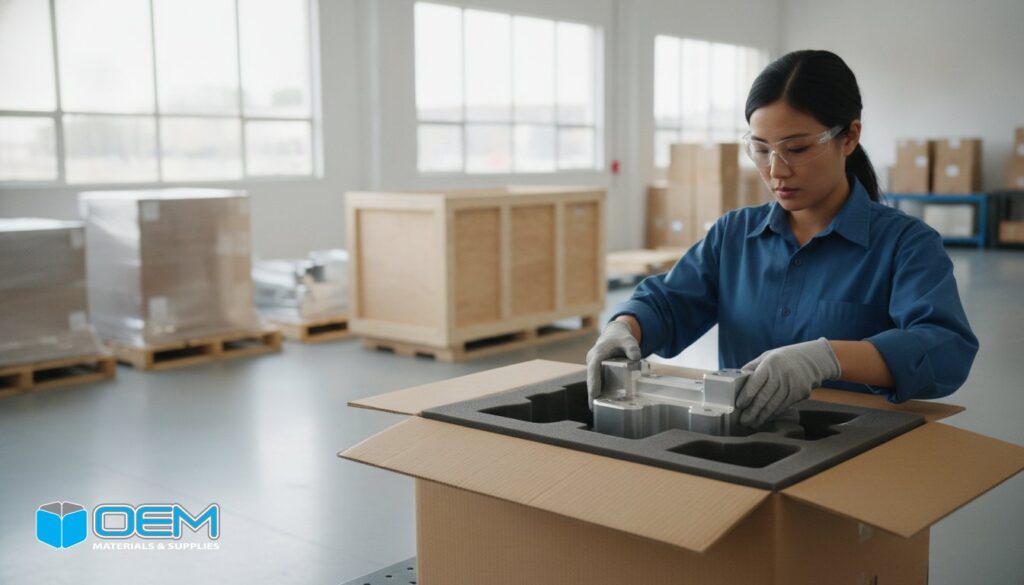
A low unit price for a stock corrugated box often masks a much higher total cost of ownership. For manufacturers in Southern California, from Orange County to the Inland Empire, the hidden expenses of inefficient packaging are becoming impossible to ignore. You likely see the impact every day in the form of rising carrier surcharges or the wasted labor required to wrap and tape oversized containers. It is a common struggle to balance the need for high-level protection with the pressure to reduce shipping spend.
This article provides a clear methodology for calculating ROI on custom packaging by analyzing the variables that truly drive your bottom line. You will learn how to quantify the financial impact of damage reduction, labor efficiency, and freight optimization. We will look at how the August 2025 dimension rounding rules and the standard 139 dimensional weight divisor make right-sizing more critical than ever before. This guide delivers a professional framework to present to your CFO, demonstrating how engineered foam and custom corrugated solutions reduce total costs while improving supply chain reliability across your entire operation.
Key Takeaways
- Shift focus from the per-unit price of a box to a total cost of ownership model that accounts for the entire lifecycle of your industrial packaging.
- Quantify the savings gained from using engineered foam inserts and custom corrugated designs as an insurance policy for high-value components in the aerospace and medical sectors.
- Identify how right-sizing your containers can mitigate the impact of dimensional weight (DIM) rounding rules and reduce excessive freight surcharges.
- Evaluate the cash flow improvements offered by vendor-managed inventory (VMI) programs that eliminate emergency order premiums and stockouts.
- Use our step-by-step guide for calculating ROI on custom packaging to present a compelling, data-driven financial case to your executive leadership.
The Industrial Framework for Packaging ROI
ROI in an industrial supply chain isn’t just a financial ratio on a balance sheet. It’s a measure of how effectively your packaging protects assets and streamlines logistics. When calculating ROI on custom packaging, you must look beyond the initial purchase order. For manufacturers in San Diego or Orange County, a successful packaging strategy ensures that high-value parts reach their destination without a single scratch while minimizing the labor and freight costs required to get them there.
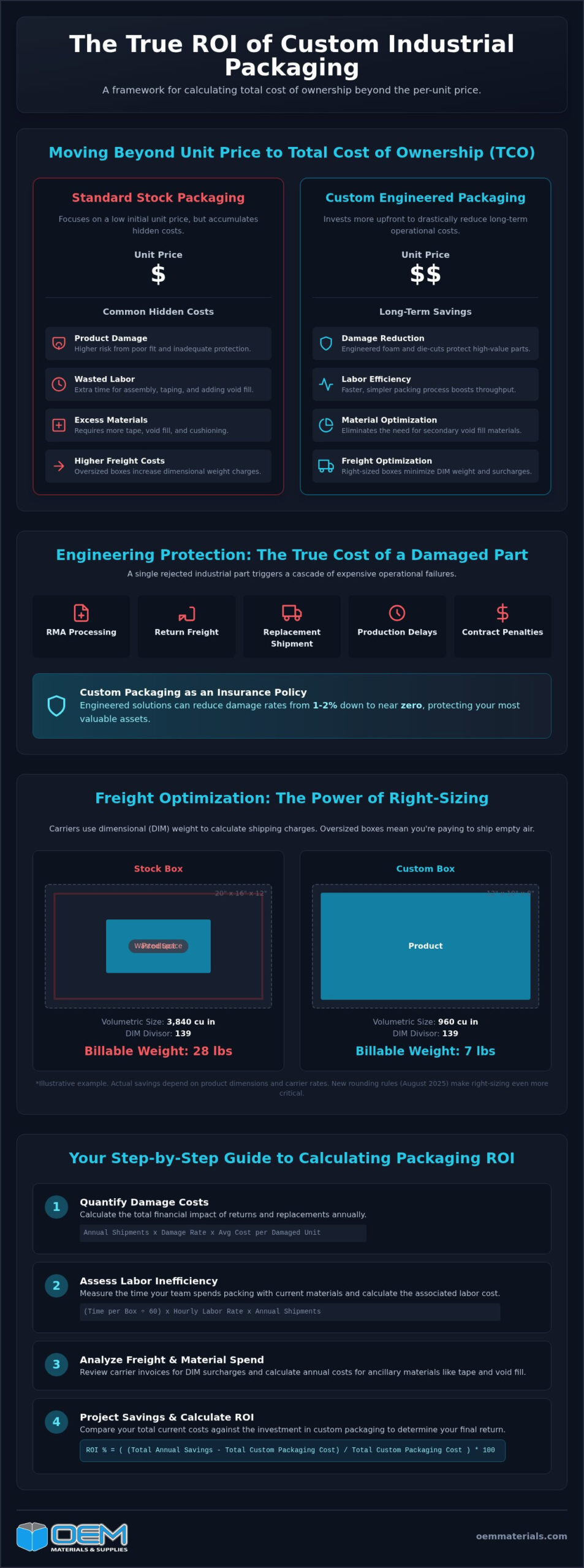
Focusing solely on unit price is a common mistake for procurement teams. A stock corrugated box might appear cheaper on an invoice, but it often carries hidden costs that erode profit margins. This is where the concept of Total Cost of Ownership (TCO) becomes essential. TCO accounts for every expense associated with the packaging lifecycle, including storage, assembly labor, and the cost of damaged goods. A custom solution might have a higher per-piece cost, but its ability to reduce secondary expenses often results in a much higher return.
Moving Beyond Unit Price to Total Cost of Ownership
Low-cost stock boxes frequently lead to higher secondary expenses. Because these containers aren’t designed for your specific product, they often require excessive amounts of packaging tape or void fill to secure the contents. These ancillary materials represent a direct hit to your budget. Wasted space is another critical factor. Oversized boxes take up more space in your warehouse and on your pallets. With industry benchmarks placing annual inventory carrying costs between 20% and 30% of the inventory’s total value, wasting shelf space on air is an expensive habit. Custom solutions allow you to maximize pallet density and reduce the footprint of your stored materials.
Identifying the Hidden Leaks in Standard Packaging
Standard packaging creates operational friction on the production line. If your team has to spend extra time folding, taping, or stuffing cushioning into a box that doesn’t fit, your throughput suffers. Professional custom packaging design eliminates this waste by creating a container that fits the product perfectly. This precision reduces material waste and speeds up the packing process. By calculating ROI on custom packaging, you can identify how much you’re currently losing to these small, recurring inefficiencies that stock boxes inevitably create. Eliminating these leaks ensures that your packaging serves as a functional asset rather than a logistical burden.
Engineering Protection: Calculating Savings from Reduced Damage
The financial ripple effect of a single damaged aerospace component or a sensitive medical device is significant. When a precision-engineered part arrives with a hairline fracture or a compromised seal, the costs begin to mount immediately. Calculating ROI on custom packaging requires a thorough analysis of these failure costs, which often remain hidden from procurement spreadsheets. For manufacturers in the Inland Empire or Los Angeles, these “hidden” costs can be the difference between a profitable quarter and a logistical deficit.
The True Cost of a Rejected Industrial Part
A rejected part triggers a cascade of expenses that far exceed the manufacturing cost of the item itself. You must factor in the labor hours your quality control team spends on inspection, documentation, and processing the Return Merchandise Authorization (RMA). Beyond internal labor, the freight costs for returning the damaged unit and shipping a replacement can be triple the original transit expense. In many OEM contracts, late delivery penalties are triggered by a single damaged part, leading to liquidated damages that erode your project’s profitability. Utilizing specialized foam packaging solutions provides a repeatable barrier against these logistical failures, ensuring your parts arrive ready for assembly.
Custom Foam and Die-Cut Corrugated as Insurance
Custom packaging functions as a targeted insurance policy for your inventory. While a stock box relies on generic bubble wrap or loose fill, custom die-cut corrugated and engineered foam inserts are designed to the exact geometry and weight of your specific product. For high-value electronics manufacturers in San Diego County, switching from stock to custom often reduces damage rates from 1 or 2 percent down to near zero.
The cost of custom tooling is a one-time investment that pays for itself by preventing even a single high-value loss. Engineered foam density is specifically calculated to absorb and dissipate kinetic energy, ensuring that G-force levels during transit remain below the product’s fragility threshold. This level of precision is impossible to achieve with off-the-shelf materials. If your current damage rates are impacting your reputation or relationship with key customers, you can request a custom prototype to see how a more robust design improves your long-term bottom line.
Operational Efficiency: Labor and Freight Optimization
Operational efficiency in a manufacturing environment is often measured in seconds and inches. While previous sections focused on the cost of failure, this analysis focuses on the cost of movement. For industrial facilities in the Inland Empire or Orange County, the physical footprint of a package determines the freight rate, while the complexity of the packing process determines the labor cost. Calculating ROI on custom packaging requires looking at how a container interacts with carrier pricing models—often with the guidance of Customs and Trade Logistics—and your production line throughput.
Carrier pricing is increasingly dictated by volume rather than actual weight. Both UPS and FedEx utilize a standard dimensional weight divisor of 139. Additionally, since August 2025, carriers have enforced strict dimension rounding rules where any fraction of an inch is rounded up to the next whole number. A stock box that is only half an inch too large in each direction can inadvertently push a shipment into a higher rate bracket. By utilizing right-sized corrugated boxes, you eliminate the “air tax” associated with oversized containers.
Reducing box volume by even 15% through custom design can lead to substantial annual savings in a high-volume shipping program. These savings extend beyond the individual parcel. Smaller boxes increase pallet density, allowing you to fit more units on a single truckload. When average Full-Truckload (FTL) rates in the US range from $2.00 to $3.30 per mile, maximizing every square foot of trailer space is a direct boost to your bottom line.
Labor Savings: Kitting and Assembly Line Integration
Packing is a repetitive task where labor costs accumulate quickly. The average warehouse worker earns between $17.31 and $18.20 per hour; therefore, every second spent hunting for bubble wrap or taping down loose flaps is a measurable expense. Custom packaging kits with pre-fitted foam inserts eliminate the need for multiple SKU handling. Instead of managing separate inventories of boxes, tape, and cushioning, your team receives a single, integrated unit.
This approach significantly reduces the “seconds-per-box” metric on the assembly line. It also minimizes the need for specialized training for packing staff, as the custom design makes the correct packing method intuitive and repeatable. For automotive suppliers in Southern California, these kitting services streamline the transition from the production floor to the loading dock, ensuring that labor is focused on manufacturing rather than logistical troubleshooting.
Quantifying the Value of Vendor-Managed Inventory (VMI)
To further enhance assembly line efficiency and reduce lead times for branded shipments, many firms also invest in on-demand labeling technology; for high-performance color and thermal printers, visit DuraFast Label Company.
Vendor-Managed Inventory (VMI) is more than a logistical convenience; it’s a financial lever for calculating ROI on custom packaging. Many manufacturers tie up significant capital in pallets of corrugated boxes and foam inserts that sit unused for months. This idle inventory carries a standard industry benchmark cost of 20% to 30% of its total value annually. By shifting to a VMI model, you reclaim that capital and improve your organization’s cash flow immediately.
The financial impact of a stockout is rarely limited to the cost of the missing box. If a production line in San Diego or Riverside stops because a specific packaging kit isn’t available, the hourly cost of idle labor and missed shipment deadlines can be devastating. VMI eliminates the need for expensive emergency orders and the associated expedited freight premiums. It transforms packaging from a source of potential risk into a predictable, reliable asset that supports your production schedule.
Eliminating Stockouts and Overstocking Costs
Managing over 50 packaging SKUs internally consumes massive amounts of administrative time. Purchasing teams must track usage, monitor lead times, and issue frequent purchase orders for various items like stretch film, edge protectors, and custom crates. VMI services shift this entire administrative burden to the supplier, who monitors your levels and replenishes stock based on actual consumption. Just-in-time (JIT) delivery programs reduce inventory carrying costs by minimizing on-hand stock and directly addressing the 20% to 30% annual benchmark for holding costs. This data-driven approach ensures you don’t over-purchase slow-moving items or face a shortage of critical components during a peak production cycle.
Freeing Up Warehouse Square Footage for Production
In Southern California, warehouse space is at a premium. Every square foot occupied by stacks of empty boxes is space that could be used for a new assembly line or revenue-generating machinery. Reclaiming this floor space provides a measurable financial benefit to your operation. By partnering with a local wholesale industrial packaging supplier, you can leverage their facility as your primary storage hub.
This local proximity allows for rapid replenishment across Orange County and Los Angeles County without the lead time risks associated with distant vendors. The ROI of VMI is found in the conversion of storage costs into production capacity. If you’re ready to optimize your floor space and stabilize your supply chain, you can request a consultation to review your current inventory usage and storage requirements.
Step-by-Step Guide to Your ROI Calculation
Industrial procurement is a data-driven process. To build a compelling business case for leadership, you must move beyond theoretical benefits and provide hard numbers. Calculating ROI on custom packaging requires a systematic audit of your current logistical performance against the projected efficiency of an engineered solution. This five-step process provides the framework necessary to justify the transition from stock materials to custom-designed assets.
- Step 1: Audit current damage rates and RMA costs. Review your logs from the previous four quarters. Don’t just look at the cost of the part; include the labor for inspection and the freight for returns.
- Step 2: Compare freight spend. Measure your current stock boxes and apply the 139 DIM divisor. Compare this to the billed weight of a right-sized custom prototype.
- Step 3: Measure labor time. Conduct a time-motion study on your packing line. Record the seconds required to assemble a stock box with loose fill versus a custom kit with integrated foam.
- Step 4: Factor in administrative and inventory carrying costs. Use the industry benchmark of 20% to 30% for inventory holding costs. Assess how much capital is tied up in excess stock packaging SKUs.
- Step 5: Apply the final ROI formula. Consolidate these annual savings into a single figure to determine your net gain over the project lifecycle.
Data Collection: What Metrics to Track
To ensure accuracy, your data collection must be granular. Focus on annual usage volume and projected growth for the next 18 months. Track your average freight cost per unit and the specific dimensions that trigger carrier surcharges. Finally, establish a baseline labor rate per hour and calculate the total hours saved per year based on the seconds saved per package. These metrics provide the empirical evidence needed for calculating ROI on custom packaging in a way that satisfies executive scrutiny.
The ROI Formula for Custom Industrial Packaging
The primary formula for this calculation is (Total Annual Savings minus Custom Investment) divided by Custom Investment. In an industrial environment, the investment includes one-time costs such as custom tooling, die-cuts, and design fees. Most Southern California manufacturers find that the initial investment is quickly offset by the reduction in “air tax” and labor friction.
Executive leadership often focuses on the payback period, which is the amount of time required to recover the initial investment through operational savings. While some projects see immediate gains, a 12-month ROI view is the standard benchmark for industrial packaging programs. This timeframe accounts for seasonal fluctuations in shipping volume and allows for a stable measurement of damage reduction. Presenting a clear payback schedule demonstrates that you aren’t just buying boxes; you’re implementing a financial strategy to reduce the total cost of ownership across your entire supply chain.
Optimizing Your Industrial Supply Chain for Long-Term Profitability
Transitioning from stock boxes to engineered solutions is a strategic shift that pays dividends across your entire operation. By focusing on the total cost of ownership rather than just the unit price, you can eliminate the hidden leaks in your budget caused by excessive freight surcharges and product damage. Calculating ROI on custom packaging provides the data necessary to justify these improvements to your executive team while securing your high-value aerospace and medical components.
OEM Materials & Supplies specializes in high-volume corrugated and engineered foam solutions for manufacturers across Orange County, LA, and the Inland Empire. Our VMI programs are designed to stabilize your inventory levels and reclaim valuable warehouse floor space for production. We understand the technical requirements of the electronics and automotive sectors and provide the prototyping capabilities needed to ensure a perfect fit.
Take the first step toward a more efficient packing line and reduced shipping spend. You can request a custom packaging ROI consultation with OEM Materials & Supplies today. Providing your product dimensions, weight, and annual usage will help us deliver a precise recommendation for your specific application. We look forward to helping you build a more resilient and profitable supply chain.
Frequently Asked Questions
How long does it typically take to see a return on custom packaging?
Most industrial manufacturers achieve a full return on investment within 6 to 12 months. This timeline depends on variables like shipping volume and current damage rates. High-value sectors like aerospace often see a faster payback because preventing a single damaged component covers the initial tooling costs. For high-volume users in Orange County, the freight savings from right-sizing corrugated boxes accumulate daily, leading to a shorter payback period.
Is custom packaging cost-effective for low-volume production runs?
Custom solutions are cost-effective for low-volume runs when the product value is high or the fragility requires specialized protection. While tooling fees for custom foam packaging must be amortized over fewer units, the cost of a single RMA for a medical device can exceed the entire packaging budget. We often recommend stock corrugated boxes paired with custom-engineered inserts to balance protection with lower upfront costs for smaller batches.
What data do I need to provide for an accurate ROI analysis?
Accurate data is essential when calculating ROI on custom packaging for your facility. You should provide the exact dimensions and weight of your product, along with current annual usage and existing damage rates. Sharing your average freight spend and the specific carrier surcharges you currently face allows for a precise comparison. This information helps identify whether right-sizing or material changes will yield the highest financial impact for your operation.
Can custom foam inserts really lower my insurance or shipping liability?
Engineered foam inserts provide documented evidence of protection that can assist in resolving shipping disputes. Carriers often deny damage claims if they determine the packaging was insufficient. By using custom inserts designed for specific G-force thresholds, you demonstrate a commitment to industry standards like ISTA testing. This repeatable protection reduces your overall liability and provides a stronger case when filing claims for carrier-related transit damage.
How does right-sizing my corrugated boxes affect my freight class?
Right-sizing directly impacts the density of your shipment, which is a primary factor in determining freight class for LTL shipments. Higher density typically results in a lower freight class and reduced shipping rates. By eliminating excess air in your corrugated boxes, you improve your pallet density and truckload utilization. This optimization is particularly beneficial for manufacturers in the Inland Empire looking to control rising transport costs for heavy industrial components.
What is the difference between unit cost and total landed cost in packaging?
Unit cost refers strictly to the purchase price of an individual box or foam insert. Total landed cost accounts for the entire lifecycle of the package, including assembly labor, storage space, freight charges, and the cost of any transit damage. Calculating ROI on custom packaging requires a shift in focus toward the landed cost. A cheaper stock box often results in a higher landed cost due to wasted space and increased labor requirements.
Does a VMI program require a minimum annual spend to be profitable?
Profitability in a VMI program is often determined by SKU complexity and warehouse constraints rather than a flat spend amount. Even mid-sized operations in Los Angeles find VMI profitable when they lack the floor space to store bulky packaging materials. The primary value lies in reclaiming production space and eliminating the administrative burden of tracking multiple SKUs. We evaluate each program based on your specific storage needs and replenishment frequency to ensure a positive return.
Can custom packaging help with regulatory compliance in medical device shipping?
Custom packaging supports regulatory compliance by ensuring that sensitive medical devices remain within specified environmental and physical limits during transit. Precision-engineered foam and specialized corrugated designs provide the standardized, repeatable protection required for validated shipping processes. This is critical for San Diego medical manufacturers who must meet rigorous quality standards. Custom solutions allow for the integration of specialized materials like ESD-safe foam to protect sensitive electronic components within medical hardware.