
Is your current packaging partner protecting your bottom line, or are they delivering boxes that arrive late and fail during transit? For many manufacturers in Southern California, from aerospace firms in Orange County to medical device designers in San Diego, a supplier who merely takes orders isn’t enough. You likely agree that managing frequent lead time delays and inconsistent material quality has become a significant drain on your operational bandwidth. These disruptions do more than stall production; they increase your total cost of ownership through product damage and administrative friction.
Recognizing the signs you need a new packaging supplier is the first step toward reclaiming efficiency in your supply chain. This guide provides an industrial checklist to help you identify critical red flags and learn how to transition to a partner that prioritizes custom engineering and reliable delivery. We will examine how technical support, vendor-managed inventory, and precision-engineered foam or corrugated solutions can replace reactive troubleshooting with proactive protection. By the end of this checklist, you will understand how to evaluate a potential partner’s ability to support Just-In-Time manufacturing and reduce long-term waste.
Key Takeaways
- Identify how unpredictable delivery schedules and frequent stockouts of corrugated boxes signal a breakdown in your current supply chain reliability.
- Recognize the critical signs you need a new packaging supplier when inconsistent material quality leads to increased product damage for sensitive components.
- Learn why low unit prices often mask higher total costs, including excessive labor and inflated freight expenses from poorly optimized packaging designs.
- Evaluate the value of a partner who offers custom engineering and rapid prototyping rather than a vendor that resists small production runs.
- Use our industrial checklist to audit your current damage rates and qualify new partners based on technical data and operational fit.
Supply Chain Instability and Lead Time Volatility
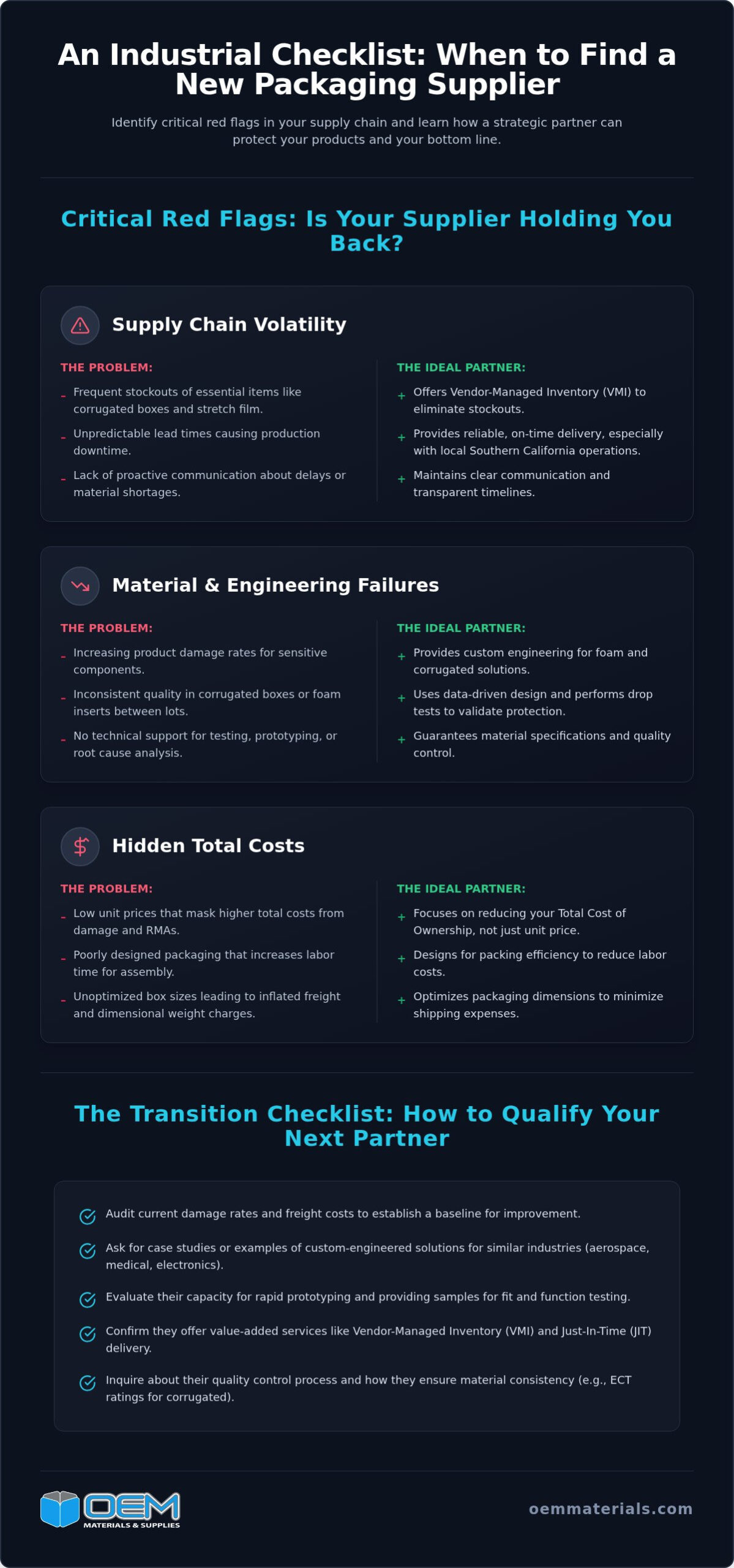
Industrial operations depend on the predictable flow of materials. When your packaging arrivals are inconsistent, the entire production line suffers. One of the clearest signs you need a new packaging supplier is when you face frequent stockouts of essential items like corrugated boxes or stretch film. These aren’t just minor inconveniences; they represent a fundamental failure in your vendor’s inventory management and commitment to your operational uptime.
Unpredictable lead times disrupt complex production schedules and strain your warehouse operations. If your current provider fails to provide transparency regarding raw material shortages or offers no proactive communication when shipments are delayed, they’re treating your business like a transaction rather than a partnership. This lack of visibility forces your procurement team to waste valuable hours chasing down status updates instead of focusing on strategic sourcing. A dependable partner provides clear timelines and immediate alerts if market conditions shift.
The Impact of Unreliable Delivery on Production
Late packaging deliveries often result in expensive manufacturing downtime. When finished products can’t be packed, they take up valuable floor space and stall the next stage of assembly. This inefficiency creates a ripple effect, leading to missed shipping windows with major retailers or distributors. For manufacturers in the Inland Empire, Los Angeles, or Orange County, working with a local Southern California supplier can often mitigate these transit delays. Proximity allows for faster response times and reduces the risk of long-haul logistics failures that plague out-of-state vendors. Reliable local delivery ensures that your packing station remains operational through every shift.
Signs Your Supplier Lacks Inventory Control
A reliable partner maintains stock levels even during market fluctuations. Constant backorders on standard consumables like packaging tape or edge protectors indicate that your supplier is operating reactively. They likely lack the infrastructure to support large-scale industrial needs or the foresight to hedge against material volatility. If your vendor doesn’t offer vendor-managed inventory (VMI) services, you’re forced to carry the burden of inventory tracking yourself.
Vendor-managed inventory is a strategy where the supplier monitors your stock levels and automatically replenishes supplies to eliminate the risk of stockouts. Without this level of support, you’re vulnerable to the signs you need a new packaging supplier that lead to missed deadlines and increased labor costs. Professional suppliers utilize VMI to ensure you have the corrugated and foam components you need exactly when they’re required for the assembly line. This proactive approach shifts the responsibility of stock maintenance to the expert, allowing your team to focus on production.
Material Engineering Failures and Increasing Product Damage
High damage rates for sensitive electronics or medical devices are often the first signs you need a new packaging supplier. A vendor who provides standard solutions for specialized components is likely under-engineering your protection. You shouldn’t see inconsistent strength ratings between different production lots of corrugated boxes. This variability often stems from uncontrolled recycled content or a lack of internal quality testing, which puts your high-value shipments at risk during long-haul transit or ocean freight.
When protective materials like foam inserts fail to meet original specifications, the consequences are immediate. Brittle foam or collapsing corrugated walls lead to expensive RMAs and damaged customer relationships. If your supplier lacks the technical support to test new prototypes or perform drop tests, they’re essentially guessing with your inventory. This lack of data-driven engineering is a major red flag for manufacturers in high-stakes industries like aerospace or automotive assembly.
Inadequate Material Specifications
Precision is mandatory for industrial protection. If your foam packaging is bottoming out, it’s a sign the density doesn’t match your product weight or the fragility of the internal components. Corrugated boxes often fail because a supplier recommended an ECT (Edge Crush Test) rating that’s insufficient for your specific stacking requirements in the warehouse. Much like choosing a food packaging partner requires vetting for safety standards, industrial buyers must vet for engineering competence and material consistency.
Stagnant Packaging Design
Packaging isn’t a static component. If your supplier hasn’t suggested a design improvement in over three years, they’re likely costing you money in material waste and labor. Modern custom packaging design focuses on optimization and precision to reduce the total weight of the shipment. Engineered inserts secure the product in a fixed position, neutralizing the vibrations and impacts that lead to surface abrasion or mechanical failure. Manufacturers in San Diego County and the Inland Empire should expect their partners to provide regular audits of their packaging efficiency.
A stagnant partner often shows resistance to rapid prototyping or technical data requests. They might ignore the benefits of specialized solutions like ESD-safe materials or cleanroom-compatible cushioning. If you’re currently experiencing high return rates due to transit damage, these are clear signs you need a new packaging supplier. You can request a technical consultation to review your current designs and identify exactly where material failures are occurring.
Rising Total Costs Despite Low Unit Prices
Focusing strictly on the per-unit price of a corrugated box is a common oversight in procurement. Unit price represents only a fraction of the total cost of ownership (TCO). If a vendor offers the lowest price but delivers designs that inflate labor or freight requirements, the initial savings are quickly erased. These hidden expenses are reliable signs you need a new packaging supplier that prioritizes operational efficiency over commodity pricing. True value is found in engineering solutions that streamline the entire fulfillment cycle.
Managing a fragmented supply chain also adds significant administrative burden. When you coordinate with separate vendors for stretch film, custom foam, and wood crates, you increase the risk of communication gaps and billing errors. Implementing effective packaging procurement strategies involves consolidating vendors to reduce soft costs and improve oversight. If your current supplier implements frequent price increases without providing data-backed justifications or service improvements, your profit margins are at risk.
Labor Inefficiency on the Packing Line
Packing speed is a critical variable in your warehouse budget. Overly complex packaging that requires manual folding or intricate tape patterns slows down your throughput. You should monitor for signs that your packaging takes too long for staff to assemble, as this indicates a lack of design optimization. Utilizing specialized kitting services or pre-assembled crates can drastically reduce the touch points required for each shipment. For manufacturers in Orange County or San Diego, shifting these labor-intensive tasks to an expert partner allows your internal team to focus on core production activities.
Freight and Dimensional Weight Issues
Oversized boxes generate unnecessary expenses through dimensional weight (DIM) pricing. Carriers charge based on the volume a package occupies, meaning you pay a premium for shipping empty air. If your supplier provides generic box sizes for specialized equipment, they are directly increasing your freight spend. Optimizing pallet loads and utilizing custom-fit corrugated boxes can maximize the number of units per shipment. This level of precision often results in substantial savings on long-haul freight costs, far outweighing any minor difference in the initial unit price of the materials.
Inflexible Service and Lack of Technical Support
For manufacturers in the aerospace and medical device sectors, technical expertise is vital. You need a partner who understands the difference between standard cushioning and ESD-safe materials or cleanroom-compatible solutions. A consultative partner provides onsite audits to identify packaging waste and suggests custom packaging design solutions that improve product protection. If your current vendor hasn’t walked your production floor in years, they are likely missing opportunities to optimize your workflow and reduce material consumption.
Logistical Inflexibility
Supply chain agility depends on your supplier’s ability to adapt to real-world fluctuations. A failure to provide just-in-time (JIT) delivery options often leads to warehouse congestion or inventory shortages. Your packaging partner must be able to adjust to changing production schedules or rapid SKU variations without causing delays. For companies operating in Los Angeles, Orange County, or the Inland Empire, local Southern California responsiveness is a competitive advantage. A local supplier can pivot faster than a national reseller, ensuring that a sudden shift in demand doesn’t leave your team waiting for crates or stretch film.
You can request a quote and technical consultation to see how an engineered approach to packaging can solve your current service frustrations and improve your operational reliability.
Transition Checklist: How to Qualify a New Partner
Transitioning to a new partner requires a methodical approach to ensure operational continuity. Once you’ve recognized the signs you need a new packaging supplier, the next step is a rigorous qualification process. Start by auditing your internal data on transit damage rates and lead time failures over the last twelve months. This baseline allows you to set specific performance benchmarks for a potential partner and measure the tangible impact of a switch.
Evaluating a new vendor should go beyond a simple price sheet. Request comprehensive technical data sheets for all corrugated materials and foam densities to ensure they meet the engineering requirements of your specific products. You should also evaluate the supplier’s ability to implement vendor-managed inventory (VMI) or just-in-time (JIT) delivery programs. These services are essential for reducing warehouse overhead and preventing the stockouts that disrupt production schedules.
Step-by-Step Supplier Evaluation
Verify that the supplier has a proven track record in your specific sector, such as medical devices, electronics, or aerospace assembly. A site visit to their Southern California facility is often necessary to confirm their production capacity and quality control standards. During this phase, you must test prototypes under real-world shipping conditions. Requesting samples of custom foam inserts or corrugated boxes allows your engineering team to verify that the fit and protection levels meet your internal standards before committing to a full production run.
Making the Switch Without Disrupting Production
For manufacturers in the beverage or healthcare sectors, finding a supplier with deep niche expertise is equally vital; you can check out Prest Packaging to see how bespoke design is applied to these specialized product categories.
A successful transition avoids production bottlenecks. It’s advisable to build a safety stock of your current packaging materials to cover the first 30 to 60 days of the new partnership. This buffer accounts for the time needed to finalize designs and set up new kitting or assembly protocols. Establish clear communication protocols with your new account team from day one to ensure that SKU variations and production spikes are handled with precision. When you see the signs you need a new packaging supplier, acting decisively prevents further erosion of your profit margins.
A reliable partner acts as an authoritative consultant rather than a simple vendor. They provide the technical expertise and logistical flexibility required to optimize your entire supply chain. If you’re ready to move away from unreliable service and high damage rates, contact OEM Materials & Supplies for a consultation on your custom industrial packaging needs. We can review your specific product dimensions, weights, and annual usage to provide engineered recommendations that lower your total cost of ownership.
Optimizing Your Industrial Packaging Strategy
Addressing lead time volatility and engineering failures is essential for maintaining a competitive edge in high-stakes manufacturing. When you identify the signs you need a new packaging supplier, you’re taking the first step toward reducing your total cost of ownership. Transitioning from a basic vendor to a technical partner allows you to replace inconsistent quality with precision-engineered protection. By focusing on total cost rather than just per-unit pricing, you can eliminate hidden drains on your labor and freight budgets.
OEM Materials & Supplies provides the local Southern California support and custom engineering expertise required for the aerospace and medical device sectors. Our VMI and JIT logistics programs are designed to eliminate stockouts and streamline your packing line. To receive a tailored recommendation, request a custom packaging quote and design consultation from OEM Materials & Supplies. Please provide your specific product dimensions, weight, and annual usage data to facilitate an accurate recommendation. We look forward to helping you build a more resilient and efficient supply chain.
Frequently Asked Questions
How do I know if my packaging supplier is overcharging me?
You can determine if you’re being overcharged by analyzing your total cost of ownership rather than unit price alone. If your per-box price is low but you face high product damage rates or excessive labor costs during assembly, your supplier’s solution is inefficient. Check for hidden fees in freight or administrative overhead. A partner that doesn’t optimize your dimensional weight is effectively costing you more in shipping expenses every month.
What are the risks of staying with an unreliable packaging vendor?
Staying with an unreliable vendor creates significant risks including manufacturing downtime and missed delivery windows with major distributors. These disruptions often lead to inventory shortages that stall assembly lines in sectors like aerospace or medical devices. Additionally, inconsistent material quality increases the likelihood of transit damage, which erodes customer trust and forces expensive RMAs. Unreliability eventually inflates your operational overhead through constant crisis management and expedited shipping fees.
How often should a manufacturer review their packaging supplier contract?
Manufacturers should review their packaging supplier contracts annually to ensure the service levels still align with current production requirements. These reviews are essential when you notice recurring signs you need a new packaging supplier, such as lead time delays or stagnant design innovation. Bi-annual audits are recommended for high-volume operations in Southern California to account for shifts in material costs and local logistics availability. Regular assessment prevents your supply chain from becoming complacent.
Can a new packaging design really reduce my shipping costs?
Custom packaging design directly reduces shipping costs by optimizing dimensional weight (DIM). Carriers charge based on the volume a package occupies, so eliminating excessive air space within a corrugated box lowers your freight bill. Engineered foam inserts can also provide better protection in a smaller footprint than standard cushioning materials. These savings depend on specific variables like product dimensions and shipping lanes, but precision design often yields significant long-term reductions in total freight spend.
What technical specifications should I ask for from a new supplier?
You should request technical data sheets that specify Edge Crush Test (ECT) ratings for corrugated boxes and density or compression sets for foam packaging. Ask for material safety data sheets (MSDS) and certificates of compliance for specialized industries like aerospace or medical manufacturing. Verifying these specifications ensures that the materials can withstand your specific stacking requirements and transit environments. A professional partner will provide this data transparently to support your quality control processes.
How long does it typically take to transition to a new packaging partner?
Transitioning to a new packaging partner typically takes between four and eight weeks. This timeframe allows for design finalization, prototype testing, and the establishment of inventory programs like VMI or JIT delivery. During this period, it’s vital to maintain a safety stock of your existing packaging to prevent production gaps. Clear communication between your procurement team and the new account manager ensures that the first full production run meets all technical requirements without delay.
What is the difference between a packaging distributor and a manufacturer?
A packaging manufacturer produces specific components like corrugated boxes or foam inserts, while a distributor sources a wide range of products from multiple factories. Choosing a partner that combines manufacturing capabilities with distribution services offers the best of both worlds. This hybrid model provides the technical expertise of custom engineering along with the convenience of a single source for consumables like stretch film and packaging tape. It simplifies your procurement process and reduces administrative overhead.
Do I need a local packaging supplier if I ship nationwide?
Even if you ship nationwide, a local Southern California supplier is essential for maintaining production agility. Proximity to your facility in Orange County or the Inland Empire allows for faster response times and reliable just-in-time delivery. Local partners can conduct onsite audits and provide rapid prototyping more efficiently than out-of-state vendors. This geographic advantage ensures your packing stations remain stocked, even when your finished products are destined for customers across the country or overseas.