
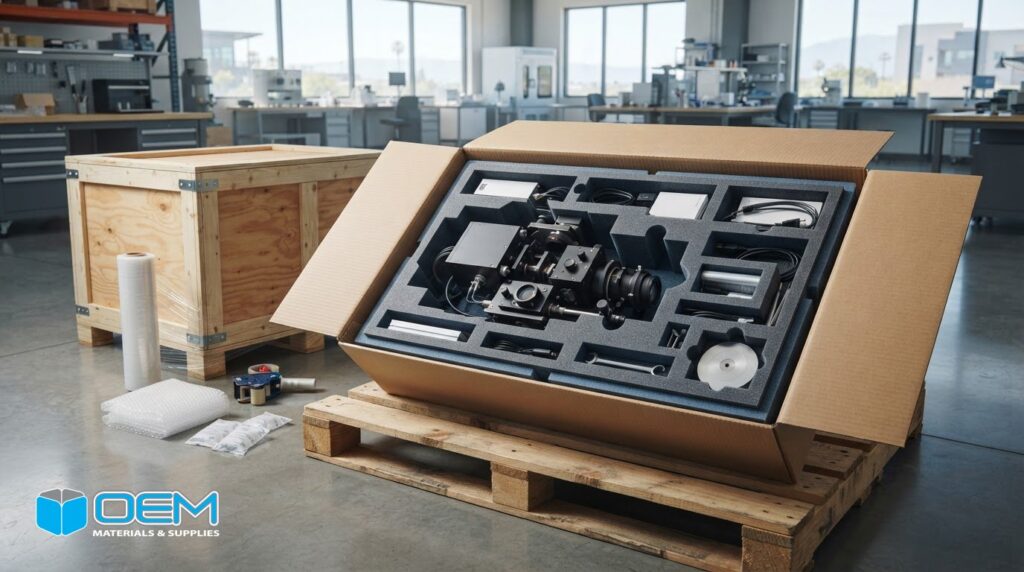
The most protective-looking foam is not automatically the right choice for a sensitive instrument. Retention packaging must hold the product in position while accounting for its shape, weight, vulnerable features, and shipping conditions. A practical guide to retention packaging for sensitive instruments Orange County buyers can use starts with those requirements, not a preferred material. Movement during handling and transit can put delicate components at risk. A clear understanding of how foam, corrugated packaging, and outer protection work together also makes supplier discussions more productive.
It is reasonable to expect packaging to keep an instrument secure throughout its intended shipping process. The challenge is turning that expectation into specific design criteria. This guide explains how to assess product and shipment needs, compare retention options, and prepare a clear brief for an Orange County packaging supplier. It also covers how to consider custom foam inserts and corrugated packaging together, so the proposed design reflects the instrument and its distribution route rather than a one-size-fits-all approach.
Key Takeaways
- Start with the instrument’s dimensions, weight, geometry, and vulnerable areas before selecting retention materials.
- Describe actual shipping, storage, and handling conditions to guide packaging design.
- Compare shaped foam, corrugated structures, and combined designs based on fit, component organization, and outer protection needs.
- Review a prototype with representative instruments to check retention, access, component separation, and packing workflow.
- For retention packaging for sensitive instruments Orange County projects, prepare a supplier brief with product details, shipment requirements, and unresolved questions.
Why sensitive instruments need purpose-designed retention packaging in Orange County
Retention packaging is designed to limit unwanted product movement during handling and shipment. For a sensitive instrument, that means considering how its shape sits in the package, which components need support, and what conditions the shipment may encounter. A design that holds one instrument securely may not suit another, even when the products are used in the same industry.
Instrument geometry matters. A protruding connector, delicate control, or uneven profile can affect where an insert should support the product and where it needs to leave clearance. Sophisticated analytical devices, such as the benchtop scanning electron microscopes distributed by Electron Optics Instruments, LLC, illustrate how specialized instruments feature sensitive optical alignments and controls that demand careful retention. Shipment conditions matter too: a package moving through parcel handling may face different demands from one transported on a pallet or between company facilities. Buyers in Orange County, Los Angeles, San Diego, and Riverside should describe the expected route and handling process instead of assuming a standard shipping environment.
What does retention packaging do for a sensitive instrument?
A shaped insert locates an instrument inside its package and helps limit shifting. The insert, cushioning, and outer container have related but distinct roles: the insert supports and separates the product, cushioning helps manage impacts and vibration, and the container provides an outer layer of protection. For background on how cushioning is considered in package design, see Package cushioning principles.
Secure positioning does not guarantee protection against every type of damage. A package design must be evaluated against the product and its distribution requirements. Material choice, insert geometry, and outer packaging all affect suitability. OEM Materials & Supplies offers foam packaging and corrugated boxes, which can be considered together as part of a packaging design.
Which Orange County businesses may need instrument packaging?
Aerospace, medical, electronics, and manufacturing operations in Orange County may ship instruments or equipment with features that require deliberate support and separation. For example, in advanced medical device manufacturing—supported by specialized CDMOs like Fong’s Engineering & Manufacturing Private Limited—procurement and engineering teams may need to balance delicate product protection with efficient packing, component organization, and the space available for storage or transport. Requirements vary by instrument and route, so the design should reflect the actual application, not just the industry label.
For retention packaging for sensitive instruments orange county, start with a clear product and shipment profile. Include dimensions, weight, fragile areas, and expected handling conditions. Then identify known concerns, such as movement, contact between components, or access during packing. OEM Materials & Supplies’ foam packaging options may be relevant when discussing insert design and material selection.
How product geometry and shipment conditions shape instrument packaging design
Package design inputs should reflect the instrument’s specific requirements and the conditions it will encounter. Dimensions and weight help define the insert’s footprint and support points. Shape matters too: a long, narrow instrument may need a different arrangement from a compact unit with protruding controls. Identify fragile areas and handling points so the design can provide support where needed without pressing against features that require clearance.
Orientation is another useful input. If an instrument must remain in a particular position, tell the packaging designer and explain why. Note whether the shipment includes accessories, cables, or other components that need separate locations. These details can inform the insert geometry and help reduce unwanted contact between items.
Which instrument and shipment details should buyers gather?
Before requesting a design, assemble the product’s dimensions, weight, shape, preferred orientation, and the locations of fragile or sensitive features. Describe each known handling stage, including the shipping method, storage conditions, and any environmental concerns relevant to the instrument. State whether it ships alone, with accessories, or as a prepared kit. If details are unknown, identify the gaps rather than assuming a standard route.
How do foam inserts and corrugated boxes work together?
Foam can be shaped to position an instrument and provide cushioning, but its suitability depends on the product and distribution requirements. OEM Materials & Supplies offers custom foam packaging for applications where an engineered insert is being considered. The corrugated outer box contains the packaged instrument and forms another part of the protective system. Evaluate its size and construction alongside the insert, not in isolation.
Think of the insert and box as coordinated parts. A well-fitted insert inside an unsuitable outer container may not meet the complete packaging need. Conversely, a suitable box cannot compensate for an insert that allows the instrument to shift or puts pressure on a vulnerable feature. Packaging design support can help translate product and shipment inputs into a brief for considering foam and corrugated packaging together. ASTM International’s ASTM D3951 commercial packaging standard is a reference buyers may review when discussing commercial packaging requirements. Confirm its relevance to a particular project with the appropriate technical stakeholders.
For retention packaging for sensitive instruments Orange County projects, share the product profile, known shipping conditions, and open questions with a packaging supplier. To discuss those requirements, submit a packaging quote request.
Compare retention packaging options without assuming one material fits every instrument
Packaging choices should follow the instrument’s shape, components, shipping conditions, and packing workflow. A shaped insert may help locate a product, while corrugated structures can form an outer container or internal dividers. A combined design brings the insert and container together for evaluation as one package. None is automatically the best choice for every instrument.
Use this comparison to frame the discussion with a packaging supplier. It outlines general design considerations, not a performance guarantee. Suitability depends on the specific instrument and distribution requirements.
| Approach | Fit and component organization | Outer protection and handling |
|---|---|---|
| Shaped foam retention | Can be formed around an instrument’s profile and provide separate locations for accessories, if the design calls for them. | Needs an appropriate outer container. Consider how the insert is loaded, removed, and handled during packing. |
| Corrugated structures | Can organize contents with partitions or other structural features, depending on the design. A corrugated structure may not provide the shaped fit needed for every instrument. | Can serve as the outer container. Assess the box and internal structure against the product and shipping needs. |
| Combined design | Pairs a shaped insert with a corrugated container to address positioning and component organization together. | Allows the insert and box to be reviewed as one configuration, including how staff pack and remove the instrument. |
When might engineered foam be part of the solution?
Consider a shaped foam insert when an instrument needs defined positioning or when components should be kept in separate locations. The product category alone is not enough to select the material or geometry. Dimensions, weight, sensitive areas, and shipment requirements all inform the assessment. Share these inputs with a supplier so the proposed design can be evaluated for the specific application.
When should buyers consider corrugated packaging or a combined design?
Corrugated packaging can provide the outer container, but it may not replace an insert when the instrument needs shaped retention. A combined configuration can be assessed for fit, component separation, external protection needs, and packing steps. Review corrugated box options alongside the requirements for the specific project.
Custom packaging can feel more involved than choosing a standard box. A clear brief makes the design easier to assess: provide dimensions, weight, product orientation, fragile areas, accessory details, shipping method, and known handling or storage conditions. For retention packaging for sensitive instruments Orange County projects, these specifics give the supplier a basis for comparing options instead of guessing at requirements.
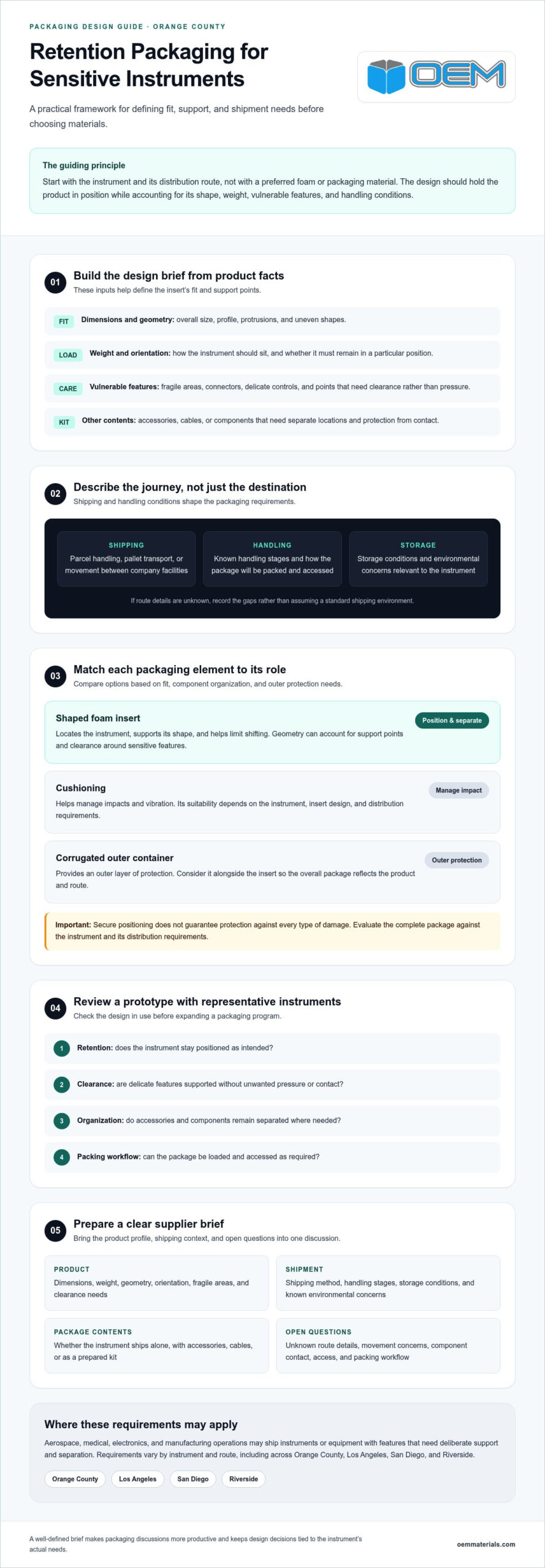
How to evaluate a retention packaging design before scaling a program
A prototype review gives engineering, operations, and procurement teams a chance to assess a proposed package before planning production. Start with a requirements brief that records the instrument’s configuration, shipment conditions, packing steps, and known concerns. Then review a prototype using representative product samples. This can reveal fit or workflow issues that may not be clear from a drawing alone.
Agree in advance on what the review will assess. Test methods and acceptance criteria should reflect the specific application and be established with the relevant technical stakeholders. Do not treat a prototype review as proof of performance beyond the conditions actually evaluated.
What should a packaging prototype review cover?
Check that the instrument fits in the intended orientation and can be placed into and removed from the package as required. Look for unwanted contact with sensitive areas, confirm that accessories have defined locations, and follow the proposed packing instructions. Ask the people who pack the product to assess the sequence, not just the finished package.
Record observations, requested changes, and unresolved requirements. If the package is revised, review the updated version against the same agreed criteria. This creates a clear record for the team to use before production planning.
How can packaging fit the Orange County operation?
Evaluate the package at the workstation as well as during shipment. Consider the space needed to store packaging materials, the number and order of assembly steps, and how the finished package moves into the shipping workflow. A design that positions the instrument appropriately should also be practical for the staff expected to pack it.
If multiple components need to be organized and prepared together, ask whether kitting or assembly support fits the operation. For teams coordinating packaging supply with scheduled production needs, just-in-time packaging support may also be worth discussing, depending on the operation’s requirements.
Move to production planning only after the review team has addressed fit, access, component separation, packing workflow, and any agreed evaluation criteria. The appropriate steps depend on product dimensions, packaging materials, and shipping requirements. For retention packaging for sensitive instruments orange county projects, sharing those details early keeps the design discussion tied to the application.
To discuss a packaging project, request a quote for your packaging requirements and include product dimensions, weight, shipment conditions, and expected usage where available.
Choose an Orange County packaging partner and prepare a quote-ready project brief
A productive supplier conversation starts with clear project information and practical questions. Look for experience with relevant packaging categories, design support, and the ability to assess whether a proposed approach fits your production needs. Ask how the supplier handles prototype review, what information is needed to develop one, and how they will address details that are still unknown. A useful partner clarifies assumptions rather than filling gaps with unverified specifications.
OEM Materials & Supplies serves industrial customers in Orange County and Southern California with packaging design support, engineered foam inserts, and corrugated packaging. These capabilities can help buyers evaluate insert and outer-container requirements together. Confirm that the proposed packaging options and production approach align with your volume, handling process, and shipment requirements.
What information should an Orange County buyer send for a quote?
Share what is available and flag what still needs confirmation. A practical brief can include:
- Instrument dimensions, weight, orientation, and photographs or drawings.
- Accessory details, including what ships with the instrument and whether components need separate locations.
- Shipping destinations, methods, handling conditions, storage concerns, and expected shipment quantities.
- Estimated annual usage and any current damage, packing, storage, or labor challenges the design should address.
These details help the supplier understand the application and ask focused follow-up questions. If shipment conditions, annual usage, or product measurements are not confirmed, say so directly rather than relying on assumptions.
What should the next step with OEM Materials & Supplies look like?
Use the project brief to scope a packaging discussion around the instrument and its route. The team can consider custom packaging design alongside foam and corrugated options, based on the information provided. Evaluate any recommendation against the actual product dimensions, materials, and shipping requirements. Confirm details such as prototype availability and production fit as part of the discussion.
For retention packaging for sensitive instruments Orange County projects, prepare product dimensions, weight, an annual usage estimate, and known shipment requirements before reaching out. Include drawings or photos and describe the packing challenges you want the design to address. Request a packaging quote or consultation.
Build a Packaging Plan Around Your Instrument
Effective retention starts with the instrument and its distribution requirements. Use product geometry, vulnerable areas, and actual handling conditions to guide material and insert decisions. Then review a representative prototype for fit, component separation, and packing workflow before planning production.
For retention packaging for sensitive instruments orange county, a clear project brief gives a supplier a practical basis for evaluating options. Include dimensions, weight, annual usage, shipment requirements, and any current damage or packing concerns. OEM Materials & Supplies offers custom packaging design and engineered foam inserts, along with corrugated boxes and kitting or assembly services for related packaging needs. Final recommendations depend on the instrument, materials, and shipping requirements.
Ready to discuss your application? Request a quote or packaging consultation and share the project details available. A well-defined starting point helps your team discuss a packaging approach suited to its operation.
Frequently Asked Questions
What is retention packaging for sensitive instruments?
Retention packaging is designed to limit unwanted product movement during handling and shipment. For a sensitive instrument, it may use a shaped insert to position the product, cushioning to help manage impacts, and an outer container. The design should account for the instrument’s geometry, fragile areas, and expected shipping conditions. It addresses defined packaging needs, but does not guarantee protection from every possible type of damage.
How do I choose packaging for a sensitive instrument?
Start with the instrument and its distribution requirements, not a preferred material. Record dimensions, weight, orientation, sensitive areas, and any accessories that ship with it. Describe handling stages, shipping methods, and storage conditions so a supplier can assess possible insert and outer-container designs. For retention packaging for sensitive instruments Orange County projects, clear product and shipment details make comparisons more relevant to the application.
Is foam packaging always the best choice for retaining an instrument?
No. Foam can be shaped to position an instrument or separate components, but its suitability depends on the product and shipment requirements. Corrugated structures may suit some packaging needs, while other applications may call for an insert and outer box designed as a coordinated system. Compare options based on fit, component organization, outer protection needs, and packing workflow. Confirm material and design choices for the specific application.
What information should I provide for a custom instrument packaging quote?
Provide the instrument’s dimensions, weight, and orientation, plus photographs or drawings if available. Include fragile areas, accessories, and how the product is currently packed. Describe shipping methods, destinations, handling and storage conditions, expected quantities, and estimated annual usage. Also explain known damage, packing, storage, or labor concerns. If some information is not confirmed, identify it as unknown so the supplier can clarify it.
Can retention packaging be designed for both the instrument and its accessories?
Yes. A packaging design can consider the instrument and accompanying components together. Share which accessories ship with the product, their approximate dimensions, and whether they need separate locations or a specific arrangement. A designed insert may help organize contents, while the outer package contains the complete set. The right layout depends on the items, packing process, and shipment requirements, so review it with representative products before production planning.
How should I evaluate an instrument packaging prototype?
Review the prototype with a representative instrument and the components that will ship with it. Check whether the product fits in the intended orientation, whether sensitive areas are clear of unwanted contact, and whether accessories stay organized. Have packers follow the proposed steps and assess placement and removal. Agree on application-specific evaluation conditions and acceptance criteria in advance, and document revisions or unresolved requirements before production planning.
Does OEM Materials & Supplies serve Orange County businesses?
Yes. OEM Materials & Supplies serves industrial customers in Orange County and Southern California, including Los Angeles, San Diego, and Riverside. Its packaging offerings include corrugated boxes and foam packaging, along with custom packaging design, engineered foam inserts, kitting, and assembly services. The company also serves customers across the United States. Discuss your instrument, shipping requirements, and project details to determine which packaging options may be relevant.