
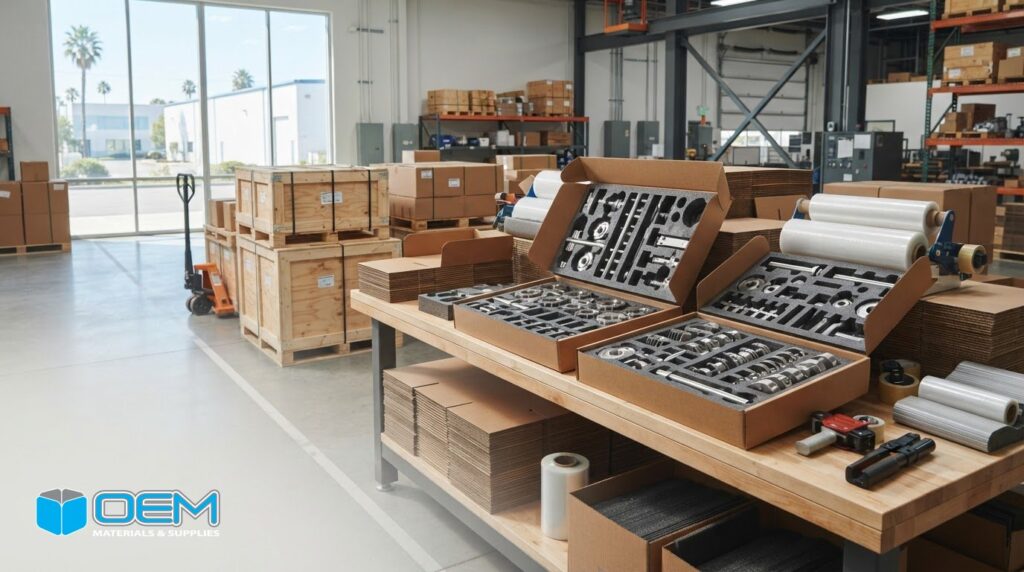
The wrong bulk packaging choice can turn a high-volume order into extra handling, damaged parts, or a gap in production inventory. For OEM buyers evaluating bulk parts packaging Los Angeles suppliers, the goal is not just to find a format that holds a part. It is to match protection, packing steps, shipping conditions, and replenishment needs.
Packaging that works for one component or route may not suit another. Use part dimensions, weight, surface finish, handling, and storage needs to compare corrugated boxes, foam packaging, cushioning materials, crates, and stretch film. This guide offers practical ways to assess fit, packing efficiency, and supplier support for operations in Los Angeles, Orange County, Riverside, and San Diego.
Key Takeaways
- Define bulk packaging around repeat production, handling, storage, and shipping needs, not simply large order quantities.
- Use part dimensions, weight, surface finish, fragility, and shipping journey to guide packaging selection and testing.
- Compare stock and custom corrugated boxes, foam-supported packs, and crates by product fit, protection, packing steps, and storage requirements.
- When evaluating bulk parts packaging los angeles suppliers, assess design support, production capacity, communication, and inventory options.
- Align packaging replenishment with production schedules and storage capacity, and consider kitting or assembly when it fits your operation.
Bulk Parts Packaging in Los Angeles: Define the Protection and Supply Problem
For OEM buyers, bulk parts packaging means planning packaging for repeat production, handling, storage, and shipment. It concerns how components are packed and supplied, not the purchase of components in bulk. A useful specification addresses both product protection and the work required to pack, store, and replenish materials.
Bulk parts packaging is a repeatable packaging system designed to protect OEM components and support their movement through production, storage, and shipment.
Damage can result from a poor fit, inadequate cushioning, or handling between workstations and the shipping dock. Extra packing steps or material can also slow fulfillment, while missed replenishment can disrupt production or shipping. Start with the part’s geometry and fragility, then consider the shipment and each handling point. These factors provide a practical basis for package design and evaluation.
Which OEM parts need a packaging plan?
Robust components may need basic separation and containment. Finished, precision, fragile, or easily scratched parts may need more controlled positioning. Record each part’s dimensions, weight, preferred orientation, and sensitive surfaces. Then map its handling from production through storage to the shipping dock. A part that stays secure in a production bin may need different protection for shipment. For components that need shaped cushioning, compare foam packaging with the part’s requirements.
What Los Angeles-area buyers should clarify first
Before requesting a recommendation for bulk parts packaging in Los Angeles, note where parts ship, how often shipments leave, and how order quantities vary. Include facility constraints such as available storage, packing space, and where packaging enters the production flow. These details can help distinguish a packaging fit issue from an inventory or workflow issue.
Separate confirmed requirements from questions that need review. For example, provide verified dimensions and shipping destinations, then flag concerns about surface contact, orientation, or handling that have not yet been tested. Suppliers can then assess options without treating an assumption as a fixed specification.
How to Specify Bulk OEM Parts Packaging for Real Shipping Conditions
A useful specification starts with the part and ends with evidence that the pack suits its intended route. Packaging specifications should reflect both the part being protected and the distribution environment it must travel through.
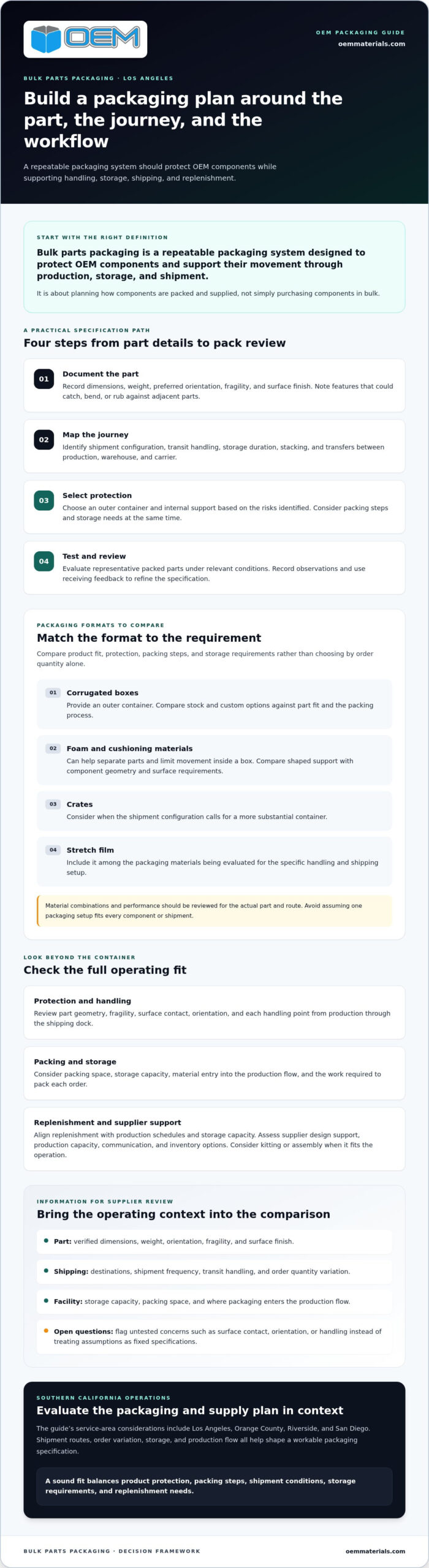
Work through these steps:
- Document the part: Record dimensions, weight, orientation, fragility, and surface finish. Note features that could catch, bend, or rub against adjacent parts.
- Map the journey: Identify shipment configuration, transit handling, storage duration, stacking, and transfers between production, warehouse, and carrier.
- Select protection: Choose an outer container and internal support based on the risks identified. Consider packing steps and storage needs at the same time.
- Test and review: Evaluate representative packed parts under relevant conditions. Record observations and use receiving feedback to refine the specification.
For example, a finished component with a scratch-sensitive surface may need separation from neighboring parts. A robust part may instead need containment and restraint suited to its shipment configuration. These are starting points, not fixed prescriptions. Check material compatibility and performance for the actual part and route. If shipments contain hazardous materials, check whether applicable requirements apply. The federal bulk packaging regulations for hazardous materials address a specific regulated context and are not general packaging specifications.
Match packaging materials to the part
Corrugated boxes provide an outer container. Foam packaging or other cushioning materials can help separate parts and limit movement inside it. Crates may suit shipment configurations that call for a more substantial container. Choose the combination based on part geometry, handling, stacking, and shipping conditions. Avoid selecting material grades or performance limits without product-specific review. When a standard format does not fit the part or packing process, consider custom corrugated boxes.
Validate the packaging before scaling volume
Test representative packed parts under conditions that reflect the intended shipment and storage process. Check whether each part fits as intended, shifts during handling, or shows damage. Observe packing steps and gather feedback from receiving operations, too. Refine the design before applying it to larger production volumes. Results apply to the product, pack configuration, and route tested, so review the design if any of these change.
For a bulk parts packaging Los Angeles program, share part dimensions, weight, shipment configuration, and route details so a packaging supplier can assess requirements and discuss suitable options.
Compare Bulk Packaging Formats and Supplier Capabilities in Los Angeles
No single format suits every OEM part. Compare options by product fit, protection, packing steps, storage footprint, and shipment type. A simple component in a stable configuration may need a different approach from a delicate part that must stay separated or a large assembly that calls for a crate. Consider the complete process, from packing through receipt, before choosing a format.
| Format | Product fit and protection | Packing and storage considerations | Shipment considerations |
|---|---|---|---|
| Stock corrugated | Useful when an available size fits the part and its protection requirements. | Can be straightforward to pack, but added cushioning or manual adjustments may add steps. Confirm storage space for the selected sizes. | Assess the complete shipping configuration, including how packed units will be handled and stacked. |
| Custom corrugated | Consider when a closer fit or a specific pack layout is needed. | A designed format may support a repeatable process, but review storage needs and packing instructions before adoption. Compare with custom corrugated boxes. | Evaluate against the part’s route, shipment configuration, and handling conditions. |
| Foam-supported pack | May help position or separate parts when movement or contact between components is a concern. | Check how parts load and unload, whether the pack is practical for repeat use, and how foam components will be stored. | Assess the full pack, not the insert alone, under the intended shipment conditions. |
| Wood crate | Consider for parts whose dimensions, weight, or shipment conditions call for a different container format. | Review the space required for packing, staging, and storage, along with the handling steps involved. | Match the crate design to the shipment configuration and route requirements. |
When standard packaging may be sufficient
Stock packaging can work when its dimensions and protection meet the part’s needs. Before standardizing it, observe a normal packing cycle. Note whether workers add substantial void fill, reposition the part repeatedly, or modify the pack by hand. Those steps may affect consistency and labor. Weigh them against the storage space and repeatability of a simpler format.
When custom packaging deserves evaluation
Evaluate custom corrugated or a foam-supported pack when stock formats do not address fit, separation, or handling requirements. A crate may also suit a part or shipment that calls for a different format. For bulk parts packaging los angeles programs, ask suppliers about design support, capacity for changing volumes, and options for kitting, assembly, and inventory coordination. Confirm what each service includes and how it would fit your operation.
Plan Bulk Packaging Inventory and Delivery for Southern California Operations
Packaging availability depends on more than average usage. Production schedules, order variability, storage capacity, and replenishment practices all affect how much material to keep on hand and when to reorder. A stable production run may call for a different plan than frequent schedule changes or uneven demand.
Base replenishment planning on actual packaging usage and confirmed lead-time information, not assumptions about a typical production week. Review past consumption alongside upcoming production plans, then account for available storage and how quickly packaging can be reordered. Share these details with your supplier so inventory discussions reflect your operation.
Kitting and assembly may consolidate packaging tasks when a process requires several components to be gathered or prepared together. Whether this helps depends on your workflow and which tasks your team wants to coordinate. Just-in-time delivery and vendor-managed inventory are also options to evaluate, not guarantees of uninterrupted supply. Review just-in-time packaging services in relation to your schedule, storage limits, and agreed program terms.
Assess delivery cadence and inventory controls
Before setting a replenishment approach, share usage history, production plans, minimum storage space, and known ordering constraints. Agree on how stock levels will be reviewed, who communicates order changes, and how delivery requests are submitted. Clarify each party’s responsibilities, including how schedule changes or unusual demand will be handled. Confirm program terms before relying on the arrangement to support production continuity.
Coordinate packaging supply across Los Angeles-area facilities
If packaging supports more than one Southern California facility, document each location’s receiving schedule, storage conditions, and consumption patterns. Operations in Los Angeles, Orange County, Riverside, and San Diego may have different coordination needs depending on where production and packing take place. Do not assume one delivery cadence or inventory arrangement fits every site.
For programs that also involve nationwide sourcing, separate local replenishment needs from requirements at other locations. Confirm applicable service coverage and delivery arrangements with the supplier, and keep stock records clear by facility so changes at one site do not obscure needs at another. A shared review process can help purchasing and operations teams identify upcoming gaps.
For a bulk parts packaging Los Angeles program, prepare usage history, production schedules, facility storage details, and replenishment constraints before requesting a quote. Request a packaging quote to discuss your operation’s requirements.
Choose a Los Angeles Bulk Parts Packaging Partner and Prepare a Quote Request
A packaging partner should connect product requirements with a workable supply plan, not simply quote a container. For bulk parts packaging in Los Angeles, assess the supplier’s approach to design, materials, production volume, inventory coordination, and communication. Ask how recommendations are developed, what information the supplier needs, and how changes to parts or order requirements are handled.
Use this checklist to guide supplier discussions:
- Design support: Can the supplier review the part, packing process, and shipping conditions together?
- Production scale: Can they discuss prototypes, short runs, and high-volume programs without assuming one volume fits all?
- Service scope: Confirm which packaging materials and related services are available, including any kitting, assembly, or inventory coordination your operation needs.
- Communication: Clarify how specifications, order changes, stock levels, and delivery requests will be discussed.
OEM Materials & Supplies supports manufacturers in Los Angeles and throughout Southern California with custom packaging solutions, including corrugated boxes, foam packaging, and crates, as well as kitting and assembly. The company supports programs ranging from prototypes and short runs to high-volume production, and offers vendor-managed inventory programs. When comparing suppliers, ask how packaging format and protective materials are considered together. Confirm current service coverage and program terms against your facility’s needs.
What information helps suppliers recommend a solution?
Prepare part drawings or dimensions, weight, orientation, and details about vulnerable surfaces or features. Include annual usage, expected order patterns, shipment destinations, and relevant shipping conditions. Describe current packing and storage steps, available space, and any damage or labor concerns. Photos or samples of the existing pack can provide useful context.
Compare recommendations before committing
Review each proposal against your documented requirements. Check the proposed format and materials, pack-out steps, storage implications, and assumptions about handling or shipment conditions. Ask whether prototypes or sample configurations can be evaluated before broader adoption, and agree on how findings will be reviewed. Related supplier-evaluation guidance may also help structure your comparison.
With part details, usage, and shipping requirements ready, contact OEM Materials & Supplies to request a bulk packaging quote or discuss a packaging recommendation for your operation.
Build a Packaging Plan That Supports Production
Effective bulk parts packaging los angeles sourcing starts with the component and its distribution path. Match the packaging format to the part’s protection needs, then review packing steps, storage capacity, and replenishment requirements before committing to a high-volume program. Assess supplier design support and how recommendations can be tested against actual operating conditions.
OEM Materials & Supplies supports manufacturers in Los Angeles and throughout Southern California with packaging design, corrugated boxes, foam packaging, crates, kitting and assembly, and vendor-managed inventory. These capabilities can help buyers assess packaging and supply needs together, with program details aligned to their operation.
For a more useful recommendation, prepare part dimensions, weight, annual usage, shipping conditions, and details about your current packaging. Request a bulk packaging quote or consultation to discuss your requirements with the team.
Frequently Asked Questions
How do I choose bulk packaging for OEM parts?
Choose packaging based on the part’s characteristics and its shipping and handling conditions. Document dimensions, weight, orientation, fragility, and sensitive surfaces, then consider transit handling, storage duration, stacking, and how parts are packed. Compare suitable formats by protection, packing steps, and storage needs. Test a representative pack before scaling volume, and use observations from shipping and receiving to decide whether the design needs adjustment.
Is custom packaging better than stock packaging for bulk parts?
Not always. Stock packaging may be suitable if its dimensions and protection fit the part without excessive void fill or manual adjustments. Custom corrugated boxes or foam packaging may be worth evaluating when a closer fit or more controlled positioning is needed. Compare the full workflow, including pack-out steps and storage space. The better option depends on the component, shipping conditions, order pattern, and how consistently the pack can be used.
What information should I provide to get a packaging quote?
Provide part drawings or dimensions, weight, orientation, and details about vulnerable surfaces or features. Include annual usage, expected order patterns, shipment destinations, and relevant shipping conditions. Describe your current packaging, packing steps, storage limits, and any damage or labor concerns. Photos or samples of the existing pack can clarify requirements and help a supplier discuss suitable options and quote details.
Can bulk packaging be customized for different OEM components?
Yes. Packaging can be designed around different component dimensions, shapes, surface sensitivities, and handling requirements. An OEM may need one configuration for a robust component and another that separates or supports a finished part. OEM Materials & Supplies provides custom packaging solutions, including corrugated boxes and foam packaging. Review each configuration against the component and shipping conditions rather than assuming one format suits every part.
How can packaging reduce damage to parts during shipping?
Packaging can help reduce damage risk by containing the part, limiting unwanted movement, and separating surfaces that could rub or contact each other. The right approach depends on part geometry, fragility, shipment configuration, and handling conditions. Evaluate a representative packed part under conditions relevant to its route, then document fit, movement, and any damage observations. Results apply to the tested product and pack configuration, so review the design if either changes.
What is vendor-managed inventory for packaging supplies?
Vendor-managed inventory, or VMI, is an arrangement in which a supplier helps coordinate agreed packaging inventory and replenishment based on information shared with the buyer. Before relying on a program, clarify how usage and stock levels are reviewed, how order changes are communicated, and who is responsible for replenishment decisions. Confirm delivery arrangements and program terms in advance. The arrangement should reflect actual consumption, production plans, storage capacity, and replenishment constraints.
Can a packaging supplier support bulk orders in Los Angeles?
Yes. OEM Materials & Supplies serves manufacturers in Los Angeles and throughout Southern California, including Orange County, San Diego, and Riverside. The company supports packaging needs from prototypes and short runs through high-volume production programs. Available capabilities include packaging design, kitting and assembly, and vendor-managed inventory. Confirm current service coverage, delivery arrangements, and program terms with the supplier to ensure they align with your facilities and order requirements.
For help evaluating packaging options for your operation, contact OEM Materials & Supplies to request a quote or discuss your requirements.