
The lowest box price can still lead to the highest packaging cost. That’s the central issue in uline pricing vs wholesale supplier comparisons: catalog convenience can simplify ordering, but the unit price alone doesn’t show what freight, excess cushioning, packing labor, or inventory adds to the total.
Uline’s broad catalog and straightforward purchasing can suit standard packaging needs. For recurring, higher-volume orders, a wholesale supplier may be a better fit if pricing, packaging specifications, and replenishment can be aligned with your operation. The right choice depends on what you buy, how often you order, and how your packaging ships.
This article compares total cost of ownership, not just quoted prices. You’ll learn how to account for freight, packing labor, product protection, and storage, and when custom corrugated boxes or foam packaging may help reduce waste. You’ll also find practical criteria for evaluating suppliers, including considerations for manufacturers in Orange County, Los Angeles, San Diego, and Riverside.
Key Takeaways
- Compare the full cost of packaging, including freight, packing labor, product protection, and storage, rather than relying on unit price alone.
- Catalog ordering can suit urgent or low-volume needs, while recurring orders may justify comparing wholesale pricing and supplier services.
- Check whether custom-sized corrugated boxes could reduce excess space and reliance on cushioning materials. The result depends on product dimensions and shipping requirements.
- Consider whether Vendor-Managed Inventory (VMI) could help align packaging stock with usage and reduce inventory management work.
- Use order volume, packaging specifications, and freight needs to decide when uline pricing vs wholesale supplier options deserve a closer comparison.
The Convenience Premium: Why Companies Start with Uline
Uline’s appeal is straightforward: a large catalog, a familiar ordering process, and standard packaging for when an operation needs it quickly. That convenience can matter during an unexpected stockout, a short production run, or a prototype build. For a low-volume purchase, ordering a standard box without a lengthy sourcing process may be worth more than pursuing a lower unit cost.
Uline operates as a major distributor within established distribution channels. Its broad, one-stop-shop model can simplify ordering across common packaging categories. Manufacturers should still compare delivered cost and operational fit rather than assume a catalog price represents the full cost of packaging.
When Catalog Ordering Makes Sense
Catalog ordering can be practical for low-volume prototyping, occasional purchases of standard items, or startups testing packaging. The trade-off is between simple purchasing and the cost of repeated orders. If the same packaging appears on purchase orders regularly, review its unit price, freight, and handling effort together.
The Scalability Wall
As production grows, recurring packaging needs can make one-order-at-a-time purchasing less efficient. Even a small difference in unit price can add up across repeated purchases, while freight on bulky corrugated boxes can change the comparison. There is no universal volume threshold. Review your order history, shipping charges, packaging specifications, and packing labor to see when catalog convenience may be costing more than it saves.
Complex products may also need packaging designed around their dimensions, fragility, or handling requirements. A standard catalog selection may not provide the required fit, leading teams to add cushioning or adjust the packing process. A wholesale supplier may be able to discuss custom corrugated boxes or foam packaging alongside recurring supply needs. Any potential savings depend on the product, materials, order volume, and shipping requirements.
A supplier relationship becomes more important when packaging is a repeatable operational input rather than an occasional purchase. In comparing uline pricing vs wholesale supplier, consider whether a supplier can support your specifications, order patterns, and inventory needs as production changes. Measure convenience against total cost and fit, not just speed or listed price.
Analyzing Total Cost of Ownership: Unit Price vs. Freight
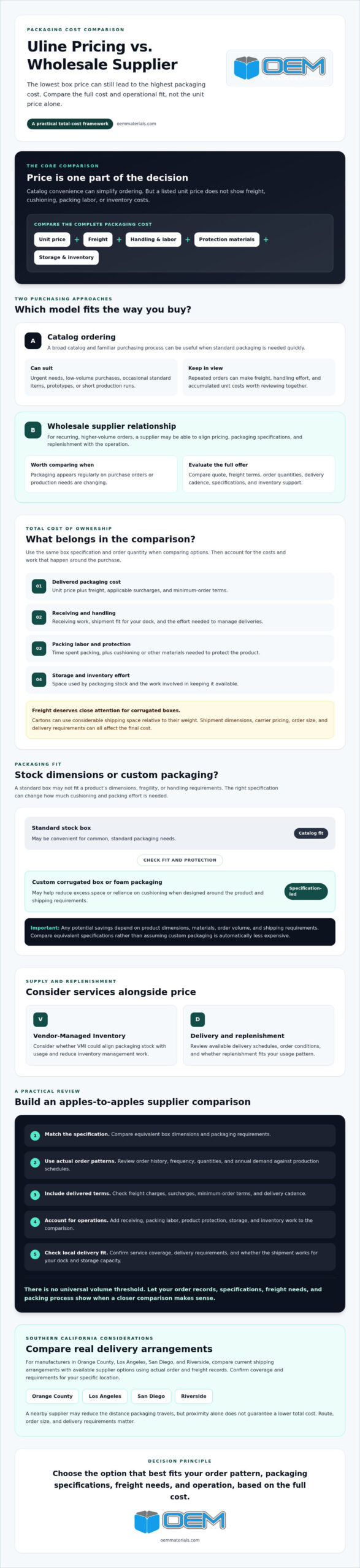
Start with delivered cost, not catalog unit price. North Carolina State University’s overview of Total Cost of Ownership explains why purchase price is only one part of a buying decision. For packaging, include freight, receiving and handling, packing labor, storage, and any materials needed to protect products inside the box.
Freight deserves close attention for corrugated boxes. Cartons can take up considerable shipping space relative to their weight, so shipment dimensions and carrier pricing can affect the final cost. Compare the delivered cost per usable box for the same specifications and order quantity. Then consider how often you order, the receiving work involved, and whether each shipment fits your dock and storage capacity.
The Shipping Cost Trap
Request a delivered quote for a consistent box specification and quantity. For carrier shipments, check freight charges, applicable surcharges, and minimum-order terms. For local supply, confirm whether the supplier serves your location and ask about delivery schedules and order conditions. A nearby supplier may reduce the distance packaging travels, but proximity alone doesn’t guarantee a lower total cost. Route, order size, and delivery requirements all matter.
OEM Materials & Supplies serves manufacturers in Southern California, including Orange County, Los Angeles, San Diego, and Riverside, as well as across the United States. Manufacturers in these areas can compare their current shipping arrangements with the supplier’s available options using actual order and freight records. Confirm delivery coverage and requirements for your specific location. The best option depends on the shipment profile and the terms offered.
Volume Discounting Realities
Catalog quantity breaks can be convenient, but they may not reflect a manufacturer’s annual demand or production schedule. A wholesale supplier may discuss pricing for repeat, higher-volume programs. Don’t assume that arrangement is automatically less expensive. Compare the quoted unit price, freight terms, order quantities, and delivery cadence against actual usage.
Use a representative ordering period and equivalent box specifications. Include any additional storage needs if a lower unit price requires larger deliveries, along with the labor involved in receiving them. A consistent comparison shows whether savings on the invoice are offset elsewhere in the operation.
For a practical uline pricing vs wholesale supplier review, gather box dimensions, order history, annual usage, and delivery locations. OEM Materials & Supplies provides custom corrugated boxes and other packaging solutions for manufacturers. Any cost advantage depends on specifications, volume, and freight requirements.
Stock Dimensions vs. Custom Engineering
A stock box is convenient when its dimensions suit the product. If the fit is loose, the packing team may need extra cushioning to control movement, and the shipment may take up more space than the product requires. Custom packaging starts with the product and shipping requirements, then matches the container and interior protection to them. This is an important part of the uline pricing vs wholesale supplier comparison: availability is useful, but fit affects material use, packing time, and shipping dimensions.
The Cost of Excess Air
Consider a component that fits a standard box only with substantial void fill around it. The extra space can mean more cushioning, more packing time, and larger cartons to store before use. Custom-sized corrugated boxes can reduce unused space when product dimensions and the shipping method support a closer fit. A smaller outer package may also reduce dimensional-weight charges, depending on carrier rules and the shipment’s actual weight and dimensions. Compare packed dimensions, not just the empty box.
Less excess packaging can also make better use of warehouse space. A right-sized box may take up less room in storage and require fewer packing adjustments. The result depends on the product mix, order quantities, and how packaging is stored.
Industry-Specific Protection
For aerospace components, medical devices, or electronics, packaging needs to account for more than exterior dimensions. Product geometry, fragility, handling, and exposure to shock or vibration can affect the design. A standard box may still be appropriate, but it may not provide the required fit or interior support without additional materials. Custom design allows the box and protective components to be considered together for the specific application.
For sensitive electronics, foam packaging can be shaped to support the product and limit movement inside the container. Foam alone doesn’t establish that a package meets ESD needs, so specify any electrostatic protection requirements separately. Choose cushioning materials based on the item and shipping conditions rather than adding filler by default.
Compare stock and custom options using the complete pack: box dimensions, protective materials, packing labor, storage needs, and outbound shipping charges. A custom design may reduce waste or improve handling, but its value depends on the product, materials, shipment profile, and order volume. The goal is packaging that protects the item without carrying unnecessary space or material through the supply chain.
Value-Added Services: VMI and Logistics Support
Packaging costs include the time your team spends ordering, receiving, counting, staging, and preparing materials. A supplier relationship that addresses these tasks can reduce administrative effort and help keep packaging available where production needs it. In the uline pricing vs wholesale supplier comparison, assess these operational effects alongside product price and freight.
With Vendor-Managed Inventory (VMI), a supplier helps coordinate packaging replenishment using agreed inventory levels and usage information. This can reduce the need for repeated small orders and help flag a potential shortage before it disrupts packing or production. The arrangement works best when responsibilities, reporting, and replenishment expectations are clear. Before starting a program, ask what inventory and usage information the supplier needs.
Eliminating Stockouts and Overages
Too little packaging can delay shipments or production; too much ties up space and working capital. A VMI program can help balance those risks by coordinating replenishment against actual use, though it can’t eliminate every supply disruption. Review packaging consumption, storage capacity, and order patterns with the supplier, then set practical inventory targets. Better visibility may also help procurement spend less time processing frequent orders and responding to last-minute shortages.
Just-in-time (JIT) delivery can support a similar goal: receiving materials closer to when they’re needed instead of holding excess stock on the warehouse floor. It depends on reliable schedules, accurate usage information, and clear communication. If deliveries arrive too early, too late, or in unsuitable quantities, the inventory benefit can disappear.
Operational Efficiency in Southern California
For manufacturers in Los Angeles, Orange County, San Diego, and Riverside, local logistics can be one factor in coordinating packaging supply. OEM Materials & Supplies serves manufacturers in these Southern California locations. Confirm delivery coverage and requirements for your specific location rather than assuming a particular route or schedule is available.
Kitting and assembly can also reduce in-house preparation when teams repeatedly gather packaging components or assemble kits before production or shipment. Before adopting these services, map the current process: time spent staging materials, order frequency, storage space, and the consequences of a stockout. Compare those demands with the proposed service scope and delivery plan. Results depend on your packaging mix, production schedule, and inventory practices.
To evaluate options, share your packaging usage, storage constraints, and delivery locations when you request a packaging quote.
Making the Switch: When to Transition to a Wholesale Partner
There’s no single order volume that makes switching worthwhile. The tipping point depends on your packaging mix, annual usage, freight charges, storage limits, and the labor required to prepare each shipment. If the same stock items appear on recurring orders, or packaging fit contributes to extra packing time, compare the full annual cost with a wholesale supplier.
A useful uline pricing vs wholesale supplier review starts with reliable purchasing and operations data. Compare equivalent specifications and include costs beyond the item price. Don’t assume a wholesale arrangement will automatically cost less. The goal is to determine which supply model fits your production needs and total cost of ownership.
Conducting a Packaging Audit
Start with your most-used packaging SKUs. For each, record dimensions, material or style, order frequency, units used, and freight charges. Calculate annual spend using actual invoices, then note storage requirements and the labor involved in receiving and packing. Track product damage or repacking incidents, too, and investigate whether poor fit may be a contributing factor rather than assuming packaging is the cause.
This audit helps distinguish occasional purchases from repeat demand that may benefit from a planned supply program. It also gives a supplier practical specifications for reviewing stock and custom options.
The Onboarding Process
Share the audit data with a prospective partner, including product dimensions and weight, annual usage, shipping requirements, and any protection concerns. For custom packaging, review a proposed design and test a prototype in the actual packing and shipping process before adopting it broadly. Record fit, packing steps, and any damage observed, then refine the design as needed.
Next, agree on order quantities, delivery schedules, and clear VMI parameters if inventory management is part of the arrangement. Define who monitors stock, what usage information is shared, and how replenishment is coordinated. A careful transition can begin with selected, repeat-use items while you verify that the packaging and delivery plan work for your operation.
OEM Materials & Supplies works with manufacturers on custom packaging design and VMI. Contact the team with your dimensions, product weight, and annual usage to discuss a custom quote and design review. Recommendations and potential savings depend on your specifications, order patterns, and shipping requirements.
Uline Pricing vs Wholesale Supplier: Build a Packaging Program Around Your Operation
The uline pricing vs wholesale supplier decision comes down to more than catalog price. Include freight, packaging fit, packing labor, storage, and inventory demands in your comparison. Stock packaging can meet immediate or low-volume needs, while recurring production may benefit from custom specifications and coordinated replenishment.
For manufacturers in Orange County, Los Angeles, San Diego, Riverside, and across the United States, OEM Materials & Supplies offers custom corrugated boxes, foam packaging, and services including VMI, kitting, and assembly. Start with clear data: dimensions, weight, annual usage, and any protection concerns. Those details help focus the discussion on options that fit your operation.
Request a custom packaging quote to review your requirements and discuss practical options for your operation.
Frequently Asked Questions
Is Uline cheaper for small businesses?
Uline can be a practical choice for small businesses that need standard packaging in low quantities or want to place occasional catalog orders. Whether it’s cheaper depends on the item, quantity, shipping, and how well the packaging fits the product. Compare the delivered cost and any extra cushioning or packing labor required. For recurring purchases, review order history to see whether a wholesale supplier’s pricing and services better fit your needs.
How much can I save by switching to a wholesale packaging supplier?
There’s no reliable savings figure without reviewing your specifications and purchasing data. Compare equivalent packaging, annual usage, freight, packing labor, storage, and damage or repacking costs. In the uline pricing vs wholesale supplier comparison, a lower unit price doesn’t guarantee a lower total cost. A supplier can review your corrugated box dimensions, product weight, shipping destinations, and order patterns to develop a relevant comparison. Results depend on those requirements and the proposed packaging.
Does a wholesale supplier have minimum order requirements?
Minimum order requirements vary by supplier, product, and whether the packaging is stock or custom. Ask about minimum quantities, order frequency, production requirements, and delivery terms before comparing quotes. For custom corrugated boxes or foam packaging, the design and manufacturing process may affect ordering expectations. Share your expected usage and storage limits so the supplier can explain which options fit your operation.
Can a wholesale supplier match Uline delivery speeds in Southern California?
Not necessarily. Confirm delivery timing for the specific product, quantity, and destination. OEM Materials & Supplies serves manufacturers in Orange County, Los Angeles, San Diego, and Riverside. Ask about delivery schedules and product availability for your location. A supplier serving your area may offer useful coordination, but don’t assume it can match a particular catalog delivery window without confirmation.
What industries benefit most from custom wholesale packaging?
Custom packaging can be valuable in aerospace, automotive, medical, and electronics operations where products may have specific size, handling, or protection needs. A closer fit can reduce reliance on excess void fill and help make packing more consistent, but the design must suit the product and shipping conditions. OEM Materials & Supplies supports these sectors with custom corrugated boxes and engineered foam inserts, from prototypes to high-volume production programs.
How does freight cost impact the price comparison between Uline and wholesale?
Freight can change which option has the lower delivered cost, particularly for bulky corrugated boxes. Compare the same box dimensions and quantity, then account for shipping charges, delivery location, order frequency, and receiving effort. A supplier closer to your operation may reduce the distance packaging travels, but the actual cost depends on route and shipment requirements. Include freight in your uline pricing vs wholesale supplier analysis rather than judging by unit price alone.