
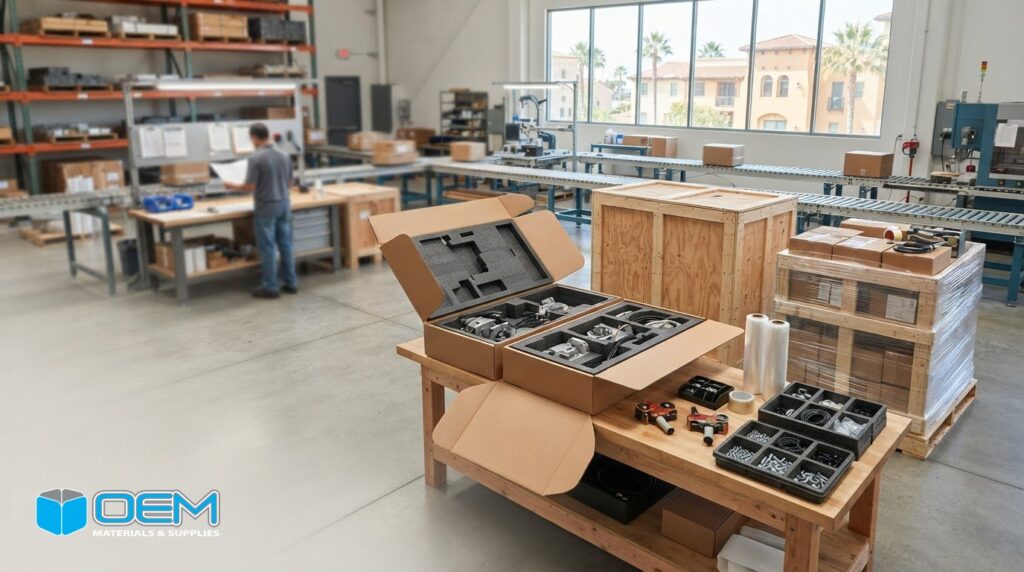
The most expensive component of your industrial packaging isn’t the corrugated board or the custom foam; it’s the hidden cost of inefficient assembly and transit damage. When a warehouse team struggles with complex kitting or a product arrives at a customer site in pieces, the total cost of ownership skyrockets. You likely recognize that oversized boxes and poorly engineered inserts are draining your margins through excessive freight charges and material waste.
Applying packaging design for manufacturability allows you to address these logistical bottlenecks before they reach the shipping dock. This approach focuses on creating functional solutions that simplify manual labor and withstand the rigors of the modern supply chain. This article explains how integrating engineering principles into your packaging choices reduces labor costs and ensures complete product protection during transit across the United States. We will explore practical ways to streamline line-side assembly for manufacturers in Orange County, Los Angeles, and the Inland Empire. By the end of this guide, you will understand how to optimize your industrial supply chain for maximum durability and cost efficiency.
Key Takeaways
- Understand how packaging design for manufacturability integrates engineering with production constraints to lower total cost of ownership by reducing labor and material waste.
- Learn to select the right corrugated board grades and custom foam inserts to secure complex assemblies without over-engineering.
- Compare the long-term cost implications of stock packaging versus custom solutions, including lead times and tooling requirements.
- Use a practical checklist to ensure new packaging concepts are compatible with automated warehouse equipment and manual kitting operations.
- Discover how single-source procurement from a local Southern California partner reduces logistical friction and transit times.
Principles of Packaging Design for Manufacturability in Industrial Supply Chains
Industrial packaging is often treated as an afterthought, yet it dictates the efficiency of your entire production floor. Design for manufacturability (DFM) is the engineering practice of optimizing a product’s design to simplify its production. In the context of supply chains, this means integrating packaging engineering with your specific production line constraints. Effective packaging design for manufacturability ensures that your shipping materials don’t just protect the product, but actually accelerate the kitting and assembly process.
What is Packaging Design for Manufacturability?
At its core, packaging DFM is the science of creating protective solutions that are as easy to assemble as they are to ship. Unlike standard structural design, which focuses solely on the physical strength of a box, DFM-aligned custom packaging design accounts for how a human operator or robotic arm interacts with the material. Packaging DFM is the strategic alignment of material selection and structural geometry to maximize assembly speed while maintaining total product integrity. It forces engineers to think about the entire lifecycle of the package. This includes how flat sheets of corrugated board are stored in an Orange County warehouse, how they are erected on a line-side station, and how they fit into a standard truckload.
The Financial Impact of Poor Packaging Design
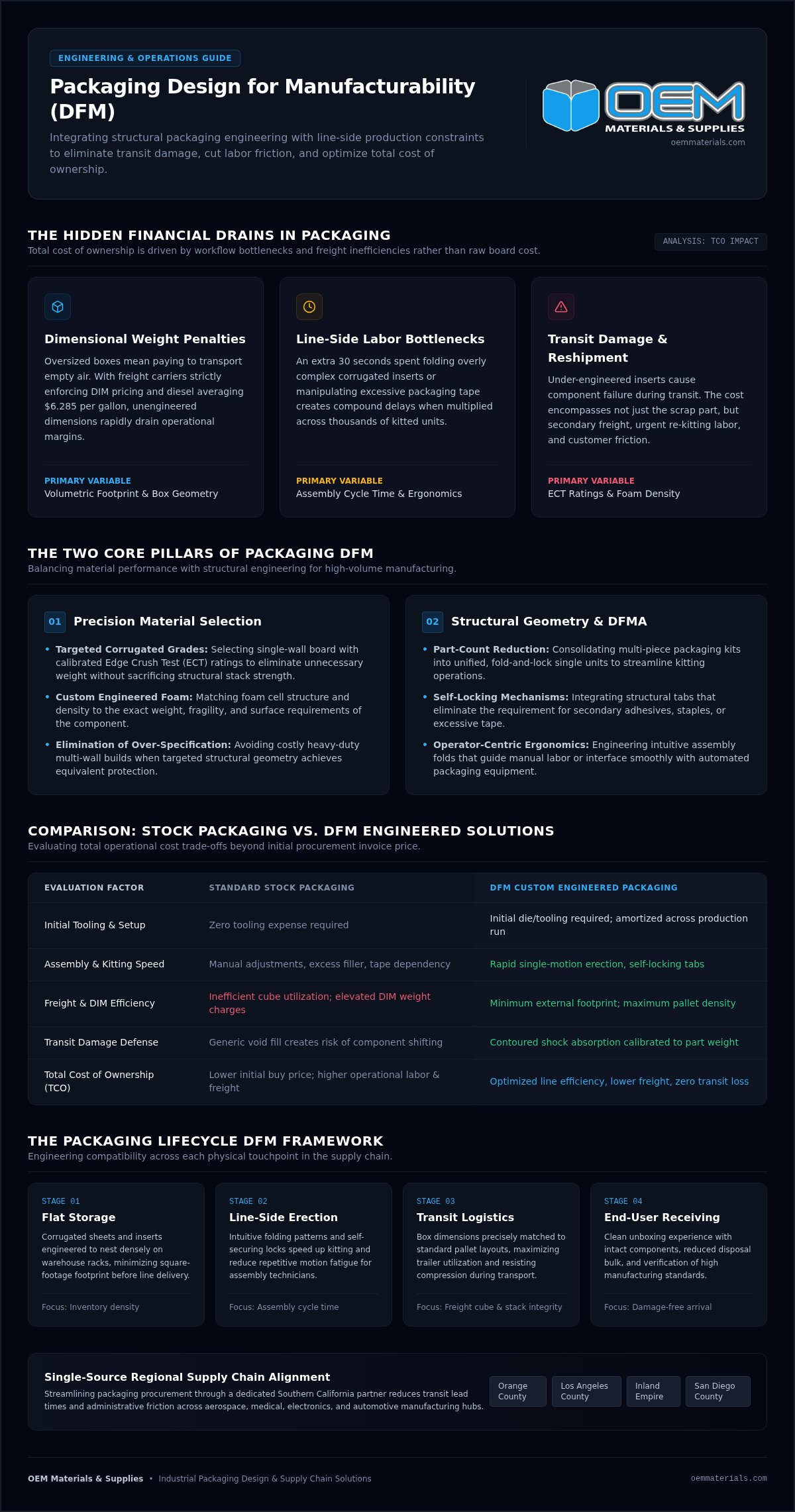
Unoptimized designs create a massive drain on capital. If a box is two inches wider than necessary, you aren’t just paying for extra paper. You’re paying for air. With diesel prices averaging $6.285 per gallon in September 2026, freight carriers are strictly enforcing dimensional weight rules. Oversized packaging leads to higher rates that quickly erode profit margins. Precision engineering avoids this by matching the external dimensions of the package to the minimum footprint required for protection.
Hidden labor costs also accumulate when designs are too complex. If a warehouse worker spends an extra thirty seconds struggling with a poorly engineered foam insert, that delay multiplies across thousands of units. This friction slows down throughput and increases the total cost of ownership. Poor material selection also results in higher transit damage rates. When a protective insert fails, you face the cost of the replacement part, the freight to reship it, and the potential loss of customer trust. High-quality packaging design for manufacturability prevents these failures by matching the material grade to the specific fragility and weight of the industrial component.
Core Pillars of Packaging DFM: Material Selection and Structural Engineering
Efficiency in the industrial supply chain relies on two variables: the materials used and the way they’re engineered to fit together. Applying packaging design for manufacturability requires a shift from simply buying boxes to developing integrated systems. When you prioritize structural geometry and material performance, you eliminate the waste that typically accumulates in high-volume production environments. This engineering-led approach ensures that every component of the package serves a specific functional purpose without over-specifying the build.
By utilizing the principles of Design for Manufacturing and Assembly (DFMA), engineers can identify opportunities to simplify the kitting process. This often involves reducing the number of individual pieces in a kit or designing self-locking tabs that eliminate the need for secondary adhesives or excessive packaging tape. If you’re ready to optimize your current specifications, you can request a quote to see how these engineering changes impact your total cost of ownership.
Optimizing Custom Corrugated Boxes for High-Volume Production
Selecting the correct corrugated board grade is the first step in preventing over-engineering. For many industrial applications, a single-wall board with a high Edge Crush Test (ECT) rating provides sufficient protection without the added weight of double-wall construction. However, heavy automotive or aerospace components often require the stacking strength of double-wall materials to prevent box failure during long-haul transit. Working with experienced corrugated packaging box manufacturers allows you to match the board grade to your specific payload requirements. Die-cut designs are particularly effective for packaging design for manufacturability because they allow for precise structural features that secure parts in place, reducing the need for loose-fill void materials.
Engineering Protective Foam Inserts for Multi-Component Kitting
For multi-component assemblies, custom foam packaging provides the necessary organization and shock absorption. The choice between polyethylene and polyurethane foam depends on the weight and sensitivity of the parts. Polyethylene is a closed-cell foam that offers excellent durability for heavy parts, while polyurethane is an open-cell material better suited for lightweight, fragile electronics. We recommend designing these inserts with integrated finger slots. This small structural addition significantly improves the speed at which operators can remove parts at the final destination, reducing labor friction and assembly time. Component nesting is another critical pillar; by orienting parts to maximize internal volume efficiency, you can reduce the overall box size and lower your dimensional weight charges.
Material and Structural Trade-Offs in Industrial Packaging Design
Every decision in industrial packaging involves a trade-off between protection, cost, and operational speed. While high-performance materials offer superior durability, they often require a larger upfront investment or longer lead times. Achieving effective packaging design for manufacturability requires you to evaluate these variables against your specific production volume and shipping environment. For instance, heavy payloads in the aerospace or automotive sectors often necessitate wood crates for maximum rigidity. However, specialized triple-wall corrugated alternatives can sometimes provide similar protection at a lower tare weight, directly reducing freight expenses.
Beyond the materials themselves, structural dimensions dictate warehouse efficiency. Standardizing your packaging to fit a 48×40 inch footprint ensures maximum plastic pallet utilization. When boxes are designed without considering these external transport constraints, you lose storage density and increase the number of shipments required to move the same volume of product. This lack of optimization creates a ripple effect of inefficiency throughout the Inland Empire and across nationwide distribution networks.
Stock Versus Custom Packaging Configurations
Purchasing managers often debate the merits of standard shipping supplies versus engineered solutions. Stock corrugated boxes are readily available and require no tooling investment, making them ideal for low-volume runs or non-fragile items. However, they frequently lead to higher total costs because they require excessive void-fill materials like bubble wrap or paper dunnage to secure the product. Custom configurations eliminate this reliance by using precise structural geometry to hold components in place. We recommend custom designs when your annual usage justifies the engineering time or when product fragility makes transit damage a recurring financial drain.
Balancing Tooling Costs with Assembly Speed
Implementing a custom packaging design for manufacturability usually involves initial capital expenditures for die-cut tooling or foam molds. While these upfront costs can seem high, they’re typically recovered through significant reductions in line-side labor. A custom-engineered kit that snaps together in seconds replaces the minutes spent taping and wrapping a product in generic materials. It’s important to remember that actual cost savings depend on specific variables like product dimensions, weight, and your annual production volume. By focusing on assembly speed, you aren’t just buying a box; you’re investing in a more efficient manufacturing process that scales with your business.
A Practical DFM Checklist for Supply Chain Managers and Engineers
Supply chain efficiency depends on repeatable, standardized processes. A robust packaging design for manufacturability strategy requires a clear framework to evaluate new concepts before they hit the production floor. This checklist ensures that your protective solutions aren’t just durable but are also compatible with automated sorting and high-density storage. By addressing these parameters during the design phase, you prevent logistical friction that typically leads to increased labor costs and transit damage.
Standardizing Dimensions for Pallet and Container Optimization
Start by aligning your external box dimensions with standard industrial pallets. In September 2026, freight costs remain a significant budget item with diesel averaging $6.285 per gallon. Maximizing pallet utilization prevents overhang and underhang, which are leading causes of corner crushing and load shifting. Proper stacking alignment ensures that the vertical strength of the corrugated board is fully utilized, protecting your high-value components during transit through the Inland Empire and across nationwide routes. Designing for the 48×40 inch footprint is essential for maintaining stability in automated warehouse environments.
Designing for Rapid Warehouse Assembly and Kitting
Manual labor is a massive variable in total packaging costs. You should prioritize design features like auto-locking bottoms that snap into place without the need for tape. These features drastically reduce manual setup times on the line-side, allowing your team to focus on production rather than box construction. Additionally, integrating edge and corner protectors into the initial design simplifies the pallet wrapping process. This prevents the stretch film from crushing the boxes and maintains the structural integrity of the entire unitized load. Don’t forget the end user; designing for rapid unpacking is just as important as assembly speed.
Verification and Transit Testing Protocols
You must validate every custom design through rigorous testing standards before committing to high-volume production. The International Safe Transit Association (ISTA) released a revised Procedure 3E in 2026 for unitized loads, which corrects compression calculation formulas to better reflect real-world shipping conditions. We strongly recommend creating a physical prototype to verify fit and function before placing a full-scale order. Drop testing and vibration analysis identify potential weak points in foam inserts or corrugated structures, preventing field failures that could damage your reputation. If you’re ready to validate your next packaging concept, you should request a quote and prototype from our engineering team today.
Streamlining Packaging DFM with a Southern California Logistics Partner
Implementing packaging design for manufacturability is most effective when your engineering team works in close proximity to your supplier. Local partnerships minimize the logistical friction that often occurs when coordinating complex custom builds across long distances. By working with a Southern California partner, manufacturers in Orange County, Los Angeles, and the Inland Empire can reduce lead times and eliminate the high freight costs associated with shipping air inside empty boxes. Single-source procurement for corrugated boxes and engineered foam inserts simplifies your billing and ensures that every component of the packaging kit fits perfectly the first time.
High diesel prices, which averaged $6.285 per gallon in September 2026, make local sourcing a financial necessity rather than a preference. When your packaging supplier is nearby, you avoid the volatility of the national freight market. With the Outbound Tender Rejection Index sitting at 12.54% as of late September, relying on long-haul carriers for bulky shipping supplies introduces unnecessary risk to your production schedule. A local partner provides the stability needed to maintain lean operations.
Custom Design and Prototyping Capabilities in SoCal
Localized support allows for a level of collaboration that generic online vendors cannot match. Our engineering teams work directly with manufacturers across San Diego County and the greater Los Angeles area to develop custom packaging design solutions that address specific production floor bottlenecks. We focus on creating rapid prototypes that your team can physically test on the line. This hands-on approach ensures that the structural geometry of the box and the density of the foam inserts are optimized for your specific assembly speed and product protection requirements before you commit to a high-volume production run.
Reducing Overhead with Vendor-Managed Inventory and JIT Programs
One of the biggest hidden costs in manufacturing is the floor space required to store bulky packaging materials. Vendor-managed inventory (VMI) programs solve this by shifting the storage burden to the supplier. We monitor your usage levels to ensure you never face a stockout of critical items like stretch film or custom corrugated containers. This data-driven approach is complemented by JIT packaging delivery, where supplies arrive precisely when they are needed for the production shift. These programs free up valuable square footage in your warehouse, allowing you to reallocate that space to revenue-generating manufacturing activities.
To begin optimizing your industrial supply chain, we invite you to contact our team for a professional consultation. To provide an accurate recommendation for your packaging design for manufacturability strategy, please be prepared to share your specific product dimensions, the weight of the components, and your estimated annual usage. We look forward to helping you reduce labor costs and eliminate transit damage through superior engineering.
Optimizing Your Industrial Supply Chain for Long-Term Efficiency
Implementing packaging design for manufacturability is no longer optional for companies facing rising freight and labor costs. By prioritizing structural engineering and material performance, you can eliminate the hidden inefficiencies that drain your operational margins. Localized support and engineered solutions prevent transit damage while accelerating line-side assembly. These principles ensure that your packaging serves as a functional asset rather than a logistical hurdle.
OEM Materials & Supplies serves aerospace, medical, and automotive manufacturers throughout Southern California with comprehensive support from rapid prototyping to high-volume production. Our value-added kitting, assembly, and vendor-managed inventory services are designed to keep your facility running lean and organized. To receive an accurate recommendation tailored to your specific operations, please request a custom industrial packaging quote from OEM Materials & Supplies today. We recommend providing specific product dimensions, weights, and annual usage to facilitate a precise technical evaluation. Your supply chain deserves the reliability of an engineering-led partner that understands the intricacies of modern manufacturing.
Frequently Asked Questions
What is the primary goal of packaging design for manufacturability?
The primary goal is to align the structural engineering of shipping materials with the specific constraints of your production line. This strategy aims to lower the total cost of ownership by reducing labor friction and material waste. By focusing on how an operator interacts with the box, engineers create solutions that are fast to assemble while providing maximum protection for industrial components throughout the entire distribution cycle.
How does custom packaging design reduce total supply chain costs?
Custom packaging design reduces costs by eliminating the reliance on excessive void-fill materials and optimizing box dimensions for freight efficiency. Properly sized containers minimize dimensional weight charges, which is critical as diesel prices reached $6.285 per gallon in September 2026. Additionally, custom solutions streamline kitting processes, allowing warehouse teams in Los Angeles and Orange County to pack more units per hour without increasing headcount or overhead expenses.
Can packaging DFM help reduce product damage during freight transit?
Yes, packaging DFM significantly reduces transit damage by utilizing engineered foam inserts and high-ECT corrugated board tailored to a product’s weight and fragility. Instead of using generic cushioning, this approach ensures a zero-movement fit inside the container. Testing to ISTA 3E 2026 standards further validates that unitized loads can withstand real-world shipping stresses across the United States, preventing costly field failures and expensive replacement shipments.
What information is required to develop a custom industrial packaging prototype?
To develop an accurate prototype, our engineering team requires the specific dimensions and weight of the product, along with its estimated annual usage. You should also provide details regarding the primary shipping method and any known fragility points. For manufacturers in San Diego or Riverside, this data allows us to select the appropriate foam density and corrugated grade, ensuring the final design is both cost-effective and operationally functional.
How do custom foam inserts improve line-side assembly efficiency?
Custom foam inserts improve efficiency by providing an organized layout for multi-component kits, which reduces the time workers spend searching for parts. Features like integrated finger slots allow for rapid removal, accelerating the assembly process at the final destination. By engineering these inserts to fit snugly within a die-cut box, you eliminate the need for manual wrapping or taping, allowing your production team to maintain a faster, more consistent throughput.
What industries benefit most from industrial packaging DFM principles?
Industries that handle high-value, complex, or fragile components benefit most from these principles. This includes aerospace, medical device, electronics, and automotive manufacturers throughout Southern California. These sectors often require specialized protective materials, such as ESD-safe packaging or cleanroom-compatible supplies. By applying packaging design for manufacturability, these businesses ensure their sophisticated products remain secure while managing the high labor costs associated with technical assembly and kitting operations.
How do vendor-managed inventory programs complement packaging design optimization?
Vendor-managed inventory (VMI) programs complement design optimization by ensuring that custom-engineered supplies are always available without cluttering your warehouse floor. While DFM reduces the footprint of the package itself, VMI manages the flow of those materials using just-in-time delivery. This combination is particularly valuable for manufacturers in high-cost areas like Orange County, as it frees up premium square footage for production while eliminating the risk of stockouts for critical shipping supplies.