
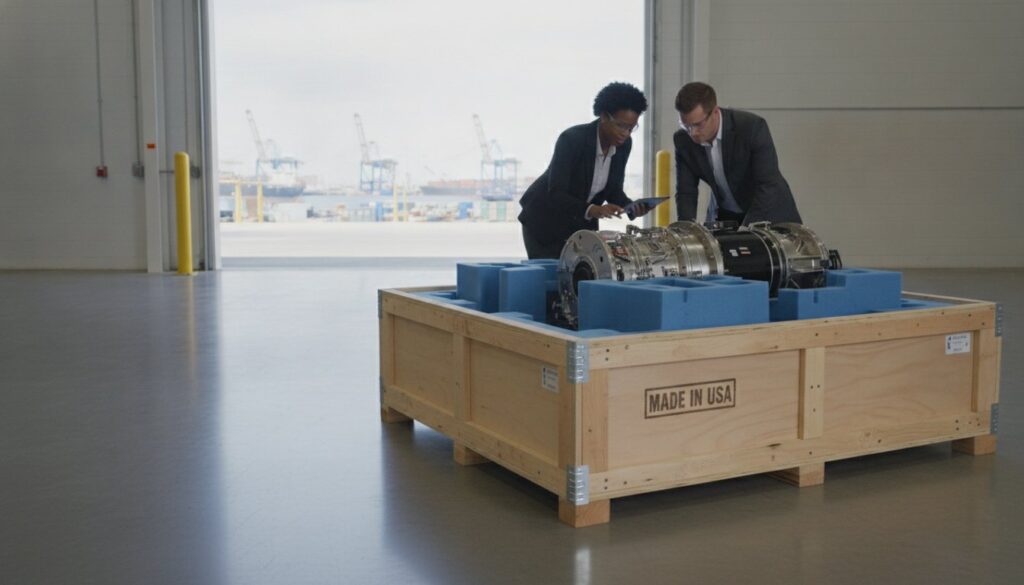
A single shipping failure or a rejected international load due to non-compliant timber can cost your operation more than an entire year of packaging spend. You understand that in a high-velocity logistics hub like Southern California, the reliability of your wood crate manufacturers in Los Angeles is a critical link in your supply chain. It’s not just about finding a container; it’s about securing a partner who understands the rigorous demands of aerospace, medical device, and heavy machinery transport.
Selecting a supplier that balances structural integrity with operational efficiency is a constant priority for procurement and warehouse managers. This guide provides the technical insights you need to identify reputable manufacturers, understand the necessity of ISPM-15 heat treatment for port compliance, and recognize the long-term value of reusable packaging under California SB 54. We will examine the essential features of industrial-grade crates and explain how to evaluate local vendors to ensure your high-value assets remain protected throughout the distribution cycle.
Key Takeaways
- Identify essential selection criteria for wood crate manufacturers in Los Angeles, focusing on weight capacity and industry experience to ensure product protection.
- Leverage the advantages of Southern California sourcing to reduce lead times and improve collaboration during the design and manufacturing process.
- Understand how custom crate features and specialized cushioning solutions solve unique logistical challenges in sectors like aerospace and medical device manufacturing.
- Evaluate how material selection and order volume directly influence unit pricing and your overall packaging budget.
- Learn how to navigate mandatory export regulations like ISPM-15 and the cost-saving implications of California SB 54 on reusable wood packaging.
What to Consider When Choosing Wood Crate Manufacturers
Identifying the right wood crate manufacturers los angeles requires a systematic approach to technical specifications and vendor capabilities. Your product’s physical dimensions and weight distribution dictate the entire engineering process of the crate. A heavy piece of industrial machinery requires a reinforced base and specific skid placement to ensure safe handling by forklifts and cranes. If the crate isn’t engineered for the specific center of gravity of your payload, you risk catastrophic structural failure during transit. For more complex requirements, exploring industrial crates designed for specific weight distributions can prevent costly transit damage and operational delays.
Reputation in the Southern California market is built on consistent performance and technical expertise. You should evaluate a manufacturer’s experience with your specific industry, whether it’s aerospace, medical devices, or automotive components. A vendor that understands the nuances of your sector will proactively suggest material choices that balance durability with total landed cost. They should also demonstrate a clear understanding of how customization, such as internal blocking, bracing, and integrated foam, reduces the labor required in your own packing lines.
Key Features of Quality Wood Crates
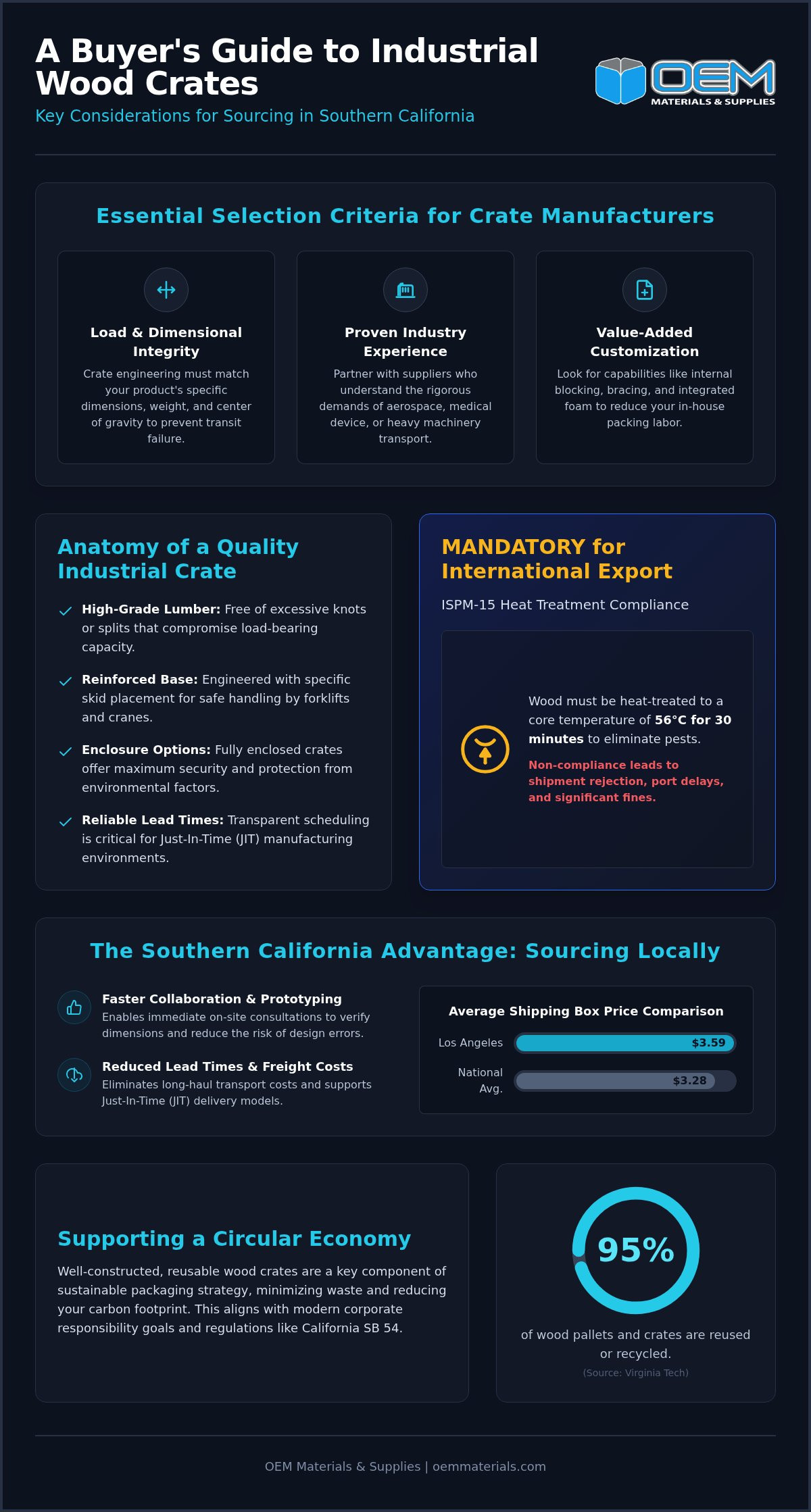
Structural integrity is the primary requirement for any industrial packaging solution. Quality crates utilize high-grade lumber that is free from excessive knots or splits which could compromise the load-bearing capacity. While open crates are common for robust items, fully enclosed wooden shipping containers offer an extra layer of security for delicate components against environmental factors and debris. For any shipment moving through the Ports of Los Angeles or Long Beach to international destinations, ISPM-15 compliance is mandatory. This requires the wood to be heat-treated to a core temperature of 56°C for 30 minutes to eliminate pests, verified by a certified “Wheat” stamp. Non-compliant packaging can lead to immediate shipment rejection and significant fines.
Assessing Manufacturer Reliability
Experienced wood crate manufacturers los angeles will offer transparent communication regarding lead times and delivery schedules. In a JIT (Just-in-Time) manufacturing environment, a delay in packaging delivery can halt your entire shipping department. Look for suppliers who provide detailed case studies or references from clients with similar volume requirements. Reliability also extends to warranty and return policies; a partner should stand behind their construction quality and offer remedies if a crate fails to meet the agreed-upon specifications. Finally, consider their proximity to your facility in Orange County or the Inland Empire, as local sourcing often results in lower freight costs and more responsive service for urgent orders.
Benefits of Sourcing Locally in Los Angeles
Proximity to your production facility is a strategic advantage when managing complex supply chains. Choosing wood crate manufacturers los angeles allows for immediate on-site consultations and rapid prototyping that distant suppliers cannot match. When an engineering team in Orange County or the Inland Empire needs a custom crate for a sensitive aerospace component, a local partner can be on-site within hours to verify dimensions and weight distribution. This physical presence eliminates the friction of remote communication. It significantly reduces the risk of design errors that lead to product damage during transit.
Local sourcing also provides a functional remedy for rising freight costs and extended lead times. Market data shows shipping box prices in Los Angeles average $3.59, which is higher than the national average of $3.28. In this environment, operational efficiency is paramount. By eliminating long-haul transport, you reduce the per-unit shipping cost of the crates themselves. This proximity supports just-in-time delivery models, allowing you to maintain lower inventory levels and free up valuable warehouse floor space. Local expertise saves time. If you are facing urgent shipping deadlines, consulting with a local specialist can provide the agility needed to meet tight windows.
Environmental Considerations
Sustainability in the packaging sector is increasingly driven by legislative mandates and corporate responsibility. Sourcing crates within Southern California minimizes the carbon footprint associated with heavy-duty transportation. The durability of well-constructed wood crates facilitates a circular economy. According to Virginia Tech research, approximately 95% of wood pallets and crates are recovered for reuse or recycling. Under the California SB 54 regulations that went into effect May 1, 2026, reusable packaging is exempt from certain producer responsibility fees. This makes durable, locally manufactured wood crates a fiscally responsible choice compared to single-use alternatives that may incur fees ranging from $0.02 to $0.71 per pound depending on the material treatment.
Local Regulations and Compliance
Operational compliance in Los Angeles is inextricably linked to the activity at the Ports of Los Angeles and Long Beach. Manufacturers in this region are specialized in meeting strict phytosanitary treatment requirements for international export. This involves heat-treating wood to a core temperature of 56°C for 30 minutes to eliminate pests, a process verified by the IPPC “Wheat” stamp. Local experts stay current with these standards and California-specific environmental laws, ensuring your shipments don’t face delays from regulatory oversight. Their familiarity with regional logistics patterns ensures that your industrial packaging meets every necessary legal threshold before it reaches the terminal.
Custom Wood Crate Solutions for Your Needs
Standardized packaging rarely suffices for high-value industrial assets. Professional wood crate manufacturers los angeles provide engineered solutions that go beyond simple boxes by incorporating precise internal blocking and specialized skidding. Customization involves more than just sizing; it includes the integration of custom foam packaging to immobilize delicate components and reinforced bases for heavy machinery. These features are critical for industries like aerospace, where components are often both fragile and exceptionally heavy. When your shipments move through international channels, these custom designs must also adhere to international wood packaging regulations to ensure your cargo passes through customs without quarantine delays.
Active collaboration between your engineering team and the manufacturer is the most effective way to prevent transit damage. By involving a specialist early in the custom packaging design process, you can identify potential points of failure before a single board is cut. This partnership ensures the crate functions as a protective system rather than just a container. Manufacturers who understand the nuances of Southern California logistics can suggest modifications that optimize pallet density, helping you manage dimensional weight costs more effectively.
Case Studies of Successful Custom Solutions
Custom crating solves specific logistical bottlenecks that off-the-shelf options cannot address. For example, a medical device manufacturer in Orange County recently reduced product loss by implementing a crate design with integrated cushioning materials and a shock-absorbing floating deck. This modification eliminated the need for excessive secondary wrap and simplified the packing process for their warehouse staff. In the electronics sector, custom-engineered crates with ESD protection have allowed firms to ship sensitive server components across the Inland Empire with zero reported failures. These practical remedies demonstrate how technical expertise translates into direct operational savings and improved customer satisfaction.
How to Initiate Your Custom Order
Starting a custom project requires a structured exchange of technical data to ensure the final product meets your performance standards. You should provide the manufacturer with exact product dimensions, total weight, and the anticipated shipping method. High-quality crates providers will use this information to develop a prototype. Prototyping is a vital step for high-value or high-volume orders; it allows your team to verify the fit and structural integrity before committing to a full production run. This methodical approach minimizes friction in your supply chain and guarantees that the packaging solution is optimized for your specific application.
Cost Considerations When Choosing Wood Crates
Unit price is only one metric in the total cost of ownership for industrial packaging. When evaluating wood crate manufacturers los angeles, you must consider how material selection and engineering impact your bottom line. High-quality lumber and reinforced construction might carry a higher initial price, but they significantly reduce the frequency of product damage claims and secondary packaging needs. If a crate fails in transit, the cost of the replacement part and the expedited freight far outweighs any initial savings on a cheaper container. For a deeper look into optimizing your budget, consulting with experienced wood crate manufacturers can help identify hidden inefficiencies in your current spend.
Material choices directly influence the final quote. Treated wood required for ISPM-15 compliance involves additional processing time and certification costs compared to domestic-grade timber. However, the regulatory environment in California now favors durability. Under SB 54, reusable packaging is exempt from certain producer responsibility fees that can range from $0.02 to $0.71 per pound for single-use alternatives. By investing in a more robust, reusable design, you avoid these recurring legislative costs while supporting a more sustainable supply chain. Order volume also plays a critical role; manufacturers can offer better rates on bulk orders by optimizing material yields and reducing machine setup time per unit.
Understanding Quotes and Proposals
A transparent proposal should detail more than just the exterior dimensions. Look for a breakdown of internal components, such as blocking, bracing, and integrated custom foam packaging. These internal features are essential for immobilizing high-value assets and are often where “hidden” costs reside if not clearly defined. Ensure the quote includes any hardware requirements, such as hinges or heavy-duty latches, and specifies the delivery terms. If a manufacturer is vague about material grades or lead times, it often leads to unexpected surcharges or production delays that disrupt your shipping schedule.
Negotiating Your Wood Crate Order
Building a long-term partnership with wood crate manufacturers los angeles provides more leverage than transactional, one-off purchases. You can often negotiate better rates by committing to annual usage volumes rather than individual POs. This allows the supplier to pre-purchase lumber at better market rates and schedule production more efficiently. Value-added services like vendor-managed inventory (VMI) or just-in-time delivery can also provide significant indirect savings by reducing your on-site storage requirements and administrative labor. To see how these variables apply to your specific project, request a tailored quote based on your product dimensions and annual usage.
Get Started with OEM Materials & Supplies
Selecting a partner among wood crate manufacturers los angeles is a decision that impacts your entire distribution cycle. OEM Materials & Supplies functions as a technical consultant for businesses across Orange County, Los Angeles County, and the Inland Empire. We provide the engineering expertise required to protect high-value assets in the aerospace, medical, and electronics sectors. Our approach focuses on solving operational challenges like product damage and inefficient packing through precision design. You can explore our range of packaging solutions here to see the structural options available for your specific load requirements.
Beyond the physical crate, we offer value-added services that optimize your internal logistics. Our just-in-time delivery models ensure you have the necessary packaging exactly when your production line needs it, reducing the need for extensive on-site storage. We also provide integrated solutions that combine wood crating with custom foam packaging and corrugated boxes. This comprehensive support allows your procurement team to consolidate vendors and maintain a more organized supply chain.
Requesting a Quote
Obtaining an accurate recommendation requires a detailed exchange of technical specifications. When you contact our team for a tailored quote, providing specific data points ensures the fastest and most precise response. We recommend having the following information ready:
- Product dimensions (length, width, and height)
- Total weight of the item and its center of gravity
- Anticipated shipping method (domestic truckload, LTL, or international ocean/air)
- Annual usage volume to help us identify potential bulk rate opportunities
Our engineers use this data to develop a design that balances structural integrity with material efficiency. For urgent requirements or complex machinery that requires on-site measurement, our team is available for immediate consultations throughout the Southern California region.
Learn More About Our Capabilities
We invite you to examine our broader service offerings to see how they integrate with your current operations. You can explore our custom packaging design services here to understand our prototyping and testing process. For those looking to reduce administrative labor and inventory carrying costs, find out how our vendor-managed inventory can streamline your operations here. We also maintain a full inventory of essential shipping supplies, including stretch film and edge protectors, to ensure every aspect of your palletized load is secured for transit. Our goal is to provide a stable, dependable partnership that allows you to focus on your core manufacturing goals.
Securing Your Supply Chain with Engineered Crating
Identifying the right wood crate manufacturers los angeles is about more than just finding a vendor; it’s about establishing a technical partnership that protects your high-value assets and ensures regulatory compliance. You’ve seen how local expertise in Southern California provides a functional remedy for lead time delays and complex export requirements. By prioritizing custom-engineered designs and understanding the long-term cost benefits of durable, reusable materials, you can significantly reduce product damage and logistical friction.
OEM Materials & Supplies is ready to support your operation with custom solutions tailored to the aerospace, medical, and manufacturing sectors. We combine local expertise with streamlined logistics and delivery options to keep your facility running at peak efficiency. Our team focuses on solving real-world packing challenges through precision engineering and responsive service. To receive a detailed recommendation based on your specific requirements, including product dimensions, weight, and annual usage, request a quote for your wood crate needs today! We look forward to helping you optimize your industrial packaging strategy.
Frequently Asked Questions
What types of wood crates are available for industrial use?
Industrial wood crates range from open-slatted designs for airflow to fully enclosed plywood boxes for maximum security. Skeleton crates provide lightweight protection for robust frames, while heavy-duty skidded crates support massive machinery. Experienced wood crate manufacturers los angeles will select the design based on your product fragility and the shipping environment. Enclosed containers are preferred for sensitive electronics to protect against environmental debris and moisture during long-haul transit.
How do I determine the right size crate for my products?
Determining the correct size requires measuring your product’s widest, longest, and highest points while accounting for internal clearance. You must leave space for cushioning materials like custom foam or bubble wrap to prevent surface abrasion. Total weight and the center of gravity are equally critical; they dictate the placement of skids and reinforced base boards. Providing accurate dimensions ensures the crate is engineered for structural integrity without wasting space that increases dimensional weight costs.
What are the benefits of custom wood crates over standard ones?
Custom crates offer superior protection by eliminating internal movement that causes product damage. Unlike standard sizes, custom solutions incorporate specific blocking and bracing designed for your item’s unique geometry. This precision fit reduces the need for excessive secondary packaging and can lower total landed costs by optimizing pallet density. For industries like aerospace or medical devices, a custom-engineered crate is often the only way to meet rigorous safety and insurance requirements.
How can I ensure my crates meet shipping regulations?
Compliance is achieved by using heat-treated lumber that carries the official IPPC “Wheat” stamp. For international shipments leaving the Port of Los Angeles, wood must be treated to a core temperature of 56°C for at least 30 minutes to satisfy ISPM-15 standards. Working with reputable wood crate manufacturers los angeles ensures your packaging meets these phytosanitary requirements. Non-compliant wood can lead to immediate shipment rejection, quarantine, or significant fines at the destination port.
What factors affect the cost of wood crates?
The total cost is influenced by the lumber grade, the complexity of internal engineering, and the current market price of timber. Specialized features like ISPM-15 heat treatment, heavy-duty hardware, or integrated ESD-safe foam will increase the unit price. However, high-volume orders often qualify for better rates due to production efficiencies. You should also consider the long-term savings from reusable designs, which can be exempt from certain fees under California SB 54 regulations.
How long does it typically take to receive a custom order?
Lead times depend on the design complexity and the total number of units required. While standard designs might be available in a few days, engineered custom crates typically take one to two weeks for production. Sourcing locally in Southern California provides a functional remedy for transit delays, as proximity to your facility allows for faster delivery. Urgent projects can often be expedited if you provide clear specifications and annual usage data during the initial consultation.
Can I get a prototype of my custom crate?
Yes, requesting a prototype is a standard part of the custom design process for high-value or high-volume orders. A physical prototype allows your engineering team to verify the internal fit and test the structural integrity before full-scale production begins. This step is vital for identifying potential points of failure and ensuring the crate interfaces correctly with your handling equipment. Prototyping minimizes the risk of costly design errors and builds trust in the final packaging solution.