
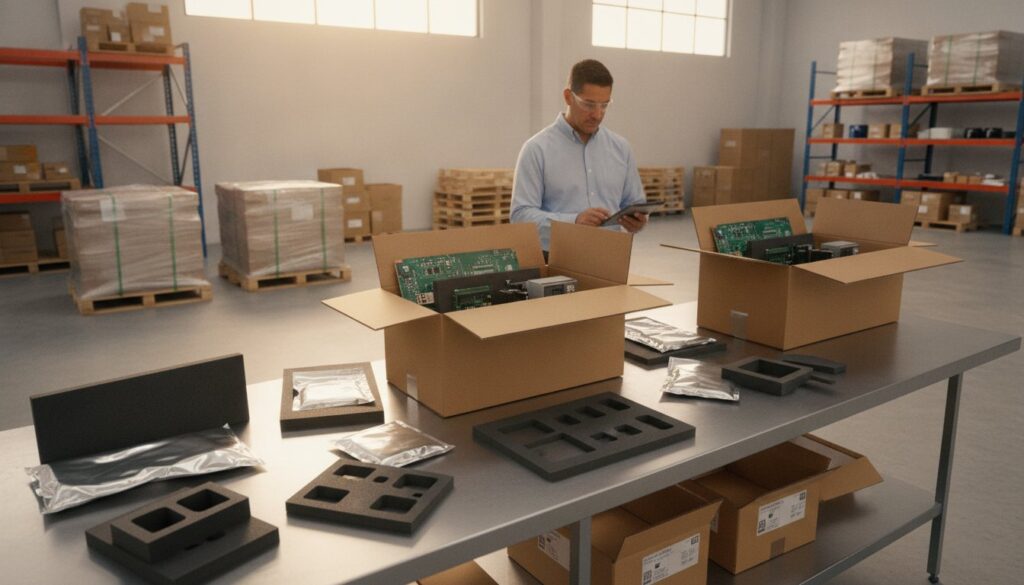
The box is not the product. For electronics manufacturers in Southern California, that distinction matters more than most purchasing managers realize. A corrugated shipper without a properly engineered interior is little more than a container, and sensitive components, circuit boards, and assembled devices deserve considerably more than that. Finding the right electronics packaging company in Los Angeles means finding a partner that understands the difference between containment and protection.
If your operation is absorbing damage claims, chasing down out-of-state suppliers for consistent lead times, or paying skilled labor to handle kitting work that could be systematized, those aren’t isolated problems. They’re symptoms of a packaging supply chain that hasn’t been fully optimized for the demands of electronics manufacturing.
This guide is built for procurement professionals and engineers who want practical answers. You’ll learn how custom foam inserts, corrugated box engineering, and vendor-managed inventory work together as a system rather than a collection of separate line items. You’ll also see why proximity to Los Angeles and Orange County manufacturing corridors can have a direct impact on your production schedule and total cost of ownership.
Key Takeaways
- Industrial electronics packaging is a complete system, not a single product. Understanding how outer corrugated containers and interior cushioning work together is essential for reducing damage claims and total cost of ownership.
- Working with a qualified electronics packaging company in Los Angeles gives Southern California manufacturers a measurable advantage in lead times, freight coordination, and supply chain responsiveness compared to sourcing from national or out-of-state vendors.
- Custom-engineered foam inserts and corrugated structures are designed around your specific product dimensions, weight, and fragility ratings, and prototyping plays a critical role in validating that design before committing to full production volumes.
- Vendor-managed inventory programs can significantly reduce the warehouse space and labor hours your team dedicates to packaging materials, though actual savings depend on your product requirements and order volumes.
- Choosing the right packaging partner means evaluating their experience across regulated industries, their capacity to scale from prototype to high-volume production, and their ability to offer engineering support rather than just off-the-shelf materials.
The Role of Specialized Electronics Packaging in Los Angeles Manufacturing
Industrial electronic packaging covers far more than the corrugated shipper sitting on a loading dock. It encompasses every material layer between a finished product and the hazards of transit, from the structural integrity of the outer container to the foam geometry cradling a circuit board inside. For manufacturers operating in Southern California, that full system has to account for a regional logistics environment that creates specific, measurable risks.
Los Angeles is one of the busiest freight corridors in North America. Products moving through the ports of Los Angeles and Long Beach face dwell time, repeated handling, and consolidation cycles before they ever reach a long-haul carrier. Cross-country shipments from the region accumulate thousands of miles of vibration, temperature cycling, and drop exposure. A packaging system that hasn’t been engineered around those conditions isn’t really protecting your product. It’s just delaying the damage claim.
Electrostatic discharge and mechanical shock are the two failure modes that general-purpose packaging handles worst. Standard polyethylene foam provides cushioning, but it won’t dissipate static charge. Standard corrugated boxes resist compression to a point, but they’re not designed to absorb the resonant frequencies that affect sensitive solder joints over extended freight cycles. Choosing the right electronics packaging company in Los Angeles means working with engineers who understand both failure modes and design against them from the start.
While engineered packaging addresses physical and static threats during transit, protecting sensitive industrial electronics also requires attention to power stability in the facility; to learn about advanced surge protection for your operations, visit Energy Control Systems.
Why General Packaging Fails Electronics OEMs
Off-the-shelf packaging solutions are built around average conditions. Electronics OEMs don’t ship average products. For example, specialized manufacturers like oemhomeappliances that produce precision kitchen and portable cooking equipment require packaging that shields sensitive internal components from vibration and shock. Heavy assemblies with fragile connectors, multi-layer PCBs with fine-pitch components, and precision-calibrated instruments all require interior structures that hold position, distribute load, and prevent contact between surfaces. General suppliers rarely have the technical vocabulary to specify foam density, compression deflection values, or ESD-safe material requirements. That gap in expertise translates directly into field failures and warranty costs.
The Economic Impact of Shipping Damage
The unit replacement cost of a damaged component is only the starting point. Add return freight, inspection labor, administrative processing, and potential production line delays at the receiving facility, and the true cost of a single damage event can be several times the product value. Across a full year of shipments, inadequate packaging can quietly erode margins in ways that never appear as a single line item on a P&L. Custom-engineered foam packaging and properly spec’d corrugated boxes carry upfront design costs, but those costs are generally offset by measurable reductions in damage claims and returns, though actual savings will depend on your product type, shipping volume, and carrier handling conditions.
Key Components of Industrial Electronics Packaging Systems
Every effective electronics packaging system operates as two coordinated layers working in concert. The outer container manages the external environment: stacking loads from warehouse pallets, puncture risks from forklifts and conveyor systems, and compression forces during freight consolidation. The interior structure handles everything the outer box can’t, which is holding the product in precise position and absorbing the mechanical energy that would otherwise transfer directly to sensitive components. Neither layer performs adequately without the other.
Material selection drives this entire equation. A lightweight consumer device and a 40-pound industrial controller require fundamentally different structural specifications, even if their outer dimensions are similar. Fragility ratings, expressed as the maximum G-force a product can withstand before sustaining damage, determine how much cushioning work the interior system must perform. Getting that calculation wrong in either direction creates problems: under-engineered inserts allow movement and impact damage, while over-engineered systems add unnecessary material cost and weight.
Custom Corrugated Boxes for Electronics
Heavy industrial electronics, including power supplies, motor drives, and rack-mounted assemblies, typically require double-wall or triple-wall corrugated construction. The additional flute layers increase edge crush test (ECT) ratings and box compression strength, which matters considerably when units are stacked four or five high on a pallet moving through a regional distribution center. Die-cut designs take this further by eliminating the dimensional tolerances that create internal movement. A box engineered to your exact product footprint reduces material waste and removes the slack that allows a product to shift during transit. Integrating custom corrugated boxes into a broader logistics strategy also means specifying print zones for handling instructions, orientation arrows, and fragile indicators in positions that actually get read by warehouse personnel rather than buried on a bottom flap.
Southern California’s electronics manufacturing base is substantial. Los Angeles manufacturing employment data from the U.S. Bureau of Labor Statistics reflects a dense concentration of production and assembly operations across the region, which means local packaging engineers have real exposure to the specific product categories and transit routes that affect corrugated performance requirements here.
Engineered Foam Inserts and Cushioning
Polyethylene and polyurethane foam serve different functions, and choosing between them requires understanding your product’s specific vulnerability profile. Polyethylene foam is a closed-cell material with consistent density across its structure. It resists moisture, holds its shape under repeated compression cycles, and works well for products that need firm, defined support. Polyurethane foam is an open-cell material that conforms more readily to irregular geometries and offers a softer cushioning response, making it better suited for products with delicate external features or complex surface contours.
Foam density is the variable that most directly controls shock absorption performance. Low-density foam deflects easily but bottoms out under heavier loads, allowing impact energy to pass through to the product. Higher-density formulations resist bottoming out but may transmit too much force for fragile assemblies. Matching density to the product’s weight and fragility rating is an engineering decision, not a catalog selection. That’s precisely where working with a qualified electronics packaging company in Los Angeles adds measurable value: the ability to use foam packaging to create custom nests that cradle complex geometries, isolate connector arrays, and prevent surface contact between adjacent components within the same shipper.
If you’re specifying a new packaging system or reviewing an existing one that’s generating damage claims, sharing your product dimensions, weight, and fragility rating with a packaging engineer is the fastest way to get an accurate material recommendation. Request a packaging review to start that conversation with specific data rather than general assumptions.
Custom Engineering for Fragile Electronic Components
Effective packaging design for electronics starts with measurement, not assumption. Before any material is specified or any tool path is cut, a qualified packaging engineer needs the complete dimensional profile of the product: length, width, height, weight, center of gravity, and the location of any external features that are particularly vulnerable to contact or pressure. That information drives every subsequent decision, from foam density selection to corrugated wall construction. Skipping that analysis and defaulting to a close-enough standard size is how damage claims accumulate.
G-force ratings are central to this process. Every electronic assembly has a threshold, expressed in G-forces, above which internal components sustain damage. That threshold determines the minimum cushioning thickness required to absorb a drop event without transmitting destructive energy to the product. A packaging engineer uses that rating alongside the product’s weight to calculate the foam deflection curve needed for adequate protection. The result is a precisely specified insert, not an approximated one. Working with an experienced electronics packaging company in Los Angeles means that calculation gets done correctly before production begins, not after a field failure prompts a redesign.
Design optimization is another outcome of this engineering process that often surprises procurement teams. When interior geometry is engineered precisely around the product, the outer container frequently gets smaller. A tighter, more efficient package reduces dimensional weight charges on freight invoices, lowers pallet cube utilization, and decreases material consumption per unit. Those reductions compound across high shipment volumes, though actual savings will depend on your carrier agreements and specific product configuration.
The Prototyping Process
Physical prototyping bridges the gap between a CAD drawing and a production-ready packaging system. Once initial dimensions are confirmed, sample foam inserts and corrugated structures are fabricated for fitment testing with the actual product. This step catches problems that software can’t predict: a connector that protrudes further than the drawing indicated, a cable that needs a dedicated routing channel, or an accessory kit that requires a secondary tray. Rapid prototyping capabilities are particularly valuable for electronics companies managing product launch schedules, where packaging validation needs to run parallel to final product testing rather than sequentially after it. Iterative refinement during this phase ensures every component in the kit has a defined, secure position before the design is released to full production runs. Learn more about custom packaging design options that support this process.
Addressing Electrostatic Discharge (ESD)
Mechanical protection addresses only half of the risk profile for sensitive electronics. Electrostatic discharge is a failure mode that leaves no visible mark on a component but can degrade performance or cause latent failures that surface weeks after a product reaches the end customer. ESD-safe materials work by dissipating static charge across the surface of the packaging rather than allowing it to build up and discharge through the product. This applies to both foam inserts and corrugated materials, which can be manufactured with anti-static additives integrated into the material itself rather than applied as a surface coating that wears away with handling.
Specifying a complete ESD-compliant packaging system means ensuring that every layer the product contacts, from the inner foam nest to the outer corrugated liner, meets the relevant industry standards for electrostatic protection. A packaging system that uses ESD-safe foam inside a standard corrugated shipper is only partially protected. The full system has to be evaluated together. If you’re sourcing packaging for circuit boards, power electronics, or precision instruments, confirm that your supplier can specify and source ESD-compatible materials across the entire interior structure, not just a single component of it. Foam packaging engineered for electronics applications should address this requirement explicitly during the design phase.
If your current packaging system was specified without a formal G-force analysis or ESD review, it may be worth requesting a packaging audit before your next production run. Sharing your product weight, fragility rating, and annual shipment volume with a packaging engineer is the fastest way to determine whether your existing design is leaving you exposed. Request a packaging review with that data in hand to get a specific recommendation rather than a general one.
Optimizing the Supply Chain for Southern California Electronics Hubs
Custom-engineered packaging solves the protection problem. Supply chain structure determines whether that packaging actually arrives when your production line needs it. For electronics manufacturers operating in Los Angeles and Orange County, those two challenges are equally consequential, and solving one without addressing the other leaves real operational risk on the table.
Working with a local electronics packaging company in Los Angeles compresses the distance between your facility and your packaging supplier in ways that directly affect production scheduling. Out-of-state vendors introduce freight transit variability that local suppliers don’t. When a production run accelerates or a product revision requires a packaging change, proximity matters. A supplier located within the Southern California logistics corridor can respond to those changes on a timeline that a national vendor simply can’t match without expedite fees.
Vendor-Managed Inventory (VMI) for Manufacturers
Packaging materials are bulky relative to their unit cost. Corrugated shippers, foam inserts, and cushioning materials consume floor space that most electronics facilities would rather dedicate to actual manufacturing and assembly. A packaging VMI program transfers the inventory management responsibility to the supplier, who monitors stock levels and replenishes materials before a stockout occurs. The practical result is a leaner facility footprint, fewer emergency purchase orders, and less administrative overhead for your procurement team. Rather than managing reorder points across multiple packaging SKUs, your team sets consumption parameters and the supplier handles the rest.
The administrative reduction is worth noting separately. Frequent small-batch purchase orders for packaging materials generate disproportionate processing costs relative to their value. Consolidating that activity under a VMI agreement reduces transaction volume without reducing supply reliability.
Kitting and Assembly Services
Receiving individual packaging components and assembling them at the packing station is a labor cost that rarely gets scrutinized closely enough. When a technician or line operator has to place foam inserts, position a product, add accessory trays, and apply labels as discrete steps, that time accumulates across every unit shipped. Just-in-time packaging delivery paired with pre-assembled kitting services changes that equation. Packaging arrives at the packing station as a complete, ready-to-use unit: box, foam nest, and labeling already integrated. The operator secures the product and closes the shipper.
Consistency improves alongside efficiency. When kitting is handled by a supplier with a defined assembly process, the variation that creeps in across different shifts and operators is largely eliminated. Products are secured the same way every time, which directly supports the damage reduction work done at the engineering stage.
If your facility is absorbing packaging-related labor costs or managing more floor space than your production footprint requires, a structured VMI and kitting arrangement is worth evaluating against your current approach. Request a supply chain review with your current packaging volumes and facility constraints to get a practical assessment of what a local program could realistically deliver.
Partnering with an Electronics Packaging Company in Los Angeles
The selection of an electronics packaging company in Los Angeles is a strategic decision that affects your bottom line as much as your engineering specifications. You aren’t just buying containers; you’re securing your product’s integrity through a complex logistics network. A qualified partner must demonstrate more than just material availability. They need to show they can handle the transition from a single rapid prototype to a high-volume production run without losing dimensional accuracy or material consistency.
Experience in highly regulated sectors like aerospace and medical device manufacturing is a reliable indicator of capability. These industries demand strict adherence to tolerances and material certifications. If a supplier can meet the rigorous requirements of a flight-critical component or a surgical instrument, they possess the quality control systems necessary for industrial electronics. Local delivery and the availability of emergency support during production spikes are also critical. When your line is running at capacity, you can’t afford to wait for a shipment from out of state.
A reliable partner should offer a comprehensive audit of your current packaging costs and damage rates. This process isn’t a sales pitch; it’s a technical review. By analyzing where failures occur and where material is being wasted, a supplier can propose changes that reduce the total cost of ownership. These improvements often come from better engineering rather than simply switching to cheaper materials, though actual savings depend on your specific product requirements and shipping methods.
Criteria for Selecting a Packaging Supplier
Verify whether the supplier offers in-house design and engineering support. Outsourcing these functions often leads to communication gaps and longer lead times. You also need a partner who can provide a full suite of materials, including plastic pallets, stretch film, and edge protectors. This consolidation simplifies your procurement process and ensures material compatibility across your entire pallet load. For more guidance on vetting industrial suppliers, learn more about choosing corrugated packaging box manufacturers for industrial needs.
Next Steps for Los Angeles Manufacturers
Manufacturers in the Southern California area should start with a structured packaging review to identify hidden inefficiencies in their packing stations and transit methods. This review often reveals opportunities to reduce labor costs through kitting or to free up warehouse space through vendor-managed inventory. When you’re ready to move forward, request a quote based on your specific product data rather than general estimates.
Contact OEM Materials & Supplies today to schedule a consultation or a formal packaging review. To help our engineering team provide the most accurate recommendation, please be prepared to provide specific data points including product dimensions, weight, fragility ratings, and annual usage volumes. We focus on reducing your total packaging costs and improving shipping efficiency through custom design and dedicated local support.
Optimizing Your Electronics Logistics Strategy
Transitioning from standard packaging to an engineered system is a primary step in reducing damage claims and controlling your total cost of ownership. By integrating custom foam nests with high-strength corrugated boxes, you address the specific G-force vulnerabilities of your components while streamlining your packing station efficiency. This approach moves packaging from a variable expense to a controlled, technical asset within your production line.
Proximity to your supplier remains a critical advantage for Southern California manufacturers. Partnering with a specialized electronics packaging company in Los Angeles allows for rapid prototyping and responsive vendor-managed inventory programs that out-of-state vendors can’t match. This local support is vital for the aerospace and medical device sectors where precision and lead time consistency are non-negotiable.
Ready to improve your shipping reliability? Contact OEM Materials & Supplies for a custom electronics packaging consultation to discuss your specific requirements. Providing data on your product dimensions, weight, and fragility will help our engineers develop a solution that reduces your total packaging spend. We look forward to supporting your production goals.
Frequently Asked Questions About Electronics Packaging
How does custom foam density protect sensitive electronics?
Foam density determines how much energy a cushioning insert absorbs before it bottoms out and transfers force directly to your product. Low-density foam deflects easily under light loads but can’t handle heavier assemblies without collapsing, allowing impact energy to reach sensitive components. Higher-density formulations resist that collapse but may transmit too much force for delicate boards or connectors. The right density is calculated against your product’s specific weight and fragility rating, not selected from a standard catalog.
Getting that calculation right matters because the consequences of getting it wrong aren’t always immediate. A foam insert that’s marginally under-specified may allow subtle movement during extended freight cycles, causing latent damage to solder joints or connector pins that surfaces after the product reaches the end customer rather than at incoming inspection.
What is the benefit of using a local Los Angeles packaging company?
Working with an electronics packaging company in Los Angeles compresses the response window for every supply chain event that matters: production accelerations, packaging revisions, prototype iterations, and emergency replenishment. Out-of-state vendors introduce freight transit variability that a local supplier doesn’t. When your line schedule shifts or a product revision requires a corrugated redesign, proximity means changes can be implemented in days rather than weeks, and without the expedite freight charges that national suppliers typically add.
Local suppliers also have direct familiarity with the Southern California logistics environment, including the handling conditions products face moving through the ports of Los Angeles and Long Beach and into regional distribution networks. That regional knowledge informs better packaging specifications from the start.
Can custom packaging help reduce my overall shipping costs?
It can, though actual savings depend on your carrier agreements and specific product configuration. When interior geometry is engineered precisely around a product, the outer container frequently gets smaller and lighter. Carriers bill on dimensional weight for many shipment types, so a tighter, more accurate package reduces freight charges per unit. Better pallet cube utilization also means more units per load, which lowers cost-per-unit on outbound freight across high shipment volumes.
There’s also a less obvious cost reduction: fewer damage claims. Return freight, inspection labor, replacement units, and administrative processing all carry real costs that don’t appear as a single line item. Custom-engineered packaging reduces those events, which directly improves your total cost of ownership across a full shipping cycle.
Do you provide ESD-safe packaging materials for electronics?
ESD-compatible materials are available for electronics applications, including foam inserts and corrugated components manufactured with anti-static additives integrated into the material itself rather than applied as a surface coating. Surface coatings wear away with repeated handling; integrated formulations maintain their dissipative properties throughout the packaging’s service life. If your products include circuit boards, power electronics, or precision instruments, we’d recommend discussing ESD requirements during the initial design phase rather than addressing them as an afterthought.
A complete ESD-compliant system means every layer the product contacts meets the relevant protection standard. A dissipative foam nest inside a standard corrugated shipper provides only partial protection. We evaluate the full interior structure together to confirm the system performs as specified. If you’re unsure whether your current packaging meets ESD requirements, that’s a practical starting point for a packaging review.
How long does the prototyping process take for custom electronics boxes?
Prototyping timelines vary based on the complexity of the product geometry and the number of revision cycles required. Simple configurations with standard dimensions typically move faster than multi-component kits with irregular geometries or dedicated accessory trays. What’s consistent is the process: initial dimensions are confirmed, sample inserts and corrugated structures are fabricated, and fitment testing is conducted with the actual product before any design is released to full production. We’d encourage you to share your product data and launch timeline directly so we can give you a realistic assessment rather than a general estimate.
What information should I provide for a custom packaging quote?
The most useful starting point is product dimensions, weight, center of gravity, and fragility rating expressed in G-forces if you have it. If your product includes accessories, cables, or secondary components that ship in the same unit, those need to be accounted for in the interior design as well. Annual shipment volume helps determine whether a vendor-managed inventory arrangement makes sense alongside the packaging design itself.
If you don’t have a formal fragility rating, that’s not a barrier to getting started. A packaging engineer can work through the relevant factors with you based on product type and component sensitivity. The more specific the data you bring to that conversation, the more accurate the material recommendation will be.
Is vendor-managed inventory available for electronics manufacturers in Orange County?
VMI programs are available to manufacturers throughout the Southern California region, including Orange County. The structure is straightforward: you set consumption parameters, and we monitor stock levels and replenish packaging materials before a stockout occurs. That arrangement removes the reorder point management and emergency purchase order cycle from your procurement team’s workload, and it reduces the floor space your facility dedicates to storing bulky corrugated and foam materials.
For electronics manufacturers managing multiple packaging SKUs across different product lines, the administrative consolidation is often as valuable as the space savings. Contact us with your current packaging volumes and facility constraints to get a practical assessment of what a local VMI program could realistically deliver for your operation.
What are the differences between polyethylene and polyurethane foam for electronics?
Polyethylene is a closed-cell foam with a consistent, firm structure across its density range. It resists moisture absorption, holds its shape through repeated compression cycles, and provides defined, stable support for products with predictable load points. It’s a strong choice for heavier assemblies or products that need precise positional control within the shipper. Polyurethane is an open-cell foam that conforms more readily to complex surface geometries and offers a softer cushioning response, which suits products with delicate external features or irregular contours that a firmer insert might stress.
Neither material is universally superior; the right choice depends on your product’s weight, geometry, and fragility profile. In some applications, both materials appear in the same insert, with polyurethane handling contact surfaces and polyethylene providing structural support beneath. A packaging engineer can specify the correct combination once your product data is on the table.