

Is the pursuit of the lowest unit price from a dozen different suppliers actually eroding your bottom line through hidden administrative and logistical costs? Many operations managers in Southern California believe that sourcing corrugated boxes from one vendor and custom foam inserts from another creates a competitive advantage. However, managing fragmented purchase orders and coordinating multiple LTL shipments often introduces more risk than reward. When quality varies between suppliers or communication gaps lead to production delays, the perceived savings from individual unit prices quickly evaporate.
Understanding the full scope of packaging vendor consolidation benefits reveals how a unified supply chain reduces administrative friction and lowers your total landed costs. By consolidating your requirements with a single-source partner, you can eliminate the integration tax that comes with managing a complex vendor list. This article examines how transitioning to a strategic partner for custom packaging, kitting, and vendor-managed inventory improves operational reliability and optimizes warehouse space. Discover how a streamlined procurement process leads to more predictable lead times and more consistent protection for your high-value components.
Key Takeaways
- Identify the hidden integration tax created by managing multiple specialized suppliers for corrugated boxes and custom foam.
- Learn how maximizing freight efficiency through consolidated shipments reduces receiving dock congestion in Southern California facilities.
- Evaluate the primary packaging vendor consolidation benefits, such as lower total landed costs and improved operational reliability.
- Explore how Vendor Managed Inventory and assembly services shift the logistical burden and labor requirements away from your internal team.
- Discover the framework for conducting a comprehensive packaging audit to transition from commodity purchasing to a strategic partnership.
Understanding the Hidden Costs of Packaging Vendor Sprawl
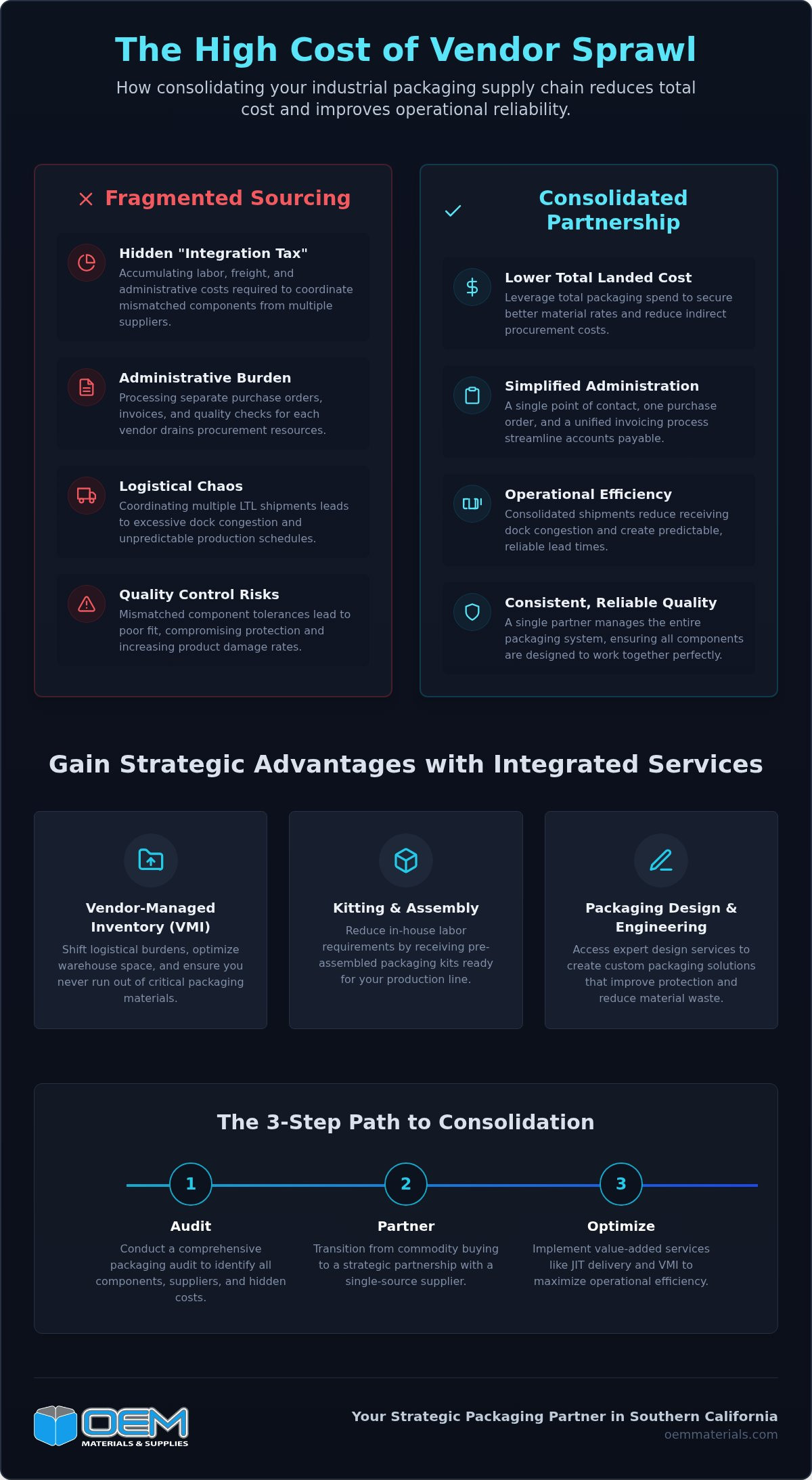
Vendor sprawl occurs when a manufacturer accumulates a fragmented list of suppliers for individual packaging components. One vendor provides the corrugated boxes, another supplies the protective foam, and a third delivers the pallets or stretch film. While this approach might seem to offer the best price on individual units, it creates a significant integration tax. This tax represents the hidden labor, freight, and administrative costs required to align materials that were never designed to work together as a cohesive system. Realizing the full range of packaging vendor consolidation benefits requires a shift from managing individual commodities to managing a unified logistics platform.
Regional manufacturers in Los Angeles County and San Diego County often find that coordinating multiple LTL shipments from different vendors leads to excessive dock congestion and higher freight costs. When these materials arrive at different times, your production schedule is at the mercy of the slowest supplier. If a box supplier’s lead time slips but the foam supplier delivers on time, your warehouse floor becomes a staging area for unfinished kits. This friction reduces operational velocity and ties up capital in disconnected inventory.
The Administrative Burden of Multiple Suppliers
Processing separate purchase orders for every component is a drain on procurement resources. Every additional vendor requires unique onboarding, separate invoicing, and distinct delivery coordination. When you multiply these tasks across dozens of suppliers, the labor hours spent on administrative oversight often outweigh any perceived savings from low unit prices. A consolidated approach simplifies the accounts payable process and allows your team to focus on higher-value supply chain optimizations. Communication gaps also become a liability during design changes; notifying five separate vendors about a single dimension adjustment increases the risk of receiving obsolete or incompatible materials.
Quality Control Risks in a Fragmented Model
Fragmented sourcing introduces variance into your protective packaging. If your foam packaging inserts come from a different manufacturer than your outer cartons, you risk tolerance stack-up issues. Slight variations in material thickness or density can lead to a poor fit, which increases the likelihood of product damage during transit. Ensuring consistent quality across all components is much simpler when a single partner manages the design and production of the entire system. For a deeper look at financial optimization, consider understanding packaging cost savings through holistic design and material selection that ensures every component works in tandem.
Financial Benefits of Consolidating Your Packaging Supply Chain
Managing packaging as a series of isolated transactions often results in missed financial opportunities. When you spread your spend across multiple vendors, you lack the leverage necessary to secure the most competitive contract terms. One of the primary packaging vendor consolidation benefits is the ability to aggregate your total annual usage of corrugated boxes, foam inserts, and stretch film into a single, high-value account. This shift transforms you from a minor customer at many shops to a priority partner at one, providing a stronger position for negotiating material price floors and stabilizing your supply chain against market fluctuations.
Leveraging Volume for Better Material Rates
Industrial packaging suppliers with multi-material expertise buy raw materials like linerboard and polyethylene resin in massive quantities. By consolidating your spend, you tap into this upstream purchasing power. Instead of negotiating a few hundred custom crates or foam kits at a time, your partner can bundle these requirements into a strategic volume commitment. This approach doesn’t just lower the unit price; it also secures priority production scheduling. During periods of material shortages, single-source partners are more likely to protect the inventory levels of their consolidated accounts compared to transactional, low-volume buyers.
Reducing Indirect Procurement Costs
Direct material savings are only half the story. The indirect costs of procurement, such as the time spent vetting new suppliers or managing redundant prototyping fees, can be substantial. When you utilize custom packaging design services from a single provider, you eliminate the cost of coordinating between separate engineering teams. A unified design process ensures that the foam density perfectly complements the corrugated board grade on the first try. This efficiency reduces the need for multiple rounds of drop testing and revisions, which saves both time and money.
Standardizing your payment terms with one primary partner also improves cash flow predictability. Rather than juggling dozens of different net-term agreements and delivery fees, you move to a streamlined accounts payable model. This reduction in administrative touchpoints allows your procurement team to focus on strategic inventory management rather than chasing down invoice discrepancies. If you’re looking to audit your current spend for potential savings, you can request a comprehensive quote to see how a consolidated program compares to your existing fragmented model.
Operational Efficiency and Logistics Optimization
The physical movement of packaging materials often represents a significant portion of a manufacturer’s total landed cost. When sourcing is fragmented, your receiving dock becomes a bottleneck for multiple Less-Than-Truckload (LTL) shipments arriving at different times. Each delivery requires labor for unloading, inspecting, and processing within your ERP system. One of the strategic packaging vendor consolidation benefits is the ability to synchronize the arrival of disparate components. By combining corrugated boxes, plastic pallets, and stretch film onto a single truckload, you reduce dock congestion and minimize the forklift labor required for internal material handling.
Freight Consolidation and LTL Reduction
Consolidating your supply chain allows for superior pallet cube utilization. Specialized vendors often ship pallets that are under-utilized because they only provide one type of material, such as lightweight foam or bulky cartons. A single-source partner can mix these items to maximize trailer space, effectively moving your operation from expensive LTL rates to more economical full truckload deliveries. For manufacturers in San Diego County and Orange County, this logistics optimization is critical for navigating high regional freight costs and strict delivery windows. Centralizing your shipments also reduces the carbon footprint of your supply chain by eliminating redundant delivery routes.
Warehouse Space and Inventory Management
Maintaining safety stock for dozens of different vendors consumes valuable floor space that could otherwise be used for production. Fragmented sourcing forces you to manage separate lead times and minimum order quantities for every component, often leading to overstocking to prevent shortages. Transitioning to a primary partner enables more sophisticated inventory strategies, such as Just-In-Time (JIT) delivery. This approach ensures that your custom foam packaging arrives exactly when your boxes are ready for assembly. Centralized inventory visibility allows you to monitor stock levels across all categories through a single point of contact, reducing the risk of production-stopping stockouts. For more insights on selecting the right partner for these requirements, refer to our Corrugated Packaging Box Manufacturers Guide.
Advanced Consolidation: VMI and Kitting Services
Strategic consolidation goes beyond simply reducing the number of invoices your team processes. It involves shifting the operational burden of inventory management and physical assembly to a partner who specializes in these functions. By utilizing Vendor Managed Inventory (VMI) and kitting services, manufacturers can realize the full range of packaging vendor consolidation benefits. This approach transforms packaging from a series of raw materials into a streamlined, ready-to-use system that supports high-velocity production lines. Eliminating the friction between procurement and the production floor is essential for maintaining a lean operation.
Vendor Managed Inventory (VMI) for Industrial OEMs
A primary challenge for supply chain professionals in the Inland Empire and Orange County is preventing production shutdowns due to unexpected stockouts of critical packaging components. Packaging VMI services eliminate this risk by granting your supplier real-time visibility into your usage patterns. Instead of your team manually tracking inventory levels for corrugated boxes or protective foam, your partner automatically replenishes stock based on agreed-upon minimum and maximum levels. This automated workflow reduces the administrative friction of constant reordering and ensures that your warehouse space is optimized for current production needs rather than excessive safety stock. This level of integrated procurement is one of the key packaging vendor consolidation benefits that directly impacts your operational uptime.
Kitting and Assembly as a Labor Solution
Internal assembly lines for complex packaging kits are often an inefficient use of skilled labor. For manufacturers in the aerospace and medical device sectors, the precision required to assemble multi-component kits can be time-consuming and prone to error. Consolidation allows you to receive ready-to-use units where the protective foam is already inserted into the outer carton or the custom wood crate. This eliminates the need for on-site assembly stations and reduces material waste by ensuring every component matches perfectly before it reaches your facility.
For machinery manufacturers in Riverside County, receiving pre-assembled kits allows their team to focus on core production tasks rather than folding boxes or gluing foam inserts. This shift reduces the footprint required for packaging assembly and simplifies the training process for warehouse staff. If your operation is struggling with high labor costs or inconsistent assembly quality, you can request a quote for a custom kitting program to see how pre-assembled units can streamline your floor operations.
How to Implement a Packaging Vendor Consolidation Strategy
Implementing a packaging vendor consolidation strategy requires a methodical approach to ensure production continuity. It is not merely a change in billing; it’s a fundamental shift in how your operation manages its physical assets. To capture the full range of packaging vendor consolidation benefits, manufacturers must move beyond transactional purchasing toward a structured, phased implementation. This process begins with data transparency and ends with a synchronized supply chain that responds to real-time production demands.
Step 1: The Packaging Spend and Material Audit
The first stage is a comprehensive audit of every SKU currently in your warehouse. Document everything from custom corrugated boxes and foam packaging inserts to auxiliary items like edge protectors and stretch film. Analyzing your total landed costs is critical. This includes the unit price, freight expenses, administrative labor for PO processing, and the cost of warehouse floor space occupied by safety stock. This audit often reveals redundant items that can be standardized across multiple product lines, which reduces inventory complexity and simplifies procurement.
Step 2: Selecting a Full-Service Solutions Partner
Choose a partner that demonstrates technical expertise across multiple material types. An ideal candidate should possess in-house capabilities for custom packaging design and rapid prototyping. This ensures that your foam, corrugated, and wood crates are engineered as a single, high-performance system. For manufacturers in the Inland Empire and San Diego County, regional support is a vital factor. Verify that the supplier has the delivery infrastructure to support your local facilities with reliable, short-distance freight. Requesting prototypes of your most complex kits allows you to verify quality consistency before fully transitioning your account.
Establishing clear Key Performance Indicators (KPIs) for the transition period is essential for measuring success. Monitor metrics such as lead time accuracy, receiving dock throughput, and the reduction in accounts payable touchpoints. Phasing the consolidation by product line or facility minimizes disruption to active production programs. This measured approach ensures your operation realizes the expected packaging vendor consolidation benefits without compromising delivery schedules or quality standards.
Optimizing Your Supply Chain for Long-Term Reliability
Transitioning from fragmented vendor management to a strategic partnership is a functional remedy for the hidden integration tax on your production floor. By centralizing the procurement of corrugated boxes, custom foam, and logistics services, you eliminate the friction of misaligned lead times and inconsistent material quality. These packaging vendor consolidation benefits extend beyond simple unit price savings; they include improved warehouse utilization and significantly lower administrative overhead. Your team can stop managing dozens of purchase orders and start focusing on core manufacturing objectives.
OEM Materials & Supplies acts as a seasoned industry partner for manufacturers throughout Los Angeles, Orange County, San Diego, and Riverside. We provide comprehensive industrial support ranging from engineered foam kits to heavy-duty wood crates and VMI programs. To begin your transition toward a more efficient supply chain, contact OEM Materials & Supplies for a packaging audit and quote. Providing specific data such as product dimensions and annual usage will help us develop a tailored solution for your facility. Streamlining your vendor list is a strategic investment in your operational velocity and bottom-line stability.
Frequently Asked Questions
What is packaging vendor consolidation?
Packaging vendor consolidation is the strategic process of reducing the number of suppliers used for materials like corrugated boxes, engineered foam, and stretch film. Instead of managing dozens of niche vendors, an operation partners with a single-source provider capable of engineering and supplying the entire packaging system. This shift moves procurement away from transactional bidding toward a more integrated, strategic relationship that prioritizes total supply chain health.
How does consolidating vendors reduce total packaging costs?
Consolidation lowers costs by eliminating the hidden administrative and logistical expenses associated with fragmented sourcing. By aggregating your spend, you gain leverage for volume pricing while reducing the labor hours spent on processing dozens of individual purchase orders and invoices. Combining items like boxes and pallets onto single truckloads also reduces freight expenses and receiving dock congestion, which are key packaging vendor consolidation benefits.
Will vendor consolidation limit my ability to find specialized packaging solutions?
Choosing a partner with multi-material expertise actually improves your access to specialized solutions. A full-service partner understands how different materials, such as ESD foam and heavy-duty corrugated, interact within a single kit. This holistic design approach often results in better product protection and more efficient packing than sourcing components from separate vendors who don’t see the final assembly requirements.
What are the risks of relying on a single packaging supplier?
The primary risk is a potential single point of failure if a supplier faces material shortages or production issues. You can mitigate this risk by selecting a partner with robust regional infrastructure and diverse raw material sources across Southern California. Professional suppliers maintain safety stock and have multiple production lines to ensure your operations remain uninterrupted during market fluctuations or supply chain disruptions.
How do I know if my operation is a good candidate for consolidation?
Your operation is a strong candidate if your procurement team spends excessive time managing dozens of small-volume purchase orders for different components. Other indicators include frequent production delays due to misaligned lead times between box and foam suppliers or high freight costs from multiple LTL shipments. If you utilize complex packaging kits requiring multiple materials, the efficiency gains from a single-source partner are usually substantial.
What is the role of VMI in a consolidated packaging strategy?
Vendor Managed Inventory (VMI) acts as the operational engine for consolidation by shifting the burden of stock management to the supplier. The partner monitors your usage levels in real-time and automatically triggers replenishment for all your packaging categories. This automation is one of the most significant packaging vendor consolidation benefits, as it prevents production-stopping stockouts while freeing up warehouse space and internal labor.
Can consolidation help with sustainable packaging goals?
Consolidation naturally supports sustainability by optimizing logistics and reducing material waste. Combining shipments reduces the carbon footprint associated with multiple delivery routes to your facility. A single partner can also engineer your entire kit to use the minimum amount of material necessary for protection, eliminating the over-packaging that often occurs when components are designed in isolation by different vendors.
How long does the transition to a consolidated vendor typically take?
A typical transition takes between 30 and 90 days, depending on the complexity of your SKUs and current inventory levels. The process begins with a comprehensive material audit followed by prototyping and testing to ensure quality consistency across all categories. Phasing the rollout by product line or department allows your team to adjust to the new workflow without disrupting active manufacturing schedules.