
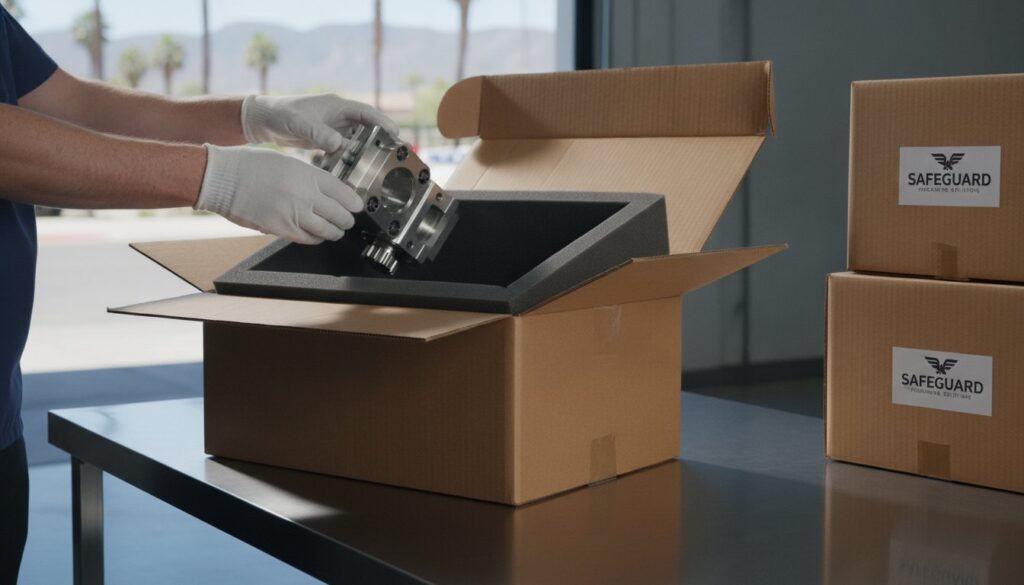
Over-packaging is not a safety net; it is an expensive inefficiency that eats into your operational margins. When an industrial shipment arrives at a facility in Los Angeles or San Diego with crushed corners or internal shock damage, the cost of the replacement part is only the beginning of your losses. You also sacrifice labor hours, repeated shipping fees, and professional credibility. Many operations struggle to find the precise balance between under-protecting fragile components and wasting money on excessive materials that drive up dimensional weight and freight costs.
Effective protective packaging is a deliberate engineering strategy rather than a series of random material choices. By understanding the technical relationship between material density, vibration dampening, and structural design, you can eliminate transit damage while simultaneously reducing your total spend. This guide provides a clear framework for building a multi-layered approach using custom foam, corrugated solutions, and specialized cushioning materials. We will examine how to select the right internal and external components for your specific application to improve warehouse throughput and ensure every shipment arrives intact.
Key Takeaways
- Identify the four primary physical threats including shock, vibration, compression, and atmospheric conditions to build a defense-in-depth strategy.
- Learn how to select internal protective packaging materials like custom foam based on product density and energy absorption requirements.
- Evaluate corrugated boxes using ECT and Mullen Burst ratings to ensure structural integrity against puncture and stacking loads.
- Discover how to unitize loads effectively with proper stretch film and pallet selection to prevent shifting or collapse during transit.
- Explore how custom packaging design and vendor-managed inventory (VMI) reduce material waste and optimize labor costs in the supply chain.
Understanding the Role of Protective Packaging in Industrial Logistics
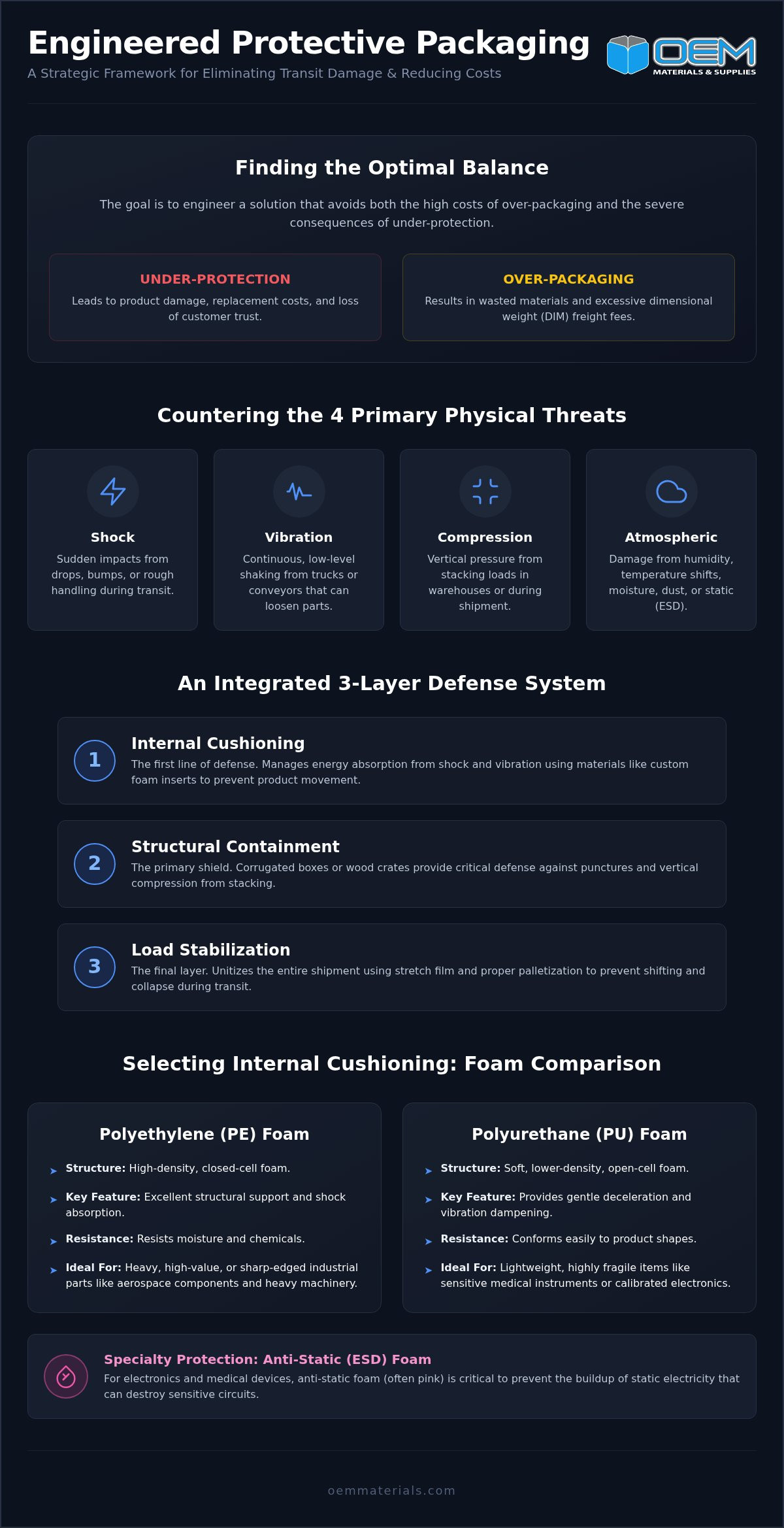
A professional protective packaging system is an integrated series of materials designed to shield industrial goods from physical, environmental, and electrostatic hazards throughout the supply chain. It is a critical component of logistics that moves beyond simple containment. An engineered strategy must address four specific threats: shock from drops or impacts, continuous vibration during transit, compression from warehouse stacking, and atmospheric conditions like extreme humidity or temperature shifts. Without this multi-layered defense, products are vulnerable to damage that often remains invisible until the end user opens the crate.
To achieve maximum reliability, engineers view packaging as a three-part system. Internal cushioning manages energy absorption and prevents movement within the container. Structural containment, usually in the form of corrugated boxes or wood crates, provides the primary defense against puncture and vertical pressure. Finally, load stabilization ensures the unitized load remains a single, cohesive mass on the pallet. When these elements work in tandem, they create a predictable environment for the product regardless of the carrier’s handling methods.
The Economic Impact of Shipping Damage
Shipping damage creates a ripple effect that extends far beyond the cost of a broken part. For manufacturers in high-precision sectors like aerospace or medical devices, a single failed component can halt an entire production line. The hidden expenses include return freight, the labor required for inspection and re-manufacturing, and the long-term erosion of customer trust. Optimization also plays a role in the total landed cost of goods. Over-packaging might prevent damage, but it often leads to excessive dimensional weight (DIM) fees. Finding the precise balance ensures you aren’t paying to ship air while still maintaining a zero-damage threshold.
Environmental vs. Physical Protection
There is a distinct difference between mechanical protection and barrier protection. Mechanical protection involves cushioning and bracing to absorb kinetic energy and mitigate physical impact. Barrier protection focuses on shielding against moisture, dust, or Electrostatic Discharge (ESD). For manufacturers in the Inland Empire or Orange County, regional climate factors are a major consideration. A shipment might leave a climate-controlled facility in San Diego and face high humidity or temperature fluctuations during cross-country transit. Utilizing high-quality labels and ribbons is essential for maintaining clear tracking and handling instructions, ensuring that carriers recognize sensitive loads that require specific orientation or environmental care.
Selecting Internal Cushioning Materials for Sensitive Components
Internal cushioning serves as the primary energy management system for industrial goods. While the outer container provides structural defense, the internal protective packaging is responsible for absorbing kinetic energy from drops and mitigating the continuous vibration found in long-haul transit. Choosing the wrong density can lead to “bottoming out,” where the material compresses fully and transfers the impact force directly to the product. Effective cushioning requires matching the material’s performance characteristics to the specific fragility and weight of the item being shipped.
Polyethylene vs. Polyurethane Foam
Selecting the correct material depends on the product’s G-force tolerance and mass. Polyethylene (PE) is a high-density, closed-cell foam packaging solution designed for heavy or sharp-edged industrial parts. It offers excellent structural support and resists moisture, making it ideal for aerospace components or heavy machinery. In contrast, Polyurethane (PU) is a soft, open-cell foam. Its flexible structure makes it the preferred choice for lightweight, highly fragile medical instruments that require gentle deceleration to prevent internal calibration shifts.
For electronics and medical devices, electrostatic discharge (ESD) is a silent threat. Utilizing anti-static foam inserts prevents the buildup of static electricity that can destroy sensitive circuits during handling. These materials are often color-coded pink for easy identification in cleanroom or assembly environments, ensuring that operators use the correct protective grade for sensitive assemblies.
Alternative Cushioning and Void Fill
Engineered foam isn’t always necessary for every SKU in your inventory. General cushioning materials like bubble wrap and paper-based void fill offer cost-effective solutions for items with lower fragility ratings. When shipping blueprints, rolled industrial textiles, or architectural drawings, mailing tubes provide a specialized rigid container that prevents creasing and crushing without the need for oversized boxes.
Efficiency in the warehouse is just as important as physical protection. Custom-cut foam inserts eliminate the variability of manual wrapping, allowing operators to secure products in seconds. Many Southern California manufacturers leverage full-service kitting and assembly to streamline their pack-out process. By receiving pre-assembled kits, your team avoids the labor-intensive task of managing multiple SKUs and manual wrapping. If you are unsure which density fits your application, you can request a custom packaging prototype to test your product’s specific requirements under real-world conditions.
Engineering Structural Integrity with Corrugated and Wood Packaging
Internal cushioning manages energy, but the outer container serves as the primary defense against external structural forces. It must resist vertical compression during warehouse stacking and prevent puncture from handling equipment or shifting cargo. A properly engineered protective packaging shell ensures that the internal components, such as the foam inserts discussed previously, can perform their job without the entire unit collapsing under pressure. Selecting the right outer material requires a technical evaluation of the load’s weight, dimensions, and the specific hazards of the transit route.
For most industrial applications, the choice begins with corrugated boxes. These are not generic containers; they are engineered structures rated by either the Mullen Burst Test or the Edge Crush Test (ECT). Mullen ratings measure the force required to puncture the box wall, which is critical for shipments with sharp or irregular industrial parts. Conversely, ECT measures the stacking strength of the board. High ECT ratings are essential for maximizing warehouse vertical space in high-volume distribution centers throughout the Inland Empire and Orange County.
Corrugated Wall Construction and Strength
Box strength is determined by the fluting and the number of walls used in construction. Single-wall corrugated is sufficient for lightweight components, but most industrial OEMs require double-wall or even triple-wall board for heavy-duty protection. Triple-wall corrugated provides a lightweight alternative to timber, offering high compression resistance for heavy loads without the significant weight penalty of wood. For a deeper look into selecting the right partner for these requirements, consult our guide on Corrugated Packaging Box Manufacturers. Matching the board grade to the total weight of the load is the first step in preventing box failure and subsequent product damage.
Custom Crating for Heavy Industrial Loads
When loads exceed the physical limits of corrugated board, wood crates become the necessary solution. This is common for heavy machinery exports and high-value aerospace components moving through San Diego or Los Angeles hubs. Unlike standard boxes, custom crates allow for integrated foam blocking and bracing. This technique locks the product into a fixed position within the rigid structure, preventing any internal movement that could lead to shock damage. Furthermore, custom-engineered crates are designed with specific base structures to facilitate safer handling by forklifts and heavy-duty cranes, ensuring the load remains stable during every transfer point in the supply chain.
Securing the Load: Stabilization through Stretch Film and Palletization
Even with the best internal foam and high-ECT boxes, a shipment can fail if the palletized load shifts during transit. Unitization is the final layer of a protective packaging strategy. It transforms individual cartons into a single, stable block that can withstand the lateral forces of truck transport and rail movement. This prevents toppling during sudden stops or sharp turns, which is a leading cause of damage in the industrial supply chain. Effective stabilization requires a technical approach to material selection and application tension.
The foundation of any unitized load is the pallet. Choosing the right pallets depends on your specific operational environment. Standard wood pallets are the industrial workhorse for most heavy loads, offering a cost-effective and repairable base. However, for medical device manufacturers or electronics facilities in San Diego and Orange County, plastic pallets are often required. Plastic options eliminate the risk of wood particulates, splinters, and moisture absorption, making them essential for cleanroom environments and international exports that must meet strict phytosanitary regulations.
Optimizing Stretch Film Performance
Stretch film is more than a simple dust cover; it provides the elastic recovery needed to hold a load together. Performance depends heavily on gauge selection and pre-stretch levels. If the film is too thin or applied with insufficient tension, it will fail to contain the load when subjected to vibration. Conversely, over-tensioning can crush the corrugated boxes at the corners. For a comprehensive understanding of how film types, puncture resistance metrics, and California’s SB 54 source reduction targets affect your load containment strategy, see our industrial guide to stretch film types, metrics, and applications. For a technical deep dive into these variables, see our guide on How to Optimize Stretch Film for Pallet Wrapping. Proper wrapping ensures that the boxes move as one cohesive unit, preventing the “toppling” effect that leads to rejected shipments.
Edge Protection and Vertical Stability
High-tension film and heavy-duty strapping can inadvertently damage the structural integrity of your containers. Edge and corner protectors solve this by distributing the pressure of strapping across a wider surface area. These components are essential when double-stacking pallets, as they reinforce the vertical corners where boxes are most likely to buckle. For distribution centers in the Inland Empire looking to maximize vertical square footage, corner protectors allow for safer stacking in both warehouses and trailers. This reinforcement ensures that your multi-layered defense remains intact from the assembly line to the final destination. To ensure your load stabilization strategy is optimized for your specific freight requirements, contact our engineering team for a palletization consultation.
Strategic Packaging Management: Custom Design and Inventory Solutions
A high-performance protective packaging strategy moves beyond material selection and enters the realm of operational optimization. A partnership with an industrial supplier should solve logistical bottlenecks rather than simply providing a catalog of parts. Strategic management involves integrating custom packaging design directly into your production workflow. This approach eliminates material waste by ensuring every insert and container is sized precisely for the product. Precise sizing also reduces the dimensional weight of your shipments, which can lead to significant freight savings depending on your carrier agreements and shipping volumes.
For manufacturers in the Inland Empire and Orange County, managing floor space is a constant challenge. With industrial real estate costs and regulatory pressures continuing to rise, sourcing the right industrial packaging supplies Orange County manufacturers depend on has become a critical factor in controlling total cost of ownership. Utilizing vendor-managed inventory (VMI) allows you to maintain critical stock levels without bloating your warehouse overhead. We monitor your usage and replenish supplies automatically, ensuring you never face a production stoppage due to a lack of packaging materials. This is complemented by just-in-time (JIT) delivery, which supports lean manufacturing principles by delivering materials exactly when they are needed for the assembly line. These services shift the burden of inventory management from your team to your packaging partner.
The Custom Prototyping Process
Engineering an effective solution begins with accurate data. The process starts with your product’s specific dimensions, weight, and fragility rating to develop a rapid prototype. Custom inserts are then engineered to eliminate the need for excessive filler materials like loose-fill peanuts or manual wrapping. To facilitate the most accurate engineering, we encourage clients to provide annual usage data and specific shipping requirements during the design phase. This ensures the final protective packaging design is optimized for both durability and cost efficiency before high-volume production begins.
Reducing Labor and Overhead with Kitting
Labor is often the most significant cost in the pack-out process. Pre-assembled packaging kits save critical time on the production floor by providing all necessary components in a single unit. Instead of operators searching for boxes, foam, and tape separately, they receive a complete kit ready for immediate use. A local Southern California supplier provides the rapid response necessary for short-run production and emergency stock needs. This regional focus ensures that Los Angeles and San Diego facilities can scale their operations without logistical delays. To start optimizing your supply chain and reducing product damage, contact OEM Materials & Supplies for a custom packaging consultation today.
Optimizing Your Industrial Supply Chain
Building a resilient supply chain requires more than buying boxes; it requires an engineered protective packaging strategy that addresses every hazard from the assembly line to the final destination. By integrating high-density foam inserts with structural corrugated containers and proper load stabilization, you can virtually eliminate transit damage. Moving toward a professional management model with VMI and JIT services further reduces warehouse overhead and streamlines your labor requirements.
OEM Materials & Supplies has served aerospace, medical, and electronics manufacturers across Southern California for decades. Our team specializes in custom engineering and rapid prototyping for complex industrial parts, ensuring your specific dimensions and weights are matched with the correct material densities. We are ready to help you reduce replacement costs and improve your operational efficiency.
To receive a recommendation tailored to your specific application, Request a Custom Packaging Quote from OEM Materials & Supplies. Please include your product dimensions, weight, and annual usage to help us provide an accurate assessment. We look forward to helping you secure your shipments and optimize your costs.
Frequently Asked Questions
What is the difference between cushioning and void fill?
Cushioning materials are engineered to absorb shock and mitigate vibration during transit to protect a product’s internal components. Void fill is a simpler solution used only to occupy empty space within a box to prevent the product from shifting. While void fill is cost-effective for durable items, sensitive industrial goods require the energy management properties of cushioning to prevent impact damage.
How do I determine the correct foam density for my product?
Determining the correct foam density depends on the weight of your product and its fragility rating, often measured in G-force tolerance. Heavier items require high-density polyethylene foam to prevent the product from bottoming out during a drop. Lightweight, fragile instruments usually require lower-density polyurethane foam to provide gentler deceleration and better vibration dampening.
When should I use double-wall corrugated boxes instead of single-wall?
You should switch to double-wall corrugated boxes when the total weight of the load exceeds the capacity of single-wall board or when pallets will be stacked high in a warehouse. Double-wall construction provides significantly higher Edge Crush Test (ECT) ratings. This structural integrity is necessary to prevent the bottom boxes from collapsing under the vertical pressure of a unitized load.
Why is load containment just as important as the box itself?
Load containment is critical because even the strongest box cannot protect a product if the entire pallet topples or shifts during transit. Proper use of stretch film and edge protectors ensures the palletized goods move as a single cohesive unit. This stabilization mitigates lateral forces that occur during sudden stops or sharp turns in the industrial supply chain.
Can custom protective packaging actually lower my shipping costs?
Custom protective packaging can lower total shipping costs by reducing the exterior dimensions of the box, which minimizes dimensional weight (DIM) fees. It also eliminates the need for excessive manual wrapping and filler materials that add unnecessary weight. While results depend on specific product dimensions, the long-term savings from reduced damage claims and lower freight charges often outweigh the initial design investment.
What are the benefits of using a local packaging supplier in Southern California?
Partnering with a local supplier in Southern California allows for just-in-time (JIT) delivery and faster response times for prototypes or short-run production. Facilities in Los Angeles, Orange County, and San Diego benefit from reduced lead times and lower inbound freight costs. A regional partner understands the specific logistical challenges of local manufacturing hubs and can provide on-site consultations more effectively.
How does vendor-managed inventory (VMI) help with packaging supplies?
Vendor-managed inventory (VMI) ensures you never run out of critical supplies by shifting the responsibility of stock monitoring to your packaging partner. We track your usage levels and replenish materials automatically before a shortage occurs. This process reduces your warehouse overhead and prevents production stoppages while freeing up your procurement team to focus on other operational priorities.