
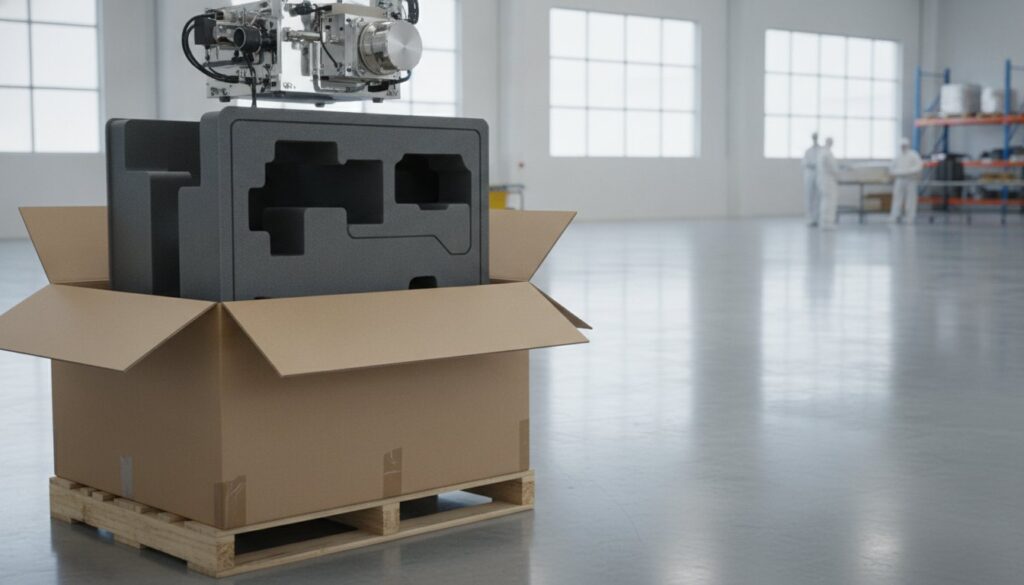
How much does a single point of failure in your supply chain cost when the cargo is a six-figure medical laser or a critical aerospace assembly? You already know that shipping high-value assets involves much more than finding a box that fits. For manufacturers across Orange County and the Inland Empire, the frustration of high product damage rates and the complexity of regulatory compliance can turn a routine shipment into a significant financial liability. Standard solutions rarely meet the rigorous demands of precision instrumentation or delicate electronics.
This guide explains how to implement professional custom packaging for sensitive equipment by selecting the right materials and engineering standards to ensure your products arrive in factory condition. You’ll learn how to eliminate transit damage while simultaneously reducing labor costs through efficient kitting and assembly strategies. We will examine technical material specifications, the benefits of custom foam inserts, and how localized design support can streamline your distribution process. By focusing on engineered protection rather than just containment, you can protect your bottom line and maintain your reputation for reliability in a competitive industrial market.
Key Takeaways
- Identify specific equipment vulnerabilities like shock, vibration, and electrostatic discharge to align material specifications with the shipping environment.
- Evaluate the structural benefits of triple-wall corrugated boxes and custom wood crates when engineering custom packaging for sensitive equipment.
- Select the appropriate foam density, such as polyethylene or polyurethane, to provide precision cushioning tailored to product weight and fragility.
- Reduce warehouse overhead and labor costs by utilizing local Southern California kitting services and vendor-managed inventory programs.
- Streamline the move from concept to production through rapid prototyping to ensure every component meets rigorous industrial and regulatory standards.
Defining Sensitive Equipment Packaging Requirements
Designing effective custom packaging for sensitive equipment requires a technical understanding of the product’s physical limits and the specific hazards of the logistical chain. You cannot apply a one size fits all approach to high value assets like medical imaging devices or aerospace components. The process begins by identifying the primary vulnerabilities of the hardware, specifically its susceptibility to shock, vibration, and electrostatic discharge (ESD). A failure to quantify these risks often leads to over-packaging, which inflates costs, or under-packaging, which results in catastrophic product loss.
Engineers must also assess the shipping environment. Parcel carriers subject packages to frequent drops and mechanical sorting, while dedicated freight involves lower impact but higher sustained vibration. For international export, you must account for additional variables like extreme temperature fluctuations and high humidity. Environmental barriers, including moisture vapor inhibitors and dust seals, are essential for maintaining the integrity of calibrated instruments during long term storage or transit through varying climates.
Shock and Vibration Mitigation
Vibration is a silent killer in the electronics and medical sectors. During transit, sustained harmonic vibrations can loosen internal fasteners, crack solder joints, and misalign optical sensors. Proper cushioning does more than just pad the item; it manages the rate of deceleration during an impact. By selecting materials with the correct dampening properties, you ensure that the energy from a drop is absorbed by the packaging rather than the equipment. G-force sensitivity, or the fragility factor, represents the maximum acceleration or deceleration an object can withstand before experiencing mechanical or functional failure.
ESD Protection for Electronics
Standard packaging materials often generate static charges that can destroy sensitive semiconductors. While basic anti-static materials prevent the generation of new charges, specialized dissipative or conductive foam packaging is required for high precision medical and semiconductor equipment. These materials provide a controlled path for static to bleed off safely. In high volume manufacturing environments, common failures occur when operators reuse anti-static bags or foam that has lost its chemical effectiveness. Implementing a rigorous custom packaging design ensures that ESD protection is integrated into the structural layout of the kit, reducing the risk of human error during the packing process.
Material Selection: Corrugated Boxes, Wood Crates, and Foam
Choosing the right outer container and internal support is a balancing act between weight, cost, and structural integrity. While some providers suggest that wood is the only option for high value items, modern triple-wall corrugated designs often provide sufficient protection for sensitive but lighter instruments. Selecting the ideal custom packaging for sensitive equipment involves evaluating how these materials interact with the cushioning layers to create a unified protective system.
Custom Corrugated Solutions
Industrial OEMs rely on custom corrugated boxes for their versatility and high strength to weight ratio. Double wall construction is standard for many industrial applications, but triple wall corrugated provides the puncture resistance and stacking strength required for heavy electronics or medical devices. Die-cut internal inserts can be engineered to suspend the product in the center of the box, ensuring that external impacts don’t reach the equipment. Our team uses rapid prototyping to verify these designs, allowing you to test the structural performance before committing to a full production run.
Industrial Wood Crates for Heavy Sensitive Gear
When equipment weight exceeds the limits of corrugated or dimensions become oversized, custom crates become the necessary solution. This is common for heavy medical machinery or large aerospace assemblies. For international shipments, these crates must meet ISPM-15 standards to ensure export compliance and prevent logistical delays at customs. The wood shell provides the external defense, but internal blocking and bracing are what truly secure the load. This technique uses custom cut wood members to lock the equipment into a fixed position, preventing any internal shifting during ocean or air transit.
Engineered foam serves as the critical primary layer for delicate surfaces, preventing scratches while absorbing shocks. Properly selected materials are the foundation of effective custom packaging for sensitive equipment. For palletized shipments, we often integrate edge protectors to distribute the pressure of stretch film and strapping. This prevents the outer packaging from collapsing under tension and increases the overall stacking strength of the pallet. If you’re unsure which material combination fits your specific fragility requirements, you can request a quote and provide your product dimensions for a technical recommendation.
Engineering Custom Foam Inserts for Precision Protection
Precision engineering for custom packaging for sensitive equipment relies on internal cushioning that matches the physical properties of the cargo. Foam is not merely a filler material; it is a calculated deceleration tool designed to manage the kinetic energy generated during transit. To understand the deeper technical specifications of these materials, you can refer to our industrial guide to foam inserts, which details density requirements and load-bearing capacities for various industrial applications.
The selection process depends on the product’s weight and fragility factor. High-density foams provide the necessary support for heavy industrial parts, while lower-density options offer the softness required for delicate sensors. We achieve this precision through advanced fabrication methods. Custom die-cutting is highly efficient for high-volume runs with consistent shapes. For complex, three-dimensional geometries or low-volume specialized equipment, CNC routing allows for incredible accuracy without the need for custom tooling. These processes ensure a snug fit that prevents the equipment from shifting, which is a primary cause of surface abrasion and mechanical failure.
Polyethylene vs. Polyurethane Foam
Polyethylene is a closed-cell foam characterized by its rigidity and resistance to chemicals and moisture. It is the superior choice for heavy equipment or items that may be exposed to harsh industrial environments. Because it retains its shape under repeated stress, it is ideal for multiple-trip foam packaging applications. In contrast, polyurethane is an open-cell foam that is much softer and more compliant. It is better suited for lightweight electronics that require a high degree of cushioning with minimal pressure on the product’s surface. Choosing between these materials requires an analysis of the product’s G-force sensitivity and the expected handling conditions.
Designing for the Unboxing Experience and Safety
The layout of an insert does more than just protect; it optimizes the unboxing process. By utilizing organized kitting, we help manufacturers reduce assembly labor and minimize the time spent on the warehouse floor. This is especially valuable for companies in the Inland Empire and Los Angeles County looking to improve operational throughput. Kitting allows for the integration of accessories, cables, and manuals into a single, organized unit, ensuring that no critical components are lost during transit.
An ergonomic insert design ensures that the end user can remove the equipment safely without applying undue stress to fragile components. Using precision-fit foam also eliminates the need for loose-fill materials, keeping your facility and your customer’s workspace clean and efficient. This level of detail is a hallmark of high-quality custom packaging for sensitive equipment. For aerospace and medical device manufacturers, this level of organization is a requirement for maintaining high quality-control standards across the supply chain.
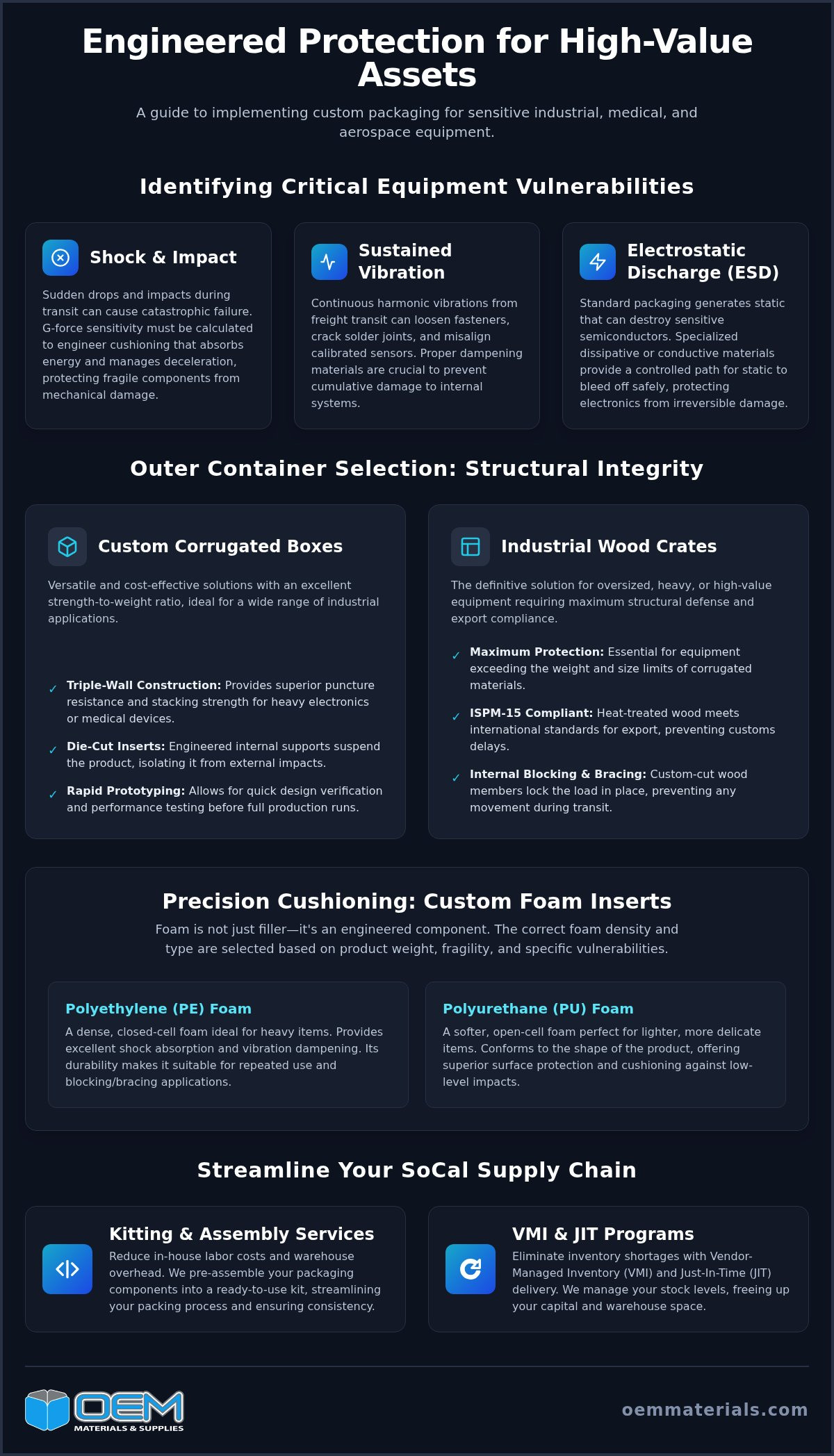
Optimizing the SoCal Supply Chain: VMI and JIT Programs
Warehouse space in Southern California, from Orange County to San Diego, carries a premium price. Industrial OEMs often struggle with the physical footprint required to store bulky custom packaging for sensitive equipment. Instead of filling your floor with empty boxes and foam, you can utilize a localized logistical strategy to reclaim that space for production. Shifting the inventory burden to a specialized partner allows you to focus resources on manufacturing rather than material management.
Implementing a vendor-managed inventory (VMI) program ensures you never face a stockout of critical protection materials. We monitor your usage levels and replenish stock automatically based on pre-set minimums. This eliminates the administrative burden of constant purchase orders and reduces the risk of a halted production line due to missing supplies. Managing multiple vendors for boxes, foam, and crates creates a fragmented supply chain. Consolidating these requirements under a single local partner reduces the paperwork trail from procurement to accounts payable.
Reducing Labor with Kitting and Assembly
Efficiency on the production line is often hindered by the time staff spends folding boxes or fitting foam inserts. Pre-assembled packaging kits arrive ready for immediate use. By outsourcing this assembly to a local partner, you reduce internal touchpoints and lower your overall cost per unit. This integrated approach to packaging for manufacturers allows your team to focus on the core assembly of high-value equipment rather than logistical prep work. Kitting also ensures that every component, from the outer corrugated shell to the internal cushioning, is present and accounted for before it reaches the packer.
Just-In-Time Delivery for Local OEMs
Proximity matters when production schedules shift unexpectedly. Our presence in Los Angeles, Riverside, and San Diego enables just-in-time (JIT) delivery that aligns with your daily output. This logistical agility is essential for manufacturers who require custom packaging for sensitive equipment but lack the square footage for high-volume storage. JIT delivery minimizes the capital tied up in sitting inventory and allows for faster design iterations when equipment specifications change. Whether you are scaling up for a new product launch or managing a low-volume specialized run, local support ensures your packaging is there exactly when the product is ready to ship.
If you want to optimize your warehouse footprint and reduce operational overhead, contact us for a supply chain consultation tailored to your annual usage and delivery requirements.
Implementing a Custom Packaging Program with OEM Materials & Supplies
Transitioning from a technical requirement to a functional, production-ready solution requires a structured engineering approach. For manufacturers in high-stakes industries like aerospace, medical device production, and automotive electronics, the cost of a packaging failure is too high to rely on guesswork. Our custom packaging design services at OEM Materials & Supplies provide a direct pathway from initial concept to high-volume distribution. We act as a technical consultant, ensuring that your custom packaging for sensitive equipment meets both internal quality standards and external shipping regulations.
Local support across Orange County, Los Angeles, and the Inland Empire allows for a collaborative design process that national commodity resellers can’t match. We focus on the specific variables of your product, including its geometry and surface sensitivity, to develop a protective system that balances material costs with maximum security. This partnership approach ensures that your packaging’s optimized for both the warehouse floor and the final destination.
The Prototyping and Testing Phase
The move to production only occurs after a rigorous prototyping phase. We create physical samples to verify the fit of foam inserts and the structural integrity of the outer container. This stage is critical for identifying potential failure points before they impact your bottom line. We recommend physical testing, such as drop tests and vibration simulations, to confirm that the cushioning effectively manages the G-forces identified during the initial requirement phase. Feedback from these tests allows OEM Materials & Supplies to refine material densities and thicknesses, ensuring the final design provides precision protection without unnecessary bulk.
Getting Started with Your Custom Quote
To provide an accurate recommendation and quote, our engineering team requires specific data points regarding your equipment and logistical needs. Providing these details upfront allows us to accelerate the design process and identify the most cost-effective material combinations. Please prepare the following information for your consultation:
- Product Dimensions: Length, width, and height of the equipment.
- Total Weight: The mass of the unit, which dictates foam density and box strength.
- Fragility Rating: The G-force limit or specific vulnerabilities like ESD or moisture sensitivity.
- Annual Usage: Estimated quantity to help us optimize production runs and VMI levels.
Professional custom packaging for sensitive equipment is an investment in your brand’s reliability. If you’re ready to eliminate transit damage and streamline your packing operations, OEM Materials & Supplies is ready to assist. We provide the technical expertise and local manufacturing support needed to solve your most complex industrial packaging challenges. Reach out to request a prototype or a comprehensive supply chain consultation.
Securing Your High-Value Assets with Engineered Solutions
Protecting precision instruments requires a transition from generic containers to a holistic engineering strategy. By integrating custom engineered foam with high-strength corrugated materials or wood crates, you address the specific shock and vibration vulnerabilities of your hardware. We have demonstrated that local logistical support through kitting and VMI programs is essential for managing the high costs of warehouse space in Southern California while ensuring a consistent supply of materials. This approach allows your team to focus on production while we manage the complexities of protection and distribution.
Implementing professional custom packaging for sensitive equipment is the most effective way to eliminate product damage and reduce administrative overhead. As a dedicated partner to aerospace and medical manufacturers in Los Angeles, Orange County, and San Diego, OEM Materials & Supplies provides the technical expertise and rapid prototyping necessary for industrial success. Please contact OEM Materials & Supplies for a custom packaging consultation and quote to begin the design process. We look forward to helping you secure your supply chain and protect your bottom line.
Frequently Asked Questions
What is the best foam for sensitive electronics?
Anti-static polyurethane and polyethylene are the most effective materials for protecting electronic components. Polyurethane is an open-cell foam ideal for lightweight items requiring soft cushioning, while polyethylene is a closed-cell foam better suited for heavier equipment needing rigid shock absorption. Both materials are available with dissipative properties to prevent static discharge from damaging internal circuitry.
How do I determine the fragility of my equipment for packaging design?
Fragility is determined by identifying the G-force rating, which represents the maximum acceleration or deceleration a product can survive without functional or mechanical failure. Our engineers use this rating to calculate the precise thickness and density of the cushioning layers. You can usually find this data in your product’s engineering specifications or determine it through controlled drop testing of the equipment.
Do you provide ESD safe packaging for medical devices?
Yes, we provide a full range of ESD and cleanroom-compatible materials specifically for the medical and semiconductor sectors. This includes anti-static foam inserts and specialized corrugated boxes designed to bleed off static charges safely. These solutions ensure that sensitive medical instrumentation remains functional and free from electronic interference throughout the distribution cycle.
Can custom packaging help reduce my overall shipping costs?
Custom packaging for sensitive equipment reduces costs by optimizing dimensional weight and eliminating the expense of product damage. By designing a container that fits your product exactly, you avoid paying for excess shipping volume and reduce the need for bulky void fill. Minimizing damage also removes the significant financial burden of processing returns and shipping replacements.
What information do I need to provide for a custom packaging quote?
To provide an accurate quote, we require the product’s exterior dimensions, total weight, and fragility rating. We also need to know your estimated annual usage and the typical shipping environment, such as parcel carriers or dedicated freight. This data allows our design team to engineer a solution that balances material strength with operational cost efficiency.
Do you offer local delivery in Orange County and San Diego?
We provide local delivery and logistical support throughout Orange County, San Diego, Los Angeles, and the Inland Empire. Our local proximity allows us to offer just-in-time delivery and rapid prototyping services that national vendors cannot match. This ensures your production line remains active without requiring large on-site inventory storage for bulky packaging materials.
Can you help with international export packaging compliance?
Yes, we manufacture custom wood crates that are fully compliant with ISPM-15 international heat-treatment standards. These crates are required for most international exports to prevent the spread of pests and ensure your cargo clears customs without delays. Our team handles the certification and marking process to guarantee your shipment meets global regulatory requirements for wood packaging.
How does kitting reduce my manufacturing labor costs?
Kitting delivers pre-assembled packaging components directly to your production line, ready for immediate use. This process removes the need for your staff to fold boxes, tape bottoms, or manually fit complex foam inserts. By outsourcing these repetitive prep tasks, you can reallocate your labor resources to higher-value assembly and manufacturing activities, increasing your overall facility throughput.