
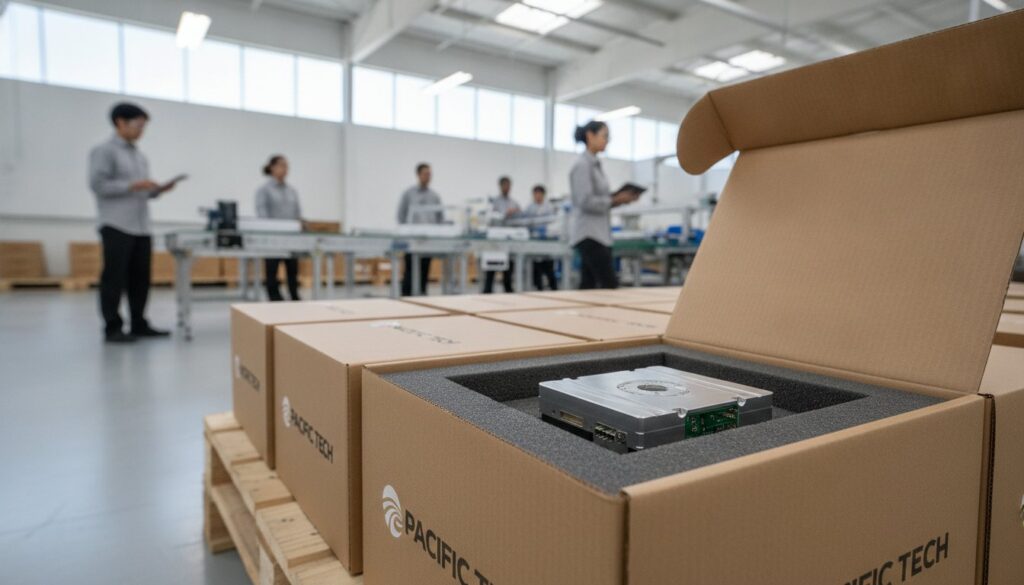
A low unit price on a purchase order means very little if a single stockout halts your entire assembly line. For manufacturers throughout Southern California, the true cost of packaging includes the labor spent on manual assembly and the overhead of managing bulky inventory. Finding a reliable high-volume production packaging supplier requires looking beyond the price per box to identify a partner that understands the technical demands of high-speed production.
Managing high-volume output is a complex balancing act where inconsistent material quality or inventory gaps can quickly erode your margins. This guide will show you how to evaluate a packaging partner that integrates custom engineering with lean supply chain logistics to reduce your total cost of ownership. We will examine how vendor-managed inventory (VMI) programs and specialized kitting services can eliminate assembly line bottlenecks, provide zero-defect protection for sensitive components, and ensure your materials are ready exactly when your production schedule demands them. This approach shifts packaging from a simple commodity to a strategic component of your operational success.
Key Takeaways
- Identify the critical differences between one-off orders and recurring production scale to ensure your high-volume production packaging supplier supports continuous manufacturing growth.
- Learn how custom engineered foam inserts and heavy-duty corrugated materials provide zero-defect protection for sensitive aerospace, medical, and electronic components.
- Discover how Vendor Managed Inventory (VMI) and Just-in-Time (JIT) delivery models reduce the total cost of ownership by eliminating stockouts and maximizing facility floor space.
- Evaluate the logistical advantages of regional proximity to streamline packaging distribution and improve response times across Orange County, Los Angeles, and San Diego.
Evaluating High-Volume Production Packaging Supplier Capabilities
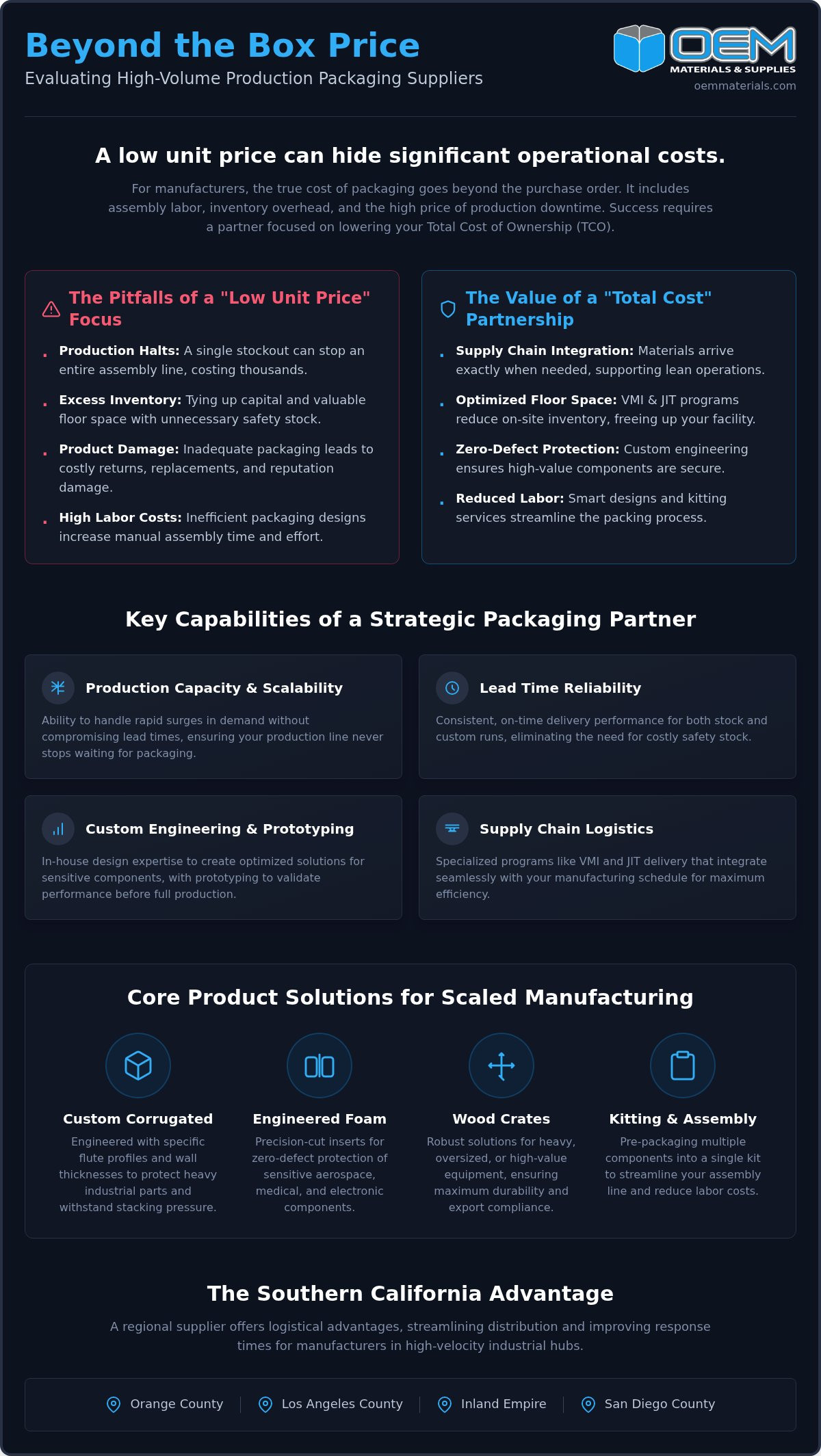
High-volume packaging is not defined simply by a large quantity on a single purchase order. It is a recurring, production-scale requirement where consistency and supply chain integration are the primary metrics of success. For manufacturers throughout Southern California, a high-volume production packaging supplier must function as a strategic partner rather than a commodity vendor. This partnership focuses on lowering the total cost of ownership by eliminating the hidden expenses associated with line stoppages, excess inventory, and product damage. When packaging is treated as a strategic component, it supports the overall efficiency of the assembly line.
Scalability is the foundation of high-volume success. If your production output spikes to meet seasonal demand or a new contract, your packaging supply must respond immediately. A supplier without the specialized infrastructure to scale becomes a bottleneck that halts your revenue. Reliable partners use technical expertise in material science to design packaging that balances weight, durability, and cost. This is especially critical for industrial applications in the aerospace and medical sectors, where sensitive components require exact tolerances and specialized protection to maintain integrity during transit.
Production Capacity and Lead Time Reliability
Assessing a supplier’s ability to handle rapid surges in demand is vital for maintaining a lean operation. You should evaluate their historical performance on lead time consistency, specifically for custom die-cut runs. Inconsistent deliveries disrupt assembly schedules and force you to carry excessive safety stock, which ties up capital and valuable warehouse floor space. Redundant manufacturing facilities are another key factor to consider. If a supplier operates from a single point of failure, your entire supply chain is at risk. A reliable partner mitigates this risk by maintaining diverse production capabilities to ensure uninterrupted service to your facility.
Custom Engineering for Industrial Applications
Industrial packaging often requires moving beyond standard stock sizes toward custom packaging design. For complex assemblies in the electronics or automotive sectors, a standard box is rarely sufficient to prevent damage. High-volume programs benefit from custom corrugated boxes and foam packaging engineered to fit the specific dimensions and fragility of the product. Selecting a high-volume production packaging supplier with engineering expertise allows you to optimize material usage, which can significantly reduce shipping costs over thousands of units. Prototyping is a non-negotiable step in this process. It ensures that the design performs as expected under real-world stress before you commit to a full-scale production run. Effective solutions often integrate multiple materials, such as wood crates or specialized cushioning, to provide comprehensive protection for high-value components.
Core Product Requirements for Scaled Manufacturing
Scaled manufacturing demands a level of material performance that standard retail packaging cannot provide. High-volume environments subject materials to intense vertical pressure in warehouse stacks and repeated handling across distribution networks. A professional high-volume production packaging supplier ensures that every component, from the outer carton to the internal cushioning, is engineered to withstand these specific industrial stresses. Reliability on the assembly line starts with materials that don’t fail under pressure.
Industrial operations require a cohesive system of protection. This includes heavy-duty corrugated cartons, specialized internal cushioning, and robust secondary materials like stretch film and edge protectors. Each element must work together to maintain load stability during transit. For manufacturers in the aerospace and automotive sectors, these materials must also meet rigorous standards for durability and export compliance. Refining your material specs can reduce damage rates; consider speaking with our team to discuss your specific product dimensions and annual usage.
Corrugated Solutions for High-Volume Lines
Selecting the correct flute profile and wall thickness is essential for protecting heavy industrial parts. B-flute corrugated provides excellent crush resistance and a flatter surface for printing, while C-flute offers superior cushioning for heavier loads. For maximum stacking strength, double-wall or triple-wall corrugated boxes are often required to prevent box fatigue in high-density warehouses. High-volume users should prioritize flat-packed bulk packaging. This format optimizes your warehouse footprint and reduces the frequency of inbound deliveries, allowing your team to focus on production rather than managing empty space.
Engineered Cushioning and Foam Packaging
Custom foam is a critical component for reducing damage rates during high-velocity shipping. Unlike generic bubble wrap, engineered foam packaging is precision-cut to the exact dimensions of your product, providing repeatable protection on the assembly line. Choosing between polyethylene and polyurethane depends on your specific production needs. Polyethylene is a closed-cell foam ideal for heavier, sensitive items that require high shock absorption. Polyurethane is an open-cell, softer foam better suited for light-weight components. These inserts ensure that even the most delicate electronics or medical devices remain secure throughout the logistics cycle.
Load stability is the final requirement for high-volume shipping. Industrial pallets and wood crates must be built to withstand heavy payloads and meet ISPM-15 export standards for international transport. Utilizing high-performance stretch film and rigid edge protectors prevents shifting during transit, which is a primary cause of product loss in bulk shipments. A high-volume production packaging supplier helps you select the right combination of these materials to ensure that your finished goods arrive at their destination in factory-perfect condition.
Optimizing the Supply Chain with VMI and JIT Programs
Managing thousands of packaging units per week creates a unique set of logistical challenges that a standard vendor cannot address. For high-volume manufacturers, the primary goal is to maintain a continuous flow of materials without clogging the warehouse with excess safety stock. A high-volume production packaging supplier provides more than just materials; they provide the logistical infrastructure to keep your lines moving. Transitioning to integrated supply chain programs like Vendor Managed Inventory (VMI) and Just-in-Time (JIT) delivery directly addresses the hidden costs of inventory bloat and administrative overhead.
Carrying excess packaging inventory ties up capital and consumes valuable square footage that could be used for production. By consolidating your procurement through a single partner, you reduce the time spent managing multiple purchase orders and tracking disparate shipments. This consolidation simplifies your supply chain and provides a clearer picture of your total operational costs. The financial impact is measurable. Reducing your inventory footprint through a JIT model allows you to operate with a leaner balance sheet while ensuring that critical materials are always available when production ramps up.
The Mechanics of Vendor Managed Inventory
The core of an effective VMI program is the automated tracking and replenishment of your stock. Instead of your team manually checking pallet counts, your supplier monitors usage patterns and manages the replenishment cycle. This process relies on establishing clear minimum and maximum inventory thresholds tailored to your specific production safety requirements. When stock reaches a predetermined minimum level, a new order is triggered automatically. Utilizing packaging VMI services ensures you never face a line stoppage due to a missing box or a lack of stretch film, even during unexpected surges in demand.
Streamlining Operations with Kitting and Assembly
High labor costs are often a direct result of inefficient packing processes. If your assembly line workers spend time folding boxes, inserting foam, or applying labels, your throughput suffers. Kitting and assembly services solve this by delivering pre-assembled packaging kits directly to your station. These kits arrive with all necessary components, such as custom foam packaging and corrugated inserts, already in place. This integration improves packing speed and accuracy, which is essential for high-volume environments in Southern California’s competitive manufacturing sectors.
Integrating custom labels and printing into the kitting process further reduces manual steps. Whether you are shipping medical devices from Orange County or automotive parts from the Inland Empire, receiving packaging that is already labeled and ready for the product minimizes the risk of human error. This comprehensive approach to kitting ensures that your packaging is as efficient as the product being placed inside it. It allows your skilled labor to focus on manufacturing while your high-volume production packaging supplier handles the preparation of the protection materials.
Selecting a Packaging Supplier for Southern California
Regional proximity is a strategic advantage for high-volume industrial manufacturers. In Southern California, navigating the logistics of Orange County, Los Angeles, and San Diego requires a partner who understands local traffic patterns and regional freight networks. The unit price of a box is only one part of the equation. High freight costs from distant suppliers often inflate the total landed cost, making local sourcing a more economical choice for bulk orders. Working with a regional high-volume production packaging supplier allows for on-site consultations where packaging engineers evaluate your assembly line in person. This proximity facilitates rapid prototyping. It enables your team to test how a combination of custom corrugated and foam inserts performs before you commit to a full production run.
Local Distribution and Freight Efficiency
Local distribution centers in hubs like Riverside and the Inland Empire are essential for maintaining tight production schedules. When your supplier is nearby, transit times are minimized. This proximity significantly reduces the risk of shipping damage and allows for more flexible delivery windows that align with your specific manufacturing shifts. A local partner can often provide emergency deliveries or adjust schedules to meet strict windows that out-of-state vendors simply cannot match. If you are managing a high-output facility in Southern California, request a quote for a logistical evaluation to see how regional distribution can improve your operational flow.
Compliance and Industry Standards
Compliance with industry standards is a critical requirement for manufacturers in specialized sectors. Aerospace and medical device companies require packaging that meets stringent quality requirements and cleanliness standards. For manufacturers shipping finished goods internationally from the ports of San Diego or Los Angeles, understanding export standards is non-negotiable. This includes ensuring all wood crates and pallets are ISPM 15 compliant to prevent costly customs delays and quarantine issues. A knowledgeable high-volume production packaging supplier manages these technical details on your behalf. They ensure that your high-volume shipments move through the global supply chain without regulatory friction, protecting both your product and your delivery timeline.
Partner with OEM Materials for High-Volume Production
OEM Materials & Supplies operates as a full-service industrial partner. We bridge the gap between initial concept and mass distribution. As a seasoned high-volume production packaging supplier, we focus on the specific logistical needs of Southern California’s manufacturing hubs. Our commitment centers on reducing total operational costs by integrating material engineering with logistical precision. We don’t just sell boxes; we provide a scalable framework that supports your production goals from the first prototype to the millionth unit. This approach ensures your packaging remains a facilitator of growth rather than a source of friction.
Reliability at scale requires a partner that understands the nuances of industrial supply chains. We transition seamlessly from rapid prototyping to high-volume production runs. This ensures that every design is vetted for performance before it hits the assembly line. By managing the entire packaging lifecycle, we help manufacturers eliminate the hidden costs of inefficient packing and material waste. Our engineering team works directly with yours to refine designs, ensuring they’re optimized for both protection and packing speed.
Comprehensive Industrial Product Range
Single-source procurement is a primary driver of efficiency for high-volume users. By managing your corrugated boxes, foam packaging, and pallets through one partner, you eliminate the administrative burden of coordinating multiple vendors. We provide specialized solutions for the aerospace, automotive, and medical sectors, ensuring every component meets rigorous industry-specific standards. Our custom packaging design services allow us to develop integrated solutions that minimize material waste. Whether you need ESD-safe materials for electronics or heavy-duty wood crates for machinery, our catalog is designed to meet the demands of modern manufacturing.
Requesting a High-Volume Program Quote
Starting a high-volume program requires a data-driven approach to ensure accuracy and cost-efficiency. To provide a technical recommendation, our specialists need specific data points. This includes your product’s exterior dimensions, total weight, and projected annual usage. This information allows us to recommend the most cost-effective materials and distribution models, such as VMI or JIT delivery. Once we establish the requirements, we develop custom prototypes for production testing to ensure the design performs under real-world stress. This prevents costly failures during the mass production phase.
Our specialists provide dedicated regional support across Southern California. Whether your facility is in Orange County, the Inland Empire, Los Angeles County, or San Diego County, we offer the local expertise necessary to optimize your supply chain. We invite you to contact our team today for a production packaging consultation. Providing your specific product data allows us to deliver a tailored solution that reduces your total cost of ownership and secures your production timeline. Partnering with a dedicated high-volume production packaging supplier is the first step toward a more resilient and efficient manufacturing operation.
Secure Your Production Timeline with Strategic Packaging
Success in scaled manufacturing requires more than a standard vendor; it demands a high-volume production packaging supplier that acts as a technical consultant. By prioritizing custom engineering and logistics programs like VMI, you eliminate the risks of stockouts and product damage that frequently disrupt high-output lines. These integrated solutions shift packaging from a recurring expense to a strategic asset that lowers your total cost of ownership. OEM Materials & Supplies has served Southern California manufacturers for decades, providing specialized industrial-grade solutions for the aerospace, medical device, and electronics sectors. Our expertise ensures your materials meet the highest standards for durability and compliance.
Our team understands the specific logistical requirements of the Inland Empire, Orange County, and San Diego markets. We are ready to help you optimize your material usage and assembly speed through rapid prototyping and custom kitting. To begin your consultation, please provide your product dimensions, weight, and annual usage requirements. We look forward to helping you build a more resilient and efficient supply chain. Request a High-Volume Production Quote today to secure your manufacturing schedule and streamline your operations.
Frequently Asked Questions
What is considered high-volume for industrial packaging?
High-volume packaging is defined by recurring, production-scale requirements where consistency is as important as quantity. While specific unit counts vary by industry, it typically involves monthly usage in the thousands. The primary indicator of a high-volume need is when packaging becomes a critical component of a continuous assembly line where any delay would cause a significant production stoppage.
How does Vendor Managed Inventory (VMI) work for packaging?
In a VMI program, your high-volume production packaging supplier takes responsibility for monitoring and replenishing your stock levels. We establish specific minimum and maximum inventory thresholds based on your production schedule. When your on-site stock reaches the minimum level, a replenishment order is triggered automatically. This system eliminates the risk of stockouts and reduces the administrative burden on your purchasing team.
Can you provide custom foam inserts for high-volume electronic shipments?
Yes, we specialize in engineering custom foam inserts for high-volume electronics, aerospace components, and medical devices. Using materials like polyethylene or polyurethane, we design inserts that provide repeatable, zero-defect protection. Our process includes prototyping and testing to ensure the foam performs consistently across large production runs, protecting sensitive components from shock and vibration during transit.
What are the benefits of kitting services in a manufacturing environment?
Kitting services significantly reduce labor costs by delivering pre-assembled packaging components directly to your production line. Instead of your skilled workers spending time folding corrugated boxes or inserting foam, they receive a complete, ready-to-use kit. This integration improves packing speed and accuracy, allowing your team to focus on manufacturing while we handle the preparation of the protective materials.
Do you offer just-in-time (JIT) delivery for SoCal manufacturers?
We provide JIT delivery services tailored to the specific needs of manufacturers in Orange County, Los Angeles, San Diego, and the Inland Empire. This model allows you to receive packaging materials exactly when they are needed for production. By reducing the amount of safety stock held on-site, you free up valuable warehouse floor space and lower your inventory carrying costs.
What information is required to receive a high-volume packaging quote?
To provide an accurate and technical quote, we require the external dimensions and total weight of your product. You should also provide your projected annual usage and any specific protection requirements, such as ESD safety or cleanroom compatibility. This data allows our engineers to recommend the most cost-effective material specifications and logistical programs for your specific manufacturing volume.
Are your wood crates and pallets compliant for international export?
All our wood crates and pallets are ISPM 15 compliant, ensuring they meet the international standards for heat treatment. This compliance is mandatory for any manufacturer shipping finished goods from Southern California ports to foreign markets. Using certified materials prevents your shipments from being delayed at customs or subjected to expensive quarantine measures in the destination country.
How do custom die-cut boxes improve high-volume packing efficiency?
Custom die-cut boxes are engineered to match your product’s dimensions exactly, which eliminates the need for excess void fill and reduces manual taping. A high-volume production packaging supplier uses these designs to create a more intuitive packing process for your assembly line. This precision results in faster throughput and ensures that every unit receives the same level of protection, reducing the risk of transit damage.