
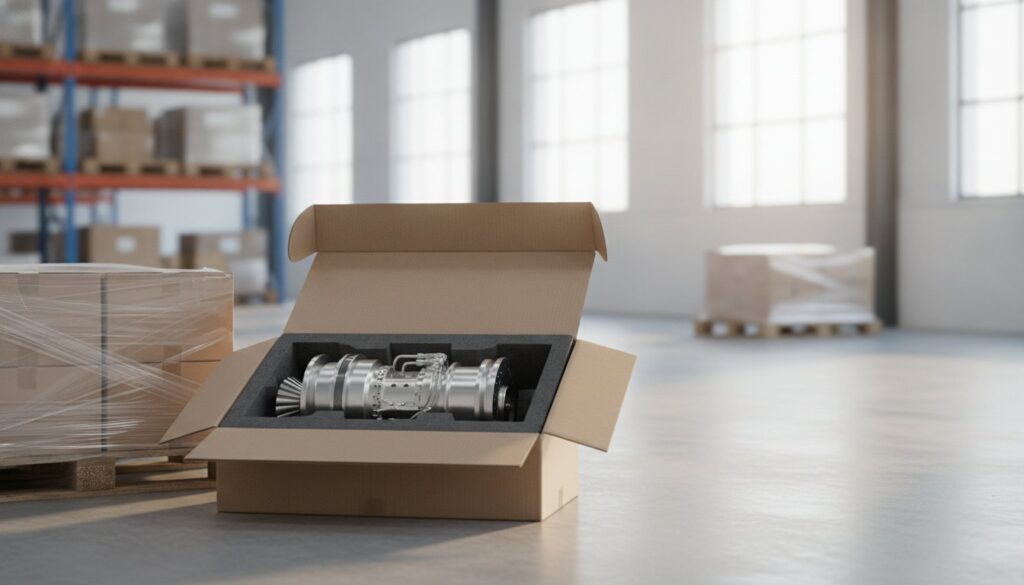
North American containerboard prices saw a net increase of $100 per ton in the first half of 2026, making every square inch of wasted material a direct hit to your bottom line. If you’re managing a production floor in Orange County or Los Angeles, you already know that inefficient manufacturing packaging does more than just inflate shipping costs. It creates bottlenecks in assembly, consumes valuable warehouse space with bulky supplies, and leads to costly product damage that frustrates your customers.
We understand that packaging is a critical manufacturing component rather than a simple commodity. This guide will show you how to transform your packaging from a logistical headache into a strategic advantage that reduces operational expenses and protects your product integrity. We will examine real-world industrial examples and optimization strategies like vendor-managed inventory and custom kitting designed specifically to streamline Southern California supply chains. You’ll learn how specialized materials and smarter floor-space management can help you meet rigorous industrial standards while controlling rising labor costs.
Key Takeaways
- Understand the technical distinction between primary and secondary manufacturing packaging to ensure component protection throughout the entire production cycle.
- Learn to select optimal protective materials, such as engineered foam and die-cut corrugated boxes, to eliminate internal movement and prevent damage to high-value goods.
- Discover how implementing vendor-managed inventory (VMI) and pre-assembled packaging kits can reclaim warehouse floor space and accelerate assembly line speeds.
- Identify the logistical advantages of sourcing industrial supplies from local Southern California partners to minimize freight costs and lead times for Los Angeles and Orange County facilities.
Industrial Packaging Strategies for Modern Manufacturing Facilities
Effective manufacturing packaging refers to the technical systems and specialized materials designed to shield components from damage during every phase of the production cycle. It’s a critical infrastructure layer that extends far beyond a simple shipping container. For high-value OEMs in Southern California, this involves a shift from generic off-the-shelf boxes to engineered protection. Precision-engineered solutions ensure that every part, from a delicate medical sensor to a heavy aerospace sub-assembly, remains within tolerance from the moment it enters the facility until it reaches the end user.
In industrial environments, the distinction between primary and secondary packaging and labeling is vital for operational flow. Primary packaging often involves materials that directly contact the product, such as anti-static films or custom foam inserts. Secondary packaging provides the structural integrity required for transit and storage, typically utilizing heavy-duty corrugated boxes or wood crates. When these systems are poorly integrated, the total Cost of Goods Sold (COGS) increases through higher labor requirements, excessive material waste, and product replacement costs. Transitioning to a custom packaging design allows manufacturers to control these variables and stabilize their margins.
The Role of Packaging in Lean Manufacturing
Lean manufacturing principles demand the elimination of waste, and packaging is a primary area for optimization. Right-sized corrugated solutions eliminate the need for excessive void fill, reducing both material costs and warehouse footprints in expensive markets like Orange County and Los Angeles. Custom-engineered kits allow assembly line workers to access parts quickly without struggling with difficult wrapping or oversized containers. This ergonomic approach minimizes material handling touches and accelerates throughput, directly impacting the facility’s daily output capacity.
Protecting the Supply Chain from Component to Customer
A resilient supply chain requires specific packaging strategies for three distinct phases of production. Inbound packaging must be robust enough to protect raw materials during freight, often utilizing custom foam packaging to secure delicate parts. Once inside the factory, work-in-process (WIP) containers facilitate safe movement between workstations, preventing internal collisions or contamination. Finally, outbound shipping containers are engineered for the rigors of the global logistics network. These containers must withstand stacking pressures, humidity, and vibration, ensuring that the finished product arrives in the same condition it left the factory floor.
Custom Protective Solutions for High-Value Components
High-value components in the aerospace, medical, and electronics sectors require more than standard cushioning. Precision manufacturing packaging relies on a technical understanding of how different materials perform under stress, vibration, and impact. We select between Polyethylene and Polyurethane foam based on the specific load and fragility of your part. Polyethylene is a durable, closed-cell foam ideal for heavier components that need structural support and moisture resistance. Polyurethane is an open-cell, softer foam that provides superior shock absorption for lightweight, highly delicate instruments.
Rapid prototyping is a non-negotiable step in the design phase for any industrial OEM. We use CNC foam cutting and precision die-cutting to create exact replicas of the final packaging for real-world testing. This ensures a precision fit that eliminates internal movement, which is the primary cause of transit damage. For electronics manufacturers in the Inland Empire and San Diego County, we often integrate Electrostatic Discharge (ESD) properties into these custom inserts. This protects sensitive circuitry from latent component failure caused by static electricity during handling and transport.
Foam Packaging for Aerospace and Medical Devices
Protecting sensitive sensors for long-range transport requires a multi-layered defense strategy. For instance, a heavy aerospace sensor might require high-density 2.2lb Polyethylene foam to prevent the part from “bottoming out” during a drop. We frequently integrate these engineered foam inserts with custom corrugated boxes to create a comprehensive protective shield. This combination provides the external puncture resistance needed for heavy freight and the internal cushioning required to maintain precision calibration for medical devices.
Corrugated Design for Industrial Durability
Industrial manufacturers must choose between different corrugated grades to balance cost and performance. While the Mullen Burst Test measures a box’s resistance to being punctured, the Edge Crush Test (ECT) is often more relevant for modern warehouse environments. Edge Crush Test (ECT) measures the compressive strength of corrugated board along the edge, determining the maximum top-to-bottom weight a box can withstand before collapsing in a stack. For heavy machinery parts, we utilize double-wall or triple-wall corrugated to handle extreme loads and prevent box deformation. If you’re designing a new component, you can request a custom prototype to verify material performance and fit before committing to a full production run.
Stabilizing Heavy Loads with Industrial Pallets and Crates
Load stability is the foundation of effective industrial logistics. Without a secure base, even the most advanced internal manufacturing packaging will fail to protect high-value equipment from the forces of transit. Selecting the correct pallet or crate depends on the weight of the load, the sensitivity of the components, and the destination of the shipment. For many Southern California facilities, this choice dictates whether a product arrives ready for installation or requires expensive repairs. We help manufacturers navigate these choices by prioritizing structural integrity and regulatory compliance.
Material selection is the first critical decision in load stabilization. Traditional wood pallets remain the industry standard for one-way shipping due to their cost-effectiveness and ease of customization. However, for cleanroom environments in the medical device and electronics sectors, plastic pallets are often the better choice. They don’t shed fibers, harbor pests, or absorb moisture, making them ideal for sterile manufacturing floors. For international shipments, all wood packaging must meet ISPM 15 standards. This requires heat treatment and a visible HT stamp to certify that the wood is free of invasive pests, preventing costly delays at customs hubs in Los Angeles or Long Beach. Understanding the full scope of these requirements — including the latest IPPC marking mandates and zero tolerance bark policies — is essential; our guide on export pallet compliance and international shipping regulations covers the most common misconceptions that lead to port rejections.
Heavy-Duty Palletization Strategies
When durability and hygiene are paramount, heavy duty plastic pallets offer a superior solution for closed-loop supply chains. Unlike wood, these platforms maintain consistent dimensions and weight, which is essential for automated storage and retrieval systems. While the standard 48×40 pallet fits most domestic trailers, oversized machinery often requires custom-sized industrial platforms to prevent overhang. Proper pallet stacking patterns are also essential for maximizing trailer space and ensuring load balance. Stacking heavy items in a columnar pattern rather than interlocking them can often improve the vertical compression strength of the entire unit.
Crating and Edge Protection for Machinery
Sensitive industrial equipment requires the structural defense of custom crates. These are engineered to handle extreme weights and provide a rigid exterior that shields against side-impact damage. To prevent the heavy-duty straps from crushing the corners of your boxes or crates, we utilize edge and corner protectors to distribute tension across a wider surface area. High-performance stretch film reduces material use while increasing load containment through advanced resin technology that maintains tight wrap tension with less total film weight. This combination of rigid crating and flexible stabilization ensures that even the most complex machinery remains stationary throughout the supply chain.
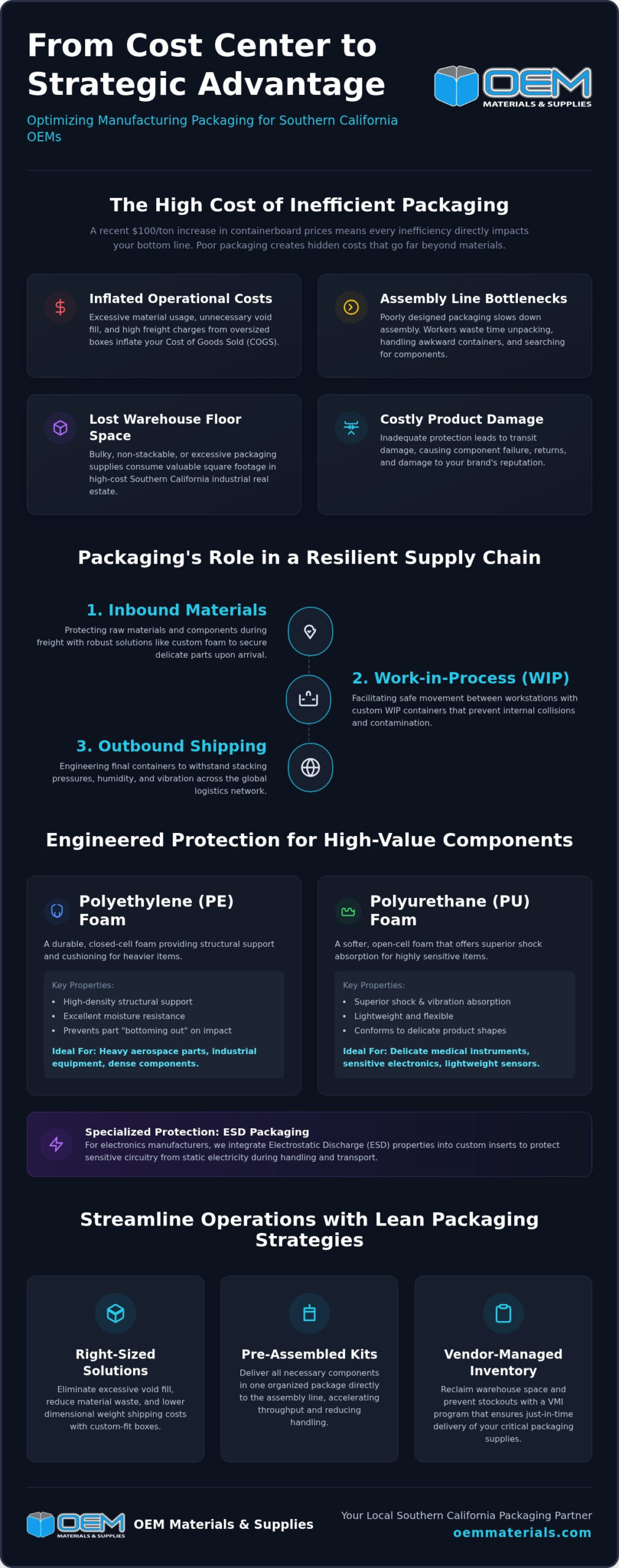
Operational Efficiency: Kitting and Vendor-Managed Inventory
Managing multiple SKUs for manufacturing packaging often creates hidden labor costs and warehouse congestion. When a production team has to pull boxes from one rack, foam inserts from another, and labels from a third location, the assembly process slows down significantly. Consolidating these materials into a streamlined system is essential for maintaining high-volume throughput. By focusing on how packaging enters your facility, you can eliminate the bottlenecks that typically occur during the final stages of production.
For manufacturers in Los Angeles and Orange County, floor space is a premium asset. Storing bulky corrugated supplies and cushioning materials on-site consumes square footage that could otherwise be used for active production lines. Transitioning to a model that prioritizes lean logistics allows your team to focus on core manufacturing tasks while we handle the complexities of material availability. This approach not only cleans up the shop floor but also ensures that packaging is never the reason for a shipment delay.
Reducing Labor Costs through Kitting
Kitting involves pre-assembling multiple packaging components into a single, ready-to-use SKU. This process combines items like custom boxes, engineered foam inserts, and required labels into one package delivered directly to the assembly station. For high-volume operations, this reduces packing time by eliminating the need for workers to search for individual parts. Medical device manufacturers frequently utilize this strategy to ensure all sterile packaging components are present and organized before the product reaches the cleanroom. This level of organization minimizes human error and guarantees a consistent, professional presentation for every unit shipped.
The Financial Impact of VMI and JIT
Implementing Vendor-Managed Inventory (VMI) shifts the burden of inventory carrying costs back to the supplier. Instead of tying up cash in months of packaging stock, you pay for materials as they are consumed. We monitor your usage levels and replenish supplies automatically, which prevents stockouts and ensures supply chain continuity during regional disruptions. This Just-In-Time (JIT) delivery model is particularly effective for Southern California facilities looking to improve cash flow and reclaim warehouse space. You can request a consultation to see how a VMI program can be tailored to your specific annual usage and production schedule.
Sourcing Manufacturing Packaging in Southern California
Sourcing manufacturing packaging locally in Southern California provides a logistical advantage that national distributors cannot replicate. Proximity to your production floor means shorter lead times and significantly lower freight expenses. When your supplier is located near major distribution hubs in San Diego or Riverside, you avoid the volatility of long-haul shipping rates and diesel surcharges. This regional focus allows for a more responsive supply chain that can adapt to sudden production spikes or design changes without the delay of cross-country transit. We act as a technical guide for facilities in Los Angeles and Orange County, ensuring that your packaging strategy aligns with local operational realities.
Choosing a partner with a deep presence in the region also simplifies compliance. With California SB 54 regulations now in full effect as of May 2026, local manufacturers face strict requirements regarding plastic packaging and producer responsibility. A local expert understands these state-specific mandates and can help you transition to compliant materials before the 2027 fee implementation. This proactive approach prevents the administrative civil penalties that can reach $50,000 per violation for non-compliance.
Regional Expertise in SoCal Industrial Sectors
Different regions in Southern California have unique industrial requirements. Aerospace manufacturers in the Inland Empire require packaging that meets rigorous military and commercial aviation standards for component protection. San Diego labs and biotech firms need specialized solutions for cold-chain or sterile environments. Meanwhile, electronics and automotive OEMs in Orange County often prioritize high-turnover logistics and ESD-safe materials. We provide tailored solutions for each of these sectors, ensuring that your packaging meets the specific technical demands of your industry and geographic location.
Choosing a Solutions-Oriented Packaging Partner
Moving beyond a commodity-based mindset requires evaluating the total cost of ownership (TCO) rather than just the price of a single box. A cheap container that leads to a 2% increase in product damage is far more expensive than an engineered solution. We offer on-site packaging audits and design consultations to identify where your current process is failing. This might involve replacing bulky void fill with precision-cut foam or consolidating multiple box sizes into a single multi-depth corrugated design. To start optimizing your operation, you can contact an expert for custom packaging design and prototypes. Providing specific data such as product dimensions, weight, and annual usage allows us to develop a recommendation that balances protection with material efficiency.
Drive Operational Efficiency through Strategic Packaging
Optimizing your manufacturing packaging is a direct investment in your facility’s throughput and bottom line. We’ve explored how engineered foam inserts and custom corrugated designs prevent costly transit damage while stabilizing complex loads. By shifting to lean logistics models like VMI and JIT, you can reclaim expensive warehouse floor space in Southern California and ensure your assembly lines never stall due to material stockouts. Precision protection is a requirement for modern OEMs; not an option.
OEM Materials & Supplies serves as a dedicated partner for manufacturers across Los Angeles, Orange County, San Diego, and the Inland Empire. We provide technical expertise in custom prototypes and engineered foam design to meet the most rigorous aerospace and medical standards. To begin your optimization process, please request a custom packaging quote for your manufacturing project. Providing your product dimensions, weight, and annual usage will help our team develop a precise and cost-effective solution for your operation. We look forward to supporting your next project.
Frequently Asked Questions
What is the difference between industrial and retail packaging?
Industrial packaging prioritizes protection, durability, and logistical efficiency throughout the production and distribution cycle, whereas retail packaging focuses on marketing and consumer appeal. Industrial solutions are engineered to withstand stacking pressures, vibration, and environmental stress during transit. Retail containers often use thinner materials that aren’t designed to survive the rigors of heavy-duty manufacturing logistics or long-term warehouse storage.
How do custom foam inserts prevent product damage in manufacturing?
Custom foam inserts prevent damage by immobilizing the component and absorbing energy from impacts or vibrations during transit. By using precision die-cutting or CNC routing, we create a cavity that matches the exact geometry of your part. This ensures that delicate components, such as medical sensors or aerospace electronics, don’t move or collide with the outer container wall, maintaining product integrity during the most demanding shipping routes.
What are the benefits of Vendor-Managed Inventory for packaging supplies?
Vendor-Managed Inventory (VMI) eliminates stockouts and reduces on-site warehouse requirements by shifting inventory oversight to the supplier. We monitor your consumption levels and replenish supplies automatically, which improves your cash flow by only charging for materials as they are used. This system is particularly effective for manufacturing packaging because it ensures high-volume supplies are always available without cluttering your production floor or tying up capital in excess stock.
Do you provide custom corrugated boxes for heavy machinery?
Yes, we design heavy-duty corrugated boxes specifically for the extreme weights associated with industrial machinery. These solutions often utilize double-wall or triple-wall construction to provide high Edge Crush Test (ECT) ratings. When paired with edge protectors and custom pallets, these boxes provide a lightweight but robust alternative to traditional wood crates for many heavy-duty applications across Southern California.
What standards apply to international shipping crates?
International shipping crates must comply with ISPM 15 standards, which require all wood packaging to be heat-treated and marked with a certified HT stamp. This regulation is strictly enforced at global ports to prevent the spread of invasive pests. Failure to use compliant wood crates can result in your shipment being quarantined or rejected at the destination, leading to significant delays and additional costs. For a detailed breakdown of current marking requirements and how to select the right export pallets to avoid port rejections, our shipping guide addresses the most up-to-date international mandates.
Can kitting services really reduce my warehouse labor costs?
Kitting services reduce labor costs by delivering pre-assembled packaging components as a single SKU directly to your assembly line. Instead of workers spending time gathering boxes, foam, and tape from different warehouse locations, they receive a ready-to-use kit. This streamlines the packing process, reduces human error, and allows your team to focus on core production tasks rather than material handling.
What information is needed to get an accurate packaging quote?
To provide an accurate quote, we require the dimensions, weight, and fragility of the product, along with your estimated annual usage. Details regarding the shipping environment, such as stackability requirements or international destinations, are also critical. Providing a prototype or CAD file of the component allows our engineers to design the most efficient and protective solution for your specific needs.
How does right-sized packaging impact shipping costs for manufacturers?
Right-sized packaging reduces shipping costs by eliminating unnecessary dimensional weight and reducing the amount of void fill material required. Carriers charge based on the space a package occupies, so oversized boxes directly inflate your freight expenses. By engineering a box that fits the product precisely, manufacturers can maximize trailer density and lower their total landed cost while minimizing material waste.