
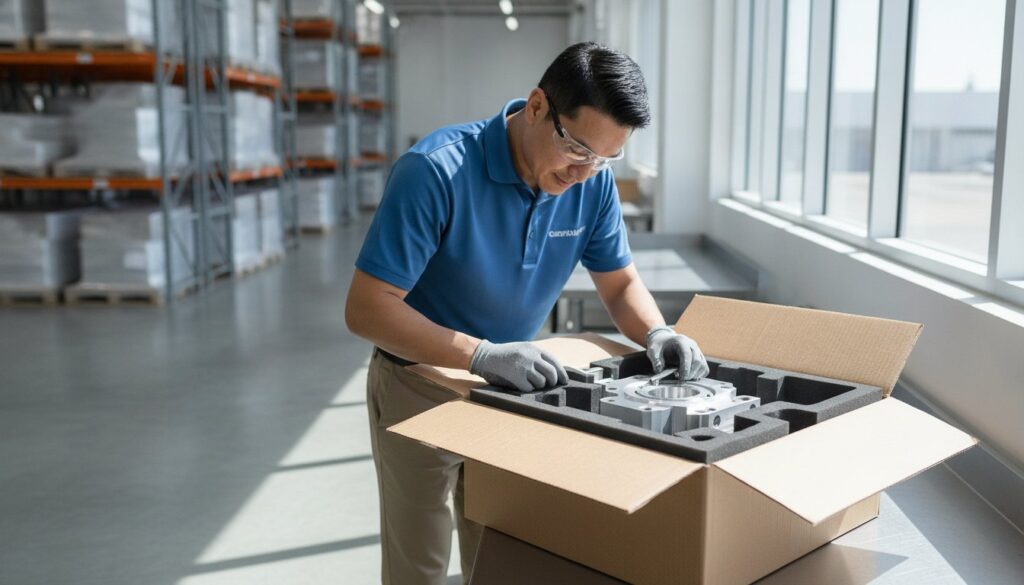
Is your warehouse currently functioning as an expensive storage unit for air and excess corrugated? Many Southern California manufacturers find that traditional procurement methods no longer protect their margins against the three separate waves of price hikes seen in the containerboard market throughout 2026. Implementing effective packaging cost reduction strategies is no longer about finding the cheapest box. It requires a technical shift toward total cost optimization. You likely feel the strain of rising resin prices and the 139 DIM divisor that has made lightweight, bulky shipments significantly more expensive across UPS, FedEx, and USPS.
Labor turnover and warehouse space constraints shouldn’t dictate your operational success. We understand that managing assembly lines while trying to reduce storage footprints is a constant balancing act for procurement teams. This guide provides a roadmap to lower your total cost of ownership through custom engineering and smarter inventory logistics. We will explore how transitioning from stock boxes to custom-engineered corrugated and foam solutions can slash dimensional weight charges. You will also learn how to improve throughput with optimized kitting and stabilize your supply chain using vendor-managed inventory or just-in-time delivery. These proven methods ensure your packaging remains a protective asset rather than a growing liability.
Key Takeaways
- Learn how to audit your current process to identify the financial gap between material purchase price and total applied cost.
- Discover how right-sizing corrugated containers and utilizing high-performance materials can lower DIM weight charges and material volume.
- Evaluate the efficiency gains of outsourcing kitting and assembly to reduce labor overhead and improve packing line throughput.
- Implement effective packaging cost reduction strategies such as Vendor Managed Inventory (VMI) to reclaim warehouse space and prevent stockouts.
- Establish a long-term savings roadmap by using rapid prototyping and quarterly design reviews to validate new engineering changes.
Auditing Your Current Packaging Process for Hidden Waste
Effective packaging cost reduction strategies begin with a rigorous physical audit rather than a simple spreadsheet review. Many procurement teams focus solely on the unit price of a corrugated box or a roll of stretch film. This narrow focus ignores the total applied cost, which includes labor, storage, and transport. Manufacturers in Los Angeles County and Orange County often find that the gap between material purchase price and total operational cost is where the most significant waste occurs. You must analyze how many touches each package requires on the assembly line. Every extra fold or piece of tape added by a worker increases your labor overhead, which is particularly taxing given the $16.90 California minimum wage in 2026.
Your warehouse footprint also plays a critical role in the audit. Stocking months of bulky packaging inventory consumes floor space that could be used for revenue-generating production. By understanding the fundamentals of packaging, you can identify if you are storing excessive air in the form of oversized boxes or over-purchasing materials that don’t align with your current throughput. A successful audit identifies these inefficiencies and converts them into measurable savings.
Quantifying the Cost of Product Damage
Product damage is a primary driver of hidden costs. Calculating the true cost of a return requires looking beyond the price of the item itself. You must account for outbound freight, reverse logistics, inspection time, and the labor required to process a replacement. If your damage rates are high in specific shipping lanes, your current materials may be under-performing. Conversely, consistently zero damage across all lanes might indicate you’re over-spending on materials. We recommend evaluating if your protective packaging costs are lower than your total damage rate. Using this data allows you to justify investments in higher-quality custom foam or die-cut inserts that provide precision protection without the bulk of generic void fill.
Analyzing Dimensional Weight (DIM) Impacts
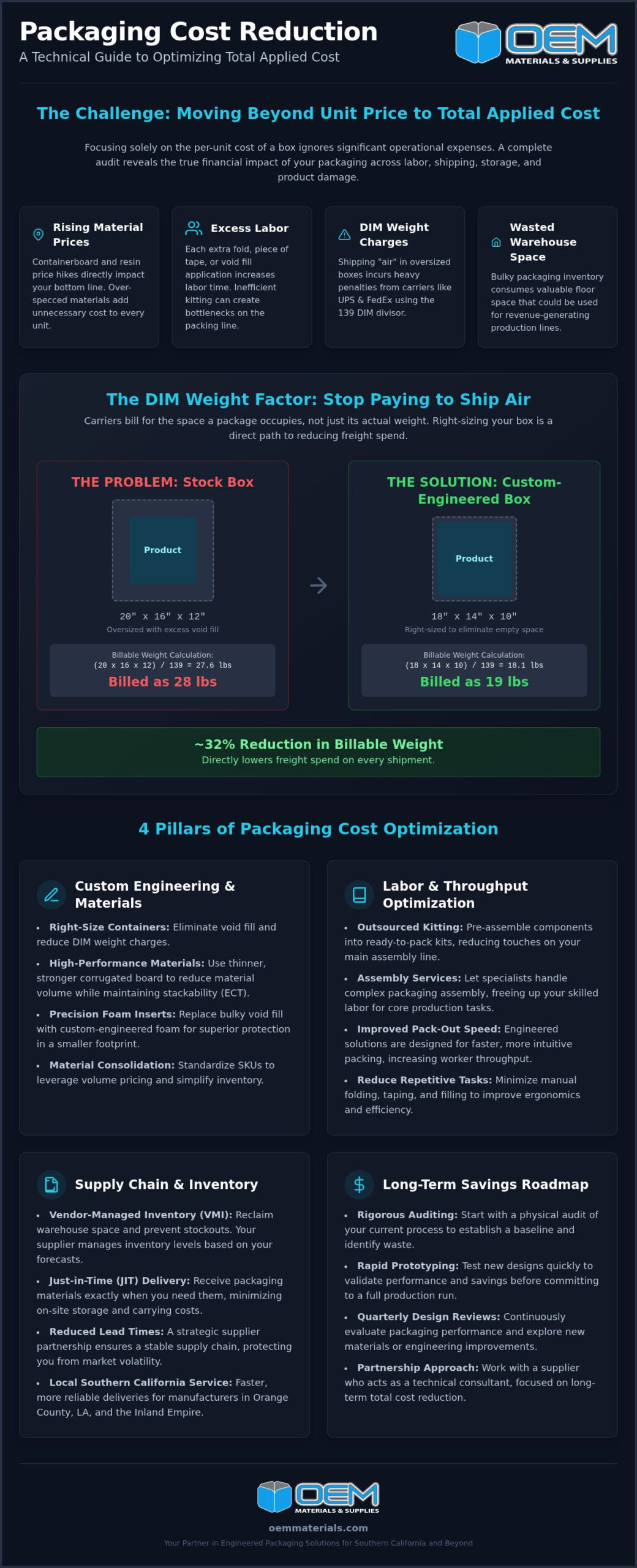
In 2026, shipping costs are driven by volume as much as weight. Major carriers including UPS, FedEx, and USPS have standardized on a 139 DIM divisor for domestic parcel shipments. This means a lightweight product in an oversized box is billed at a much higher weight than its actual scale reading. You’re essentially paying to ship air. Custom-sized boxes eliminate this waste by right-sizing the container to the product dimensions. Manufacturers switching from stock containers to custom-engineered solutions often see a direct reduction in freight spend by minimizing the billable volume of every shipment across their distribution network.
Custom Engineering and Material Optimization Strategies
Engineering-led packaging cost reduction strategies focus on the physical properties of materials to drive down total ownership costs. Transitioning from stock containers to custom-engineered designs allows you to eliminate excessive void fill. This is critical in 2026, as major carriers strictly enforce the 139 DIM divisor. By right-sizing your corrugated boxes, you remove the “air” that triggers higher billable weights. High-performance materials also allow for thinner walls without sacrificing Edge Crush Test (ECT) ratings. This reduces material volume while maintaining necessary stackability in the warehouse.
Integrating custom foam packaging into your design often permits a smaller outer container. Precision-engineered foam absorbs shock more efficiently than bulkier alternatives like bubble wrap or packing peanuts. Consolidating multiple components into a single die-cut design also reduces the number of touches required at the packing station. If you’re looking to optimize your current designs, you can request a technical consultation to review your current specifications.
Material Consolidation and Standardization
Standardizing materials across your product lines is a powerful lever for cost control. Reducing the number of unique SKUs in your inventory allows you to leverage volume pricing from your supplier. We often find that manufacturers can replace several specialized materials with a single multi-functional option that provides both cushioning and surface protection. This simplification streamlines procurement and reduces the risk of stockouts on critical components. It also makes your assembly lines more efficient by reducing the variety of materials workers must manage.
Engineering for Protection and Density
For high-value sectors like medical devices and aerospace, protection cannot be compromised. However, over-engineering leads to material waste. We focus on balancing foam density and thickness to ensure safety while minimizing the physical footprint. Using custom foam inserts allows for higher part density per pallet, which directly lowers transport costs. This approach aligns with EPA guidelines on sustainable packaging by reducing the total volume of waste generated throughout the supply chain. Precision design ensures that every cubic inch of the package serves a functional purpose, protecting your margins as effectively as your products.
Reducing Labor Costs through Kitting and Assembly
Labor overhead represents one of the most volatile variables in the total cost of ownership for Southern California manufacturers. With the 2026 California minimum wage set at $16.90 per hour, manual assembly tasks that were once negligible now require strict scrutiny. Implementing packaging cost reduction strategies must address the efficiency of the packing station itself. If your team is manually folding boxes and hand-applying void fill, you are likely losing significant throughput to inefficient touches. Every second spent on redundant assembly is a second taken away from your core manufacturing output.
Specialized kitting services offer a functional remedy by delivering pre-assembled components directly to your production line. This is a critical advantage for the medical device and aerospace sectors in Los Angeles and Orange County, where shipments often involve multiple delicate components. Using pre-configured kits ensures that every foam insert and corrugated part is accounted for before the product reaches the shipping dock, virtually eliminating the human error associated with complex assembly and reducing the risk of incomplete shipments.
The ROI of Outsourced Packaging Assembly
Determining the financial benefit of outsourcing requires a comprehensive look at your facility. Beyond the hourly wage, consider the square footage currently occupied by raw packaging materials and assembly tables. Shifting to finished kits allows you to reallocate that floor space to core manufacturing activities that drive revenue. Industry data on supply chain packaging optimization demonstrates that reducing logistical complexity at the warehouse level can yield substantial savings for high-volume operations. By purchasing completed kits, you transform a variable labor cost into a fixed material cost, making your annual budget more predictable and manageable.
Designing for Rapid Assembly
Engineering your packaging for speed is just as important as engineering it for protection. We often suggest transitioning to corrugated designs with auto-lock bottoms or integrated self-sealing features. These modifications remove the need for tape dispensers and heavy machinery, allowing workers to secure a product in seconds. Additionally, integrating edge and corner protectors into the initial kit design simplifies the palletization process. By selecting materials that are intuitive and easy to handle, you improve worker throughput and reduce the training time required for new staff on the assembly line.
Streamlining the Supply Chain with VMI and JIT
Inventory management is often the most overlooked component of packaging cost reduction strategies. While engineering and labor focus on the physical package, supply chain optimization addresses the hidden costs of procurement and storage. Implementing Vendor Managed Inventory (VMI) allows you to transfer the burden of stock monitoring and replenishment to your supplier. This transition eliminates the risk of production-stopping stockouts and significantly reduces the administrative hours spent on manual inventory counts. By consolidating your supply chain, you also gain a hedge against the frequent material price hikes observed in the 2026 containerboard and resin markets.
Reclaiming Warehouse Space in Southern California
Industrial real estate in Los Angeles County and Orange County remains among the most expensive in the nation. Using your facility to store months of bulky corrugated inventory is an inefficient use of high-cost square footage. We recommend shifting your packaging inventory to a supplier’s warehouse to maximize your active production area. Utilizing JIT packaging services ensures that materials arrive exactly when they are needed on the assembly line. This approach is particularly effective for manufacturers in the Inland Empire and San Diego County who need to maintain lean operations without sacrificing the ability to scale production rapidly.
Improving Cash Flow with VMI
Traditional procurement models tie up significant capital in safety stock that may sit on a shelf for months. VMI programs often allow for a transition to a pay on use model, where you are invoiced only when materials are actually pulled for production. This shift directly improves your cash flow by reducing the amount of working capital locked in stagnant inventory. Additionally, VMI provides superior visibility into your actual consumption rates. This data allows for more accurate forecasting and prevents the over-ordering of specialized components like custom foam or printed labels.
Consolidating your packaging requirements under a single managed program also streamlines your accounting department. Instead of managing dozens of individual purchase orders and invoices, you move toward a consolidated billing system. This reduces the soft costs of procurement and allows your team to focus on higher-value supply chain activities. To see how these inventory models can be tailored to your specific usage rates, you can contact our team for an inventory audit.
Implementing a Long-Term Packaging Savings Plan
Sustainable cost control is never a one-time event. It requires a commitment to ongoing analysis and a structured review process. We recommend establishing a quarterly review with your industrial packaging supplier to evaluate consumption data and identify emerging waste. In 2026, market volatility remains a constant challenge. By monitoring raw material trends, specifically for containerboard and polyethylene resin, you can anticipate price shifts and adjust your procurement strategy before they impact your margins. Long-term supply agreements can also provide a necessary buffer against the frequent price hikes seen across the industry this year.
Optimization isn’t limited to the box itself; it extends to how your team applies materials on the warehouse floor. Training your staff on proper application techniques for stretch film for pallet wrapping is a high-impact way to reduce material spend. Excessive film usage doesn’t always equate to better load stability. Often, it’s just a sign of improper tension settings or lack of training. Consistent education ensures your team uses only what is required to secure the load, preventing both material waste and the risk of transit damage.
Testing and Validation of New Designs
Implementing packaging cost reduction strategies involves a degree of risk that must be managed through technical validation. We use rapid prototyping to ensure that any move toward thinner, high-performance materials doesn’t compromise the safety of your product. Transit tests are essential. They simulate the actual stresses of your shipping lanes, from the vibration of long-haul trucks to the impacts of automated sorting hubs. Utilizing professional custom packaging design services allows you to iterate quickly, ensuring your designs remain compliant with the latest carrier regulations and DIM weight standards without sacrificing structural integrity.
Partnering for Continuous Improvement
A solution-oriented partner provides more value than a commodity vendor. You need a partner that understands the technical requirements of the aerospace, medical, and electronics sectors in Southern California. Establishing a feedback loop between your shipping floor and your packaging engineer is vital. If a particular kit is consistently difficult to assemble or if damage rates spike in a specific region, that data should trigger an immediate design review. When you’re ready to refine your current program, provide your supplier with specific data: product dimensions, weight, and annual usage. This precision allows for accurate recommendations that reflect the unique operational needs of your facility in Los Angeles or Orange County.
Optimizing Your Total Cost of Ownership
Reducing industrial packaging spend is no longer about finding the cheapest box. It’s about engineering a system that balances protection, labor, and logistics. We’ve explored how auditing for hidden waste and transitioning to custom-engineered corrugated and foam solutions can directly lower your DIM weight charges. By outsourcing kitting and assembly, you convert variable labor into predictable material costs while freeing up your manufacturing floor for core production. Reclaiming warehouse space through VMI and JIT programs remains a critical advantage for operations in Los Angeles, Orange County, San Diego, and Riverside.
Implementing these packaging cost reduction strategies ensures your supply chain remains resilient against the material price hikes and carrier rule changes seen throughout 2026. Our team specializes in the technical requirements of the aerospace, medical device, and electronics sectors, providing the precision your products demand. We’re ready to help you identify specific savings opportunities tailored to your product dimensions and annual usage. To begin optimizing your operation, Request a Packaging Audit and Quote today. We look forward to partnering with you to build a more efficient, cost-effective shipping process.
Frequently Asked Questions
What is the most effective way to reduce packaging costs quickly?
The most effective way to reduce costs quickly is through a physical audit of your current shipping containers to identify “air” and over-engineered materials. Eliminating excess void fill and right-sizing your corrugated boxes can yield immediate savings on material volume. These packaging cost reduction strategies focus on the total applied cost rather than just the unit price. Quick wins often come from reducing the billable weight of your most frequent shipments.
Does custom packaging actually save money compared to stock boxes?
Custom packaging often saves money by reducing the total cost of ownership, even if the per-unit price of the box is higher. Right-sized containers lower dimensional weight charges and minimize the need for secondary materials like bubble wrap or peanuts. By engineering a box specifically for your product, you reduce shipping volume and labor time. These savings typically offset the initial design and tooling investment within a few production cycles.
How can I reduce the labor costs associated with my packaging line?
Outsourcing your packaging assembly to a specialized kitting service is the most direct way to lower labor overhead. This shift allows your team to focus on core manufacturing tasks while we handle the box folding and foam insertion. Using kits with auto-lock bottoms or self-sealing features also improves throughput at the packing station. These efficiencies are essential for managing the $16.90 California minimum wage in 2026.
What is Vendor Managed Inventory (VMI) in the packaging industry?
Vendor Managed Inventory (VMI) is a service where your supplier takes responsibility for monitoring and replenishing your packaging stock. This program eliminates the need for manual inventory counts and reduces the administrative burden on your procurement team. By shifting inventory to our facility, you reclaim valuable warehouse space in Southern California and ensure that you only pay for the materials you actually consume. This model significantly improves operational cash flow.
How does dimensional weight (DIM) affect my total packaging spend?
Dimensional weight allows carriers like UPS and FedEx to charge for the space a package occupies rather than just its actual weight. In 2026, the standard divisor is 139, meaning a large, lightweight box will be billed at a significantly higher weight. Right-sizing your containers is critical to avoid paying to ship air. This technical adjustment is one of the most impactful packaging cost reduction strategies for high-volume shippers.
Can I reduce packaging costs without increasing the risk of product damage?
You can maintain or even improve protection levels while lowering costs by utilizing precision-engineered materials. Switching to custom foam packaging provides superior shock absorption compared to generic cushioning, allowing for smaller outer boxes. High-performance corrugated materials also offer equivalent Edge Crush Test (ECT) ratings with thinner walls. This approach reduces material volume without compromising the safety of high-value electronics or medical devices during the rigors of transit.
How often should I audit my industrial packaging materials?
We recommend auditing your industrial packaging materials at least once per quarter. Regular reviews allow you to adapt to fluctuations in raw material prices, such as the resin hikes seen in 2026, and adjust for changes in carrier billing rules. A quarterly feedback loop between your shipping floor and your engineering partner ensures that your design specifications remain effective as your product lines and shipping lanes evolve over time.
What data do I need to provide for a packaging cost reduction consultation?
To receive an accurate consultation, you should provide specific data including product dimensions, actual weight, and annual usage rates. It is also helpful to share your current damage rates across different shipping lanes and your typical pallet configuration. This technical detail allows us to engineer a solution that optimizes for both material density and transport efficiency. Accurate data ensures our recommendations reflect the unique operational needs of your facility.