
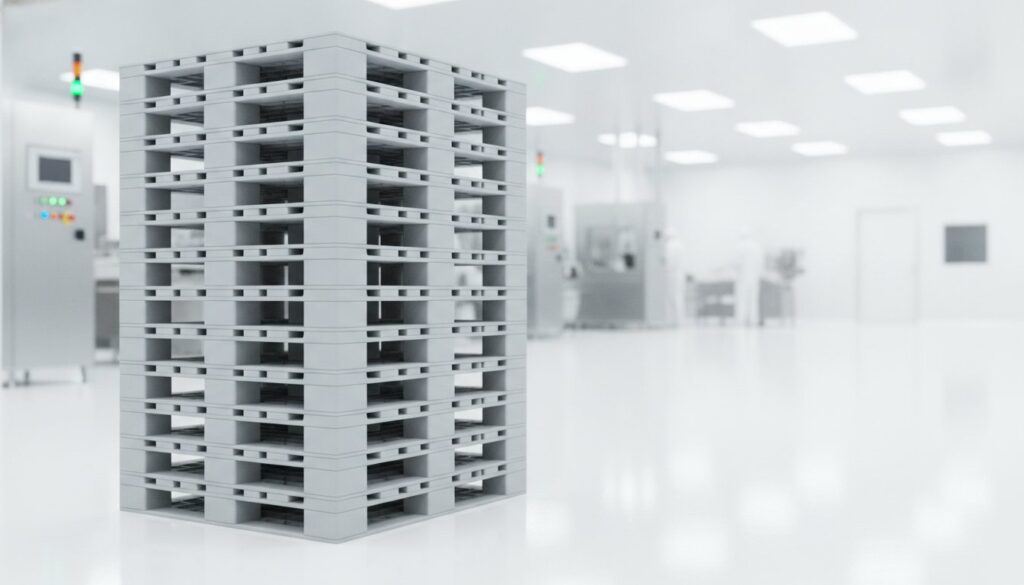
A standard heavy-duty pallet might look clean to the naked eye, but in an ISO 7 or ISO 8 environment, the wrong material choice can become the single point of failure for your entire production run. Maintaining strict contamination control is a constant challenge for facility managers in Southern California, where even microscopic wood fibers or mold spores can trigger a regulatory nightmare. You already know that product safety hinges on every piece of equipment that enters your controlled space.
It is frustrating to watch labor costs climb as teams manually transfer goods between external shipping pallets and internal cleanroom platforms just to keep contaminants out. We will show you how to select plastic pallets for cleanroom environments that satisfy FDA and GMP requirements while improving your operational speed. This guide breaks down the technical differences between deck geometries, the necessity of virgin HDPE resin, and how the latest ISO 14644-13:2026 standards impact equipment suitability for manufacturers in Los Angeles, Orange County, and San Diego.
Key Takeaways
- Identify the specific ISO 14644 classifications and FDA requirements that dictate whether your facility requires open or closed deck pallet designs.
- Understand the performance differences between HDPE and Polypropylene when selecting plastic pallets for cleanroom environments to ensure durability during chemical sterilization.
- Streamline manual transfer processes and reduce labor expenses by establishing protocols for moving goods from external shipping pallets to sterile internal platforms.
- Leverage Southern California inventory locations to implement just-in-time delivery and vendor-managed inventory programs that prevent pallet shortages during critical production cycles.
Why Plastic Pallets are Essential for Cleanroom Compliance
A cleanroom-grade pallet is a specialized, inorganic load carrier engineered to function within controlled environments. These units are defined by their non-porous, smooth surfaces that resist the accumulation of particulates. Unlike standard equipment, plastic pallets for cleanroom environments are built to withstand the rigors of chemical sterilization. They don’t degrade when exposed to the caustic cleaning agents or high-temperature wash-down cycles required to maintain sterile conditions. For facility managers in Orange County and Los Angeles, these pallets provide a reliable solution for meeting stringent hygiene protocols while ensuring long-term operational durability.
The Problem with Traditional Wood Pallets
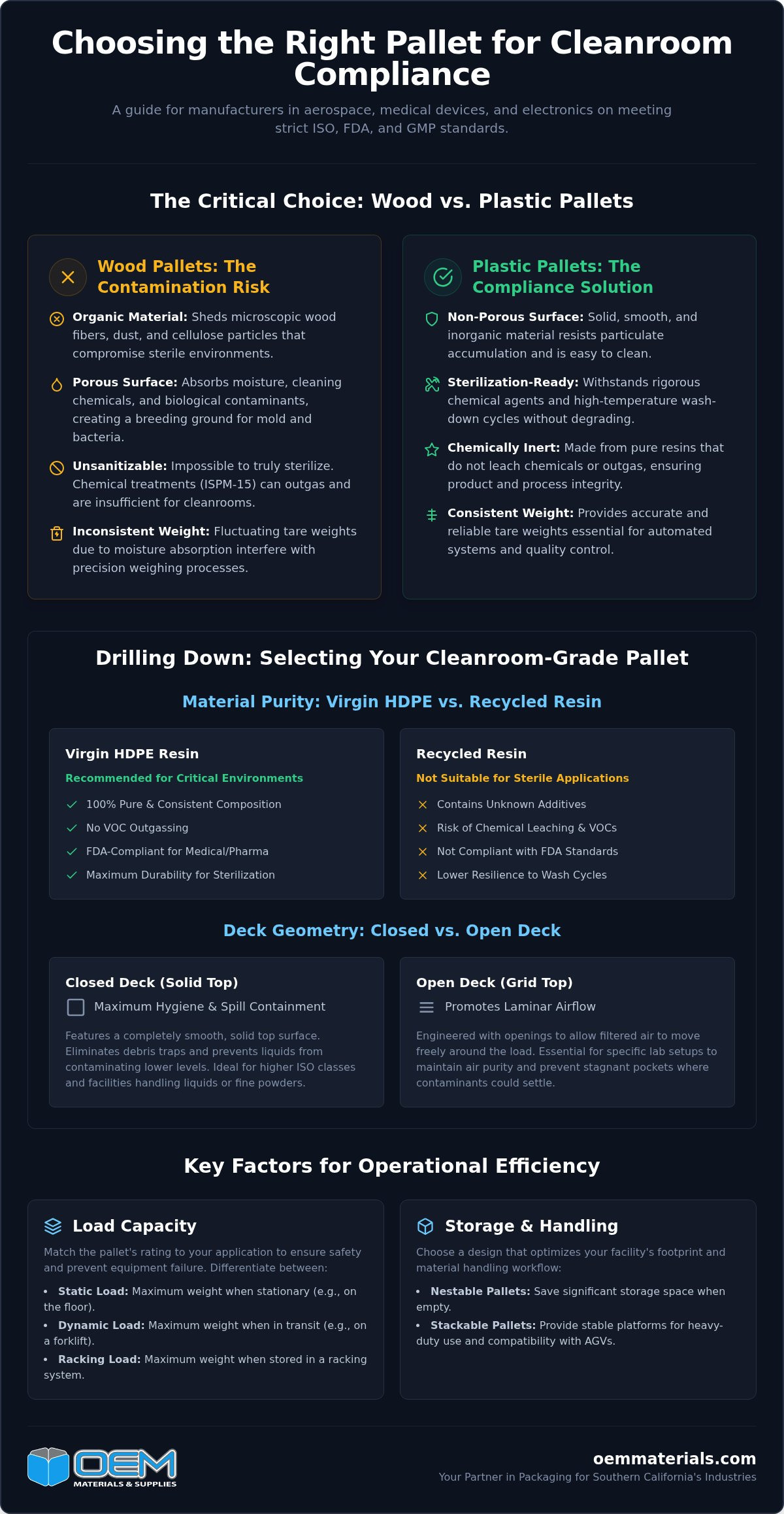
Wood pallets represent a significant contamination risk in sterile manufacturing. They are organic, meaning they naturally shed microscopic cellulose fibers and dust. These particles can easily compromise a batch of sensitive electronics or medical components. Wood is also highly porous. It absorbs moisture, cleaning chemicals, and biological contaminants, making it impossible to truly sanitize. This absorption leads to fluctuating tare weights, which creates inaccuracies in precision weighing processes. Even heat-treated pallets compliant with ISPM-15 standards are problematic. The chemical treatments and potential for mold growth make wood a catastrophic choice for any facility following strict ISO classifications for air purity.
Material Purity: Virgin vs. Recycled Resins
The chemical composition of a pallet dictates its suitability for high-stakes environments. Most medical and pharmaceutical labs require virgin High-Density Polyethylene (HDPE). This material is pure, consistent, and free from the unknown additives often found in recycled plastic. Recycled resins can occasionally outgas, releasing volatile organic compounds (VOCs) that interfere with sensitive chemical reactions or delicate sensors. Virgin HDPE is also more resilient during high-cycle sterilization. It maintains structural integrity and impact resistance longer than recycled alternatives. In sectors where FDA-approved materials are a legal necessity, investing in high-quality plastic pallets made from virgin resin is the only way to guarantee both compliance and product safety. These resins are non-reactive, ensuring that your material handling equipment never becomes a source of chemical leaching or particulate contamination.
Selecting the Right Cleanroom Plastic Pallet Material and Design
Selecting the optimal pallet configuration requires a detailed assessment of your facility mechanical and environmental demands. It is not enough to simply replace wood with plastic; you must evaluate how the pallet geometry and material properties align with your specific production workflows. In Southern California, where high industrial real estate costs necessitate vertical storage, racking capacity becomes a primary concern. You need to distinguish between static loads for stationary storage, dynamic loads for transit, and racking weight limits for high-density shelving. Choosing a rackable design ensures safety and maximizes the footprint of your warehouse in Los Angeles or Orange County.
Space optimization also influences the choice between nestable and stackable designs. Nestable pallets offer a significant reduction in storage volume when empty, which is useful for facilities with limited floor space. However, stackable pallets with solid runners are often required for heavy-duty applications or when using automated guided vehicles (AGVs). If your operation involves complex material handling, you can request a quote for a technical consultation to determine which structural design best supports your annual usage and equipment compatibility.
Closed Deck vs. Open Deck Geometry
The choice of deck geometry is often dictated by your facility’s air filtration and hygiene requirements. Closed deck pallets feature a completely smooth, solid top surface that eliminates debris traps and prevents liquid spills from reaching lower levels. These are frequently required for higher ISO classes where particulate accumulation must be strictly controlled. Conversely, open-grid decks are engineered to promote laminar airflow. In specific lab setups, these openings allow filtered air to move freely around the load, which is essential for maintaining Cleanroom Compliance and preventing stagnant air pockets. Both geometries are compatible with automated cleaning systems, though closed decks are generally faster to wipe down manually.
Material Science: HDPE vs. Polypropylene
Material selection directly impacts the long-term ROI and performance of plastic pallets for cleanroom environments. High-Density Polyethylene (HDPE) is the industry standard for impact resistance, particularly in cold storage or freezer applications where other plastics might become brittle. It provides excellent durability for high-cycle environments. Polypropylene (PP) offers greater stiffness and superior heat resistance, making it the preferred choice for processes involving high-temperature sterilization or autoclaving. While PP may have a different upfront cost profile, its ability to maintain structural integrity under thermal stress prevents premature pallet failure. Matching the resin to your sterilization protocol ensures that your material handling assets remain in service for years rather than months.
Navigating ISO Classifications and Hygiene Standards
Operational success in a sterile environment requires more than just a durable platform; it demands strict adherence to the ISO 14644-1 standard. As your facility moves from a Class 8 secondary packaging area to a Class 5 aseptic filling suite, the technical requirements for your material handling equipment become significantly more rigorous. You can’t use the same pallet for every zone. Plastic pallets for cleanroom environments are designed to meet these specific thresholds by eliminating the microscopic hiding places where particulates and microbes thrive.
FDA and GMP guidelines for pharmaceutical and medical device manufacturing emphasize the prevention of cross-contamination. This means your pallets must be chemically compatible with the industrial disinfectants and sporicidals used in your facility. Ensuring that your equipment meets established Hygiene Standards prevents the surface degradation that can lead to particulate shedding. If a pallet’s surface becomes etched or pitted by caustic cleaners, it is no longer compliant and must be removed from the sterile zone immediately.
ISO Class Requirements for Pallet Construction
For Class 5 environments, the construction of the pallet is as important as the resin purity. These spaces require pallets with welded seams. Standard injection-molded pallets often have internal cavities or ribs that can trap water and contaminants during a wash-down. A welded pallet is completely sealed, ensuring no internal moisture or bacteria can accumulate. This level of precision is especially critical when pallets are used in conjunction with custom medical device packaging kits, where the entire assembly must maintain a validated state of cleanliness to protect the final product.
ESD and Anti-Static Properties
Electronics manufacturers in San Diego and the Inland Empire face a different challenge: electrostatic discharge. In these cleanrooms, a standard plastic pallet can generate a static charge that destroys sensitive microprocessors or integrated circuits. We solve this by providing pallets with anti-static or static-dissipative additives. These specialized plastic pallets for cleanroom environments safely bleed off static charges to the ground. For maximum protection, these pallets should be paired with custom-engineered foam inserts that provide both physical cushioning and ESD shielding for sensitive components during internal transport.
Operational Efficiency: Cleanroom Transfers and Load Stabilization
Moving materials from a loading dock into a controlled environment creates a logistical bottleneck known as the “Grey Zone.” This is where raw materials arriving on standard wood or recycled plastic must be transferred to dedicated plastic pallets for cleanroom environments. Managing this transition efficiently is the difference between a streamlined operation and a labor-intensive failure. For manufacturers in Orange County and the Inland Empire, reducing the physical strain on warehouse teams is a priority. Lightweight plastic designs are significantly easier to handle than 70 pound wood alternatives, which lowers the risk of workplace injuries and reduces the overall labor hours required for pallet swaps.
Modern warehouses increasingly rely on Automated Storage and Retrieval Systems (ASRS) to manage inventory. These systems require extreme dimensional accuracy and zero structural deflection. Unlike wood, which can warp, shrink, or splinter, a high-quality plastic pallet provides the consistent footprint necessary for optical sensors and high-speed conveyor belts to operate without interruption. If you’re looking to optimize your facility’s material flow and prevent costly conveyor jams, you can request a quote for a logistics assessment to ensure your pallet fleet matches your automation hardware.
The Internal-to-External Transfer Process
Manual restacking of cases is an expensive, slow process that increases the chance of product damage and contamination. We recommend the use of pallet inverters or “exchangers” to switch loads from external shipping pallets to internal cleanroom platforms in seconds. This mechanical solution preserves the integrity of the secondary packaging while minimizing human contact with the product. To avoid inventory gaps during peak production cycles, many of our partners in Los Angeles utilize packaging VMI. This service ensures a steady supply of sanitized, compliant pallets is always available at the transfer station, preventing idle labor time and keeping your production lines moving.
Stabilizing Loads for Sterile Transit
Once a load is transferred, it must be secured for movement through airlocks and high-velocity air showers. Standard films can release volatiles or “outgas” that compromise sensitive air quality sensors, so we specify low-outgassing stretch film for these critical applications. For high-value medical components or aerospace parts, adding edge protectors distributes the pressure of the wrap and prevents crushing during high-speed handling. Finally, the consistent tare weight of a plastic pallet allows for precise shipping calculations. This accuracy is vital for manufacturers in San Diego who must account for every gram in their logistical documentation to ensure freight cost predictability.
Sourcing Cleanroom Pallets in Southern California
Sourcing plastic pallets for cleanroom environments in the Southern California market requires a partner who understands the intersection of regional logistics and strict regulatory standards. While national providers often focus on generic solutions, local manufacturers in aerospace and biotech hubs need rapid response and technical expertise. Investing in high-cycle plastic pallets reduces the frequency of replacements compared to wood or low-quality alternatives. However, it is important to note that actual cost savings and operational results depend on specific variables, including your product dimensions, material choice, and specific shipping requirements. Balancing the initial investment with the anticipated lifespan of the pallet ensures a more predictable supply chain budget.
Customization is a vital component of cleanroom integrity. Color-coded pallets allow for immediate visual verification of zone control, ensuring that equipment from a “grey zone” does not accidentally enter a Class 5 suite. For high-value asset management, RFID tracking can be integrated into the pallet structure to monitor movement and sterilization cycles automatically. These technical features transform a simple load carrier into a data-driven tool for supply chain oversight. Matching the right pallet to your specific environmental needs prevents product contamination and ensures your facility remains compliant with evolving ISO and FDA regulations.
Local Availability in Los Angeles and Orange County
Strategic warehousing across Orange County, Los Angeles, and San Diego enables just-in-time (JIT) delivery, which reduces the need for large on-site storage footprints. This is particularly valuable for biotech firms in Irvine or aerospace OEMs in El Segundo where square footage is at a premium. Local availability also simplifies the procurement of related items like crates and bulk packaging from the same regional hub. On-site consultations allow us to evaluate your specific cleanroom layout and conveyor clearances, ensuring that the pallets you order integrate perfectly with your existing infrastructure without requiring expensive modifications.
Custom Packaging and Design Services
A successful industrial packaging strategy integrates the pallet with secondary protection. Our custom packaging design services ensure that specialized cleanroom equipment is secured by foam inserts and secondary packaging that matches the cleanliness of the pallet itself. To provide the most accurate recommendation for your facility, we request specific data points such as product weight, outer dimensions, and annual usage. This data-driven approach ensures you receive a solution tailored to your exact environment rather than a one-size-fits-all product.
Optimizing Your Cleanroom Supply Chain
Maintaining a sterile environment requires material handling equipment that performs under pressure and meets rigorous regulatory standards. Selecting the right platform involves more than just a material swap; it requires a deep understanding of resin science and airflow dynamics. By prioritizing virgin HDPE purity and selecting the appropriate deck geometry, you can eliminate contamination risks and ensure long-term durability in high-cycle environments. Implementing efficient transfer protocols between external shipping and internal sterile zones is the most effective way to reduce labor costs while maintaining ISO compliance.
OEM Materials & Supplies has served Southern California manufacturers since 1995, providing specialized expertise in aerospace and medical device compliance. Our inventory locations allow for rapid JIT delivery to facilities across Orange County and Los Angeles, ensuring your production lines never stall due to equipment shortages. We understand the technical requirements of plastic pallets for cleanroom environments and act as a technical partner to help you navigate the nuances of facility air purity and sterilization needs. Our team is ready to assist with custom configurations that fit your specific workflow.
To get started, contact OEM Materials for a cleanroom pallet quote today. Please provide your product dimensions, weight requirements, and estimated annual usage so our engineers can provide an accurate recommendation for your operation. We look forward to supporting your manufacturing goals.
Frequently Asked Questions
Are plastic pallets really required for ISO Class 7 cleanrooms?
Wood pallets are generally prohibited in ISO Class 7 environments because they shed organic fibers and can harbor mold or bacteria. While ISO standards focus on airborne particulate counts, facility specific GMP protocols almost always mandate non-porous, inorganic load carriers. Using plastic pallets for cleanroom environments ensures you remain compliant with surface cleanliness requirements and prevents the introduction of microscopic shedders that could compromise your air filtration systems.
How do I clean and sanitize plastic pallets for reuse in sterile environments?
Cleaning protocols typically involve high pressure wash downs with industrial detergents followed by chemical sanitization using isopropyl alcohol or sporicidal agents. Because cleanroom grade pallets are non-porous and often feature welded seams, they don’t trap moisture or cleaning residues. Some high performance polypropylene models can also withstand autoclaving. It’s essential to verify that your pallet material is chemically compatible with the specific disinfectants used in your sterilization cycles to prevent surface etching.
Can plastic pallets be used with standard forklifts and pallet jacks?
Most industrial plastic pallets are designed with standard dimensions and 4-way entry points, making them fully compatible with existing forklifts, pallet jacks, and ASRS equipment. However, some nestable models feature specific leg configurations that may require narrow tine jacks. It’s important to check the fork opening dimensions of your equipment against the pallet’s specifications. Consistent dimensions ensure that the pallets move smoothly through automated conveyors and airlocks without snagging or triggering sensor errors.
What is the typical lifespan of a heavy-duty plastic pallet in a pharmaceutical setting?
In a controlled, high cycle pharmaceutical environment, a heavy-duty pallet made from virgin HDPE typically lasts between seven and ten years. Unlike wood pallets that require frequent repair or replacement after a few trips, plastic pallets for cleanroom environments can handle 250 or more cycles before showing significant wear. The actual lifespan depends on handling practices and exposure to caustic chemicals. This longevity makes the total cost of ownership much lower than cheaper alternatives over time.
Is there a difference between hygienic pallets and standard plastic pallets?
Hygienic pallets are specifically engineered with totally smooth, solid surfaces to eliminate the ribs and cavities found in standard plastic pallets. Standard models often have structural honeycombs that can trap dust, liquids, and bacteria, making them difficult to sanitize completely. Hygienic versions are often welded or molded as a single, seamless piece. This design is preferred for Class 5 and Class 6 environments where the highest level of particulate control is required to maintain product safety.
How much weight can a cleanroom-grade plastic pallet typically hold?
Load capacities vary significantly based on whether the weight is static, dynamic, or racked. A heavy-duty cleanroom pallet can typically support up to 30,000 pounds of static weight when resting on a level floor. For dynamic movement on a forklift, capacities usually range between 4,000 and 5,000 pounds. If you plan to use high density racking in your Southern California facility, ensure the pallet is rated for the specific unsupported weight of your product loads to prevent structural failure.
What happens if a plastic pallet gets cracked or damaged in the cleanroom?
Damaged pallets must be removed from the cleanroom immediately to prevent contamination. Even a small crack can become a breeding ground for bacteria or begin shedding plastic micro particulates into the air. Unlike wood, plastic pallets cannot be repaired with nails or patches while maintaining their sterile rating. Regular inspections should be part of your GMP protocol to identify structural compromises. Once removed, high quality HDPE pallets are 100% recyclable, supporting facility sustainability goals.
Can I get custom-sized plastic pallets for specialized lab equipment?
Custom sized plastic pallets are available for specialized lab equipment that doesn’t fit the standard 48×40 footprint. While standard sizes are readily available for JIT delivery in Los Angeles and Orange County, custom dimensions often require specific tooling or minimum order quantities. For unique aerospace or medical components, we often recommend pairing a standard pallet with a custom engineered foam insert. This approach provides the necessary stability and protection without the high cost of custom pallet molds.