
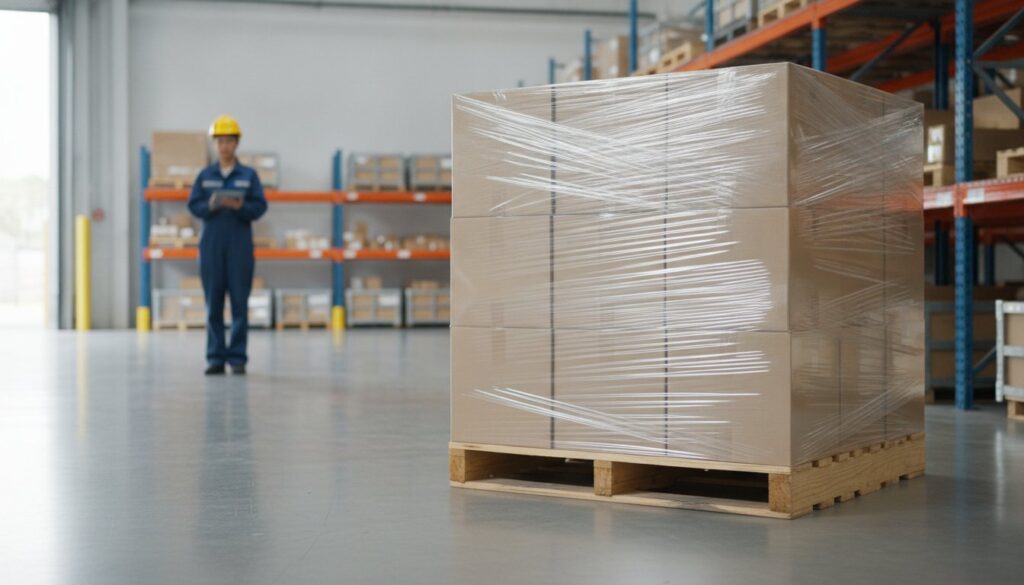
Is your stretch film a precisely engineered component of your load stability, or is it just a commodity expense that fails during transit? Most operations managers recognize that inconsistent containment is the primary driver of product damage and excessive material waste. You likely see the impact in your warehouse through shifted loads and high film costs that erode your margins. Relying on outdated specifications often leads to structural failures that compromise your entire supply chain.
Mastering the technical specifications and application methods of stretch film allows you to improve load containment while significantly reducing shipping damage. This guide provides the technical expertise required to optimize your packaging strategy, covering essential metrics like puncture resistance and the 2026 source reduction targets mandated by California’s SB 54. We will outline how to achieve better stability and lower costs per pallet by selecting the correct materials for your specific load profile. This approach ensures your distribution center operates with maximum efficiency across Los Angeles, Orange County, and the Inland Empire.
Key Takeaways
- Learn the fundamental principles of load containment to eliminate product shifting and reduce transit damage during shipping.
- Distinguish between cast and blown extrusion to choose materials that balance optical clarity with superior puncture resistance.
- Master technical metrics like pre-stretch ratios and micron thickness to maximize your stretch film yield and lower total material costs.
- Discover how strategic inventory management and local sourcing in Southern California can stabilize your supply chain and reduce lead times.
Fundamentals of Stretch Film in Modern Logistics
Stretch film is a highly elastic plastic film engineered specifically for pallet stabilization. Unlike shrink wrap, which requires heat to conform to a shape, Stretch wrap utilizes its inherent elastic recovery to bind loads tightly together. This mechanical tension maintains the integrity of a pallet during the vibrations and shifts common in truck or rail transport. In modern logistics, it serves as the final, critical layer of defense for products leaving a manufacturing facility. It’s the difference between a load arriving intact and one that requires expensive restacking.
Beyond structural support, this material provides a secondary barrier against environmental contaminants. It effectively shields goods from dust, debris, and moisture during storage and transit. For companies in Southern California distribution hubs, protecting inventory from warehouse dust is just as vital as preventing physical impact. Understanding these basics is part of a broader strategy for protective packaging basics, where every material choice works to eliminate the risks of transit damage. Effective wrapping protocols turn a simple plastic layer into a sophisticated containment system.
The Role of Load Containment in Damage Prevention
Load containment is the ability of the film to hold a palletized load together as a single unit. If containment force is insufficient, the load will shift. This leads to corner damage or complete pallet collapse. Proper containment relies on the relationship between film tension and the specific weight of the product. High-density or irregular loads require precise wrap patterns to ensure the bottom of the pallet is securely anchored to the base. Consistent patterns, rather than simply adding more material, create the most stable results for industrial manufacturers. It’s about precision, not volume.
Linear Low-Density Polyethylene: The Industrial Standard
Linear Low-Density Polyethylene (LLDPE) is the primary material used for high-performance stretch film. Its molecular structure consists of a linear backbone with short, uniform branches that allow the plastic to stretch significantly without snapping. This high elongation property is what enables the film to be pre-stretched by machine equipment to 250% or 300% of its original length. Material purity is essential here. Lower-quality resins often contain inclusions that cause premature tearing or puncture failures. High-purity LLDPE ensures maximum clarity for barcode scanning and the puncture resistance needed for sharp-edged corrugated boxes.
Cast versus Blown Extrusion: Choosing the Right Material
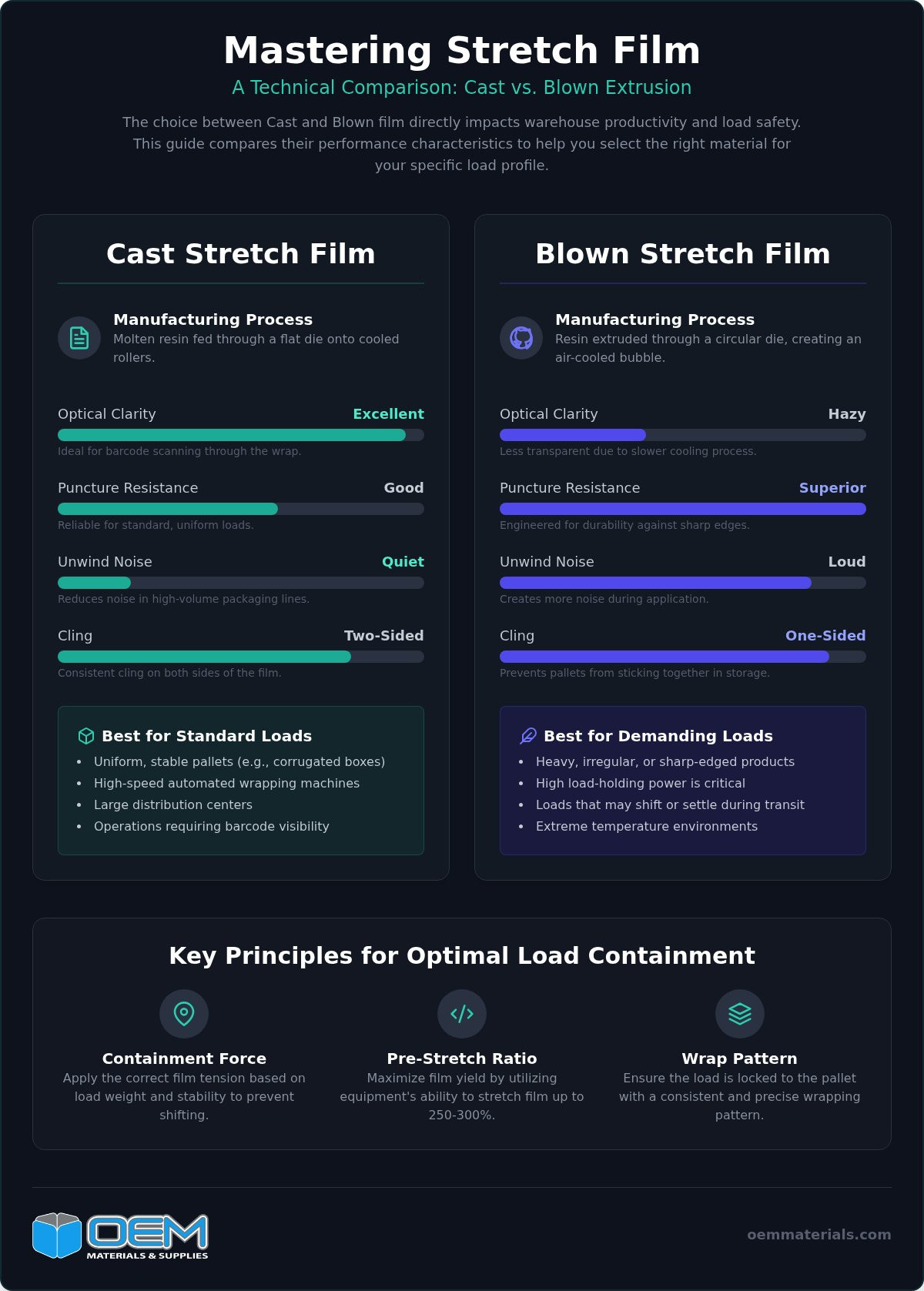
Selecting the correct stretch film requires a technical understanding of how the extrusion process dictates material performance. Cast film is manufactured by feeding molten resin through a flat die onto internally cooled rollers. This rapid cooling creates a material with high clarity and a smooth, quiet release. In contrast, blown film is produced by extruding resin through a circular die to create a vertical bubble that is cooled by ambient air. This slower cooling process results in a tougher, more resilient film with superior mechanical properties.
The choice between these two materials directly impacts warehouse productivity and load safety. While cast film is the most common choice for standard distribution, blown film remains the industrial standard for demanding environments. Choosing the wrong material often leads to excessive film breaks or compromised pallet stability during transit. You must evaluate your specific load profile and warehouse conditions before finalizing a procurement specification.
Performance Characteristics of Cast Stretch Film
Cast film is highly valued for its optical clarity. This transparency is essential for logistics operations that rely on barcode scanning through the wrap. Because the film is produced at high speeds with consistent thickness, it is the preferred choice for automated wrapping machines. It offers a quiet unwind, which significantly reduces noise levels in high-volume packaging lines. For standard, uniform loads like corrugated boxes on a stable pallet, cast film provides a cost-effective solution with reliable performance. It’s the go-to material for high-speed throughput in large distribution centers.
Industrial Applications for Blown Stretch Film
Blown film is engineered for durability and high load-holding power. Its superior puncture resistance makes it the only viable option for heavy, irregular, or sharp-edged loads that would easily tear standard cast materials. It features a high level of one-sided cling, ensuring the film adheres to itself without sticking to adjacent pallets in a crowded trailer. This is particularly useful for manufacturers in the Inland Empire or Orange County who manage outdoor staging or cold storage. Blown film maintains its structural integrity in extreme temperatures, preventing the film from becoming brittle or losing tension. If your application involves heavy machinery parts or irregular crates, you should request a technical consultation to determine the optimal gauge and material type for your requirements.
When choosing between these materials, consider your warehouse temperature and total load weight. Cast film excels in controlled environments with uniform pallets, while blown film is necessary for high-stress applications and variable temperatures. Matching the film’s physical properties to your logistical challenges is the first step in reducing material waste and preventing shipping damage.
Key Performance Metrics for Load Containment
To optimize pallet stabilization, you must look beyond the price per roll and evaluate specific technical metrics. Thickness is traditionally measured in gauge or microns. In the United States, gauge remains the standard, while microns are used internationally. For example, a standard 80-gauge film is equivalent to 20.3 microns. While thickness was once a primary indicator of strength, modern resin technology allows thinner, high-performance stretch film to achieve superior results compared to thicker legacy materials. This shift is particularly relevant as California’s SB 54 mandates a 10% reduction in plastic packaging weight by 2027, forcing manufacturers to prioritize material efficiency over bulk thickness.
Understanding Pre-Stretch and Material Yield
Pre-stretch is the process of elongating the film before it is applied to the load. This is a critical factor for determining material yield. When using manual application, operators rarely achieve more than 20% stretch due to physical limitations and fatigue. In contrast, modern wrapping machines can achieve pre-stretch ratios of 200% to 300%. This allows a single roll of film to cover significantly more pallets, reducing the total cost per unit shipped. High-performance thin-gauge films are specifically engineered to handle these high ratios without snapping. This efficiency is vital for high-volume distribution centers in the Inland Empire and San Diego County where material waste directly impacts operational margins.
Measuring Containment Force
Containment force is the most accurate metric for verifying pallet stability. It measures the total pressure the film exerts on the load. You can verify this using a specialized containment force tool, which measures the force in pounds at the top, middle, and bottom of the pallet. Relying on gauge alone is a common mistake that leads to shipping damage. A thinner film applied with high tension often provides better stability than a thicker film applied loosely. Industry standards suggest that heavy industrial loads may require 15 to 20 pounds of containment force, while lighter loads might only need 5 to 10 pounds. Establishing these benchmarks ensures consistent load safety across your entire supply chain. For companies managing complex logistics, integrating these metrics into a vendor-managed inventory (VMI) program ensures you always have the right high-performance materials on hand to meet these rigorous standards.
By focusing on these metrics, operations managers can move away from commodity-based purchasing and toward an engineered packaging strategy. This data-driven approach reduces the risk of load failure and minimizes the environmental footprint of your shipping operations. Using the correct combination of pre-stretch and containment force is the most effective way to protect your inventory while controlling costs.
Specialty Films for Complex Shipping Requirements
Standard stretch film is an effective general-purpose tool, but specific industrial challenges demand engineered additives. High-value shipments often require opaque films to conceal contents from potential theft. Colored films are equally useful for streamlining inventory identification in large San Diego or Los Angeles County distribution centers. To ensure these films perform as intended, they should be paired with edge and corner protectors. These components prevent the film from puncturing on sharp corners. This maintains the integrity of the containment force even when you use thinner, high-performance gauges. Integrating these materials creates a comprehensive protection system that standard wraps cannot provide alone.
Environmental Protection with UVI and VCI Films
Outdoor storage in Southern California exposes pallets to high levels of solar radiation. Standard polyethylene degrades quickly under UV light, becoming brittle and losing its holding power. Ultraviolet Inhibitor (UVI) films contain additives that absorb this radiation. This extends the film’s lifespan during outdoor staging or long-haul shipping through diverse climates. For manufacturers in the aerospace and automotive sectors, moisture is a constant threat. Volatile Corrosion Inhibitor (VCI) stretch film releases a protective vapor that forms a molecular layer on metal surfaces. It prevents oxidation and rust without the need for messy oils or coatings. If you’re shipping sensitive metal components, request a quote for specialized VCI materials to protect your high-value assets and ensure they remain corrosion-free during transit.
Vented and Perforated Films for Airflow
Certain products require constant airflow to maintain quality and safety. Vented and perforated films feature holes or mesh patterns that allow the load to breathe while maintaining structural stability. This is essential for hot-fill products that must cool without trapping condensation. Trapped moisture often weakens corrugated boxes and promotes mold growth, leading to structural failures in the stack. Perforated films are also vital in the medical device and electronics industries where temperature consistency and sterilization requirements are critical. These films provide the necessary ventilation while still offering the high-tensile strength required for pallet stabilization. Selecting the correct specialty film is a strategic decision that directly impacts your bottom line by preventing environmental damage and ensuring product efficacy.
Implementing a Strategic Wrapping Program in Southern California
High-volume distribution centers in the Inland Empire operate on thin margins and tight schedules. In these environments, the procurement of stretch film must be treated as a logistical strategy rather than a simple purchase. A strategic program integrates material selection with local supply chain support to ensure continuous operation. Conducting on-site wrap audits is vital for identifying material waste that often goes unnoticed in daily operations. For manufacturers in Orange County, local inventory management is the most effective way to reduce lead times and avoid the high costs of emergency sourcing. This regional focus allows for a more responsive and reliable supply chain.
Local Sourcing and Inventory Efficiency
Just-in-time delivery is essential for facilities that cannot afford to dedicate valuable warehouse space to bulk packaging storage. Large manufacturing facilities in Los Angeles and San Diego benefit from frequent, smaller shipments that align with their production cycles. Implementing vendor-managed inventory (VMI) further optimizes this by shifting the burden of stock monitoring to the supplier. This system eliminates stockouts of critical supplies like stretch film and custom corrugated boxes. OEM Materials & Supplies acts as a seasoned industry partner for these regions, providing the technical expertise and local support needed to keep high-speed lines moving without interruption.
Conducting a Professional Wrap Audit
A professional wrap audit is the cornerstone of material optimization. This process involves a technical evaluation of your current film usage to identify areas of excessive waste or insufficient containment. Many facilities discover they are using outdated gauges that don’t match their current load profiles. By applying the principles found in our guide on optimizing stretch film for pallet wrapping, you can transition to high-performance materials that provide better stability with less plastic. Right-sizing your film gauge can lead to significant annual cost savings, though actual results vary based on variables like pallet weight and shipping distance. We invite you to request a quote and technical consultation to begin evaluating the efficiency of your facility’s wrapping program.
Optimizing Your Pallet Stabilization Strategy
Transitioning from a commodity-based purchase to an engineered wrapping program is the most effective way to protect your inventory and control costs. By prioritizing metrics like containment force and pre-stretch ratios, you ensure that every roll of stretch film delivers maximum stability with minimal material waste. Whether you’re managing high-volume distribution in the Inland Empire or specialized manufacturing in San Diego, matching the correct film extrusion to your specific load profile eliminates the primary causes of transit damage.
OEM Materials & Supplies serves as a technical partner for the aerospace, medical, and electronics sectors across Southern California. We specialize in high-performance load containment and material optimization to help you meet rigorous industry standards and regional sustainability mandates. We’re ready to help you conduct a professional wrap audit to identify hidden inefficiencies in your warehouse operations. Request a customized stretch film quote for your facility to begin improving your shipping reliability. We look forward to helping you build a more efficient and secure supply chain.
Frequently Asked Questions
What is the difference between hand film and machine stretch film?
Hand film is designed for manual application and typically comes in shorter rolls with lower weight for operator safety. Machine stretch film is engineered for high-speed automated equipment and features higher pre-stretch capabilities, often exceeding 250%. While hand application is suitable for low-volume tasks, machine film provides more consistent containment force and lower material costs for high-volume distribution centers in Orange County and the Inland Empire.
How do I determine the correct containment force for my pallet loads?
You determine containment force by measuring the pressure exerted by the film using a specialized digital tool at the top, middle, and bottom of the pallet. Industrial standards generally require 10 to 20 pounds of force for heavy loads, while lighter items may only need 5 to 10 pounds. This metric depends on the weight, dimensions, and stability of your specific product rather than just the thickness of the material used.
Can high-performance thin-gauge film replace standard 80-gauge film?
High-performance thin-gauge film can effectively replace standard 80-gauge film when it is engineered with advanced resins that offer equivalent or superior puncture resistance. These thinner materials allow for significant source reduction and help manufacturers comply with California’s SB 54 requirements for plastic weight reduction. The key is ensuring the thinner film maintains the required containment force during transit without snapping under high pre-stretch tension.
What is the benefit of using colored stretch film for industrial shipping?
Colored film provides immediate visual identification for inventory management and enhances security by concealing high-value contents. Logistics teams in Los Angeles County use opaque or tinted materials to differentiate between various product lines or to indicate specific shipping priorities. This visual coding system reduces picking errors in crowded warehouses and prevents tampering by making it difficult for unauthorized personnel to view the palletized goods.
How does pre-stretch impact the total cost of pallet wrapping?
Pre-stretch reduces the total cost of pallet wrapping by elongating the material before application, which increases the yield of each roll. High-performance wrapping machines can stretch film up to 300%, allowing one roll to cover significantly more pallets than manual application. This efficiency lowers the cost per pallet wrapped and reduces the volume of plastic waste generated by your facility, although results depend on your specific equipment settings.
When should I use blown stretch film instead of cast stretch film?
You should use blown stretch film for heavy, irregular, or sharp-edged loads that require extreme puncture resistance and high holding power. Blown film is also superior for outdoor storage and cold environments because it maintains its structural integrity in variable temperatures. While cast film is quieter and clearer, blown film’s mechanical toughness is essential for securing industrial crates or machinery that might easily tear standard pallet wraps.
Does stretch film expire or lose its effectiveness over time?
The material does not have a formal expiration date, but its performance can degrade if stored in poor conditions for more than one year. Exposure to extreme heat, humidity, or direct UV light will cause the resin to become brittle and lose its cling properties. To maintain effectiveness, store your inventory in a cool, dry warehouse and rotate stock to ensure you are always using the most recently received material.
What is the role of neckdown in stretch film application?
Neckdown is the narrowing of the film width that occurs when the material is stretched during application. If the film is pulled too tightly without proper equipment calibration, it narrows significantly, which reduces the coverage area and requires more revolutions to secure the pallet. Managing neckdown is critical for maintaining consistent load containment and ensuring that the top and bottom of the pallet are fully anchored to the base.